惯性聚合 高效追踪和阅读你感兴趣的博客、新闻、科技资讯
阅读原文 在惯性聚合中打开

推荐订阅源

Hugging Face - Blog
Hugging Face - Blog
量子位
H
Help Net Security
Microsoft Azure Blog
MongoDB | Blog
MongoDB | Blog
小众软件
小众软件
爱范儿
爱范儿
博客园 - 【当耐特】
Vercel News
Vercel News
S
SegmentFault 最新的问题
M
MIT News - Artificial intelligence
F
Fortinet All Blogs
Apple Machine Learning Research
GbyAI
GbyAI
博客园 - 叶小钗
博客园_首页
V
Visual Studio Blog
宝玉的分享
宝玉的分享
B
Blog
MyScale Blog
MyScale Blog
C
Check Point Blog
博客园 - 三生石上(FineUI控件)
L
LangChain Blog
V
V2EX

Hugging Face - Blog

Waypoint-1.5: Higher-Fidelity Interactive Worlds for Everyday GPUs ALTK‑Evolve: On‑the‑Job Learning for AI Agents Safetensors is Joining the PyTorch Foundation Holo3: Breaking the Computer Use Frontier Any Custom Frontend with Gradio's Backend A New Framework for Evaluating Voice Agents (EVA) Bringing Robotics AI to Embedded Platforms: Dataset Recording, VLA Fine‑Tuning, and On‑Device Optimizations One-Shot Any Web App with Gradio's gr.HTML CUGA on Hugging Face: Democratizing Configurable AI Agents New in llama.cpp: Model Management Building Deep Research: How we Achieved State of the Art OVHcloud on Hugging Face Inference Providers 🔥 20x Faster TRL Fine-tuning with RapidFire AI Building for an Open Future - our new partnership with Google Cloud Aligning to What? Rethinking Agent Generalization in MiniMax M2 Building a Healthcare Robot from Simulation to Deployment with NVIDIA Isaac Sentence Transformers is joining Hugging Face! Unlock the power of images with AI Sheets Supercharge your OCR Pipelines with Open Models Google Cloud C4 Brings a 70% TCO improvement on GPT OSS with Intel and Hugging Face Get your VLM running in 3 simple steps on Intel CPUs Nemotron-Personas-India: Synthesized Data for Sovereign AI Introducing RTEB: A New Standard for Retrieval Evaluation Accelerating Qwen3-8B Agent on Intel® Core™ Ultra with Depth-Pruned Draft Models VibeGame: Exploring Vibe Coding Games Nemotron-Personas-Japan: ソブリン AI のための合成データセット Swift Transformers Reaches 1.0 – and Looks to the Future Smol2Operator: Post-Training GUI Agents for Computer Use SyGra: The One-Stop Framework for Building Data for LLMs and SLMs Gaia2 and ARE: Empowering the community to study agents
Introducing Storage Regions on the HF Hub
Eliott Coyac, Remy, Adrien Carreira, Michelle Habonneau, Violett · 2023-11-03 · via Hugging Face - Blog

Back to Articles

This article is also available in Chinese 简体中文.

As part of our Enterprise Hub plan, we recently released support for Storage Regions.

Regions let you decide where your org's models and datasets will be stored. This has two main benefits, which we'll briefly go over in this blog post:

  • Regulatory and legal compliance, and more generally, better digital sovereignty
  • Performance (improved download and upload speeds and latency)

Currently we support the following regions:

  • US 🇺🇸
  • EU 🇪🇺
  • coming soon: Asia-Pacific 🌏

But first, let's see how to setup this feature in your organization's settings 🔥

Org settings

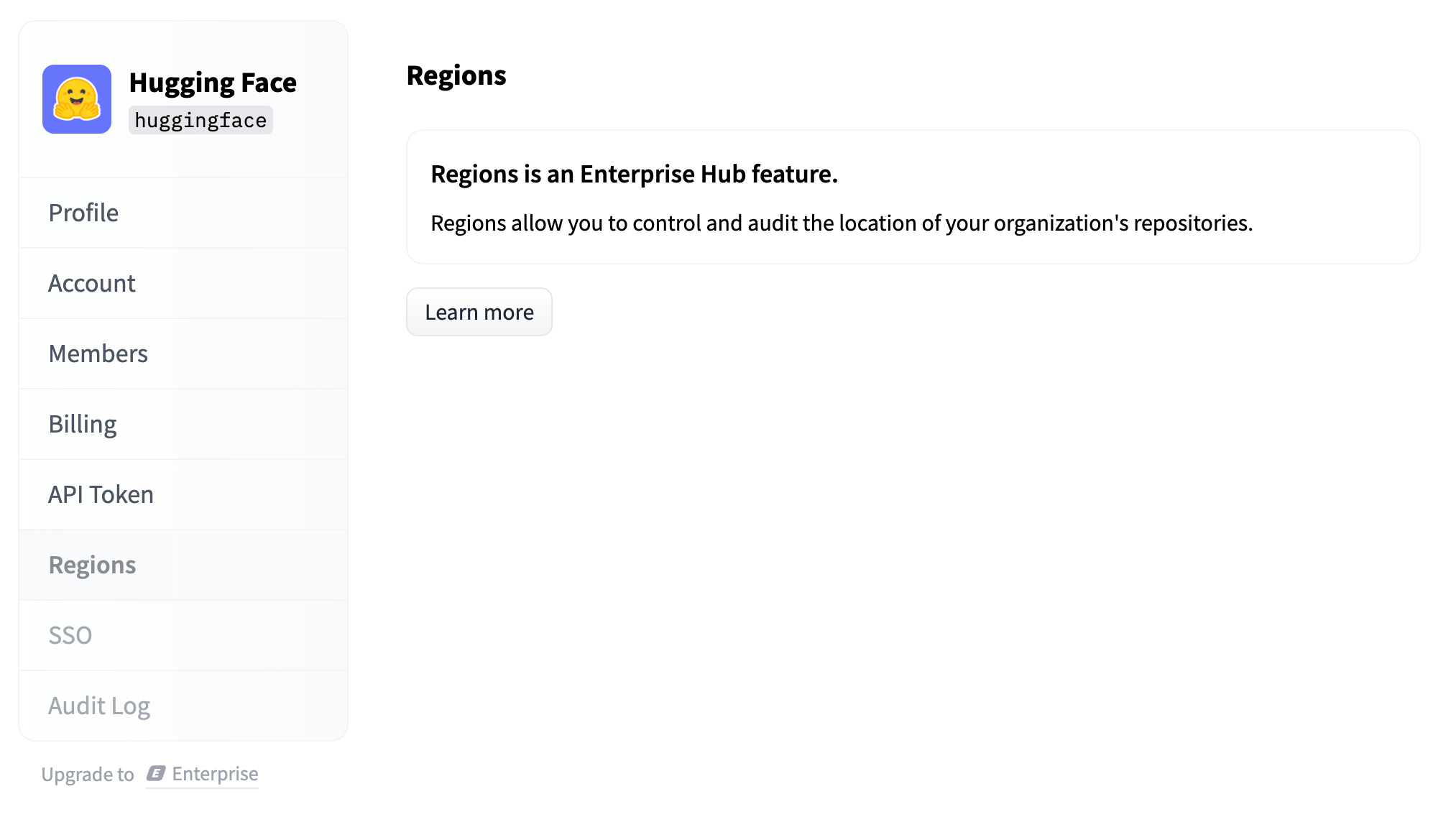
If your organization is not an Enterprise Hub org yet, you will see the following screen:
As soon as you subscribe, you will be able to see the Regions settings page:
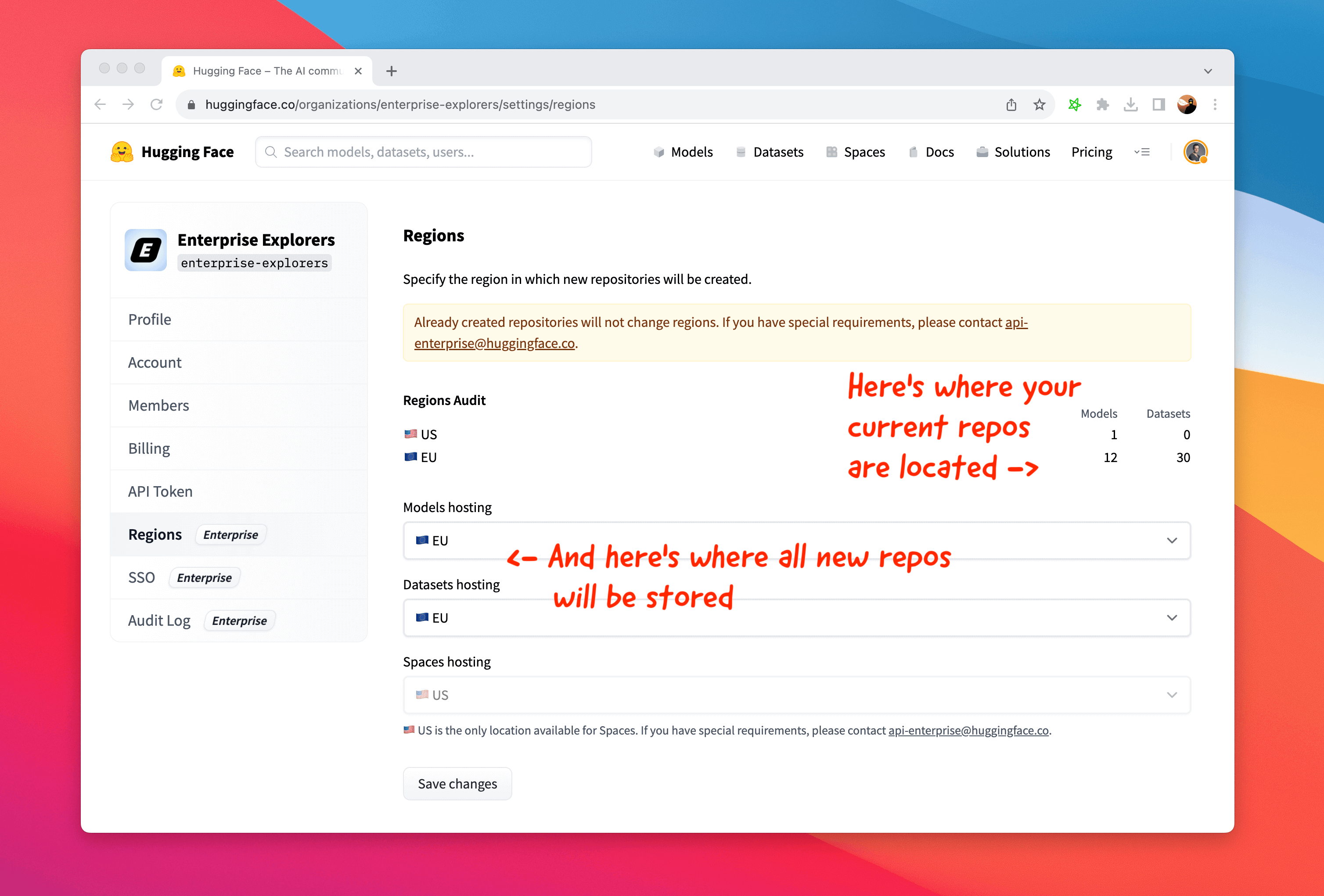
On that page you can see:

  • an audit of where your orgs' repos are currently located
  • dropdowns to select where your repos will be created

Repository Tag

Any repo (model or dataset) stored in a non-default location will display its Region directly as a tag. That way your organization's members can see at a glance where repos are located.

Regulatory and legal compliance

In many regulated industries, you may have a requirement to store your data in a specific area.

For companies in the EU, that means you can use the Hub to build ML in a GDPR compliant way: with datasets, models and inference endpoints all stored within EU data centers.

If you are an Enterprise Hub customer and have further questions about this, please get in touch!

Performance

Storing your models or your datasets closer to your team and infrastructure also means significantly improved performance, for both uploads and downloads.

This makes a big difference considering model weights and dataset files are usually very large.

As an example, if you are located in Europe and store your repositories in the EU region, you can expect to see ~4-5x faster upload and download speeds vs. if they were stored in the US.