





惯性聚合 高效追踪和阅读你感兴趣的博客、新闻、科技资讯
阅读原文 在惯性聚合中打开

推荐订阅源

人人都是产品经理
人人都是产品经理
freeCodeCamp Programming Tutorials: Python, JavaScript, Git & More
宝玉的分享
宝玉的分享
月光博客
月光博客
爱范儿
爱范儿
让小产品的独立变现更简单 - ezindie.com
WordPress大学
WordPress大学
有赞技术团队
有赞技术团队
阮一峰的网络日志
阮一峰的网络日志
博客园_首页
钛媒体:引领未来商业与生活新知
钛媒体:引领未来商业与生活新知
博客园 - 三生石上(FineUI控件)
博客园 - 聂微东
小众软件
小众软件
量子位
MongoDB | Blog
MongoDB | Blog
Blog — PlanetScale
Blog — PlanetScale
The Cloudflare Blog
Stack Overflow Blog
Stack Overflow Blog
U
Unit 42
Hugging Face - Blog
Hugging Face - Blog
T
The Blog of Author Tim Ferriss
H
Help Net Security
Cyber Security Advisories - MS-ISAC

Hugging Face - Blog

Waypoint-1.5: Higher-Fidelity Interactive Worlds for Everyday GPUs ALTK‑Evolve: On‑the‑Job Learning for AI Agents Safetensors is Joining the PyTorch Foundation Holo3: Breaking the Computer Use Frontier Any Custom Frontend with Gradio's Backend A New Framework for Evaluating Voice Agents (EVA) Bringing Robotics AI to Embedded Platforms: Dataset Recording, VLA Fine‑Tuning, and On‑Device Optimizations One-Shot Any Web App with Gradio's gr.HTML CUGA on Hugging Face: Democratizing Configurable AI Agents New in llama.cpp: Model Management Building Deep Research: How we Achieved State of the Art OVHcloud on Hugging Face Inference Providers 🔥 20x Faster TRL Fine-tuning with RapidFire AI Building for an Open Future - our new partnership with Google Cloud Aligning to What? Rethinking Agent Generalization in MiniMax M2 Building a Healthcare Robot from Simulation to Deployment with NVIDIA Isaac Sentence Transformers is joining Hugging Face! Unlock the power of images with AI Sheets Supercharge your OCR Pipelines with Open Models Google Cloud C4 Brings a 70% TCO improvement on GPT OSS with Intel and Hugging Face Get your VLM running in 3 simple steps on Intel CPUs Nemotron-Personas-India: Synthesized Data for Sovereign AI Introducing RTEB: A New Standard for Retrieval Evaluation Accelerating Qwen3-8B Agent on Intel® Core™ Ultra with Depth-Pruned Draft Models VibeGame: Exploring Vibe Coding Games Nemotron-Personas-Japan: ソブリン AI のための合成データセット Swift Transformers Reaches 1.0 – and Looks to the Future Smol2Operator: Post-Training GUI Agents for Computer Use SyGra: The One-Stop Framework for Building Data for LLMs and SLMs Gaia2 and ARE: Empowering the community to study agents
Introducing DOI: the Digital Object Identifier to Dataset...
Sasha Luccioni, Sylvestre Bcht, Christopher Akiki, Alix Leroy · 2022-10-07 · via Hugging Face - Blog

Back to Articles

Sasha Luccioni's avatar

Sylvestre Bcht's avatar

Christopher Akiki's avatar

Alix Leroy's avatar

Our mission at Hugging Face is to democratize good machine learning. That includes best practices that make ML models and datasets more reproducible, better documented, and easier to use and share.

To solve this challenge, we're excited to announce that you can now generate a DOI for your model or dataset directly from the Hub!
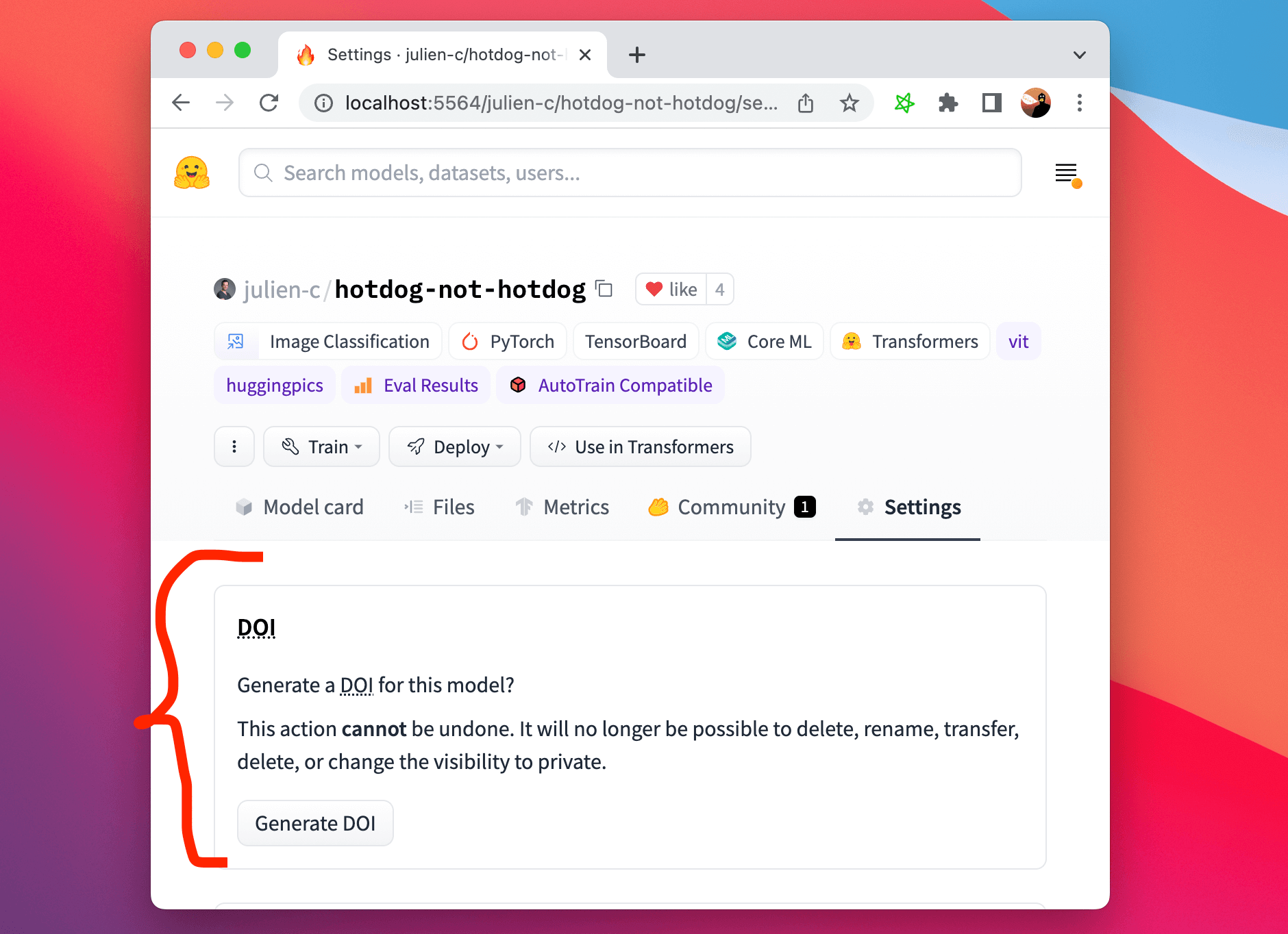
DOIs can be generated directly from your repo settings, and anyone will then be able to cite your work by clicking "Cite this model/dataset" on your model or dataset page 🔥.
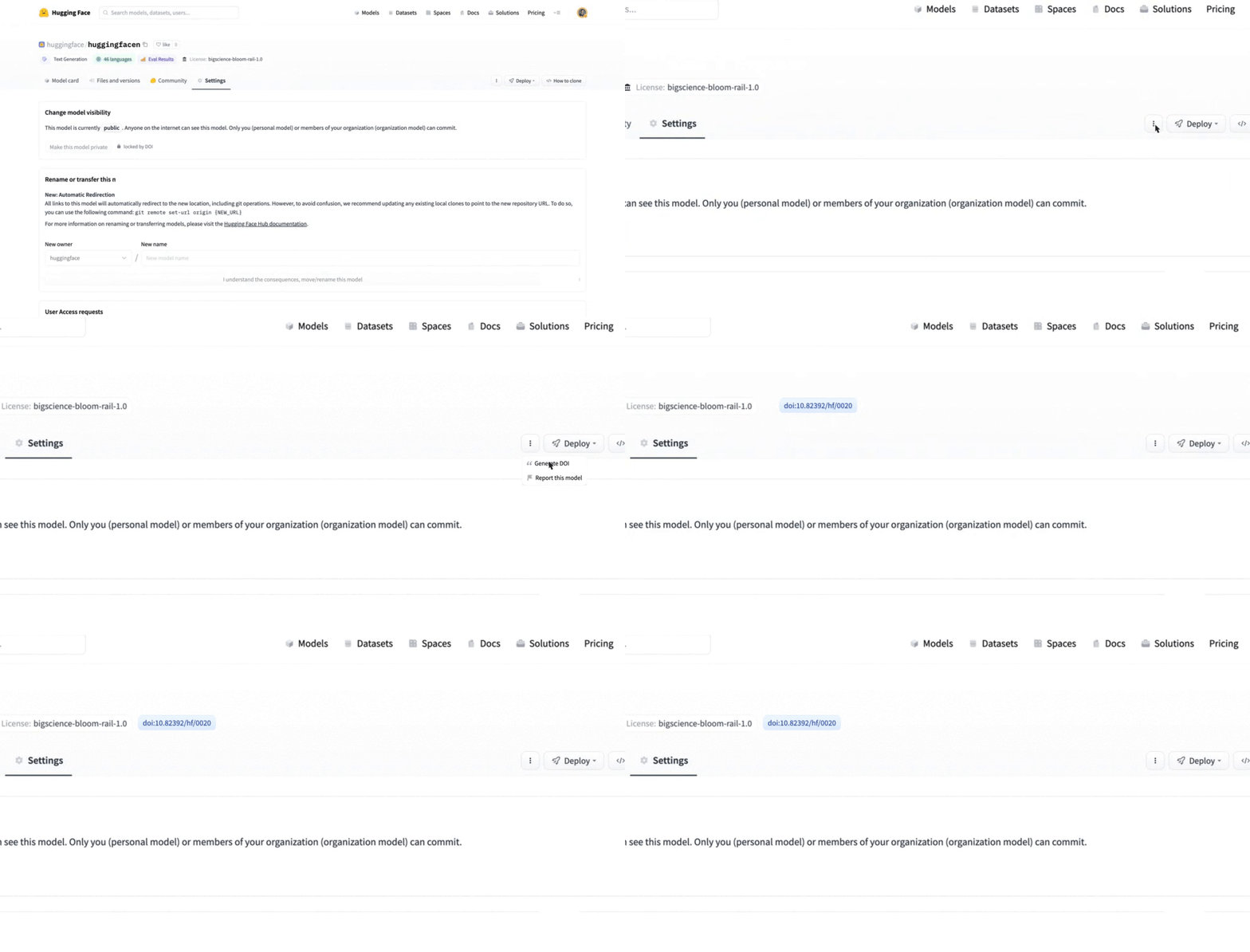
Generating DOI

DOIs in a nutshell and why do they matter?

DOIs (Digital Object Identifiers) are strings uniquely identifying a digital object, anything from articles to figures, including datasets and models. DOIs are tied to object metadata, including the object's URL, version, creation date, description, etc. They are a commonly accepted reference to digital resources across research and academic communities; they are analogous to a book's ISBN.

DOIs make finding information about a model or dataset easier and sharing them with the world via a permanent link that will never expire or change. As such, datasets/models with DOIs are intended to persist perpetually and may only be deleted upon filing a request with our support.

How are DOIs being assigned by Hugging Face?

We have partnered with DataCite to allow registered Hub users to request a DOI for their model or dataset. Once they’ve filled out the necessary metadata, they receive a shiny new DOI 🌟!
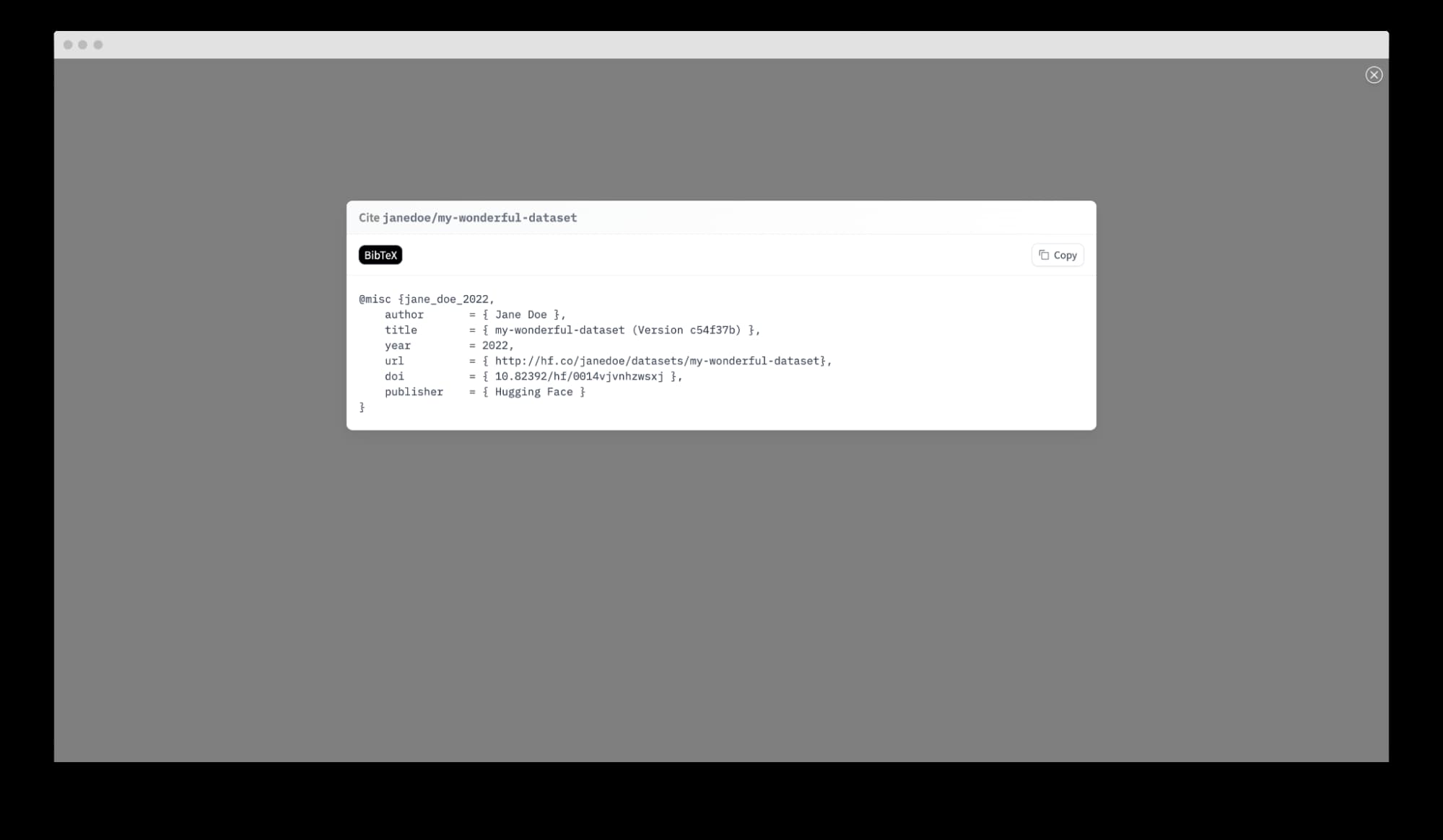
Cite DOI

If ever there’s a new version of a model or dataset, the DOI can easily be updated, and the previous version of the DOI gets outdated. This makes it easy to refer to a specific version of an object, even if it has changed.

Have ideas for more improvements we can make? Many features, just like this, come directly from community feedback. Please drop us a note or tweet us at @HuggingFace to share yours or open an issue on huggingface/hub-docs 🤗

Thanks DataCite team for this partnership! Thanks also Alix Leroy, Bram Vanroy, Daniel van Strien and Yoshitomo Matsubara for starting and fostering the discussion on this hub-docs GitHub issue.