








The Cloud operating model is all about simplicity—bringing the agility of public clouds together with the security and control that enterprises have traditionally placed importance on. The fundamental expectation is to deploy applications with “one-click”—or one-API call.
In embracing this model, application developers expect to move at warp speed but are often hampered by necessary guardrails imposed by the infrastructure and security teams. For the Modern Enterprise so beholden to rapid software development as part of their innovation lifecycle, this can be frustrating.
The challenge traditionally lies in the complexity of setting up and provisioning infrastructure and security. These problems are compounded in hybrid and multi-cloud deployments, and where multiple teams are involved. Network teams are responsible for configuring and making the network operational. Security teams then take over the definition and implementation of firewall and advanced security policies. This can be multi-layered. Likewise, the application load balancing teams are responsible for ensuring the application performance.
While well intentioned, these teams produce several tickets that can take days to weeks to resolve. As a result, a simple application can take weeks, if not months, months to be deployed.
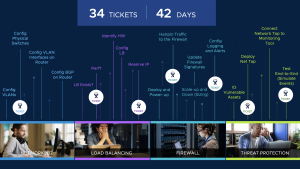
Application owners and the lines of business owners, want true agility, with self-service environments that are ready-to-go, on-demand. They don’t want to be bothered by infrastructure setup. On the other hand, infrastructure and security teams are chartered with building the right guardrails and have responsibility for governance and compliance.
How do we resolve these paradoxical needs? It is important to meet the needs of the application owners, without bailing on the responsibility of the infrastructure and security teams.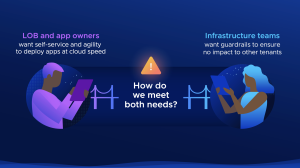
At VMware Explore, one of the main innovations we announced was NSX+. VMware NSX+ is a cloud-managed SaaS-based operating model for centralized policy, visibility, security and ALB for network and security deployments. A central component introduced with these announcements was the enterprise-grade Virtual Private Cloud (VPC).
VPCs have been available in the context of public clouds. But public clouds are rarely interoperable. It was necessary to bring something like that in the context of private and multi-cloud deployments.
The NSX+ private and multi-cloud VPC construct just that.
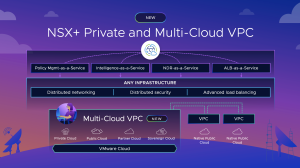
Built for the modern Enterprise, the NSX+ VPCs is enterprise-grade from Day-1. It enables well-segmented, role-based responsibilities that are native to the skillset and responsibility of different teams. Infrastructure and security teams can quickly configure networks and security policies and application owners can spin-up full-stack application environments via self-service constructs that adhere to the corporate requirements. These operate over a shared infrastructure, with tenancy isolation that ensures no other tenant is impacted, and function as self-contained “safe sandboxes.”
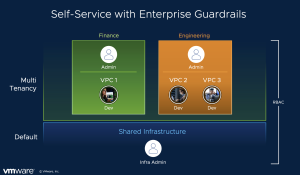
These solutions are possible because of the software abstraction stacks that VMware has built out, and can’t be achieved through legacy networking solutions from hardware-based vendors. The NSX+ VPCs are powerful constructs that can now form a foundational component of every organization that values agility, simplicity and security.
NSX+ VPCs will quickly become indispensable for the modern Enterprise.
To learn more about VMware NSX+, check out these resources:
此内容由惯性聚合(RSS阅读器)自动聚合整理,仅供阅读参考。 原文来自 — 版权归原作者所有。