



惯性聚合 高效追踪和阅读你感兴趣的博客、新闻、科技资讯
阅读原文 在惯性聚合中打开

推荐订阅源

T
Threatpost
aimingoo的专栏
aimingoo的专栏
OSCHINA 社区最新新闻
OSCHINA 社区最新新闻
T
Tailwind CSS Blog
J
Java Code Geeks
博客园_首页
Google Online Security Blog
Hugging Face - Blog
Hugging Face - Blog
C
CXSECURITY Database RSS Feed - CXSecurity.com
I
Intezer
P
Palo Alto Networks Blog
V
Vulnerabilities – Threatpost
雷峰网
雷峰网
O
OpenAI News
SecWiki News
SecWiki News
小众软件
小众软件
酷 壳 – CoolShell
酷 壳 – CoolShell
美团技术团队
N
News | PayPal Newsroom
Project Zero
Project Zero
Forbes - Security
Forbes - Security
IT之家
IT之家
A
Arctic Wolf
WordPress大学
WordPress大学
Jina AI
Jina AI
T
Tor Project blog
博客园 - 三生石上(FineUI控件)
S
Secure Thoughts
Google DeepMind News
Attack and Defense Labs
博客园 - 聂微东
Exploit-DB.com RSS Feed
P
Privacy International News Feed
Cloudbric
Cloudbric
G
GRAHAM CLULEY
博客园 - 叶小钗
H
Hacker News: Front Page
腾讯CDC
量子位
Help Net Security
Help Net Security
人人都是产品经理
人人都是产品经理
C
Cyber Attacks, Cyber Crime and Cyber Security
月光博客
月光博客
奇客Solidot–传递最新科技情报
奇客Solidot–传递最新科技情报
宝玉的分享
宝玉的分享
爱范儿
爱范儿
L
Lohrmann on Cybersecurity
Hacker News - Newest:
Hacker News - Newest: "LLM"
Recorded Future
Recorded Future
C
CERT Recently Published Vulnerability Notes

Snorkel AI

Building AI-Native Systems for Federal Infrastructure: A Conversation with Rezaur Rahman Code World Models and AutoHarness for LLM Agents Benchtalks #1: Alex Shaw (Terminal-Bench, Harbor) – Building the Benchmark Factory Building FinQA: An Open RL Environment for Financial Reasoning Agents How Tool Discipline Let a 4B Model Outsmart a 235B Giant on Financial Tasks Coding agents don’t need to be perfect, they need to recover Closing the Evaluation Gap in Agentic AI SlopCodeBench: Measuring Code Erosion as Agents Iterate Introducing the Snorkel Agentic Coding Benchmark 2026: The year of environments Part V: Future Direction and Emerging Trends in Rubric-Based AI Evaluation The self-critique paradox: Why AI verification fails where it’s needed most Chat With the Terminal-Bench Team | Snorkel AI Intelligence per watt: A new metric for AI’s future Terminal-Bench 2.0: Raising the bar for AI agent evaluation Snorkeling in RL environments Introducing SnorkelSpatial: A Benchmark for LLM Spatial Reasoning Scaling Trust: Rubrics in Snorkel's Quality Process Evaluating Multi-Agent Systems in Enterprise Tool Use Evaluating Coding Agents with Terminal-Bench 2.0 Parsing isn’t neutral: why evaluation choices matter The science of rubric design The right tool for the job: An A-Z of rubrics Data quality and rubrics: how to build trust in your models Building the benchmark: inside our agentic insurance underwriting dataset Evaluating AI agents for insurance underwriting LLM observability: key practices, tools, and challenges Anthropic Claude + AWS: revolutionizing pharma data analytics with Snorkel AI Data-centric development of an enterprise AI agent with Snorkel Building the data development platform for specialized AI LLM-as-a-judge for enterprises: evaluate model alignment at scale Why GenAI evaluation requires SME-in-the-loop for validation and trust Research spotlight: is long chain-of-thought structure all that matters when it comes to LLM reasoning distillation? Why enterprise GenAI evaluation requires fine-grained metrics to be insightful What is specialized GenAI evaluation, and why is it so critical to enterprise AI? LLM alignment techniques: 4 post-training approaches Research spotlight: Is intent analysis the key to unlocking more accurate LLM question answering? Why enterprises should embrace LLM distillation Retrieval-augmented generation (RAG) failure modes and how to fix them What is large language model (LLM) alignment? Databricks + Snorkel Flow: integrated, streamlined AI development How LLM evaluation drives better models in Snorkel Flow Unlock proprietary data with Snorkel Flow and Amazon SageMaker LLM evaluation in enterprise applications: a new era in ML Snorkel AI joins the AWS ISV Accelerate Program and launches Snorkel Flow Availability in AWS Marketplace AI data development: a guide for data science projects SnorkelCon 2024: Inaugural Snorkel AI user conference gathers leaders from 30+ Fortune 500 companies Snorkel Flow 2024.R3: Supercharge your AI development with enhanced data-centric workflows Explore the new GenAI Evaluation Suite: Snorkel 2024.R3 New NLP features in Snorkel Flow 2024.R3 Enterprise data compliance and security review: Snorkel Flow 2024.R3 How a global financial services company built a specialized AI copilot accurate enough for production Task Me Anything: innovating multimodal model benchmarks Alfred: Data labeling with foundation models and weak supervision RAG: LLM performance boost with retrieval-augmented generation Call center AI for customer experience management: a case study New GenAI features, data annotation: Snorkel Flow 2024.R2 How data slices transform enterprise LLM evaluation Meta’s Llama 3.1 405B is the new Mr. Miyagi, now what? Meta’s new Llama 3.1 models are here! Are you ready for it? Data-centric AI with Snorkel and MinIO Weak supervision for non-categorical applications + superalignment Snorkel AI signs strategic collaboration agreement with AWS to help enterprises cross the demo-to-production chasm AI alignment made simple: innovative solutions for businesses How does the Snorkel Flow label model work? Vision language models: how LLMs boost image classification Long context models in the enterprise: benchmarks and beyond How to build production-grade RAG retrieval with Snorkel Flow How Bonito helps fine-tune specialized LLMs faster than ever Walking safely before building flying saucer seatbelts: introducing Enterprise Alignment Role-based access controls in Snorkel Flow secure enterprise data Accelerating AI development in manufacturing with Snorkel Flow and AWS SageMaker How ROBOSHOT boosts zero-shot foundation model performance Discover what’s new in Snorkel Flow: Flexible data and LLM connectivity, secure data controls, and more! Faster than ever document intelligence with new Snorkel Flow FM-first workflow The art of data development for Enterprise LLMs Crossing the demo-to-production chasm with Snorkel Custom How Snorkel topped the AlpacaEval leaderboard (and why we're not there anymore) CRFM's HELM and enterprise LLM evaluation beyond accuracy How we achieved 89% accuracy on contract question answering Five sessions not to miss at Google Cloud Next 24 Content filtering breakthrough: Snorkel client reaches 96% recall in 3 days Here's how Snorkel Flow + Google AI built an enterprise-ready model in a day Snorkel teams with Microsoft to showcase new AI research at NVIDIA GTC Fine-tuned representation models boost LLM systems. Here's how Enterprise GenAI to surge in 2024: survey results Large language model training: how three training phases shape LLMs LoRA: Low-Rank Adaptation for LLMs LLM distillation demystified: a complete guide Enterprises must shift their focus from models to data in AI development Insurance’s GenAI revolution: a business perspective Scaling human preferences in AI: Snorkel's programmatic approach Building better enterprise AI: incorporating expert feedback in system development “Fall in love with your data”—Snorkel AI’s Enterprise LLM Summit Why QBE Ventures invested in Snorkel AI New benchmark results demonstrate value of Snorkel AI approach to LLM alignment Retrieval augmented generation (RAG): a conversation with its creator Snorkel Flow 2023.R4: enhanced UI + PDF and Databricks tools How Snorkel Flow users can register custom models to Databricks Stanford professor discusses exciting advances in foundation model evaluation
How Skill-it! enables faster, better LLM training
Fred Sala · 2024-03-12 · via Snorkel AI

Humans learn tasks better when taught in a logical order. A child who has already learned addition, for example, will have an easier time learning multiplication. Along with our collaborators at Stanford, I and my students at the University of Wisconsin-Madison have discovered that a similar logic applies to large language models, and we’ve developed a way to exploit this tendency that we call “Skill-it!”

I recently presented a summary of our Skill-it! research findings at Snorkel AI’s Enterprise LLM Summit. The presentation also included a peek into some other research we’ve done on how to strengthen foundation models when you don’t have additional data, a process we call “zero-shot robustification.” You can watch the entire video below—which I would recommend—but I’ve summarized the main points here.

Understanding Skill-it!

Large language models (LLMs) can accomplish a diverse range of tasks, from writing code to chatting with users. However, the sheer amount of data they need to process during training can be overwhelming. That’s where Skill-it! comes in.

The Skill-it! tool helps us select and order the data these models are trained or fine-tuned on to enhance their capabilities in the most efficient way possible.
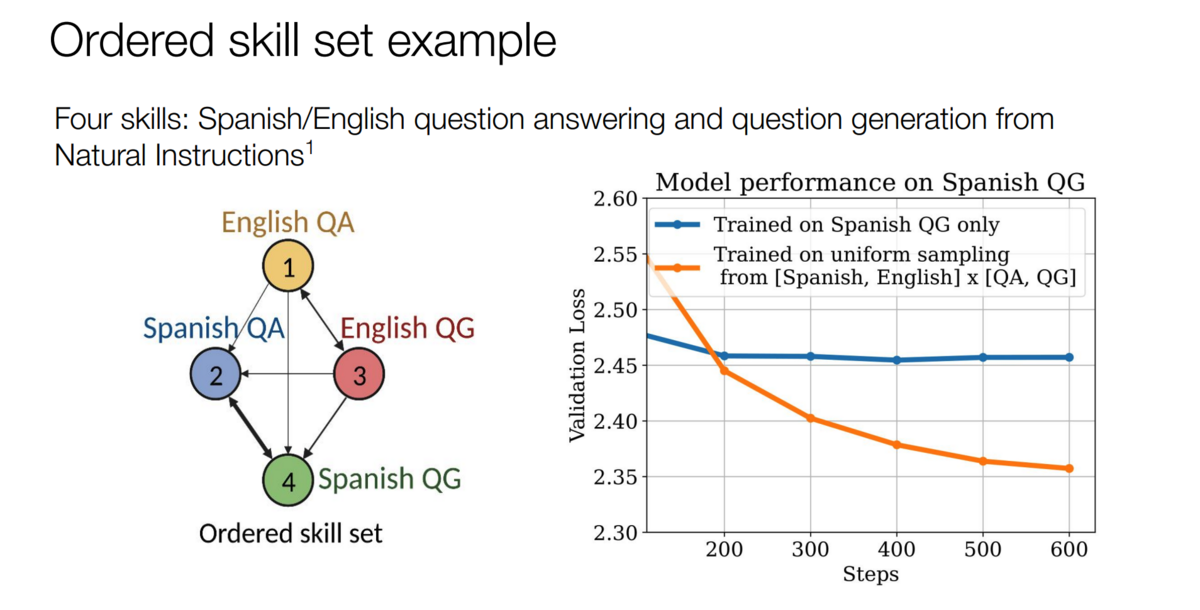
Image1

In Skill-it!, we define a “skill” as a specific capability or behavior that the model acquires from a piece of data. This could be a task, a data source, a category, or a family of tasks. We then partition our dataset into different groups that correspond to these skills.

From here, we construct what we call a “skills graph.” This graph represents the different skills we’ve identified, with edges between skills indicating how learning one skill can aid in learning another. This graph allows us to create an “order” for the skills, helping the model learn more structurally and efficiently.

The algorithm adjusts the mixture of skills at each round of training, basing these adjustments on the skills graph and the model’s performance on each skill. An initial data mixture trains the model for one round. Then, Skill-it! constructs a new mixture based on an update rule. This update rule takes into account adjacency from the skills graph and the evaluation loss, allowing us to continuously refine the data mixture to optimize each round of the model’s learning process.
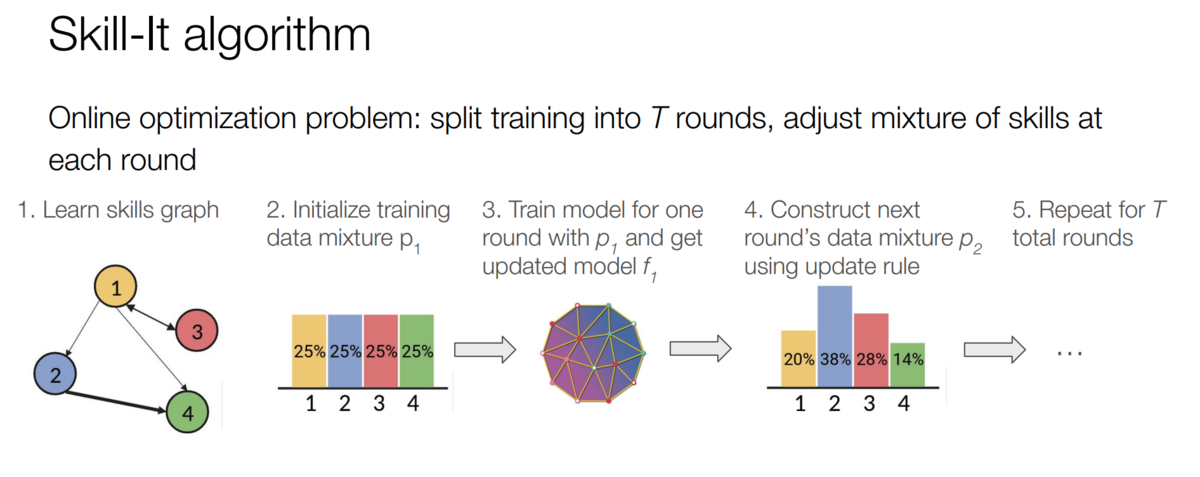
Image2

The Impact of Skill-it!

Skill-it! has demonstrated significant impact in optimizing the training of language models. Its performance has been tested across a variety of tasks and baselines, consistently proving its efficacy. Here are some noteworthy accomplishments of Skill-it!

  • Performance across multiple tasks: Skill-it! outperformed other methods in a diverse set of tasks. In one example involving question generation in Spanish, Skill-it! managed to improve the validation loss rate significantly faster than other methods.
  • Superiority over baselines: In a comprehensive evaluation involving 12 different baselines, Skill-it! emerged as the top performer in 11 cases.
  • Efficiency: Skill-it!’s approach to ordering and mixing training data based on the skills graph and evaluation loss results in a more efficient learning process.
  • Scalability: Not only does Skill-it! perform well on individual tasks, but its performance also scales effectively when applied to larger, more complex models.

Zero-shot robustification

In certain situations, we may not have access to additional data for training. This is where a technique we call “zero-shot robustification” comes into play. This innovative approach offers a unique solution to improve the robustness of models without the need for external data.

Understanding zero-shot robustification

Zero-shot robustification operates on a simple yet powerful premise. It queries an LLM for insights into its understanding of useful features and those that are spurious or misleading.

In our paper on the topic, we use the popular Waterbirds dataset, which requires distinguishing between water birds and land birds. An unmodified CLIP model would frequently confuse land birds shown in or near water as water birds, and vice versa. We asked an LLM what features to emphasize and ignore. It suggested—correctly—that we should ignore the background and focus on the shape of the bird’s beak.

We then use those insights to guide the CLIP model’s predictions on the fly—without any fine-tuning or training data.
The Process of Zero-Shot Robustification

Once we’ve gathered these insights, the next step involves modifying the model’s representations based on this newfound knowledge.

How can we turn the text-based insights into a way to modify our model’s representations? First, we embed them (e.g., with CLIP’s text encoder). Next, inspired by work on debiasing word embeddings, we use simple linear-algebraic operations. For example, to get rid of a spurious concept, we project the current representation onto a subspace invariant to the one spanned by the embedded spurious insight. This boosts the features that the language model has identified as useful and diminishes or eliminates those that are deemed spurious. This fairly simple procedure has the potential to dramatically increase prediction quality without any external data.
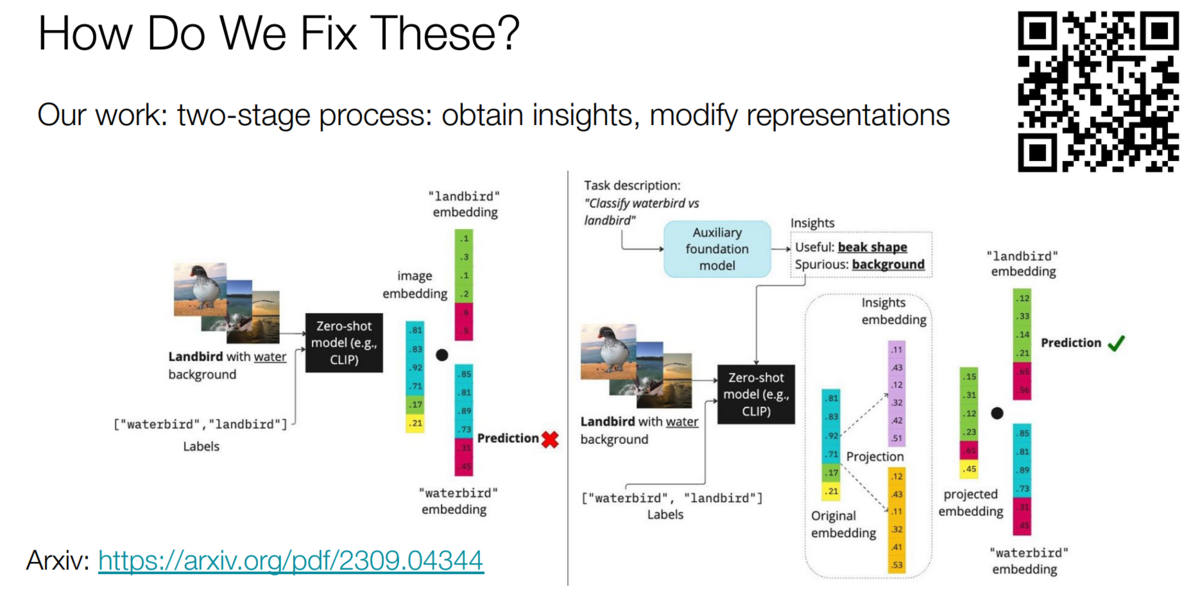
Image3

The Impact of Zero-Shot Robustification

This approach to robustification can significantly improve the model’s robustness. Even without access to additional training data, zero-shot robustification allows us to leverage the model’s inherent knowledge to enhance its performance. This not only helps make the models more reliable but also aids in mitigating issues caused by spurious correlations, leading to more accurate predictions and outcomes.

Getting more from foundation models more efficiently

Skill-it! and zero-shot robustification provide powerful tools for optimizing the training and robustness of foundation models. By ordering training data efficiently and leveraging the model’s inherent knowledge, we can greatly improve the performance of foundation models across a range of tasks.

As we continue to explore these techniques and others, we look forward to the future of language model training and the potential it holds.

More Snorkel AI events coming!

Snorkel has more live online events coming. Look at our events page to sign up for research webinars, product overviews, and case studies.

If you're looking for more content immediately, check out our YouTube channel, where we keep recordings of our past webinars and online conferences.