








Today, AI is marked by a growing asymmetry: the excitement around agentic AI is real — backed by quantitative progress on model cards and genuine leaps forward, especially in coding. But ask individuals or enterprises where they feel ready to deploy agentic automation in high-stakes, domain-specific settings outside of coding… and you will find hesitation. The reason: our ability to measure AI has been outpaced by our ability to develop it, and this evaluation gap is one of the most important problems in AI.
The evaluation gap won’t be solved by public benchmarks alone, and the risk of “benchmaxxing” is real — closing it will also require use-case-specific field deployments and other evaluation tools. But benchmarks are a critical piece of the measurement toolkit; and the best open benchmarks don’t just measure AI progress — they define entire new vectors of AI development. Benchmarks like Terminal-Bench, METR, and ARC-AGI become critical guideposts for the field of AI — and the path to safe, trustworthy AI agents will depend on more of them.
Open benchmarks are one of the most important levers for advancing AI safely and responsibly—but the academic and open-source teams driving them often hit resource constraints, especially in the face of the exponentially expanding complexity of what tomorrow’s benchmarks need to cover. That’s why Snorkel, with support from our partners at Hugging Face, Prime Intellect, Together AI, Factory HQ, Harbor and PyTorch, is launching Open Benchmarks Grants: a $3M commitment to support the research and development of open benchmarks for AI.
Looking into the agentic future, benchmarks must close the gap between what we measure and actually encounter, falling along three core dimensions: environment complexity, autonomy horizon, and output complexity.
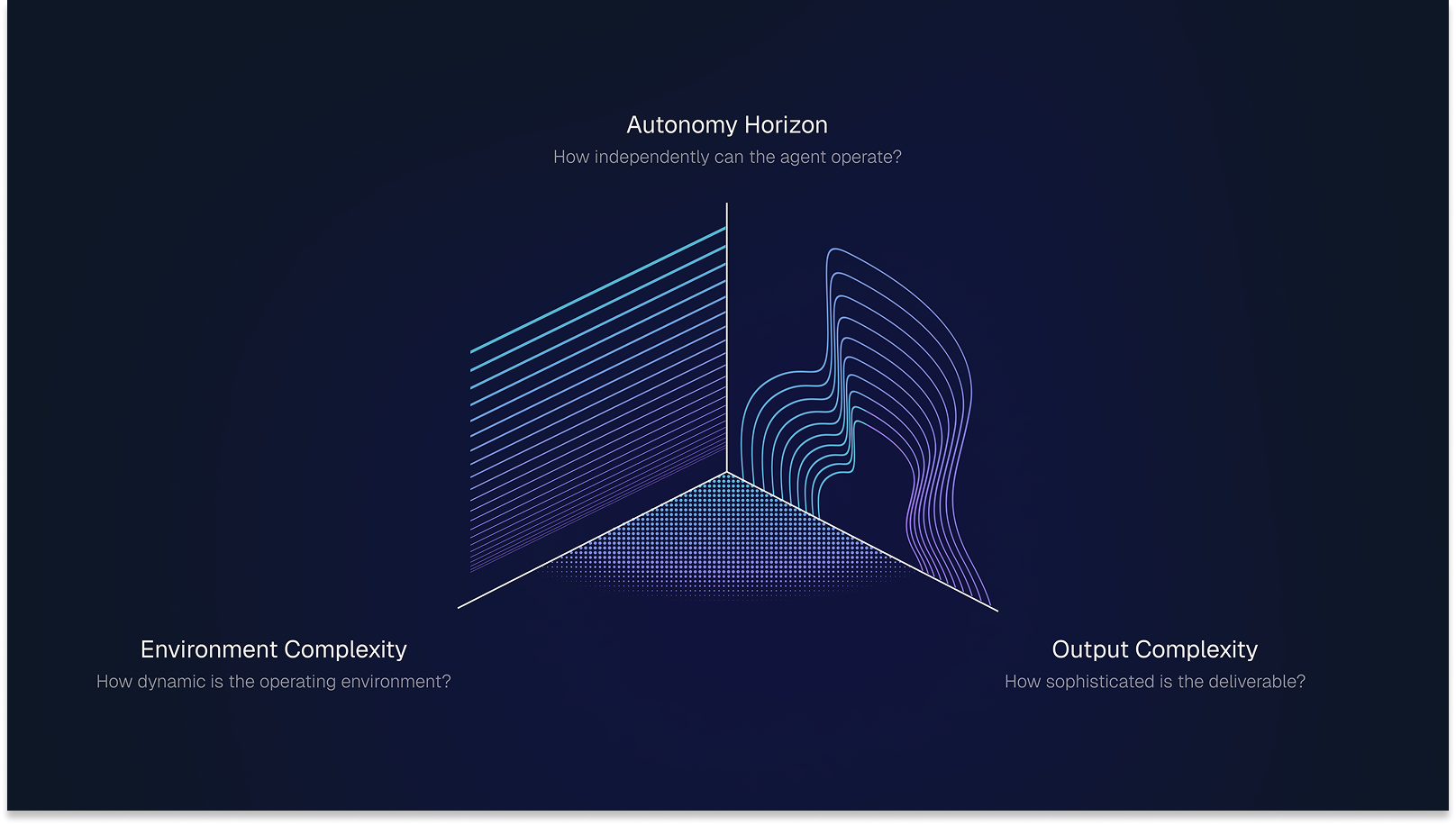
Real operating environments are far more complex than today’s benchmark environments, and that gap is often where agents fail. For instance, consider coding agents, the most advanced agents today: a real codebase has org-specific policies, sprawling context across Slack screenshots and design docs, flaky toolchains, human reviewers with tribal knowledge, and parallel contributors. Most benchmarks capture a fraction of this complexity. Tomorrow’s benchmarks need to capture aspects of environment complexity like:
A defining axis of autonomy is how long an agent can operate before reliability breaks down. Take a customer experience agent onboarding an enterprise customer over several weeks: by week two, it may lose track of the customer’s needs across hundreds of setup tasks; an early integration choice can introduce issues that won’t surface until launch; and a reorg can shift priorities midstream. Each of these reflects a distinct dimension:
As agents produce more complex work, evaluation (both for final evaluation and reward signals during training) must become more complex too — and the gap is growing. For instance, consider an agent producing an entire software product, or a complex report making a strategic recommendation. There’s no unit test for whether a deliverable is “good or bad”; instead, nuanced rubrics and evaluations of many dimensions—and perhaps of the processes, research, and reasoning used to produce them—need to be considered in a use case specific way. Tomorrow’s benchmarks need to capture these aspects:
Selected teams will receive funding, scaled expert data development support, and/or research and engineering collaboration, drawing from a decade of data-centric AI research and deployments starting at the Stanford AI Lab. Our founding partners Hugging Face, Prime Intellect, Together AI, Factory HQ, Harbor and PyTorch are also contributing research, advisory support, and platform credits.
The path to trusted autonomy will require an honest and evolving view of what agents can and cannot do, shaping everything from the next generation of products to public policy decisions. The pioneers building new open benchmarks that define the major new vectors of development in AI are doing some of the most important work in AI — and we are incredibly excited to support them with Open Benchmarks Grants.
Applications are reviewed on a rolling basis starting March 1, 2026. Apply for a grant here. Selections will be made on a quarterly basis.
此内容由惯性聚合(RSS阅读器)自动聚合整理,仅供阅读参考。 原文来自 — 版权归原作者所有。