



惯性聚合 高效追踪和阅读你感兴趣的博客、新闻、科技资讯
阅读原文 在惯性聚合中打开

推荐订阅源

爱范儿
爱范儿
钛媒体:引领未来商业与生活新知
钛媒体:引领未来商业与生活新知
G
GRAHAM CLULEY
www.infosecurity-magazine.com
V2EX - 技术
V2EX - 技术
The Last Watchdog
The Last Watchdog
S
Secure Thoughts
Webroot Blog
Webroot Blog
PCI Perspectives
PCI Perspectives
L
LINUX DO - 最新话题
Hacker News: Ask HN
Hacker News: Ask HN
N
News and Events Feed by Topic
H
Heimdal Security Blog
H
Help Net Security
T
The Blog of Author Tim Ferriss
P
Proofpoint News Feed
The GitHub Blog
The GitHub Blog
Jina AI
Jina AI
Recent Commits to openclaw:main
F
Full Disclosure
小众软件
小众软件
S
Securelist
罗磊的独立博客
NISL@THU
NISL@THU
D
Darknet – Hacking Tools, Hacker News & Cyber Security
C
Cisco Blogs
云风的 BLOG
云风的 BLOG
C
CERT Recently Published Vulnerability Notes
Cisco Talos Blog
Cisco Talos Blog
Know Your Adversary
Know Your Adversary
S
Schneier on Security
D
DataBreaches.Net
M
MIT News - Artificial intelligence
V
Vulnerabilities – Threatpost
N
News and Events Feed by Topic
有赞技术团队
有赞技术团队
F
Fortinet All Blogs
T
Tenable Blog
The Register - Security
C
Check Point Blog
AWS News Blog
AWS News Blog
Cloudbric
Cloudbric
C
CXSECURITY Database RSS Feed - CXSecurity.com
cs.AI updates on arXiv.org
C
Cyber Attacks, Cyber Crime and Cyber Security
Cyber Security Advisories - MS-ISAC
Google Online Security Blog
博客园 - 叶小钗
Hacker News - Newest:
Hacker News - Newest: "LLM"
博客园 - 司徒正美

Snorkel AI

Building AI-Native Systems for Federal Infrastructure: A Conversation with Rezaur Rahman Code World Models and AutoHarness for LLM Agents Benchtalks #1: Alex Shaw (Terminal-Bench, Harbor) – Building the Benchmark Factory Building FinQA: An Open RL Environment for Financial Reasoning Agents How Tool Discipline Let a 4B Model Outsmart a 235B Giant on Financial Tasks Coding agents don’t need to be perfect, they need to recover Closing the Evaluation Gap in Agentic AI SlopCodeBench: Measuring Code Erosion as Agents Iterate Introducing the Snorkel Agentic Coding Benchmark 2026: The year of environments Part V: Future Direction and Emerging Trends in Rubric-Based AI Evaluation The self-critique paradox: Why AI verification fails where it’s needed most Chat With the Terminal-Bench Team | Snorkel AI Intelligence per watt: A new metric for AI’s future Terminal-Bench 2.0: Raising the bar for AI agent evaluation Snorkeling in RL environments Introducing SnorkelSpatial: A Benchmark for LLM Spatial Reasoning Scaling Trust: Rubrics in Snorkel's Quality Process Evaluating Multi-Agent Systems in Enterprise Tool Use Evaluating Coding Agents with Terminal-Bench 2.0 Parsing isn’t neutral: why evaluation choices matter The science of rubric design The right tool for the job: An A-Z of rubrics Data quality and rubrics: how to build trust in your models Building the benchmark: inside our agentic insurance underwriting dataset Evaluating AI agents for insurance underwriting LLM observability: key practices, tools, and challenges Anthropic Claude + AWS: revolutionizing pharma data analytics with Snorkel AI Data-centric development of an enterprise AI agent with Snorkel Building the data development platform for specialized AI LLM-as-a-judge for enterprises: evaluate model alignment at scale Why GenAI evaluation requires SME-in-the-loop for validation and trust Research spotlight: is long chain-of-thought structure all that matters when it comes to LLM reasoning distillation? Why enterprise GenAI evaluation requires fine-grained metrics to be insightful What is specialized GenAI evaluation, and why is it so critical to enterprise AI? LLM alignment techniques: 4 post-training approaches Research spotlight: Is intent analysis the key to unlocking more accurate LLM question answering? Why enterprises should embrace LLM distillation Retrieval-augmented generation (RAG) failure modes and how to fix them What is large language model (LLM) alignment? Databricks + Snorkel Flow: integrated, streamlined AI development How LLM evaluation drives better models in Snorkel Flow Unlock proprietary data with Snorkel Flow and Amazon SageMaker LLM evaluation in enterprise applications: a new era in ML Snorkel AI joins the AWS ISV Accelerate Program and launches Snorkel Flow Availability in AWS Marketplace AI data development: a guide for data science projects SnorkelCon 2024: Inaugural Snorkel AI user conference gathers leaders from 30+ Fortune 500 companies Snorkel Flow 2024.R3: Supercharge your AI development with enhanced data-centric workflows Explore the new GenAI Evaluation Suite: Snorkel 2024.R3 New NLP features in Snorkel Flow 2024.R3 Enterprise data compliance and security review: Snorkel Flow 2024.R3 How a global financial services company built a specialized AI copilot accurate enough for production Task Me Anything: innovating multimodal model benchmarks Alfred: Data labeling with foundation models and weak supervision RAG: LLM performance boost with retrieval-augmented generation Call center AI for customer experience management: a case study New GenAI features, data annotation: Snorkel Flow 2024.R2 How data slices transform enterprise LLM evaluation Meta’s Llama 3.1 405B is the new Mr. Miyagi, now what? Meta’s new Llama 3.1 models are here! Are you ready for it? Data-centric AI with Snorkel and MinIO Weak supervision for non-categorical applications + superalignment Snorkel AI signs strategic collaboration agreement with AWS to help enterprises cross the demo-to-production chasm AI alignment made simple: innovative solutions for businesses How does the Snorkel Flow label model work? Vision language models: how LLMs boost image classification Long context models in the enterprise: benchmarks and beyond How to build production-grade RAG retrieval with Snorkel Flow How Bonito helps fine-tune specialized LLMs faster than ever Walking safely before building flying saucer seatbelts: introducing Enterprise Alignment Role-based access controls in Snorkel Flow secure enterprise data Accelerating AI development in manufacturing with Snorkel Flow and AWS SageMaker How ROBOSHOT boosts zero-shot foundation model performance Discover what’s new in Snorkel Flow: Flexible data and LLM connectivity, secure data controls, and more! Faster than ever document intelligence with new Snorkel Flow FM-first workflow The art of data development for Enterprise LLMs Crossing the demo-to-production chasm with Snorkel Custom How Snorkel topped the AlpacaEval leaderboard (and why we're not there anymore) CRFM's HELM and enterprise LLM evaluation beyond accuracy How we achieved 89% accuracy on contract question answering Five sessions not to miss at Google Cloud Next 24 Content filtering breakthrough: Snorkel client reaches 96% recall in 3 days Here's how Snorkel Flow + Google AI built an enterprise-ready model in a day Snorkel teams with Microsoft to showcase new AI research at NVIDIA GTC How Skill-it! enables faster, better LLM training Fine-tuned representation models boost LLM systems. Here's how Enterprise GenAI to surge in 2024: survey results LoRA: Low-Rank Adaptation for LLMs LLM distillation demystified: a complete guide Enterprises must shift their focus from models to data in AI development Insurance’s GenAI revolution: a business perspective Scaling human preferences in AI: Snorkel's programmatic approach Building better enterprise AI: incorporating expert feedback in system development “Fall in love with your data”—Snorkel AI’s Enterprise LLM Summit Why QBE Ventures invested in Snorkel AI New benchmark results demonstrate value of Snorkel AI approach to LLM alignment Retrieval augmented generation (RAG): a conversation with its creator Snorkel Flow 2023.R4: enhanced UI + PDF and Databricks tools How Snorkel Flow users can register custom models to Databricks Stanford professor discusses exciting advances in foundation model evaluation
Large language model training: how three training phases shape LLMs
Stephen Bach · 2024-02-28 · via Snorkel AI

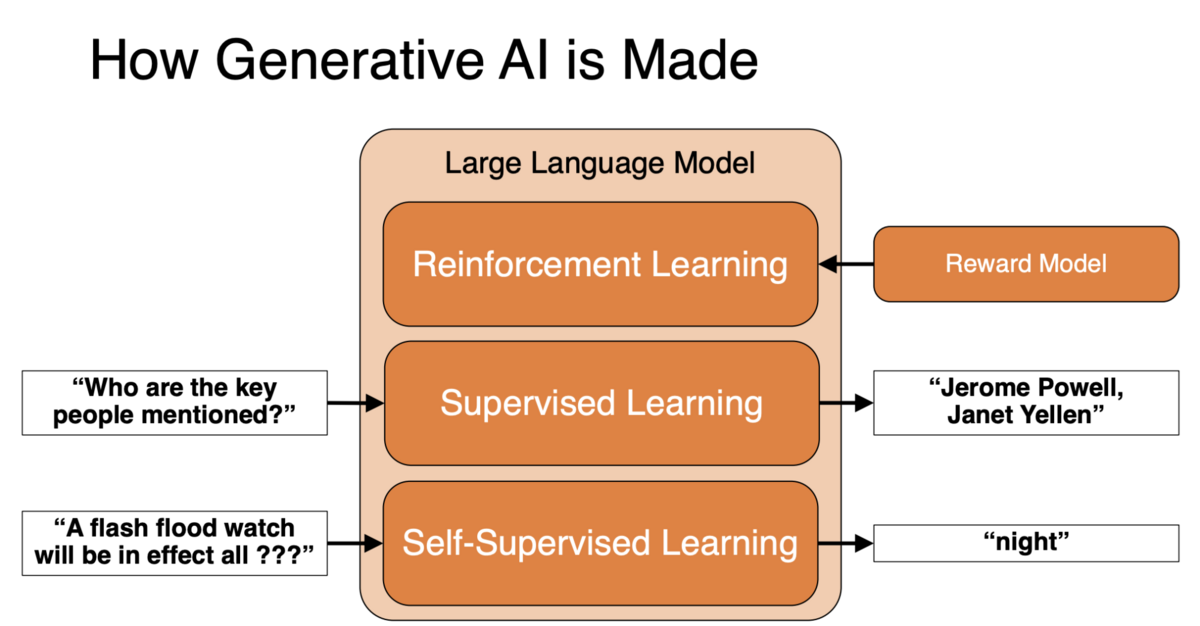
Training large language models is not a singular process. Rather, it’s a multi-layered stack of training processes, each with its unique role and contribution to the model’s performance.

The three main phases are:

  • self-supervised learning
  • supervised learning
  • reinforcement learning.

I recently gave a talk at Snorkel AI’s second Enterprise LLM Summit about the problems that can surface when the data for these three labels is not properly aligned. The talk included a short explainer of the three training phases, which the Snorkel team excerpted as a separate video. I’ve summarized the main points below.

Phase 1: self-supervised learning for language understanding

Self-supervised learning, the first stage of training, is what traditionally comes to mind when we talk about language modeling.

It involves feeding the model with vast amounts of unannotated or raw data and having it predict ‘missing’ pieces of it. The model learns something about language and the domain of the data to generate plausible answers.

For example, if we feed the model with text from a weather website and ask it to predict the next word, it has to understand something about the language and the weather domain. In the presentation, I gave the example sentence “A flash flood watch will be in effect all _____.”

In an intermediate state, the model ranks a list of predictions, from likely answers (“day”, “night”, “hour”) to less plausible ones (“month”), and even nonsensical ones (“giraffe”) that should be assigned very low probability. This process is called self-supervision (as opposed to unsupervised learning) because there is a specific right answer—the word that actually appeared in the text we collected—which was “night” in my example. Self-supervision is similar to unsupervised learning in that it can use abundant, unannotated data.
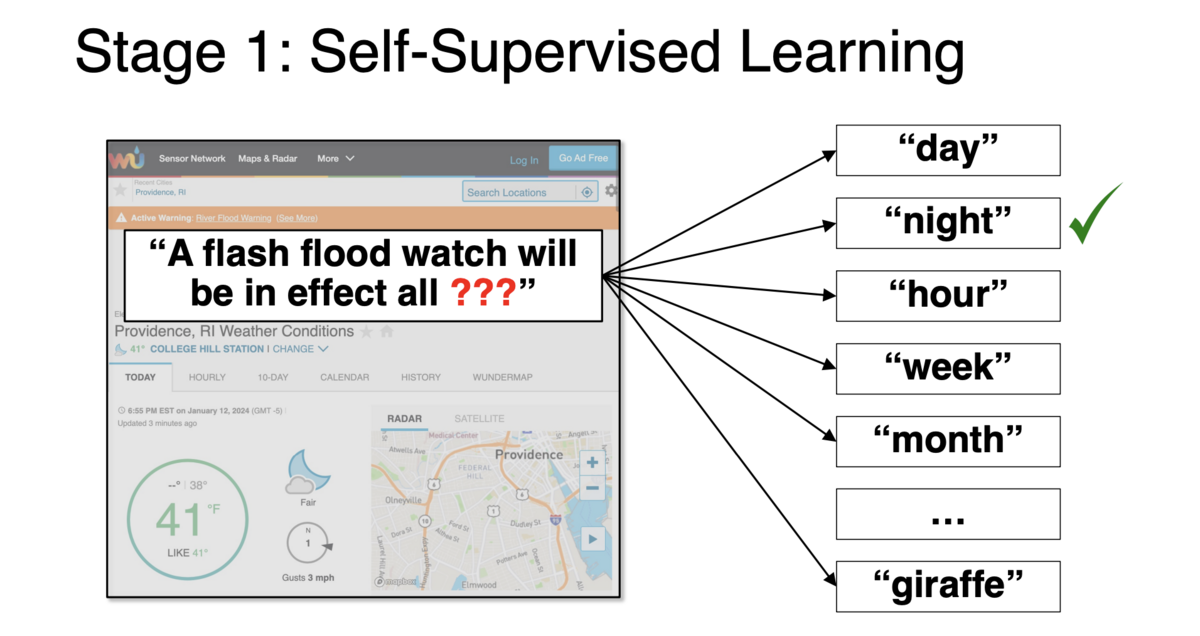
Image1

Phase 2: Supervised learning for instruction understanding

Supervised learning, also known as instruction tuning, is the second stage in the training process of large language models (LLMs). It’s a crucial phase that builds upon the foundational knowledge acquired during the self-supervised learning stage.

In this phase, the model is explicitly trained to follow instructions. This goes beyond the basic prediction of words and sentences, which is the main focus of the self-supervised learning stage. The model now learns to respond to specific requests, making it far more interactive and useful.

The effectiveness of instruction tuning in enhancing the capabilities of LLMs has been demonstrated in various studies, several of which included Snorkel researchers. One notable outcome was that the model showed improved performance in generalizing to new, unseen tasks. This is a significant achievement as one of the main objectives of machine learning models is to perform well on unseen data.

Due to its proven effectiveness, instruction tuning has become a standard part of LLM training. With the completion of the instruction tuning phase, the model is now explicitly trained to be a helper, doing more than just predicting the next words and sentences. It’s now ready to interact with users, understand their requests, and provide helpful responses.
Image2

Phase 3: reinforcement learning to encourage desired behavior

The final stage in the training stack is reinforcement learning. This encourages desired behavior and discourages unwanted outputs. This stage is unique as it does not provide the model with exact outputs to produce, but rather grades the outputs it generates.

The concept of reinforcement learning predates LLMs, but Open AI first proposed it in the context of LLM training shortly after the introduction of instruction tuning. The process starts with a model, already enriched with the ability to follow instructions and predict language patterns. Next, data scientists use human annotations to distinguish between better and worse outputs. These data annotations serve as a guideline for the model, helping it understand which responses are preferred and which are not. The feedback from these annotations is then used to train a reward model.

The reward model is a critical component of this process. It provides rewards at scale, effectively guiding the model towards producing more desirable responses and discouraging less desirable ones. This method is particularly effective in promoting fuzzier concepts like brevity and discouraging harmful language, enhancing the overall quality of the language model’s output.

This approach to reinforcement learning is often referred to as reinforcement learning with human feedback. It emphasizes the importance of human involvement in the training process, ensuring that the model’s learning is aligned with users’ expectations.
The three phases of large language model training

Three phases. Three techniques. One improved model.

Training of LLMs is a multi-faceted process that involves self-supervised learning, supervised learning, and reinforcement learning. Each of these stages plays a critical role in making LLMs as capable as they are. The self-supervised learning phase helps the model to understand language and specific domains. Supervised learning enables the model to follow instructions and generalize to new tasks. Finally, reinforcement learning encourages desirable behaviors and discourages harmful language. The combined effect of these stages results in a more effective and capable LLM.

Learn More

Follow Snorkel AI on LinkedInTwitter, and YouTube to be the first to see new posts and videos!