






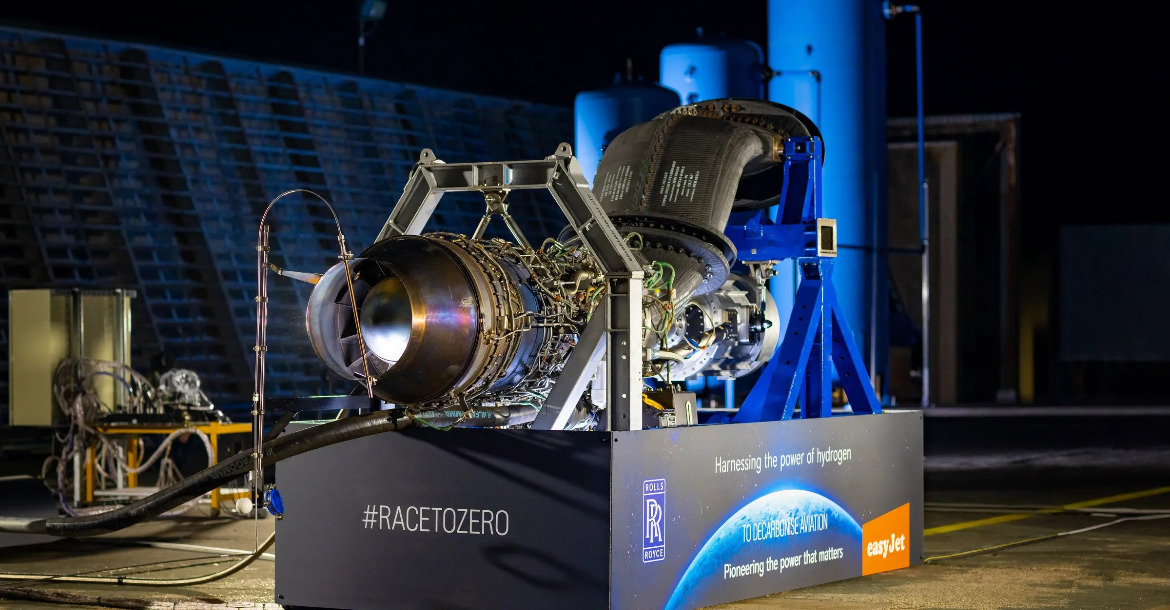
Rolls-Royce has achieved an aviation milestone in a bid to decarbonise air travel with a successful ground test of an aircraft engine that runs on hydrogen.
A joint project with airline easyJet, which is providing financial support, the test took place at a British military facility in Wiltshire.
Rolls-Royce said that the successful test was a “major step towards proving that hydrogen could be a zero-carbon aviation fuel of the future.”
The test utilised a converted Rolls-Royce AE 2100-A regional aircraft engine, typically used to power turboprop planes, and ran the engine on hydrogen fuel. The green gaseous hydrogen was supplied by the European Marine Energy Centre, which generates renewable energy at a production facility on Eday in the Orkney Island off the north coast of Scotland.
Grazia Vittadini, chief technology officer of Rolls-Royce, commented: “The success of this hydrogen test is an exciting milestone.”
“We are pushing the boundaries to discover the zero-carbon possibilities of hydrogen, which could help reshape the future of flight.”
The aim to decarbonise the aviation industry has been a battle fought for some time now. With rising concerns surrounding sustainability and climate change, airlines and aircraft manufacturers have been doing the best they can to reduce their carbon dioxide emissions.
With the banning of single-use plastics onboard for meals, investment in sustainable aviation fuel (SAF) and the development of better technologies such as hydrogen-fuelled engines, the aviation industry is getting closer to its goal of decarbonisation.
Grant Shapps, UK’s Secretary of State for Business, Energy and Industrial Strategy, emphasised the importance of the engine test.
“The UK is leading the global shift to guilt-free flying and today’s test by Rolls-Royce and easyJet is an exciting demonstration of how business innovation can transform the way we live our lives.”
“The early success of the ground test has shown a promising future for the aviation industry and the hope that the extensive amount of carbon emissions produced by a single long-haul flight will be reduced to a thing of the past.”
After this successful ground test, Rolls-Royce and easyJet have a “longer-term ambition to carry out flight tests” of a hydrogen-fuelled engine. Exactly when this test will take place is still up in the air.
