








A worrying pattern around incomplete security fixes has been observed: patches that vendors release as fixes often fail to remove the underlying weakness, and attackers are able to bypass those fixes within weeks or months.
The traditional vulnerability management paradigm assumes that vendor-issued security patches provide comprehensive remediation for disclosed vulnerabilities. However, recent researches demonstrates a concerning pattern: 15.5% of security patches require subsequent fixes, with 8.05% classified as incomplete and 4.15% fundamentally incorrect. This phenomenon extends beyond isolated incidents, representing a systematic challenge that undermines the foundational assumptions of modern cybersecurity practices.
A recent comprehensive study analyzing 8100 security patches reveals that 84.6% of unreliable patches are not publicly disclosed as incomplete, creating invisible security gaps that leave organizations vulnerable despite apparent compliance with patching requirements.
This blog will examine that pattern by digging into few high-impact case studies, measuring the operational effects of NVD processing delays, reviewing pre-disclosure intelligence dynamics, and evaluating how AI tools are changing the speed and scale of exploit development. Through comprehensive analysis of recent vulnerability research and threat intelligence reports, we trace the practical root causes that let these bypasses occur and offer pragmatic mitigation advice for vulnerability researchers and security teams.
In the first section of this article, we’ll look at examples of how quickly patches were bypassed in the wild. Six vulnerabilities disclosed this year will serve as examples.
Original CVEs: CVE-2025-49704 (CVSS 8.8) and CVE-2025-49706 (CVSS 6.5)
Bypass CVEs: CVE-2025-53770 (CVSS 9.8) and CVE-2025-53771 (CVSS 6.5)
Timeline:
Details: CVE-2025-53770 bypassed the deserialization fix for CVE-2025-49704, while CVE-2025-53771 bypassed the authentication fix for CVE-2025-49706. The bypasses exploited the same core logic through alternative paths, enabling unauthenticated remote code execution.
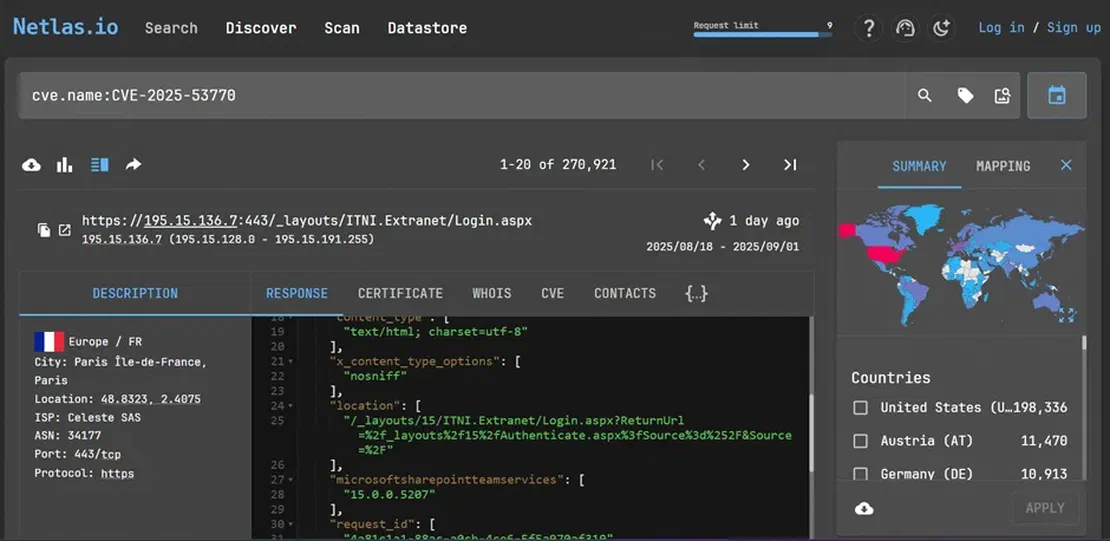
Internet Exposure Assessment: Using Netlas.io search query cve.name:CVE-2025-53770 revealed approximately 270,921 internet-facing SharePoint instances, with the highest concentrations in the United States (198,336 hosts), Austria (11,470 hosts), and Germany (10,913 hosts), demonstrating the massive attack surface available to threat actors exploiting this bypass vulnerability.
Tip: Test related interfaces
After patching, actively test all related interfaces and endpoints, not just the ones mentioned in the advisory. For example, simulate attacks via SOAP or other API endpoints to ensure no hidden routes remain.
Original CVE: CVE-2025-31324 (CVSS 10.0)
Residual Risk CVE: CVE-2025-42999 (CVSS 9.1)
Timeline:
Details: CVE-2025-31324 was initially patched as a missing authorization check in SAP NetWeaver’s Visual Composer /developmentserver/metadatauploader endpoint. However, SAP’s April patch was incomplete—it only added authentication controls without addressing the underlying insecure deserialization vulnerability in the same component.
CVE-2025-42999 represents what Onapsis Research Labs called the “residual risk that remained after patching CVE-2025-31324.” The initial fix stopped unauthorized uploads but left the deserialization flaw that processes uploaded content intact.
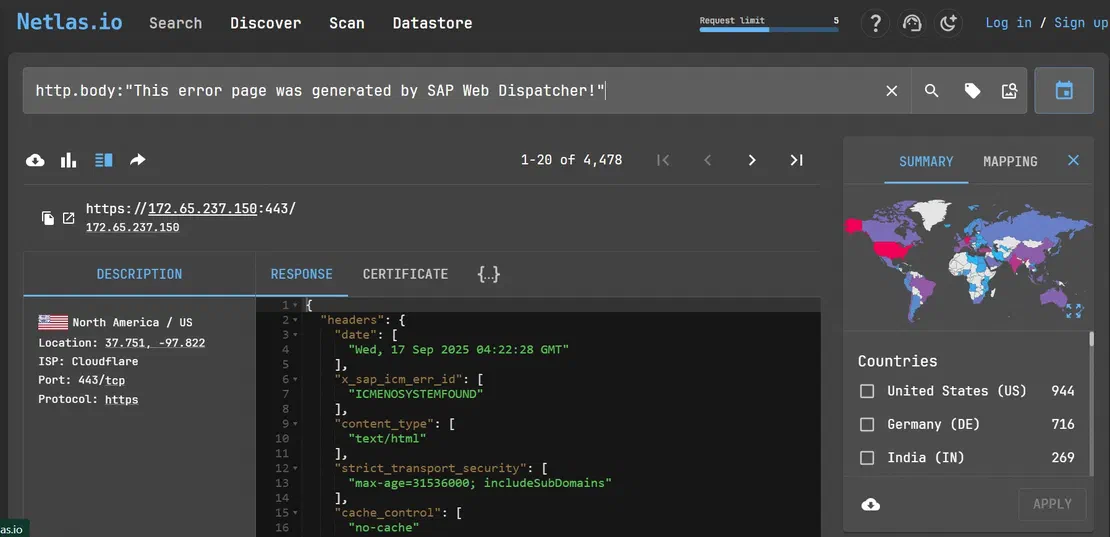
Internet Exposure Assessment: Netlas.io search query http.body:"This error page was generated by SAP Web Dispatcher!" reveals approximately 4,478 internet-facing SAP NetWeaver systems globally vulnerable to the CVE-2025-31324 and CVE-2025-42999 attack chain. The geographic distribution shows significant concentrations in the United States (944 hosts), Germany (716 hosts), and India (269 hosts), indicating substantial enterprise exposure across major business regions where these critical SAP systems typically host mission-critical applications and sensitive corporate data.
Tip: Validate the root issue
After applying a vendor patch, validate whether the fundamental vulnerability class is fixed. Perform targeted tests (e.g. send malicious serialized payloads) to ensure the underlying issue (like deserialization) is truly resolved.
Original CVE: CVE-2025-24054 (CVSS 6.5)
Bypass CVE: CVE-2025-50154 (CVSS 7.5)
Timeline:
Details: The original patch blocked UNC-path icon retrieval from malicious .library-ms files but failed to address Windows Explorer’s automatic icon extraction from remote executables’ embedded .rsrc sections. When a shortcut points to a remote executable (instead of using a remote icon), Explorer automatically downloads the entire binary to extract its icon data, triggering NTLM authentication without user interaction. A comprehensive patch that blocked all automatic remote resource loading from untrusted locations would have prevented this bypass.
Tip: Test alternative code paths
For OS-level patches, test alternative code paths. For instance, after patching a Windows feature, check not just documented uses (like .library-ms) but also related behaviors (like executable icon loading) to catch overlooked cases.
Original CVE: CVE-2025-4123 (CVSS 7.6)
Bypass CVE: CVE-2025-6023 (CVSS 7.6)
Timeline:
Details: The original CVE-2025-4123 patch addressed open redirect vulnerabilities but only implemented basic Content Security Policy (CSP) enhancements without covering client-side path traversal in scripted dashboards. The bypass exploited residual path traversal combined with the open redirect to achieve XSS execution. A comprehensive fix implementing strict CSP with connect-src directives and thorough path validation would have prevented the chained attack vector.
Tip: Test input handling & chaining
After web application patches, perform targeted penetration tests on input handling and chaining. Use tools or manual tests to try path traversals and redirects together, ensuring that all related vulnerabilities are actually eliminated.
Original CVE: CVE-2025-23084 (CVSS 5.6)
Bypass CVE: CVE-2025-27210 (CVSS 7.5)
Timeline:
Details: The initial patch normalized file paths to prevent ../ sequences but did not account for Windows reserved device names (e.g., CON, AUX). Attackers used requests like /api/CON/../../secrets to bypass path sanitization and access sensitive files. A comprehensive fix validating against all Windows device names and enforcing absolute path constraints would have prevented this bypass.
Tip: Cross-platform validation
For cross-platform code, test patches on every OS. After fixing a path issue, include attacks using special filenames (like CON, AUX) or mount points in your fuzzing and testing suite to catch Windows or Linux-specific bypasses.
These incidents share a clear pattern: each patch addressed a specific symptom but left other avenues unprotected, which attackers quickly found. To understand why this happens, we now examine the underlying causes of patch failures.
The phenomenon of patch bypasses represents one of cybersecurity’s most persistent challenges. Despite vendors releasing security updates, attackers consistently find ways to circumvent these fixes, creating a dangerous cycle where organizations believe they’re protected while remaining vulnerable. Below we will examine the main root causes of the “revival” of seemingly defeated vulnerabilities.
Incomplete Scenario Coverage. Patches frequently address only the specific attack vector reported, leaving alternative exploitation paths untested and unprotected. Academic research reveals that 15.5% of vulnerabilities persist for extended periods before being “actually” fixed, with development teams focusing on demonstrated exploits rather than analyzing broader attack surfaces. For example, in CVE-2025-53770, initial patches secured specific web-part endpoints while leaving alternative SOAP interfaces vulnerable. A large-scale empirical study of over 4,000 security patches found that “security fixes are poorly timed with public disclosures, allowing attackers who monitor open-source repositories to get a jump of weeks to months on targeting not-yet-patched systems”.
Flawed Implementation Logic. Even when developers understand what needs to be fixed, they often implement the solution incorrectly, creating new ways for attackers to bypass the security controls. It’s like installing a new lock but using the wrong type of key or putting it on the wrong door. Studies show that 4.15% of patches are incorrect, often due to “missed edge or exception cases, incorrect conditioning, and implementation errors”. These problems occur when developers focus on fixing the specific reported attack rather than understanding the broader vulnerability class, leading to solutions that work against known exploits but fail against variations.
Surface-Level Symptom Fixes. Organizations frequently address symptoms rather than root causes, creating an illusion of security while fundamental vulnerabilities remain exploitable through different means. Research shows 8.05% of patches are incomplete and 3.87% exhibit both incomplete and regressive characteristics, often because fixes target visible symptoms rather than architectural weaknesses. Root cause analysis studies indicate that “deeper systemic issues beyond the immediate incident” are consistently overlooked, leading to “similar incidents across other systems”.
Inadequate Testing and Validation. Insufficient testing environments consistently fail to catch bypass opportunities that attackers readily discover, representing a critical gap between security theory and practice. Organizations typically take 30-60 days to stabilize patches with a 15-day target for critical ones, but this timeline “often fails to keep pace with rapid scanning and exploitation activities”.
In addition, testing and development-process failures are important causes:
In addition to these development-related issues, attackers also gain other advantages before patches ever land. In the next section, we examine how early intelligence leaks give them a head start.
Attackers are also working before defenders even know a patch is coming. Research indicates 32.1% of known exploited vulnerabilities were exploited on or before their CVE disclosure day, representing an 8.5% increase from 2024. This acceleration suggests:
MAPP is a Microsoft-led early vulnerability-sharing initiative providing trusted partners pre-release access to vulnerability info and exploit code with strict NDAs to accelerate patching and defense. However, MAPP has faced abuse concerns:
While programs like MAPP aim to improve security, their effectiveness depends on strict controls to prevent data leakage that adversaries exploit as pre-disclosure intelligence.
Open-source intelligence (OSINT) and social-media intelligence (SOCMINT) analysis often expose vulnerability details before official database entries, providing critical early warnings:
These channels compress the window for defenders, compelling integrated social and repository monitoring as essential for proactive vulnerability research. Even with leaks and OSINT, defenders still rely on official feeds that are slowing down. Next, we examine how NVD processing bottlenecks amplify patch bypass risks.
Even after a vulnerability is known, defenders depend on data feeds like the National Vulnerability Database (NVD). Unfortunately, NVD has experienced unprecedented operational challenges that have significantly degraded its capacity to process and enrich Common Vulnerabilities and Exposures (CVEs). This deterioration has profound implications for cybersecurity operations, particularly in the detection and mitigation of patch bypass vulnerabilities—sophisticated attack techniques that circumvent security patches and exploit gaps in vulnerability management processes.
Since February 2024, the National Vulnerability Database’s capacity to process and enrich CVEs has collapsed, fueling the patch bypass epidemic:
These delays leave CVSS scores, CPE mappings and CWE classifications unavailable for extended periods, crippling automated detection and prioritization.
The deterioration of NVD processing capabilities has created critical gaps in vulnerability intelligence that attackers can exploit. On average, it takes 44 days from vulnerability disclosure to exploitation in the wild. With NVD processing delays, security teams operate with outdated information and cannot assess and mitigate risks promptly.
By denying timely, enriched intelligence, NVD delays magnify patch bypass threats:
Many organizations have been forced to implement alternative vulnerability intelligence sources and develop custom risk assessment methodologies. However, these approaches often lack the standardization and comprehensive coverage that the NVD traditionally provided, creating inconsistencies in vulnerability management across the cybersecurity community.
Tip: Augment NVD with other feeds
Compensate for NVD gaps by ingesting multiple sources. Subscribe to CISA’s KEV, vendor advisories, and community trackers (e.g. VulnCheck). Automate merging these feeds so that if a critical vulnerability is known in one source but not yet in NVD, you still get alerted. This reduces blind spots when NVD is lagging.
The deterioration of NVD processing capabilities represents a critical weakness in global cybersecurity infrastructure that directly benefits malicious actors seeking to exploit patch bypass vulnerabilities. Without immediate and substantial improvements to processing capacity, the gap between vulnerability disclosure and effective mitigation will continue to widen, creating increasingly dangerous conditions for organizations worldwide.
On top of that, AI is making new exploits nearly instantaneous. In the next section, we explore how AI tools accelerate attacks from discovery to deployment.
Attackers are also getting an AI boost. The cybersecurity landscape has witnessed a dramatic evolution in AI-powered exploitation capabilities, with major developments demonstrating how AI now plays a critical role in accelerating vulnerability exploitation from discovery to mass deployment.
Boston University, UC Santa Barbara, UNSW Sydney et al, researchers developed CVE-GENIE, demonstrating industrial-scale vulnerability reproduction. The framework successfully exploited 51% of 841 tested CVEs at $2.77 per exploit, using four specialized LLM agents for environment reconstruction and exploit generation. This breakthrough proves vulnerability weaponization can be fully automated at unprecedented cost efficiency, transforming cybersecurity economics.
The Villager framework achieved over 10,000 downloads within two months of its July 2025 PyPI release. Combining Kali Linux with DeepSeek AI models, it features 4,201 AI system prompts for automated exploit generation, 24-hour self-destructing containers for evidence elimination, and Model Context Protocol architecture enabling distributed attack coordination. Security researchers describe Villager as “Cobalt Strike’s AI successor,” warning of its potential trajectory from legitimate red-team tool to widespread criminal adoption.
Check Point Research documented HexStrike AI’s capability to exploit CVE-2025-7775 (Citrix NetScaler) within 12 hours of disclosure. The platform orchestrates 150+ security tools through autonomous AI agents, compressing tasks that previously required weeks into under 10 minutes of automated execution. Its four-phase automation—reconnaissance, exploitation, persistence, and exfiltration—enables simultaneous attacks against thousands of targets with AI-generated exploit variations.
Ransomware-as-a-Service Evolution: Anthropic’s threat intelligence revealed sophisticated AI integration across criminal enterprises. A single UK-based operator used Claude to automate complete extortion pipelines affecting 17 organizations, with ransom demands exceeding $500,000 based on AI-driven financial analysis of exfiltrated data. Chinese state-aligned actors integrated Claude across 12 of 14 MITRE ATT&CK tactics during multi-month campaigns against Vietnamese critical infrastructure.
Taken together, these developments mean adversaries can discover, analyze, and weaponize new vulnerabilities in minutes. Defenders need equally advanced tools and processes. The next section outlines enhanced defensive strategies for this AI-driven era.

Modern patch bypass vulnerabilities demand sophisticated defensive strategies that integrate artificial intelligence, threat intelligence, and operational excellence. Based on analysis of recent bypass campaigns and emerging AI-powered exploitation tools, security teams require fundamentally enhanced approaches to vulnerability management and patch validation.
Traditional patch testing approaches have proven inadequate against sophisticated bypass techniques demonstrated in cases like Mongoose’s nested query injection and Microsoft SharePoint’s alternative deserialization paths. Advanced validation frameworks now integrate multiple AI-driven analysis layers to identify potential bypass scenarios before production deployment.
Automated Rule Generation and Testing
Research shows that LLM-powered frameworks can automatically create diverse test cases covering expected behaviors, edge cases, and boundary conditions that human testers often miss. Meta’s TestGen-LLM and similar tools demonstrate how natural language processing transforms vulnerability descriptions into executable test scripts, achieving enhanced coverage through mutation-guided test generation that explores alternative exploitation paths.
Academic studies validate this approach: LLMPatch, using multiple AI models including GPT-4, Gemini, Claude3, and Llama3, successfully fixed vulnerabilities in 45-57% of 306 real-world test cases, nearly doubling the 21-35% success rate of traditional automated patching methods. The system’s strength lies in having multiple AI models independently review each patch, catching errors that single-model approaches might miss and providing more reliable validation than any individual AI system working alone.
CVE-GENIE’s four-agent architecture— Processor, Builder, Exploiter, and CTF Verifier — demonstrates comprehensive validation coverage from environment reconstruction through exploit verification. The framework successfully reproduced 51% of 841 tested CVEs at $2.77 per exploit, proving that automated exploit generation can systematically test patch completeness at scale.
Modern validation leverages tools like Autogrep, which automatically generates security rules from vulnerability patches using large language models. The system processes vulnerability patches to create 645 high-quality Semgrep rules across 20 programming languages, achieving effective coverage while filtering out 71.15% of overly specific patterns.
Static analysis tools like CodeQL and Semgrep can explore alternative exploitation paths through data-flow and control-flow analysis. CodeQL’s path queries trace tainted input from sources to sinks, surfacing nested routes that bypass surface-level patches. When combined with comprehensive fuzzing using AFL++ and libFuzzer, these approaches identify residual vulnerabilities that single-layer validation misses. When Mongoose patched CVE-2024-53900, comprehensive validation using recursive query structure testing would have immediately identified the nested $or operator bypass scenario.
Recommended Reading
AI-Driven Attack Surface Discovery
Intelligence-driven vulnerability management has become essential as exploitation timelines compress and AI tools accelerate threat actor capabilities. Organizations must integrate multiple intelligence sources to detect potential exploits before widespread deployment.
Academic research demonstrates that social media platforms frequently surface vulnerability details before official disclosure. Studies show 17% of CVEs on Twitter and 51% on Reddit appear before NVD publication, with discussions preceding official entries by an average of 87 days.
Organizations implementing automated monitoring of GitHub Gists through platforms like Vulnerability-Lookup can identify proof-of-concept scripts and leaked credentials that correlate with active vulnerability campaigns.
Tip: Automate threat feeds & virtual patching
Automate your threat feeds. When proof-of-concept code or indicators of compromise emerge, teams can deploy compensating controls such as temporary Web Application Firewall rules or IPS signatures to shield assets during the patching window.
Effective patch bypass prevention requires risk-based prioritization, comprehensive testing protocols, and integrated security orchestration that accounts for accelerated exploitation timelines.
Organizations must implement tiered vulnerability management approaches that leverage multiple intelligence sources. Industry data confirms that KEV-listed vulnerabilities are remediated 3.5 times faster than non-KEV vulnerabilities, with median times of 174 days versus 621 days respectively. This dramatic difference demonstrates the effectiveness of centralized vulnerability cataloging and mandatory compliance deadlines.
The JetBrains TeamCity CVE-2023-42793 case demonstrates the value of Exploit Prediction Scoring System (EPSS) integration. The vulnerability achieved a 94.58% EPSS score weeks before Russian nation-state exploitation, enabling proactive patching for organizations monitoring EPSS feeds. Conversely, Fortinet CVE-2024-21762 maintained near-zero EPSS scores despite active exploitation and CISA KEV listing, highlighting the need for comprehensive intelligence correlation beyond automated scoring systems.
During critical vulnerability campaigns like SharePoint CVE-2025-53770, response effectiveness directly correlates with asset classification maturity. The vulnerability enabled unauthenticated remote code execution through deserialization flaws, with Microsoft confirming active exploitation beginning July 18, 2025. Organizations with pre-established Tier 1 classification for internet-facing SharePoint systems could implement emergency mitigations more rapidly than those requiring real-time asset discovery and impact assessment.
Automate detection of bypass attempts by correlating SIEM alerts with threat-intel indicators — look for unusual payloads deployments or malformed Referer headers in SharePoint logs. Integrate MISP for IOC sharing and configure Splunk Enterprise Security or IBM QRadar to trigger tickets when post-patch anomalies occur. This ensures defenders catch bypass exploitation as quickly as it emerges.
When patching must be delayed, immediate containment becomes the priority. Start by tightening network boundaries: micro-segment critical workloads or containers so any exploit stays confined to its original host and cannot pivot laterally across the environment. Complement this with temporary virtual patches at the edge — deploy Web Application Firewall rules that block the specific request patterns tied to the new vulnerability until a production fix can be safely rolled out. Continuous monitoring of these controls ensures they remain effective as threat actors adapt.
By prioritizing high-risk vulnerabilities, rigorously validating patches, and enforcing network and virtual controls, blue teams can reduce “incomplete security” gaps and stay ahead of AI-and script-driven bypass tactics.
The evidence is clear: today’s patch-and-pray model is broken. Security updates still leave exploitable gaps, most bypasses are never disclosed, and AI tools now turn a fresh CVE into a working exploit in minutes while the NVD labors through a months-long backlog. Case studies — from SharePoint’s 270,000 exposed servers to SAP’s residual deserialization flawsn — show how “fixed” bugs quietly reopen as high-impact breaches. To survive this new reality, security programs must pivot from blind trust in vendor patches to an intelligence-driven, AI-assisted approach: monitor early-warning chatter on social code and social media, validate every hotfix with multilayer testing (LLM-generated fuzzing, CodeQL, dynamic analysis), and prioritize remediation using risk signals like KEV and EPSS. Patch once, test twice, watch always — and treat every update as the start of scrutiny, not the end of the job.

I can show you how deep the Internet really goes
Discover exposed assets, infrastructure links, and threat surfaces across the global Internet.
此内容由惯性聚合(RSS阅读器)自动聚合整理,仅供阅读参考。 原文来自 — 版权归原作者所有。