



惯性聚合 高效追踪和阅读你感兴趣的博客、新闻、科技资讯
阅读原文 在惯性聚合中打开

推荐订阅源

爱范儿
爱范儿
钛媒体:引领未来商业与生活新知
钛媒体:引领未来商业与生活新知
G
GRAHAM CLULEY
www.infosecurity-magazine.com
V2EX - 技术
V2EX - 技术
The Last Watchdog
The Last Watchdog
S
Secure Thoughts
Webroot Blog
Webroot Blog
PCI Perspectives
PCI Perspectives
L
LINUX DO - 最新话题
Hacker News: Ask HN
Hacker News: Ask HN
N
News and Events Feed by Topic
H
Heimdal Security Blog
H
Help Net Security
T
The Blog of Author Tim Ferriss
P
Proofpoint News Feed
The GitHub Blog
The GitHub Blog
Jina AI
Jina AI
Recent Commits to openclaw:main
F
Full Disclosure
小众软件
小众软件
S
Securelist
罗磊的独立博客
NISL@THU
NISL@THU
D
Darknet – Hacking Tools, Hacker News & Cyber Security
C
Cisco Blogs
云风的 BLOG
云风的 BLOG
C
CERT Recently Published Vulnerability Notes
Cisco Talos Blog
Cisco Talos Blog
Know Your Adversary
Know Your Adversary
S
Schneier on Security
D
DataBreaches.Net
M
MIT News - Artificial intelligence
V
Vulnerabilities – Threatpost
N
News and Events Feed by Topic
有赞技术团队
有赞技术团队
F
Fortinet All Blogs
T
Tenable Blog
The Register - Security
C
Check Point Blog
AWS News Blog
AWS News Blog
Cloudbric
Cloudbric
C
CXSECURITY Database RSS Feed - CXSecurity.com
cs.AI updates on arXiv.org
C
Cyber Attacks, Cyber Crime and Cyber Security
Cyber Security Advisories - MS-ISAC
Google Online Security Blog
博客园 - 叶小钗
Hacker News - Newest:
Hacker News - Newest: "LLM"
博客园 - 司徒正美

Kaspersky official blog

Why live chat agents can read your messages before you hit “Send” Real-world attacks on corporate AI agents How Google phone number verification works, and whether you should turn it off ConsentFix: a new ClickFix variation for compromising Microsoft 365 accounts How to protect your data after a breakup Email hijacking via OAuth Prompt attacks on the Gemini AI-assistant and Google Workspace with Gemini Key vulnerabilities of Microsoft’s July 2026 Patch Tuesday Meta launched and almost instantly rolled back a feature that trained its AI image generator on Instagram user content. What’s wrong with Meta's NameTag feature and why you should be wary of it Targeted phishing attacks on manufacturing companies Why CAPTCHAs are about to vanish: how AI rewrote the "prove you're human" test The unpatchable backdoor in Yarbo robot mowers Managing the risks of LLM aggregators and AI API proxies Social engineering: how scammers manipulate their victims How today's threat actors break into companies 250,000 misconfigurations in GitHub Actions How hackers use PowerShell scripts to steal Telegram accounts How Hola Browser was weaponized to spread a Monero miner World Cup 2026: watch out for these scams Building an autonomous SOC: core challenges and solutions The FROST attack: how SSD access delays expose users’ activity Taming shadow-AI on corporate devices Hentai games with a nasty twist XChat: what’s wrong with Elon Musk’s new messaging app? Security gateway for autonomous vehicles Is Wi-Fi safe in Mexico? The great messaging heist targeting your wallet Don’t let fake IPTV apps ruin your World Cup Attackers disguising phishing as Google AppSheet notifications Qualcomm vulnerability: phone repairs and car maintenance are no longer safe A lost art finds its way into phishing emails Is your TV box renting out your network? How to turn off unapproved AI tools across organization Subscription security: how to protect your account, your wallet… and your sanity The capabilities of Kaspersky Container Security LLM raiders and how to repel them What happens in the bedroom stays in the bedroom Fake ticket websites exploiting BTS world tour Is your security system secure? Supply chain attack via Trivy and LiteLLM
Survey-based scams
2026-03-26 · via Kaspersky official blog

Spammers are constantly seeking new ways to reach the widest audience possible while dodging email filters — all to ensure their “tempting” offers land in your inbox rather than the spam folder. To pull this off, bad actors are increasingly pivoting to legitimate platforms, dreaming up sophisticated ways to weaponize them for their own gain.

We’ve previously covered scam attacks using Google Forms, where fraudulent emails were sent directly from Google’s mail servers. In those cases, links were shielded by the reputable forms.gle domain, allowing them to breeze past spam filters. Now, a similar tactic has been implemented using Yandex Surveys. Here’s a look at how this new scam works, and how you can stay safe.

Everything looks fine at first glance…

Online survey tools are fairly common these days. Marketing professionals use them to gather feedback, HR departments use them for employee engagement, and researchers use them to study target audiences. But how are scammers getting in on the action?

They create a survey, embed links to fraudulent websites within the body, and blast out emails containing the survey link to their mailing lists. Standard anti-spam filters see URLs like yandex.com/poll/… as legitimate. Recipients often have the same reaction, reasonably assuming, “It’s a link to a well-known service — what could go wrong?”

Our experts have tracked a massive spike in these emails. In January, Kaspersky Premium blocked just over 2200 of these messages; by February, that number soared to over 32 000. We’re looking at aggressive scaling here — nearly a 15-fold increase in just one month.

A poll page created on Yandex Surveys featuring a message and fraudulent link

Here’s a survey page containing a scam message and link. The visible portion features a well-known crypto exchange logo and an active link to the attackers’ site. At the bottom, you’ll notice a couple of dots — more on these later

Spammers distribute these survey links through their own channels, often hijacking website feedback forms that lack sender verification. The fact that the message originates from a legitimate network provides yet another green flag for anti-spam filters to let these emails slide right through.
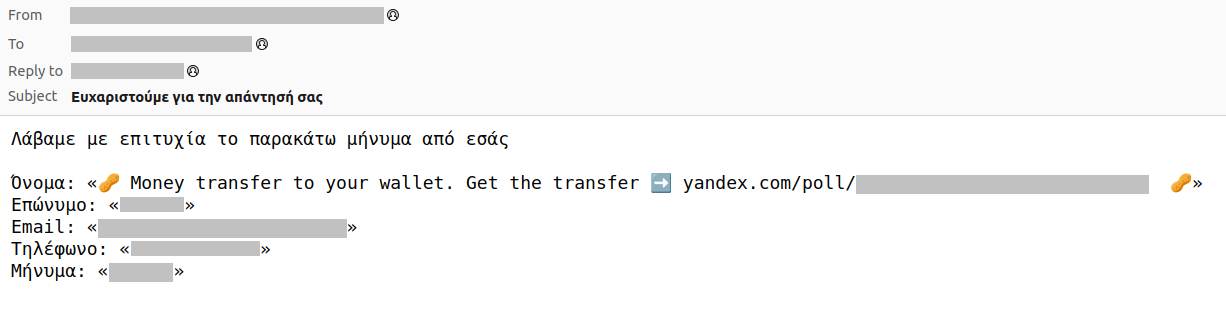
A crypto scam email in English sent through a feedback form on a Greek website

A crypto scam email in English sent through a feedback form on a Greek website

The most popular themes for this type of spam currently involve crypto scams — promising users a windfall in digital currency — and links to sketchy dating sites.

How scammers exploit Yandex Surveys

To build a survey that doesn’t actually look like one, attackers take advantage of the platform’s extended survey mode.

Yandex Surveys allows users to swap out a simple question for a text block, which can include descriptions, images, or videos. This is exactly where scammers embed their pitch and the link to their phishing site. They use the built-in “Upload media” feature to add official-looking logos and other embellishments that sell the illusion.

To make sure the victim doesn’t see the “Next” button or the standard disclaimer — which warns that surveys are created by third parties and that Yandex isn’t responsible for the content — the scammers pad the space below the scam block with invisible characters. For instance, they might add dozens of lines of transparent emojis; you can’t see them, but they still take up screen real estate. Further down, past the point where most people would stop scrolling, they simply drop in punctuation marks, one per line.
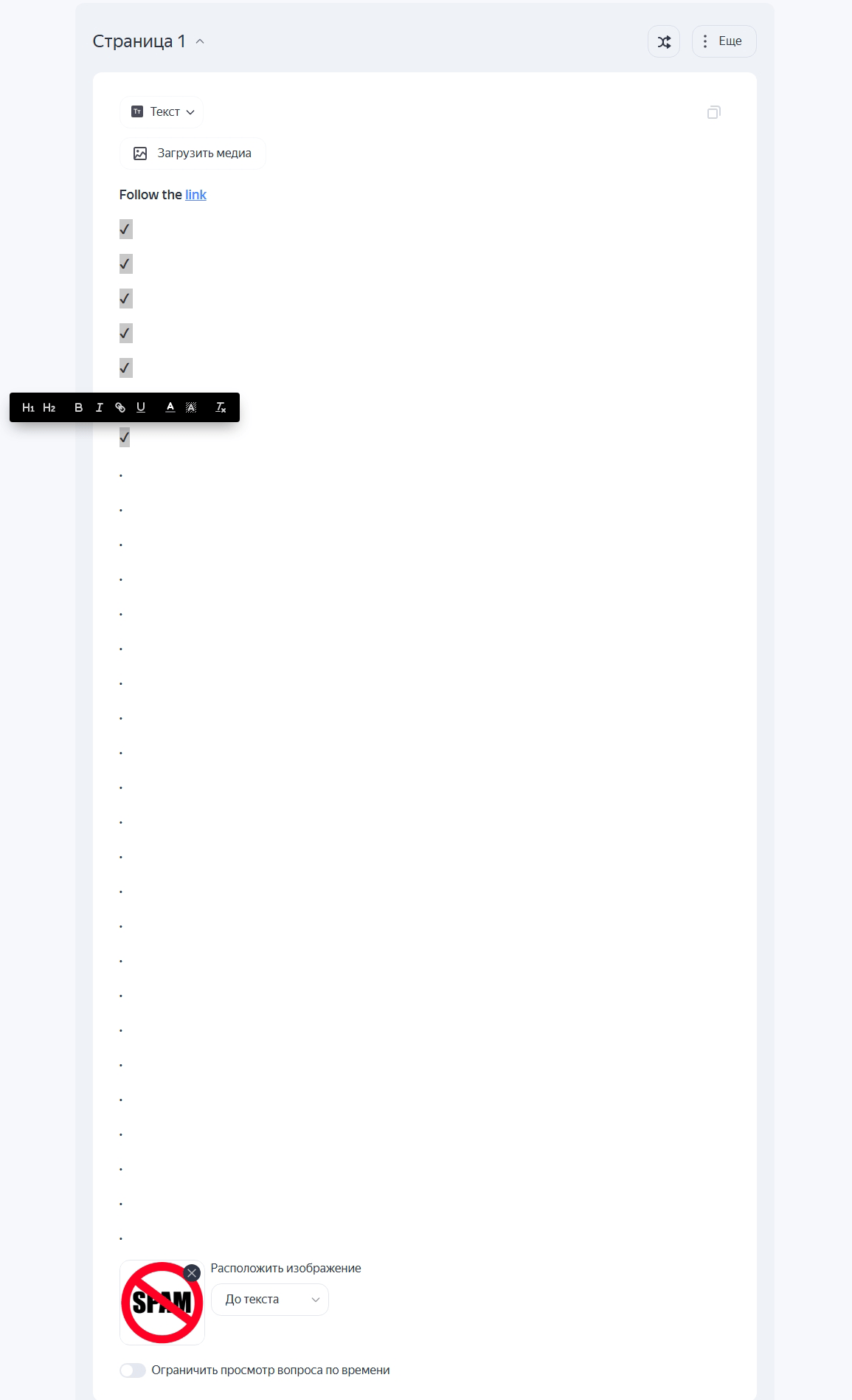
Transparent emojis and punctuation marks used in the surveys

To understand how these surveys are built, we used a test survey to retrace the scammers’ steps. Transparent emojis are used to create dead space under the scam block, followed by punctuation marks further down where few users are likely to scroll

The result? The user sees nothing but the fraudulent offer and the link, while everything else is pushed off-screen. It’s the same technique we’ve seen used with Google Forms.

Beyond the benefit of using legitimate URLs, another perk for the scammers is that this method doesn’t cost them a dime. They aren’t paying the service for promotion, or using the built-in targeting tools; they simply blast the link to their own database. In this scenario, the service is essentially being used as good-reputation web page hosting.

To top it off, the scammers can jump into the “Statistics” section of the survey to track click-through rates in real-time and then export the data into a spreadsheet. This is basically a turnkey analytics suite.

Once a victim clicks the link in the survey and lands on the attackers’ website, they are greeted by a professional-looking site running a classic “prize giveaway” scheme.

How to avoid taking the bait:

  • Don’t blindly trust “reputable domain names”. Seeing yandex.com or forms.gle in the address bar is no longer a guarantee that the content is safe. Anyone can create a survey at those addresses.
  • Stay alert if you receive an unexpected email. Be especially wary if it promises a payout, a prize, or asks you to “confirm” something urgently. These are scammers’ tricks of choice.
  • Always scroll to the bottom of the page. If the content abruptly cuts off and you’re left with a wall of empty space, that should set off alarm bells. Check the footer — you’ll often find service disclaimers or other clues that prove you’re looking at a fraudulent survey.
  • Don’t click links in suspicious surveys. If you do happen to click through, never enter any personal or financial information on the resulting site.
  • Use a trusted security tool. Kaspersky Premium detects these fraudulent sites and blocks access before you have a chance to hand over your data or risk infecting your device through a zero-click vulnerability.

Finally, it’s worth noting that scammers didn’t actually hack Yandex Surveys; instead, they took a creative — albeit malicious — approach to repurposing the tool for their own ends. Since Yandex Surveys is scheduled to shut down on April 6, 2026, this specific scheme will soon hit a dead end. Still, scammers are constantly hunting for the next loophole to exploit. Your best defense remains a healthy dose of skepticism toward any unexpected email — even if the links point to a domain you know and trust.

Other tricks spammers use: