



惯性聚合 高效追踪和阅读你感兴趣的博客、新闻、科技资讯
阅读原文 在惯性聚合中打开

推荐订阅源

N
News and Events Feed by Topic
GbyAI
GbyAI
博客园 - Franky
宝玉的分享
宝玉的分享
Blog — PlanetScale
Blog — PlanetScale
Google DeepMind News
Cyber Security Advisories - MS-ISAC
人人都是产品经理
人人都是产品经理
Microsoft Azure Blog
The Register - Security
腾讯CDC
freeCodeCamp Programming Tutorials: Python, JavaScript, Git & More
I
InfoQ
The Cloudflare Blog
OSCHINA 社区最新新闻
OSCHINA 社区最新新闻
Engineering at Meta
Engineering at Meta
MongoDB | Blog
MongoDB | Blog
有赞技术团队
有赞技术团队
CTFtime.org: upcoming CTF events
F
Full Disclosure
cs.AI updates on arXiv.org
Vercel News
Vercel News
博客园 - 【当耐特】
Exploit-DB.com RSS Feed
S
Schneier on Security
cs.CV updates on arXiv.org
Project Zero
Project Zero
量子位
M
MIT News - Artificial intelligence
Stack Overflow Blog
Stack Overflow Blog
C
Cyber Attacks, Cyber Crime and Cyber Security
美团技术团队
Attack and Defense Labs
C
Cybersecurity and Infrastructure Security Agency CISA
T
The Blog of Author Tim Ferriss
cs.CL updates on arXiv.org
T
Troy Hunt's Blog
Google Online Security Blog
罗磊的独立博客
P
Proofpoint News Feed
Schneier on Security
Spread Privacy
Spread Privacy
S
SegmentFault 最新的问题
L
LINUX DO - 最新话题
Simon Willison's Weblog
爱范儿
爱范儿
博客园 - 聂微东
A
About on SuperTechFans
PCI Perspectives
PCI Perspectives
D
Docker

CSS Wizardry

Front-End’s Missing Metric: The TBT Window Meet Your Users Where They Are with Obs.js Better Browser Caching with No-Vary-Search font-family Doesn’t Fall Back the Way You Think What Is CSS Containment and How Can I Use It? When All You Can Do Is All or Nothing, Do Nothing Obs.js: Context-Aware Web Performance for Everyone Low- and Mid-Tier Mobile for the Real World (2025) The Fastest Site in the Tour de France Making Sense of the Performance Extensibility API Why Do We Have a Cache-Control Request Header? HTML Is Not a Programming Language… Build for the Web, Build on the Web, Build with the Web Licensing Code on CSS Wizardry A Layered Approach to Speculation Rules Designing (and Evolving) a New Web Performance Score Core Web Vitals Colours The Ultimate Contract Templates for Tech Consultants: Protect Your Business and Get Paid Optimising for High Latency Environments Cache Grab: How Much Are You Leaving on the Table? blocking=render: Why would you do that?! Correctly Configure (Pre) Connections The Three Cs: 🤝 Concatenate, 🗜️ Compress, 🗳️ Cache What Is the Maximum max-age? How to Clear Cache and Cookies on a Customer’s Device The Ultimate Low-Quality Image Placeholder Technique Core Web Vitals for Search Engine Optimisation: What Do We Need to Know? In Defence of DOM­Content­Loaded Site-Speed Topography Remapped Why Not document.write()? Speeding Up Async Snippets Critical CSS? Not So Fast! Measure What You Impact, Not What You Influence Optimising Largest Contentful Paint Measuring Web Performance in Mobile Safari Site-Speed Topography Speed Up Google Fonts Real-World Effectiveness of Brotli Performance Budgets, Pragmatically Lazy Pre-Browsing with Prefetch Making Cloud.typography Fast(er) Time to First Byte: What It Is and How to Improve It Self-Host Your Static Assets Tips for Technical Interviews Cache-Control for Civilians Bandwidth or Latency: When to Optimise for Which ITCSS × Skillshare What If? CSS and Network Performance The Three Types of Performance Testing Getting to Know a Legacy Codebase Image Inconsistencies: How and When Browsers Download Images Identifying, Auditing, and Discussing Third Parties My Digital Music Setup Measuring the Hard-to-Measure Finding Dead CSS The Fallacies of Distributed Computing (Applied to Front-End Performance) Ten Years Old Relative Requirements Airplanes and Ashtrays Performance and Resilience: Stress-Testing Third Parties Refactoring Tunnels Little Things I Like to Do with Git Writing Tidy Code Configuring Git and Vim Base64 Encoding & Performance, Part 2: Gathering Data Base64 Encoding & Performance, Part 1: What’s Up with Base64? Code Smells in CSS Revisited Typography for Developers Moving CSS Wizardry onto HTTPS and HTTP/2 Ack for CSS Developers A New Year, a New Focus Preparing Vim for Apple’s Touch Bar Choosing the Correct Average CSS Shorthand Syntax Considered an Anti-Pattern CSS Wizardry Newsletter Nesting Your BEM? Improving Perceived Performance with Multiple Background Images Continue Normalising Your CSS Pure CSS Content Filter Pragmatic, Practical, and Progressive Theming with Custom Properties Refactoring CSS: The Three I’s Speaker’s Checklist: Before and After Your Talk Improving Your CSS with Parker The Importance of !important: Forcing Immutability in CSS Mixins Better for Performance Managing Typography on Large Apps White October Events Workshop Partnership BEMIT: Taking the BEM Naming Convention a Step Further Travelling Like You Want to, When You Have To Contextual Styling: UI Components, Nesting, and Implementation Detail Subtleties with Self-Chained Classes Cyclomatic Complexity: Logic in CSS Immutable CSS Can CSS Be Too Modular? More Transparent UI Code with Namespaces When to use @extend; when to use a mixin The Specificity Graph CSS Wizardry Ltd.: Year 1 in review CSS Guidelines 2.0.0
The HTTP/1-liness of HTTP/2
Harry Roberts · 2023-07-12 · via CSS Wizardry

Written by on CSS Wizardry.

This article started life as a Twitter thread, but I felt it needed a more permanent spot. You should follow me on Twitter if you don’t already.

I’ve been asked a few times—mostly in workshops—why HTTP/2 (H/2) waterfalls often still look like HTTP/1.x (H/1). Why are things are done in sequence rather than in parallel?

Let’s unpack it!

Fair warning, I am going to oversimplify some terms and concepts. My goal is to illustrate a point rather than explain the protocol in detail.

One of the promises of H/2 was infinite parallel requests (up from the historical six concurrent connections in H/1). So why does this H/2-enabled site have such a staggered waterfall? This doesn’t look like H/2 at all!
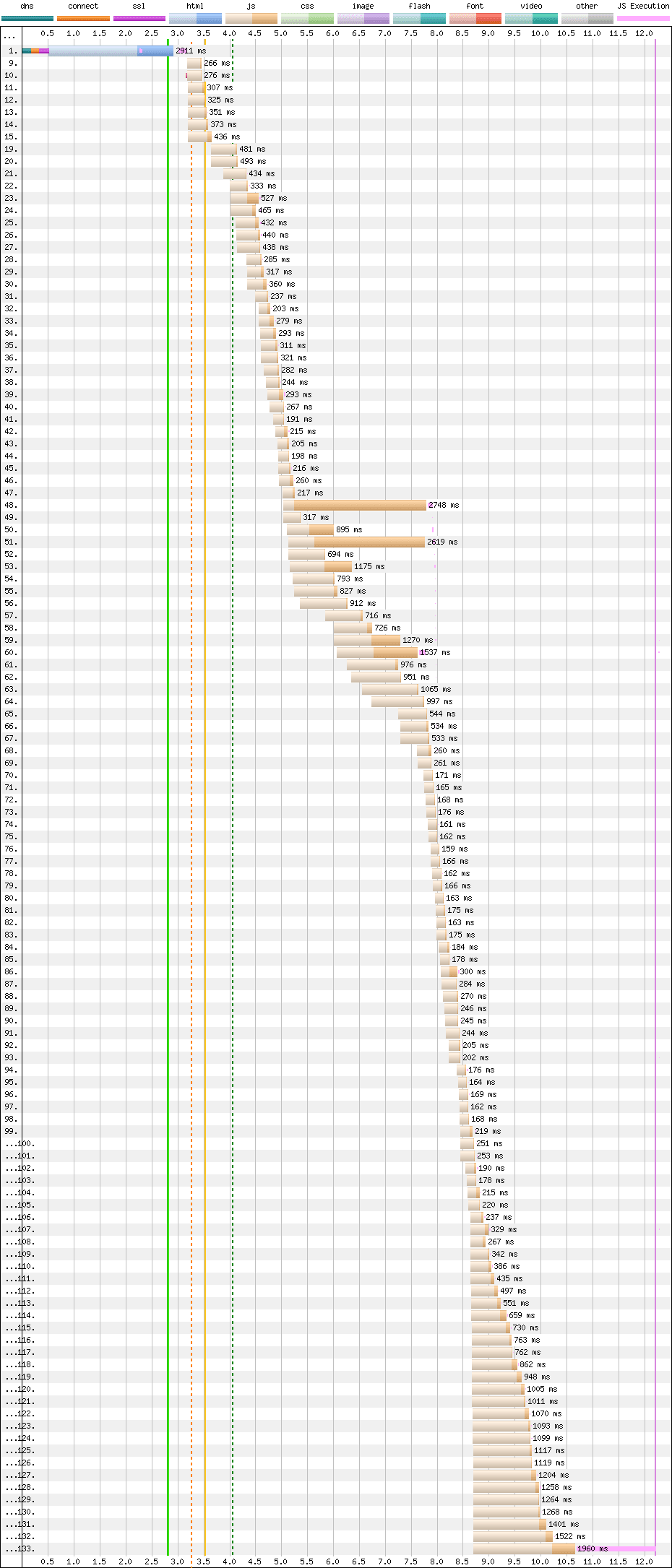
This doesn’t look very parallelised!

Things get a little clearer if we add Chrome’s queueing time to the graph. All of these files were discovered at the same time, but their requests were dispatched in sequence.
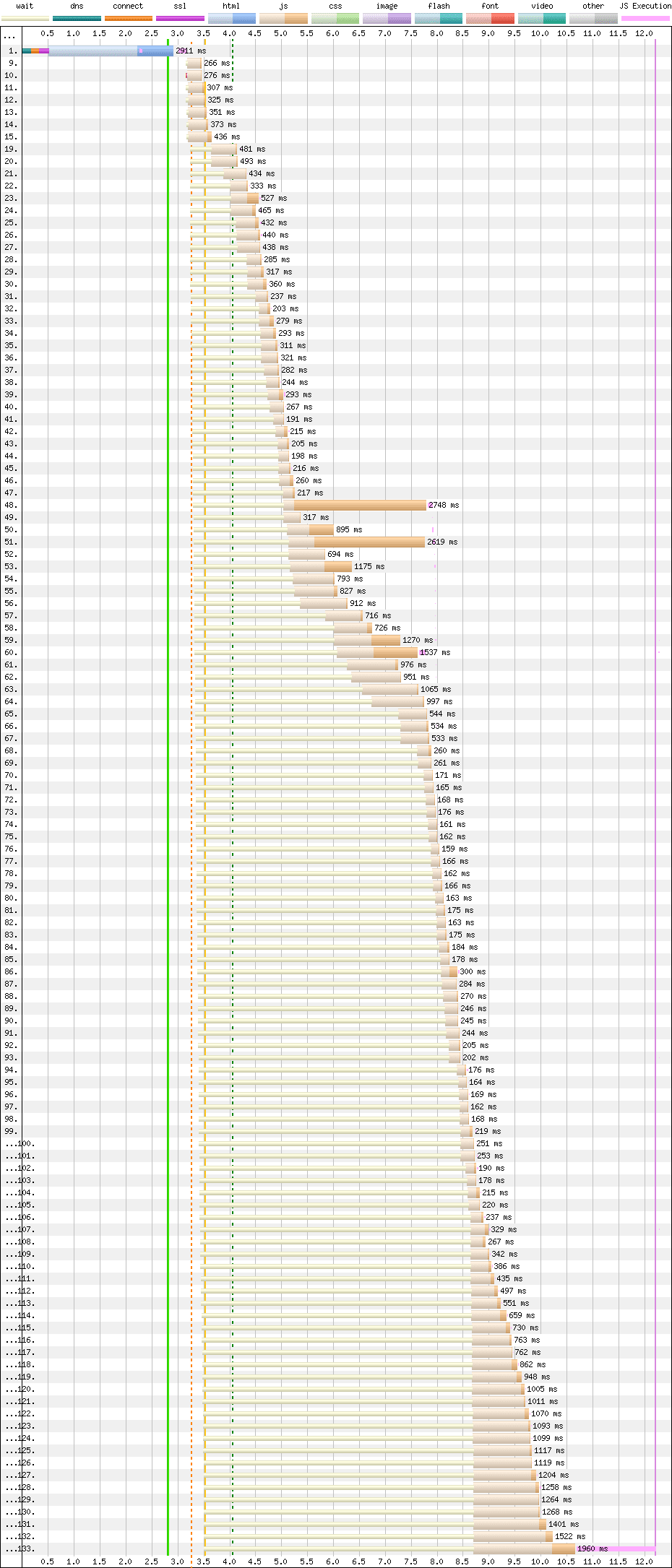
The white bars show how long the browser queued the request for. All files were discovered around 3.25s, but were all requested sometime after that.

As a performance engineer, one of the first shifts in thought is that we don’t care only about when resources were discovered or requests were dispatched (the leftmost part of each entry). We also care about when responses are finished (the rightmost part of each entry).

When we stop and think about it, ‘when was a file useful?’ is much more important than ‘when was a file discovered?’. Of course, a late-discovered file will also be late-useful, but really the only thing that matters is usefulness.

With H/2, yes, we can make far more requests at a time, but making more requests doesn’t magically make everything faster. We’re still limited by device and network constraints. We still have finite bandwidth, only now it needs sharing among more files—it just gets diluted.

Let’s leave the web and HTTP for a second. Let’s play cards! Taylor, Charlie, Sam, and Alex want to play cards. I am going to deal the cards to the four of them.

These four people and their cards represent downloading four files. Instead of bandwidth, the constant here is that it takes me ONE SECOND to deal one card. No matter how I do it, it will take me 52 seconds to finish the job.

The traditional round-robin approach to dealing cards would be one to Taylor, one to Charlie, one to Sam, one to Alex, and again and again until they’re all dealt. Fifty-two seconds.

This is what that looks like. It took 49 seconds before the first person had all of their cards.

Everything isn’t faster—everything is slower.

Can you see where this is going?

What if I dealt each person all of their cards at once instead? Even with the same overall 52-second timings, folk have a full hand of cards much sooner.

Half a JavaScript file is useless to us, so let’s focus on getting complete responses over the wire as soon as possible.

Thankfully, the (s)lowest common denominator works just fine for a game of cards. You can’t start playing before everyone has all of their cards anyway, so there’s no need to ‘be useful’ much earlier than your friends.

On the web, however, things are different. We don’t want files waiting on the (s)lowest common denominator! We want files to arrive and be useful as soon as possible. We don’t want a file at 49, 50, 51, 52s when we could have 13, 26, 39, 52!

On the web, it turns out that some slightly H/1-like behaviour is still a good idea.

Back to our chart. Each of those files is a deferred JS bundle, meaning they need to run in sequence. Because of how everything is scheduled, requested, and prioritised, we have an elegant pattern whereby files are queued, fetched, and executed in a near-perfect order!

Hopefully it all makes a little more sense now.

Queue, fetch, execute, queue, fetch, execute, queue, fetch, execute, queue, fetch, execute, queue, fetch, execute with almost zero dead time. This is the height of elegance, and I love it.

I fondly refer to this whole process as ‘orchestration’ because, truly, this is artful to me. And that’s why your waterfalls look like that.