





The iGaming industry is growing quickly – but the bigger story is happening behind the scenes.
Live, in-play betting now makes up more than half of all wagers and continues to grow. Mobile has become the dominant channel. And global expansion, especially in newly regulated markets like the United States, is accelerating competition. The result? Altogether, the iGaming market is projected to approach $170 billion by 2031.
That growth isn’t just adding users. It’s changing what platforms are expected to do.
iGaming is no longer about reliably delivering content. It’s about processing bets, updating odds, enforcing rules, and stopping threats – all in real time.
And that’s where strain starts to show.
Every live bet is time-sensitive.
Odds shift continuously. Scores update in seconds. And users expect everything from placing a bet to getting the confirmation, to happen instantly. Sub-150ms responsiveness is quickly becoming the baseline.
Instant bets have long been the holy grail of iGaming. The ability to place a wager on the very next moment of action - who scores the next three-pointer, whether a penalty kick is missed, or if the next play results in a touchdown - fundamentally changes how fans engage with live sports. Instead of waiting hours for an outcome, bettors receive immediate feedback and instant gratification, creating a far more dynamic and addictive experience.
This shortens the engagement loop dramatically, increases betting frequency, and keeps users continuously invested throughout the event. As operators compete for retention and differentiation, the platforms capable of supporting real-time data processing, ultra-low latency delivery, and rapid odds updates will be best positioned to capitalize on the next wave of iGaming adoption.
On the other hand, when performance slips, the impact is immediate. Bets are abandoned. Trust erodes. And revenue follows suit. This isn’t just about speed, it’s about keeping the experience reliable when timing is part of the product.
At the same time, operators are dealing with challenges that don’t sit neatly together.
Traffic that doesn’t ramp – it spikes. Major events can drive global demand in seconds. Systems need to scale just as quickly or risk downtime at the most valuable moments.
Threats that target revenue directly. DDoS attacks, credential stuffing, and automated betting activity are constant. These attacks are often timed to coincide with peak traffic times, when disruption is most costly.
Regulation that varies by region. Operators have to enforce geo restrictions, data residency requirements, and fraud controls across jurisdictions – while preventing VPN-based workarounds and maintaining a seamless user experience.
Individually, these are solvable problems. Together, they create operational friction.
To keep up, many teams have added more tooling: CDNs for delivery, WAF for security, separate systems for bots, logging, failover, and so on.
The result is a fragmented, but functioning (for now) stack.
Different control planes. Limited visibility across systems. Slower response when something goes wrong. Manual processes where automation is needed most.
Traditional CDNs, in particular, weren’t designed for this kind of workload. They handle static delivery well, but struggle when every request is dynamic, time-sensitive, and tied to a transaction.
The bigger issue is architectural. When performance, security, and application logic are handled in separate layers, every decision takes longer. Requests travel further. Systems depend on coordination between tools that weren’t built to operate in real-time.
That model starts to break down under the demands of live betting.
To support real-time betting at scale, operators need to reduce both latency and complexity – at the same time.
That’s difficult to do when critical functions are split across multiple systems. Instead, more operators are shifting toward a model where those functions run closer together and closer to the user.
This is where the Edge comes in.
Instead of sending every request back to centralized infrastructure, operators are moving logic, security, and decision-making closer to users.
That shift makes it possible to:
Validate bets near the point of interaction
Update odds globally without delay
Block malicious traffic before it reaches origin
Enforce geo and compliance rules in real-time
It’s not just about moving the data faster. It’s about removing the friction introduced by distributed, disconnected systems.
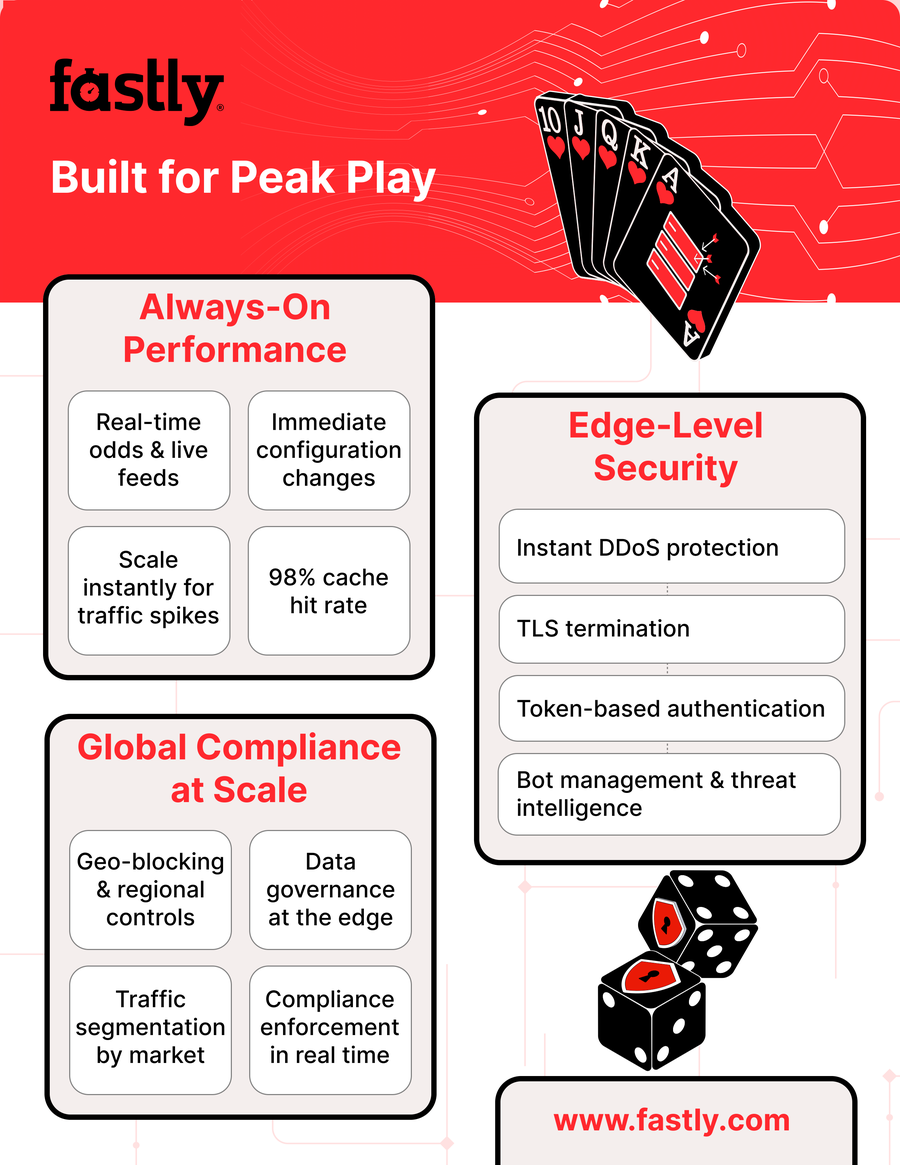
The impact shows up in how platforms perform under pressure.
Faster gameplay: Odds updates and bet confirmations happen without unnecessary round trips, keeping pace with live events and reducing the chance of dropped or delayed bets.
Stronger protection without added latency: Threats are handled at the edge, so mitigation happens in real-time without slowing down legitimate users.
Resilience during peaks: Traffic spikes can be absorbed without overwhelming backend systems, even during major sporting events.
Better visibility: Teams can see what happens, when it happens, making it easier to catch and resolve issues before they escalate.
Simpler compliance: Geo restrictions and routing decisions can be enforced immediately, without adding operational overhead or user friction.
Taken together, these capabilities make it easier to deliver the kind of fast, reliable experience that real-time betting depends on.
Platforms like Fastly’s are built for this shift, combining delivery, security, observability, and resilience into a single edge platform.
That allows operators to improve performance, run logic closer to users, and mitigate threats without adding latency – all while simplifying how their systems are managed.
Learn how Fastly helps iGaming platforms deliver faster, more resilient experiences — and see what a modern edge architecture looks like in practice.
此内容由惯性聚合(RSS阅读器)自动聚合整理,仅供阅读参考。 原文来自 — 版权归原作者所有。