Elevating security, control, and accessibility: Stack Int...
Carrie Koos·2026-09-03·via Stack Overflow Blog
To build an enterprise AI strategy that scales, teams need an organizational memory they can trust. That means ensuring the underlying knowledge layer is fresh, secure, accessible, and seamlessly integrated into developer workflows.
In our 2026.6 release, we are shipping updates across administrative security, programmatic API control, developer portal integrations, and platform-wide accessibility—ensuring both your engineers and your AI agents act on verified, decision-grade knowledge.
As enterprise teams expand API access to feed internal AI tooling and automated workflows, securing those pipelines is critical. We’ve added a dedicated Security settings page within the Admin console to unify session and request governance:
Header-Enforced API Keys: Eliminate key leakage in server logs by requiring X-API-Key headers for API v2.3 requests.
Session Inactivity Controls: Set maximum inactivity windows before re-authentication is required.
Granular Daily Rate Limits: Define and customize daily API rate caps per application (up to 10,000 requests/day) to help control compute costs and align with our API pricing structure.
Secret Rotation & Exposure Prevention: Rotate service application credentials while securing keys so they are treated as non-displayable secrets.
Stale content leads to agent mistakes and human confusion. We're continuing to build automated knowledge-health capabilities directly into Stack Internal:
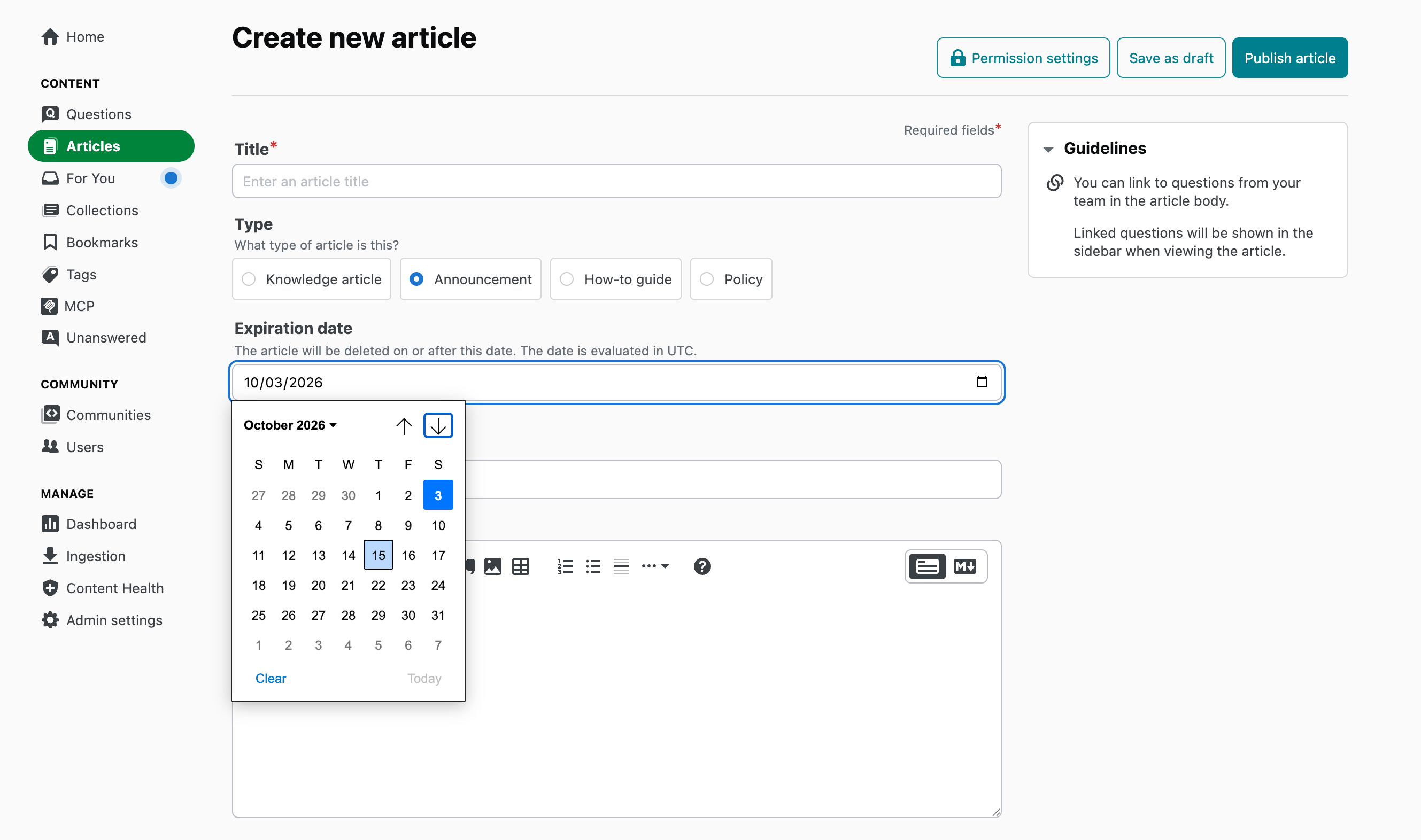
Article Expiration: When publishing Announcement articles, you can now set a scheduled expiration date. Expired articles are automatically soft-deleted, preventing outdated policies or transient notices from clogging search results or agent retrieval contexts.
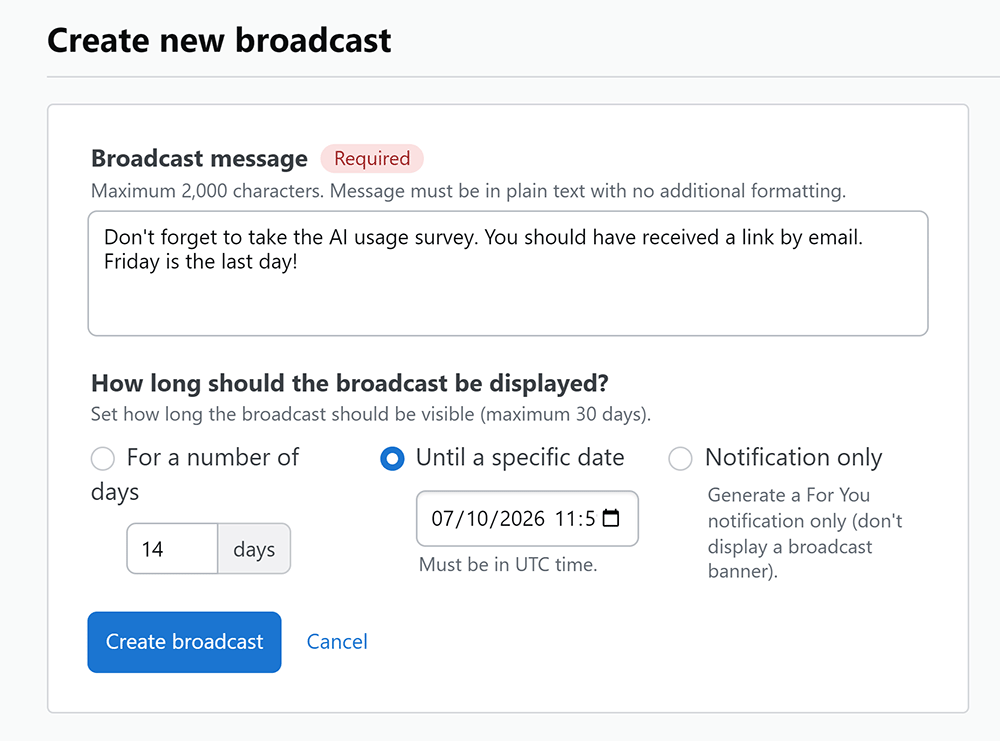
Community Broadcasts (Now GA): Previously in limited release, admins and moderators can now publish top-of-page broadcast notices and "For You" notifications across communities to highlight critical updates.
10x Custom Awards: Reward knowledge sharing at scale with custom award limits expanded from 10 to 100.
We’re making it easier to embed Stack Internal context programmatically into your existing developer ecosystems:
Tag Preferences & Synonym APIs: Programmatically manage user watched/ignored tags and unify taxonomy via new endpoints (/tags/{tagId}/synonyms).
Richer User Context: The /users/{id} endpoint now returns vote counts, question/answer stats, badge summaries, and ExternalID for cleaner identity syncing across enterprise HR directory tools.
Backstage Integration Update: Our official Backstage plugin (v1.7.0+) now supports Backstage’s New Frontend System alongside the legacy architecture, ensuring zero disruption during portal upgrades.
We believe decision-grade knowledge should be seamlessly accessible to everyone. The 2026.6 release includes the following accessibility updates across user, moderator, and admin workflows:
Enhanced Screen Reader Support: Improved dropdown state announcements, item counts, and feedback for actions like bookmarking or watching tags.
Keyboard & Reflow Navigation: Refined focus management across dialogs, date pickers, and graphs, alongside optimized layouts for high zoom levels and narrow displays.
Contrast & Semantic Markup: Improved color contrast for text, status indicators, and badges that no longer rely on color alone to convey meaning.
Plus over a dozen bug fixes addressing tag edit validations, suggested edit review queues, and Slack integration rendering.