


For more than a decade now Google Analytics has been the go-to web analytics services for the Internet. But the winds are changing. Regulators across the world are getting serious about user privacy and restricting the use of cookies and other trackers.
Publishers that rely on traditional, cookie-based solutions are starting to see gaps in their data and increasingly turn to cookieless solutions as an addition or a supplement to their web analytics provider.
TL;DR
- Publishers using Google Analytics need a cookiebanner
- More and more people decline cookies
- This leaves a traffic data gap
- Cookieless analytics solutions like Simple Analytics run "in front of" the cookiebanner
- Simple Analytics fixes your data traffic gap
- Combining Google Analytics with Simple Analytics give you a 360 degrees view
- Two analytics solutions sounds daunting? It isn't since Simple Analytics is intuitive and easy to implement.
Here is a detailed breakdown why reliance on cookies can be a liability and how a cookieless solution can fix that. Let’s dive in!
- Cookies: the good, the bad and the ugly
- Addressing the data gap
- Adapting to a cookieless future
- Going cookieless with Simple Analytics
- More privacy, less cookie banners
- An intuitive UI
- Easy integration
- You own your data
- Teamwork made easy
- We value your trust
- Compliance made easy
- Try it out!
The UK Government chose Simple AnalyticsJoin them
Cookies: the good, the bad and the ugly
The pros of cookies are well known to marketers and publishers by now. Cookies allow for accurate measurement of key web analytics metrics such as page views and unique visitors- at least in theory. On the other hand, cookies raise severe privacy concerns by harvesting user data. Things only get worse when personal information is used for retargeting.
Compliance requirements are problematic as well. Many countries around the world require cookie consent. Internet users are increasingly concerned with data privacy and often reject cookies or use ad blockers. This results in high rates of cookie rejection.
When half your user base rejects or blocks cookies, some trends in the data will be very difficult or outright impossible to spot. Cookie opt-out creates a massive data gap for traditional web analytics.
Addressing the data gap
- The simplest way to close the data gap is ignoring the law. You just write cookies in the browser no matter what the users and the law say (please don't actually do this).
This is a terrible idea for many reasons. This strategy is not only unethical but also a surefire way for organizations to get in trouble with privacy watchdogs. The EU even has an official cookie scanning tool, and its logs are easily used as proof in legal procedures.
- A second way to address the data gap is putting up a cookie wall: a publisher tells website visitors that they can only access an article after consenting to cookies. In other words, visitors can either pay with their money, pay with their data, or scram.
This strategy is not without drawbacks. Cookie walls are something of a legal gray area under the EU GDPR. Legal issues aside, a take-it-or-leave-it proposition can leave a sore taste in the user’s mouth and undermine trust in a publisher.
None of these options is really attractive. But there is a different path: publishers can adapt to the new regulatory requirements and ditch cookies- or at least, lessen their reliance on cookie-based analytics.
Adapting to a cookieless future
An increasing number of businesses rely on cookieless solutions. These tools come with pros and cons: avoiding cookies and other identifiers is a privacy-friendly approach but sacrifices some accuracy- at least on paper.
But in practice, the data gap for cookie banners is huge and getting bigger by the day. When rejection rates for cookies are high, having less fine-grained data for the entire user base enables better measurements than collecting detailed data for a portion of the user base only.
The choice between traditional and cookieless analytics is not black-and-white, either. Some businesses successfully use cookieless tools as a complement to cookie-based services such as Google Analytics and Adobe Analytics. This combination gives them the best of both worlds- they have fine-grained data from cookies along with 360 degrees vision on their user base.
Identifying trends is easier when the data at your disposal is both fine-grained and comprehensive. But because of cookie banners, you cannot have fine-grained data for the entire user base. The best you can do is collect fine grained data from users who accept cookies and more high-level data from the rest. This allows marketers to spot possible trends across two complementary data sets and opens the door to very powerful insight.
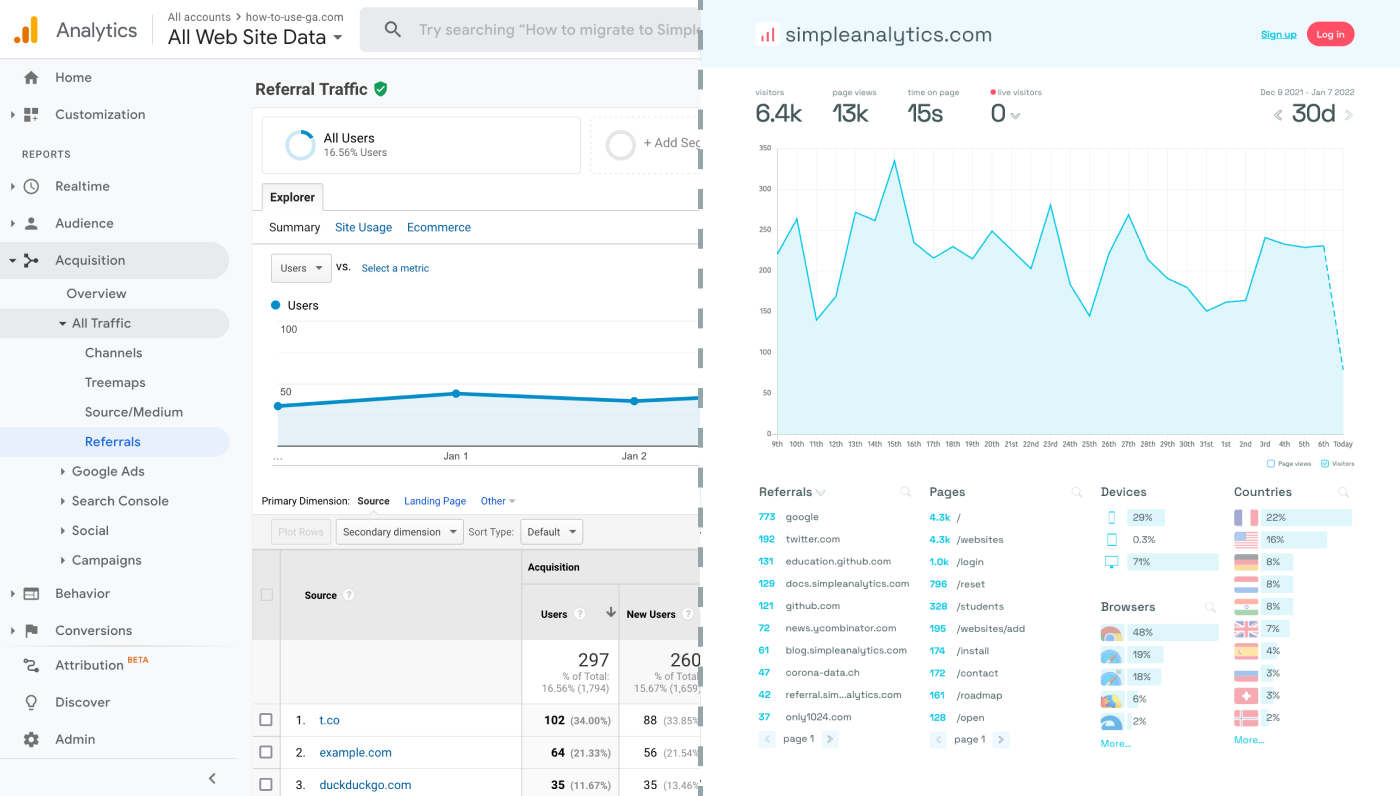
Going cookieless with Simple Analytics
Relying on two web analytics tools at the same time sounds daunting. But things don't have to be difficul. Simple Analytics is built with this scenario in mind. Simple Analytics isn’t just cookieless and privacy-friendly: it is a powerful, intuitive product that new users can learn quickly and integrate seamlessly with other tools.
We at Simple Analytics ditched cookies entirely. Our customers can use our service without having to display a cookie banner, or combine Simple Analytics with a traditional web analytics tool to mitigate the data loss from cookie opt-outs.
But we do more than just ditch cookies: we don’t collect any personal data at all-period. We do not track users based on IP, generate device fingerprints, or invade on the user’s privacy in any way.
Simple Analytics doesn’t exploit shady workarounds to track users. We offer true privacy instead. It’s as simple as that.
An intuitive UI
We designed our software to be as intuitive as possible for new users. All of the metrics you need fit in a clear, user-friendly dashboard that isn’t cluttered with useless options. We make web analytics simple- it’s in our name after all.
Easy integration
We made sure that Simple Analytics can be integrated with other software with no friction. You can import your Google Analytics data and use our plug-in library for integration with common services like Google Tag Manager, Google Looker Studio, WordPress, CloudFlare, and more. If we don’t have the right plug-in, the Simple Analytics API allows you to simply export raw and aggregated data.
You own your data
You own and control your Simple Analytics data. We do not use your data for any purpose, do not sell it to anyone, and do not store it if you leave Simple Analytics. You can export it at any time, and it is yours to keep if you stop using the service. We have absolutely no claim over it- full stop.
Teamwork made easy
Simple Analytics makes it easy to share the data with your team. You can forward reports to your team or grant them direct access to the data with team roles like Admin, Finance, or Developer. All these features can be managed seamlessly through your account with only a few clicks.
We value your trust
We honor our customers’ trust. We work non-stop to address any problems they might have and offer Enterprise-level customers full video support for any issue they might experience with Simple Analytics.
We also offer a Service level agreement where we commit to reliably providing a high quality service and ensuring the integrity and availability of customer data.
Compliance made easy
Not collecting personal data is a radical data minimization strategy that *eases the compliance burden on our customers. If you stop collecting personal data, you no longer need to worry about the GDPR, the CCPA, and other privacy legislations.
Additionally, Simple Analytics comes with extensive legal documentation and legal & compliance support for Enterprise customers.
Try it out!
If you are looking to ditch cookies or supplement a cookie-based solution, feel free to give Simple Analytics a try.
Additionally, if you want me to personally walk you through, schedule a meeting using my calendar link. I'm happy to help!