






In this article, I'm going to explain why we are going all in on the reverse trial and what other growth channels we use and have tried.
There are many growth strategies we are considering: partnerships, customer-led growth, freemium, SEO, product-led growth, paid marketing (ads or affiliate), premium support, and free tools, among others. Before diving into freemium, I'm exploring all the other growth avenues first.

At Simple Analytics, our goal is to reach $1M ARR by the end of 2027. If you want to stay up to date on our road to $1M ARR, subscribe to my co-founder’s newsletter on Substack.
- Growth Channels
- Partnerships
- Customer-led Growth
- Product-led Growth
- Paid Marketing
- Premium Support
- Free Tools
- Open-source
- Free trial
- Free = Evil
- Free plan
- Reverse free trial
- When is it a success?
- What if it fails?
The UK Government chose Simple AnalyticsJoin them
Growth Channels
Partnerships
I’m usually skeptical about partnerships because they often feel imbalanced in terms of value exchange. However, we do explore smaller, strategic partnerships. For example, being one of the first apps in a marketplace like Cloudflare Apps helps us gain visibility while they benefit from populating their marketplace with quality apps.
Partnerships become much more exciting when you can bring something significant to the table. Offering all their customers free analytics, for instance, could be a game-changer. Stay tuned.
Customer-led Growth
At Simple Analytics, customer-led growth involves showcasing how customers use our business through case studies, allowing them to vote on features (check out our community), and incentivising testimonials. We’ve found a great way to gather testimonials: whenever we notice a customer being happy with our support, we send them a thank-you email and ask for a review. They almost always respond positively.
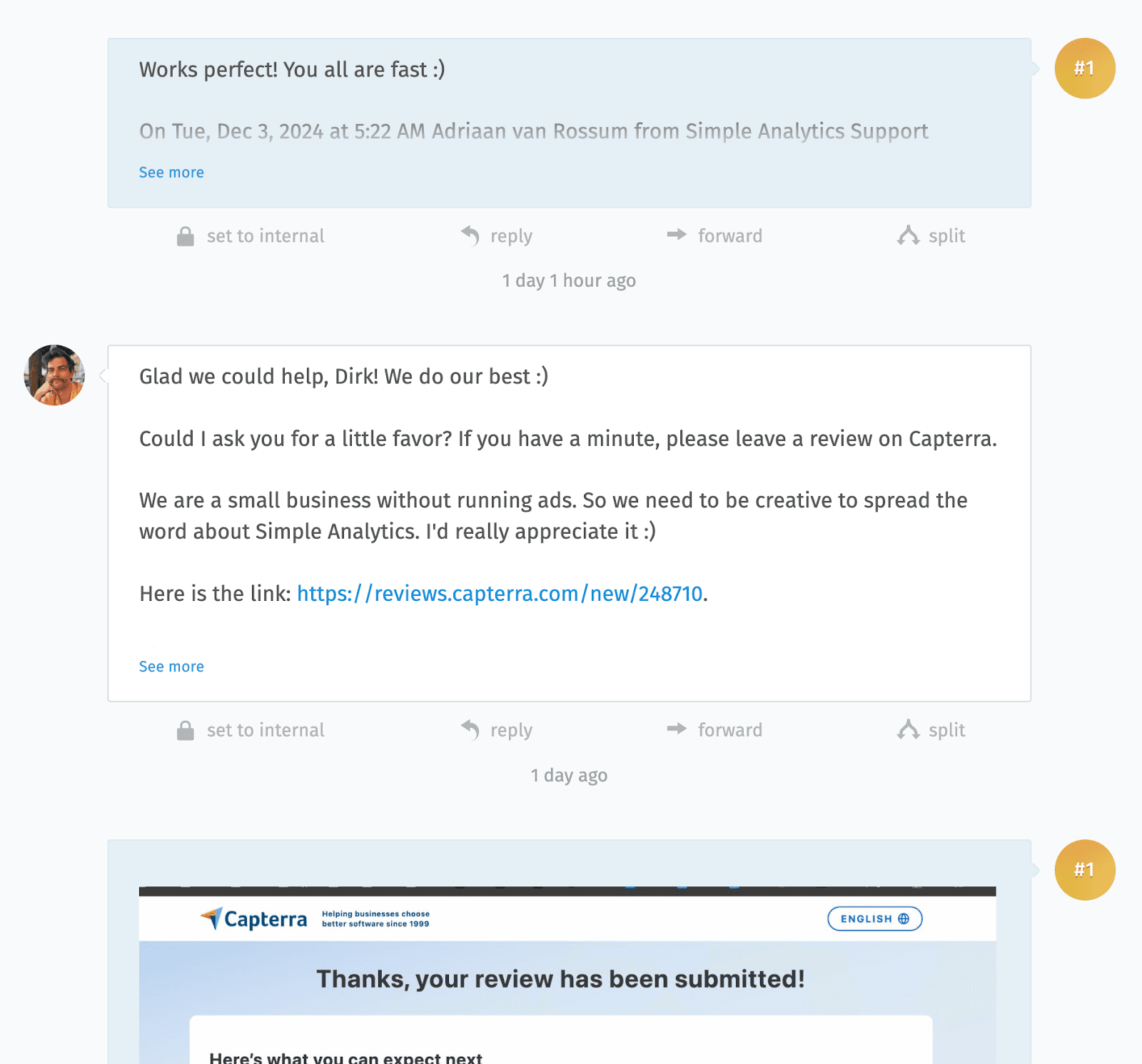 Ask for a review after helping customers
Product-led Growth
Product-led growth focuses on demonstrating the value of our product quickly, either through a freemium model or a “try-before-you-buy” approach. We initially adopted this model, allowing users to try everything during a trial period (after entering their credit card). This strategy shortens the sales cycle, improves user experience, lowers acquisition costs, and generates higher revenue per employee. A great example of this is Ahrefs, which has achieved $100M ARR with only 40 employees.
Paid Marketing
At Simple Analytics, we avoid paid marketing, including ads, as we believe relying on networks like Google’s ad platform would contradict our privacy-first message. It just doesn’t align with our values. While we occasionally experiment with affiliate marketing, it hasn’t proven to be a major growth driver for us.
Instead, we focus on empowering our users by offering them 50% of the first-year revenue for every new customer they refer. This approach feels more authentic, aligns with our mission, and lets us grow through the trust and advocacy of our community.
Premium Support
We could choose to go all-in on premium support, offering highly personalized assistance, faster response times, and even dedicated account management. While this might appeal to larger customers or those who value hands-on guidance, it would come at a significant cost, primarily my time.
Right now, I allocate about 30 minutes daily to support, which feels like the perfect balance. It allows me to stay in touch with customer needs and maintain a personal connection without letting support consume my entire day. Scaling up to premium support would require either hiring a dedicated support team or sacrificing time I’d rather spend on product development, strategy, and growth. For now, I believe keeping support simple and efficient aligns better with how we want to grow.
Free Tools
Creating free tools is another effective growth strategy that can significantly enhance visibility and user engagement. A notable example of this approach is VEED.io, which I learned last year stands for “video.” This platform has successfully attracted a wide user base by offering valuable tools for free, thereby encouraging users to explore its premium features later on.
Offering free tools gets people using your product immediately. When they want to dive deeper, they encounter a paywall. By that point, they’ve already invested time in your product, and switching to another option feels like a hassle. Most users prefer to keep going with what they’re already doing, so they click the pay button, avoiding the pain of starting over elsewhere.
Free tools are also particularly beneficial for indie hackers who often prefer coding over marketing. Make your marketing week count!
Open-source
If your target audience is developers, open-sourcing your software can be an excellent way to attract new customers. Developers can host the software themselves, eliminating hosting costs for you. However, this approach requires ensuring your product can be installed on a wide variety of systems, handling all edge cases. It also involves managing the open-source community, where contributors often have a say in product development.
For me, the challenges of managing that community and giving up the speed of decision-making are significant barriers to making Simple Analytics open source. I’m open to the idea, but the workload doesn’t excite me. Right now, I’d rather focus on building the next feature that many customers will enjoy.
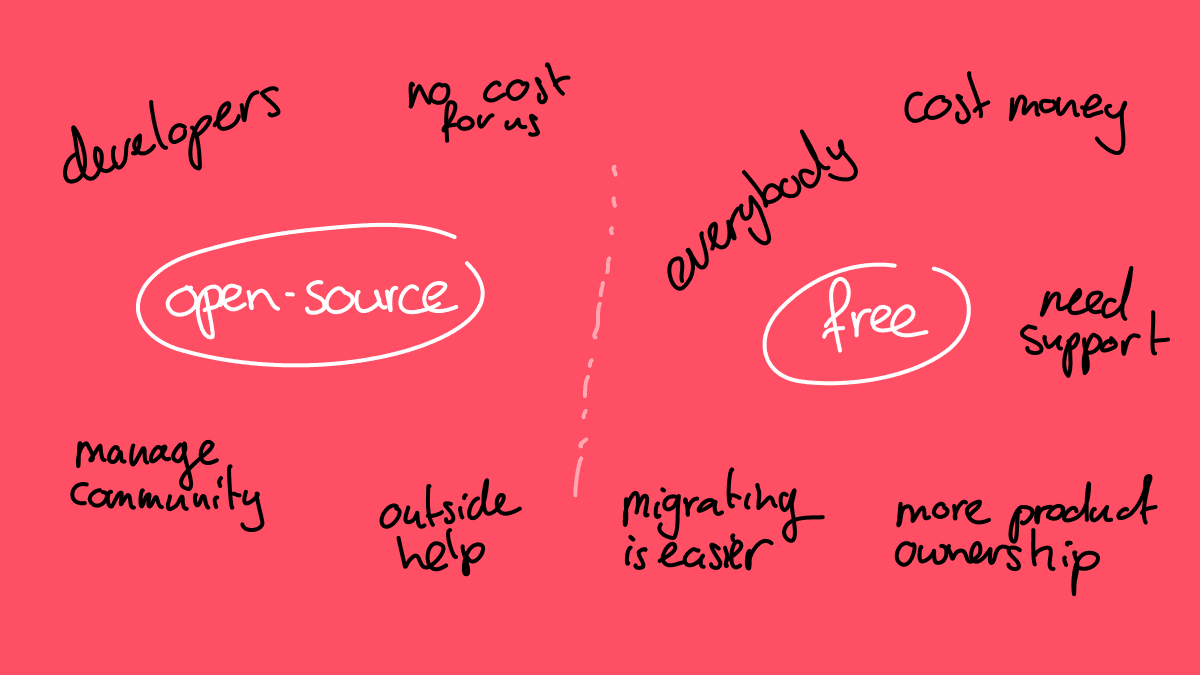 Open-source vs. Free
Free trial
Since the beginning of Simple Analytics we have had a free trial. Or to be complete: we started with a credit card trial (where users need to enter their credit card before the trial starts).
After removing this requirement, we saw a 0% net difference. Although user sign-ups increased, conversions decreased, resulting in the same number of new paying customers. Thus, the credit card requirement had no impact for us.
Free = Evil
Our ultimate goal is to build a growth flywheel that brings in a steady stream of potential customers. Offering a free product can help achieve this, but as many indie hackers warn, “free = evil.” Converting free users into paying customers is one of the hardest challenges. You need a massive user base, yet conversion rates are usually very low. Plus, maintaining the product for so many non-paying users can drain resources. That’s why bootstrapped businesses often avoid this growth strategy.
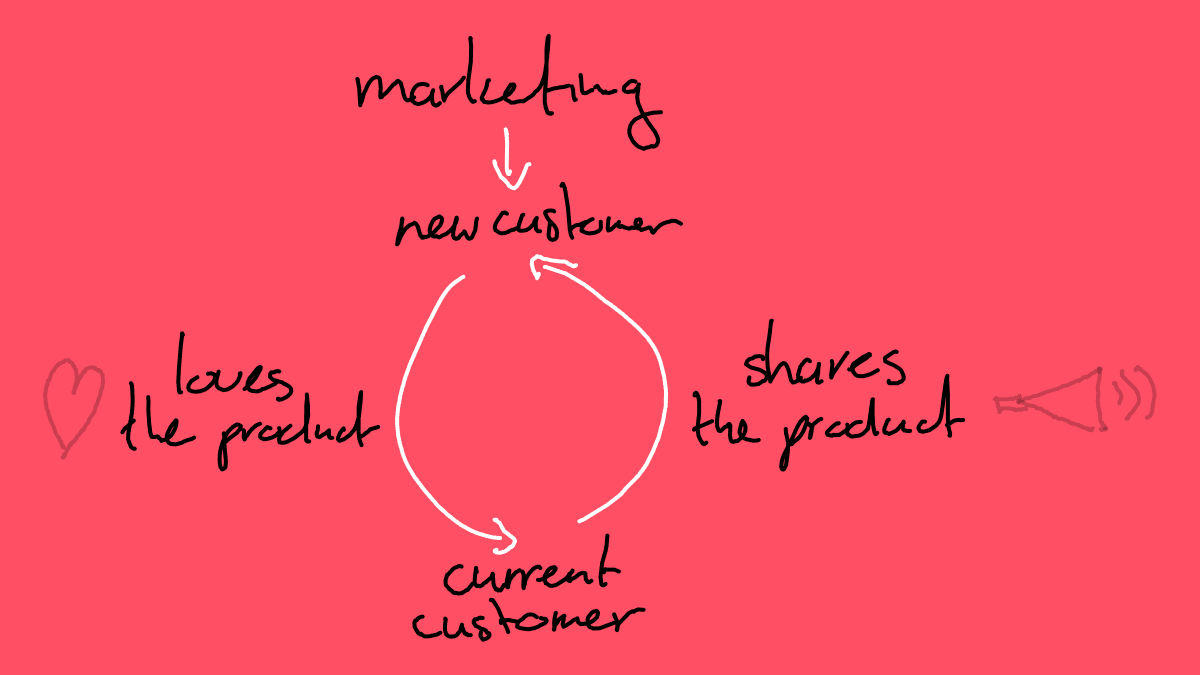 Marketing flywheel
VC-funded companies, on the other hand, love free plans, they use them to show growth metrics to investors. But when they eventually introduce paid plans, they often fail because their existing users aren’t their target audience anymore. The strategies that attracted those users bring in free users, not paying ones. That’s usually when these businesses collapse.
Simple Analytics is a bootstrapped business, meaning we’ve taken no outside investment, just our own time and effort. That’s why I launched with paid plans only. I couldn’t afford the risks that VC-backed companies take. I needed to turn a profit quickly or shut down entirely.
However, we want to grow to a new level, and we need to take drastic measures to get there. We can grow at the same rate, 4-5% MoM (month-over-month), and definitely get to $1M ARR. But if we want to get there sooner, we need to play a different game.
Free plan
That’s when we decided to introduce a free plan. My co-founder, Iron Brands (yes, that’s his real name), is usually the one bringing fresh growth ideas to the table. I’m often hesitant at first, questioning if they align with our long-term vision or are worth the effort. But Iron does his homework, tons of research, and presents his case in a video. I watch it at 2x speed, and with solid arguments, he always convinces me it’s worth testing.
We soft-launched the free plan about six months ago. It was nerve-wracking. What if current customers downgraded to the free plan? What if new users chose free over any paid plan? What if we didn’t attract enough new users, lost money, or saw our MRR drop? The fear was real. Maybe that’s why we soft-launched it, to minimize the risk while we figured things out.
And we did lose some ground. While MRR didn’t decline outright, growth slowed significantly. Over the past 12 months, our average MRR growth dropped to just 2% MoM, with the last month hitting -3%. The declining euro value didn’t help either, but it became clear that this wasn’t the right path forward.
Reverse free trial
While the free plan didn’t work for us directly, we didn’t want to throw it away this fast. We are in it for the long term. We can play around until we find our growth flywheel. Better to be six months without growth and growing 10% MoM after that than always staying at 4-5%.
After realizing the free plan wasn’t driving the growth we needed, we decided to experiment. Instead of offering unlimited free access, we introduced a reverse free trial.
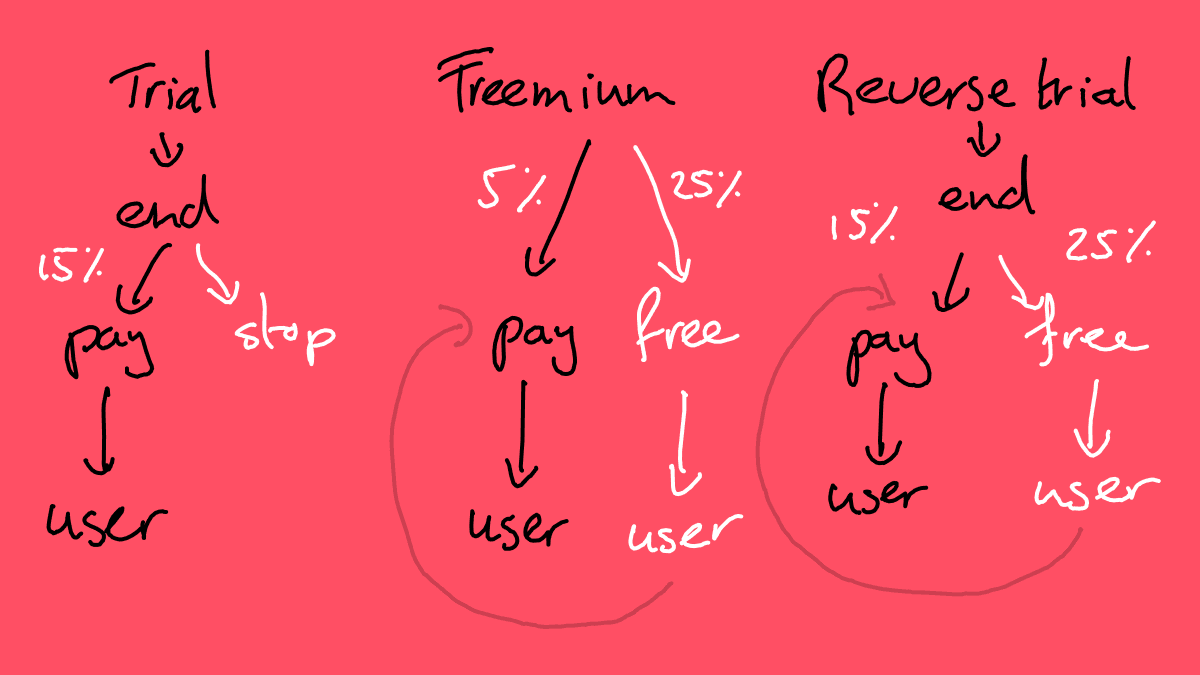 Conversions between Free, Trial, and Reverse Trial
With a regular trial, you convert some percentage of users before the trial ends. Those who don’t decide to buy your product will likely stop using it entirely and never come back. This model works well to drive conversions directly from marketing channels but misses out on users who need more time to see value: maybe weeks, months, or even years. These users often won’t convert with a regular trial. Plus, the total number of users exposed to your product stays low because the paid offering scares many people away upfront.
At Simple Analytics, we moved to a freemium model. Not to convert every free user into a paying customer, but to create a flywheel of ambassadors. These ambassadors might have a blog or side project alongside their job. Getting them to use Simple Analytics increases the chance they’ll mention us in meetings about analytics at their company. That’s the main reason we moved to freemium. We know this is a long-term game. We need a lot of free users to get enough recommendations into businesses. We know it works; we just need volume.
But we can’t wait indefinitely for volume. We still need to grow profits at our regular rate of 4-5% MoM. According to Elena Verna, former Head of Growth at Amplitude, conversion rates differ significantly between trials and freemium. With a trial, about 15% convert to paid, whereas freemium sees 5% convert to paid and 25% stay on the free plan. Freemium does get more eyeballs. Around 30% convert to being users, double what a regular trial achieves. However, freemium can cost you about 10% of paying users, which is a hit we can’t afford.
 Conversion output
That’s where the reverse trial came in. With a reverse trial, we might hit a 15% conversion to paid and 25% to free, totaling 40%! This means we get far more eyeballs while maintaining strong conversions.
The reverse free trial gives new users access to all features and encourages them to explore and use them. In Simple Analytics, for example, we enable users to add goals to their dashboard. To make this easier, we pre-load three placeholder goals that can be added with a single click, allowing users to see the feature’s value immediately.
When the trial ends, we prompt them with a notice that these goals will be deleted unless they upgrade to a paid plan. By then, they’ve likely grown accustomed to the feature and see its value, making them more inclined to convert to a paid plan, or at least, that’s the idea behind our approach.
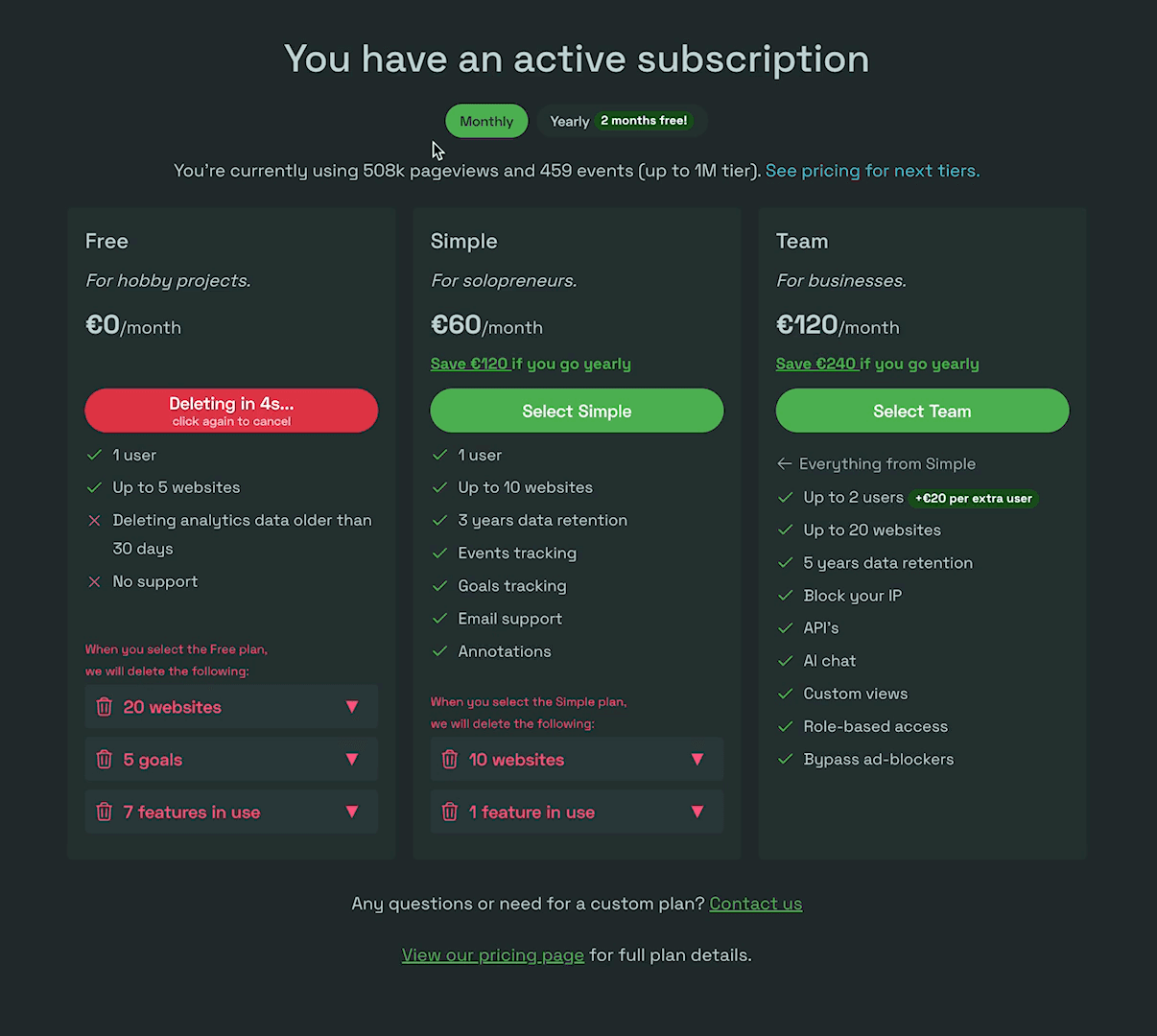 Deleting data in seconds when choosing Free
We also made it crystal clear to our users that moving to the Free plan comes with serious limitations. For example, if they’ve exceeded their data limits, they’re met with a clear (and slightly cheeky) modal explaining what they’ll lose if they downgrade. Transparency is key here, not just to nudge users toward upgrading but also to ensure they fully understand the trade-offs of choosing the Free plan.
When is it a success?
For the reverse free trial to be considered a success, the most obvious indicator is MRR growth. If we see a consistent increase of more than 5% month-over-month, we know it’s working. Beyond that, success looks like a stronger trial-to-paid conversion rate. It’s not just about more people signing up but about more of them sticking around and paying for the value they’ve already experienced. Lastly, retention is a big piece of the puzzle. If users who upgrade after the trial end up staying longer, that’s a clear win.
What if it fails?
If the reverse free trial doesn’t deliver the results we’re looking for, we’ll start tweaking things again. This could mean adjusting the trial length, introducing more in-app nudges or popups, or finding better ways to highlight the paid plan’s value during the trial period.
If those tweaks don’t work, we always have the option to return to a paid-only model. It’s not the most exciting move, but it’s a safe fallback that worked for us in the past. Another bold option is exploring the idea of going open source. It’s a big step, but it could bring in a new wave of users and contributors while aligning with our mission.
Of course, the last resort is trying something entirely new. This could mean focusing on partnerships, integrations, or even creating a different pricing structure to drive growth.
At the end of the day, we’re here to play the long game. Experimenting, learning, and adapting is all part of the process to figure out what drives sustainable growth for Simple Analytics.
The end.