


惯性聚合 高效追踪和阅读你感兴趣的博客、新闻、科技资讯
阅读原文 在惯性聚合中打开

推荐订阅源

PCI Perspectives
PCI Perspectives
AI
AI
L
LINUX DO - 最新话题
Exploit-DB.com RSS Feed
W
WeLiveSecurity
T
Troy Hunt's Blog
K
KPMG report finds enterprise disconnect between AI and its ROI | CIO
Forbes - Security
Forbes - Security
Google DeepMind News
Hacker News - Newest:
Hacker News - Newest: "LLM"
O
OpenAI News
D
DataBreaches.Net
S
Secure Thoughts
SecWiki News
SecWiki News
L
LangChain Blog
Google DeepMind News
博客园 - 【当耐特】
Recent Announcements
Martin Fowler
Martin Fowler
cs.AI updates on arXiv.org
Application and Cybersecurity Blog
Engineering at Meta
Engineering at Meta
H
Heimdal Security Blog
有赞技术团队
有赞技术团队
The Last Watchdog
The Last Watchdog
Recent Commits to openclaw:main
宝玉的分享
宝玉的分享
N
News | PayPal Newsroom
博客园 - 聂微东
TaoSecurity Blog
TaoSecurity Blog
Cloudbric
Cloudbric
Blog — PlanetScale
Blog — PlanetScale
cs.CV updates on arXiv.org
量子位
T
Threatpost
Security Latest
Security Latest
P
Privacy & Cybersecurity Law Blog
GbyAI
GbyAI
博客园 - 叶小钗
L
Lohrmann on Cybersecurity
S
Security @ Cisco Blogs
Y
Y Combinator Blog
Cyber Security Advisories - MS-ISAC
T
Tailwind CSS Blog
C
Cyber Attacks, Cyber Crime and Cyber Security
酷 壳 – CoolShell
酷 壳 – CoolShell
H
Hackread – Cybersecurity News, Data Breaches, AI and More
Apple Machine Learning Research
N
Netflix TechBlog - Medium
L
LINUX DO - 热门话题

The Eclectic Light Company

Apple has released an update to XProtect for all macOS Hero or hooligan: Theseus’ later years BSD flags are incompatible with iCloud Drive Apple has released macOS Tahoe 26.5.1 In memoriam Mary Cassatt: 1, 1868-1880 Solutions to Saturday Mac riddles 362 What Location Services do in macOS Eclectic paintings of Joseph Stella: 2 European myths Last Week on My Mac: Razzle and dazzle Eclectic paintings of Joseph Stella: 1 American landscapes Saturday Mac riddles 362 Protect files with the Locked or Immutable flag Reading Visual Art: 252 Dragonfly What happens in the log when an app crashes as it starts up? Portraits of trees: Introduction On Reflection: Conclusions and contents Which tasks require mains power? Medium and message: Vast canvases Online reference to external displays for Apple silicon Macs What’s in that phishing email? Hero or hooligan: Theseus and Ariadne Solutions to Saturday Mac riddles 361 How to search document versions Rubens’ Consequences of War Rubens’ Peace and War Saturday Mac riddles 361 How to search Time Machine backups? Naturalists: Contents and artists On Reflection: Extending the image Tackle QuickLook problems Medium and message: Pottery Hero or hooligan: Theseus and the sandals How QuickLook provides thumbnails and previews Last Week on My Mac: Syncing metadata in iCloud Drive Paintings of visits to India 1778-1877 Saturday Mac riddles 360 Naturalists: Sorolla and Zorn On Reflection: Pierre Bonnard 1909-1946 SpotTest 1.2 can display Spotlight metadata directly On Reflection: Pierre Bonnard 1899-1908 How to preserve versions, and how to create versioned PDFs Medium and message: Sculpture What gets synced in iCloud Drive? Hero or hooligan: Perseus 2 Solutions to Saturday Mac riddles 359 Last Week on My Mac: snapshots, the elephant in APFS Paintings of Beatrice Portinari: to 1862 Saturday Mac riddles 359 Naturalists: Into the 20th century How to check whether Spotlight is getting the right metadata On Reflection: Mirror play Hero or hooligan: Perseus 1 The bicentenary of Frederic Edwin Church: 1857-77 Solutions to Saturday Mac riddles 358 macOS virtual machines and audio-video syncing A walk in the parks of Rome, Vienna, Manhattan and Brooklyn Saturday Mac riddles 358 Naturalists: Photography Use Finder tags for categories Control what gets written to the log Medium and message: Tapestry Virtualisation on Apple silicon Macs is different Jerusalem Delivered: Overview and contents The bicentenary of Frederic Edwin Church: 1849-57 Solutions to Saturday Mac riddles 357 Painting Pandora and her box: 1883-1919 Painting Pandora and her box: 1550-1882 Saturday Mac riddles 357 The secret life of the xattr The macOS Natural Language framework and Nalaprop Medium and Message: Stained glass The MACL extended attribute Jerusalem Delivered: 13 Leading characters Solutions to Saturday Mac riddles 356 Privacy: How locations are protected Painting Spring blossom 2 Last Week on My Mac: Don’t be a victim of fraud Painting Spring blossom 1 Saturday Mac riddles 356 Explainer: Recovery Reading Visual Art: 249 Mask Naturalists: Urban poverty On Reflection: Cézanne Privacy: Which folders are protected in Tahoe? Medium and Message: Mosaic Jerusalem Delivered: 12 Delivery Solutions to Saturday Mac riddles 355 Centaurs 2: Revenge Centaurs 1: Fights Saturday Mac riddles 355 Explainer: sandboxes Naturalists: The modern meal Why you can’t trust Privacy & Security Apple has just released an update to macOS Tahoe, to version 26.4.1 On Reflection: Divisionism Please help update CPU frequencies for Apple silicon Macs Commemorating the centenary of the death of John Ferguson Weir Privacy: Files & Folders or Full Disk Access? Jerusalem Delivered: 11 Into Jerusalem Privacy: protected folders
Reading Visual Art: 250 Winged sandals
hoakley · 2026-04-24 · via The Eclectic Light Company

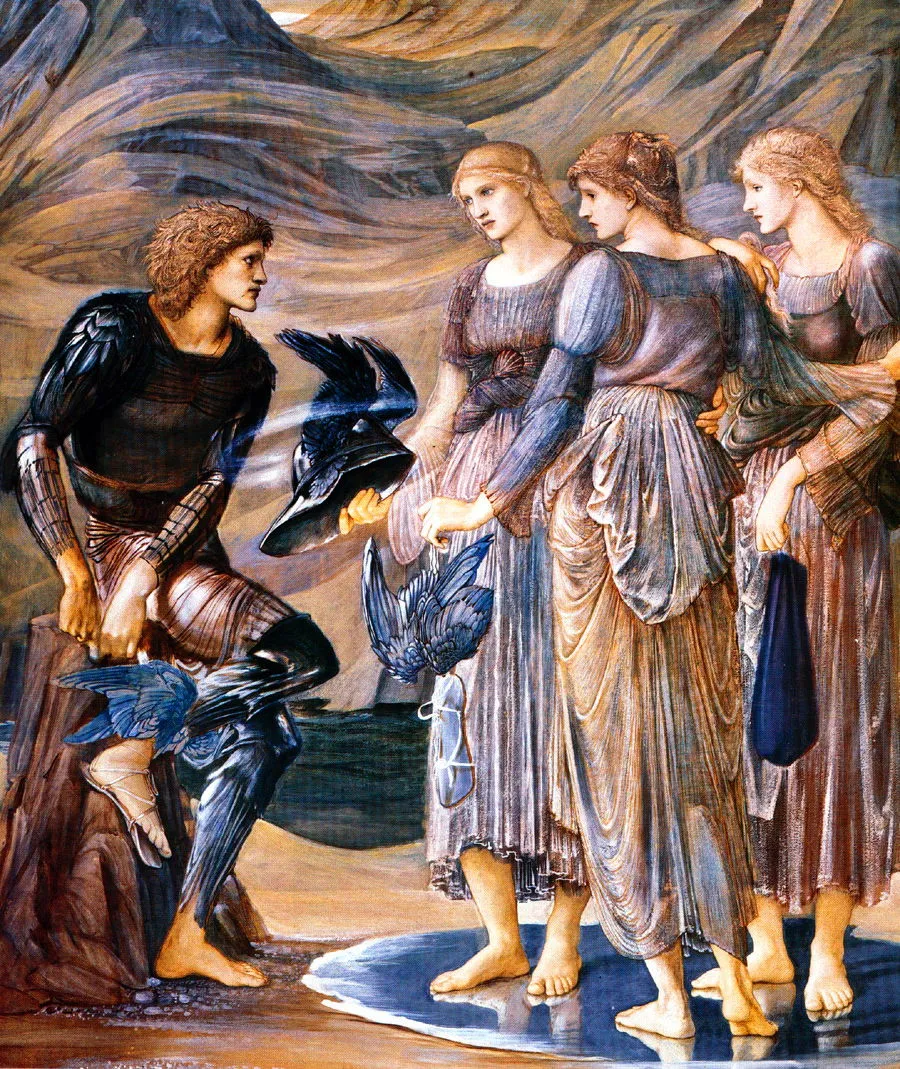
Edward Burne-Jones (1833–1898), The Perseus Series: Perseus and the Sea Nymphs (1877), bodycolour, 152.8 × 126.4 cm, Southampton City Art Gallery, Southampton, England. Wikimedia Commons.

When reading a painting of classical myth, the feet and footwear can be very important. Although they’re by no means common, if you see a figure wearing what could be winged sandals, you can narrow them down to one of two: Hermes or Mercury as messenger of the gods, and the hero Theseus. However, their depictions aren’t always consistent, and the absence of winged sandals doesn’t mean you can exclude them, unfortunately.

I start with the god, whose talaria were fashioned from gold by Hephaestus/Vulcan to enable him to fly as fast as any bird.

Sandro Botticelli (Alessandro di Mariano di Vanni Filipepi), Primavera (Spring) (c 1482), tempera on panel, 202 x 314 cm, Galleria degli Uffizi, Florence. Wikimedia Commons.

One of the most famous depictions of Hermes, typically in a supporting role, is in Botticelli’s magnificent Primavera from around 1482.
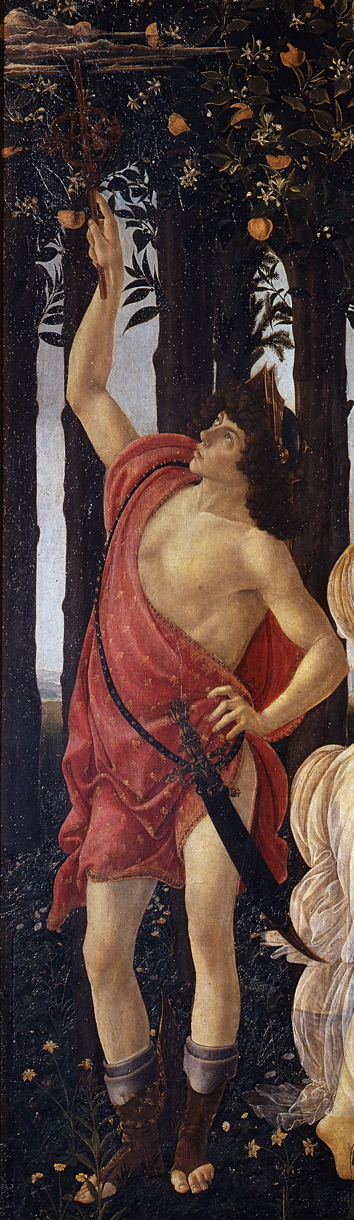
Sandro Botticelli (Alessandro di Mariano di Vanni Filipepi), Primavera (Spring) (detail) (c 1482), tempera on panel, 202 x 314 cm, Galleria degli Uffizi, Florence. Wikimedia Commons.

Hermes’ mother Maia gave her name to the month of May, so is associated with Spring. Botticelli has chosen to give the serpents on his caduceus wings to make them resemble small dragons. The god is also more typically seen with his caduceus in his left hand, rather than his right as shown here, and his winged sandals clearly aren’t made of gold.

mantegnaparnassus
Andrea Mantegna (1431–1506), Parnassus (Mars and Venus) (1496-97), oil on canvas, 159 x 192 cm, Musée du Louvre, Paris. Wikimedia Commons.

Hermes is a frequent figure in paintings of gatherings of deities, including Andrea Mantegna’s Mars and Venus, known better as Parnassus (1496-97), painted for Isabella d’Este. At the right of this complex gathering is Hermes with his winged sandals and caduceus, and Pegasus the winged horse. Apollo is at the far left, making music for the Muses on his lyre.
bayeuolympus
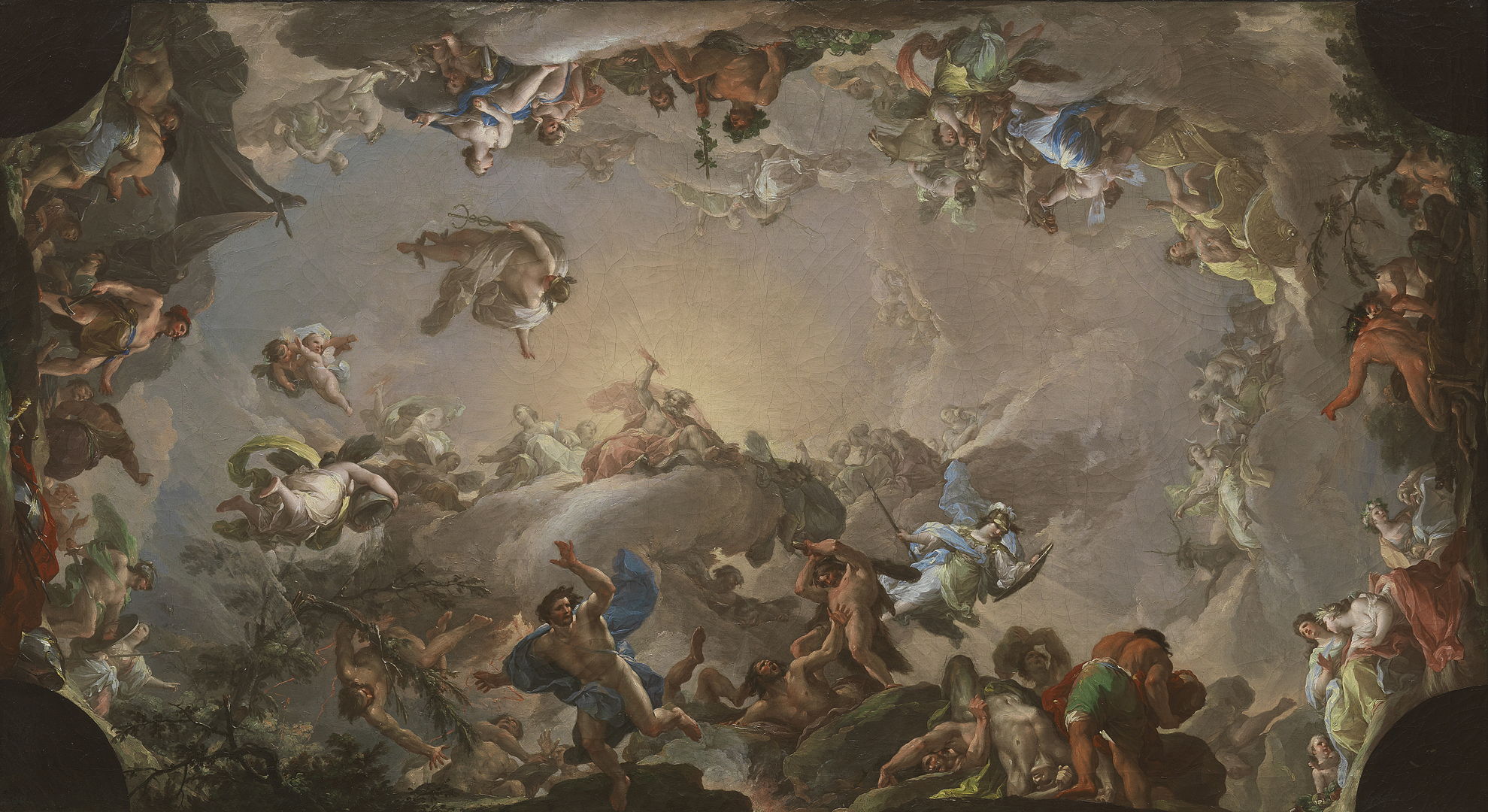
Francisco Bayeu y Subías (1734–1795), Olympus: The Fall of the Giants (1764), oil on canvas, 68 x 123 cm, Museo Nacional del Prado, Madrid, Spain. Wikimedia Commons.

Francisco Bayeu y Subías was Goya’s brother-in-law. His Olympus: The Fall of the Giants from 1764 shows the war between the Titans and Olympian gods, and was presumably hung under a ceiling. Just to the upper left of its centre, holding his caduceus and wearing winged sandals, is Hermes.

renoirjudgementparis
Pierre-Auguste Renoir (1841–1919), The Judgment of Paris (c 1908-10), oil on canvas, 73 x 92.5 cm, Hiroshima Museum of Art, Hiroshima, Japan. Wikimedia Commons.

Auguste Renoir’s account of The Judgment of Paris, from about 1908-10, demonstrates his skill as a narrative painter. After Paris has accepted Aphrodite’s bribe of Helen, he is shown awarding her the golden apple provided by the discordant Eris from the garden of the Hesperides. Watching on is Hermes, complete with his winged helmet and sandals, and caduceus.

Hermes seldom lent out his talaria, but there’s one occasion that has become well known. When Perseus was on his mission to obtain the head of Medusa, he was kitted out with Hermes’ sandals, the cap of Hades for invisibility, and a kibisis or sack in which to conceal the Gorgon’s severed head.

perseusandromedapompeii
Unknown, Perseus Freeing Andromeda (c 50-75 CE), height 122 cm, Casa dei Dioscuri (VI, 9, 6), Pompeii, moved to Museo Archeologico Nazionale di Napoli, Naples. By WolfgangRieger, via Wikimedia Commons.

This Pompeian account of Perseus Freeing Andromeda from about 50-75 CE shows Andromeda still chained to the rock by her left wrist, and partially clad rather than naked as the myth related. Perseus has Medusa’s head tucked behind him, her face shown for ease of recognition. He is wearing his winged sandals, and carrying his sword in his left hand, although there’s no sign of Cetus the sea-monster yet.

rubensperseusandromeda
Peter Paul Rubens (1577–1640), Perseus and Andromeda (c 1622), oil on canvas, 99.5 x 139 cm, Hermitage Museum, Saint Petersburg, Russia. Wikimedia Commons.

Peter Paul Rubens’ Perseus and Andromeda from about 1622 contains most of the cues and clues to the original narrative. Andromeda is almost naked, although unchained at this stage, on the left. Perseus is clearly in the process of claiming her hand as his reward, for which he is being crowned with laurels, as the victor. He wears winged sandals, and holds the polished shield that still reflects Medusa’s face and snake hair. Much of the right of the painting is taken up by Pegasus, and at the lower edge is the dead Cetus, its fearsome mouth wide open.

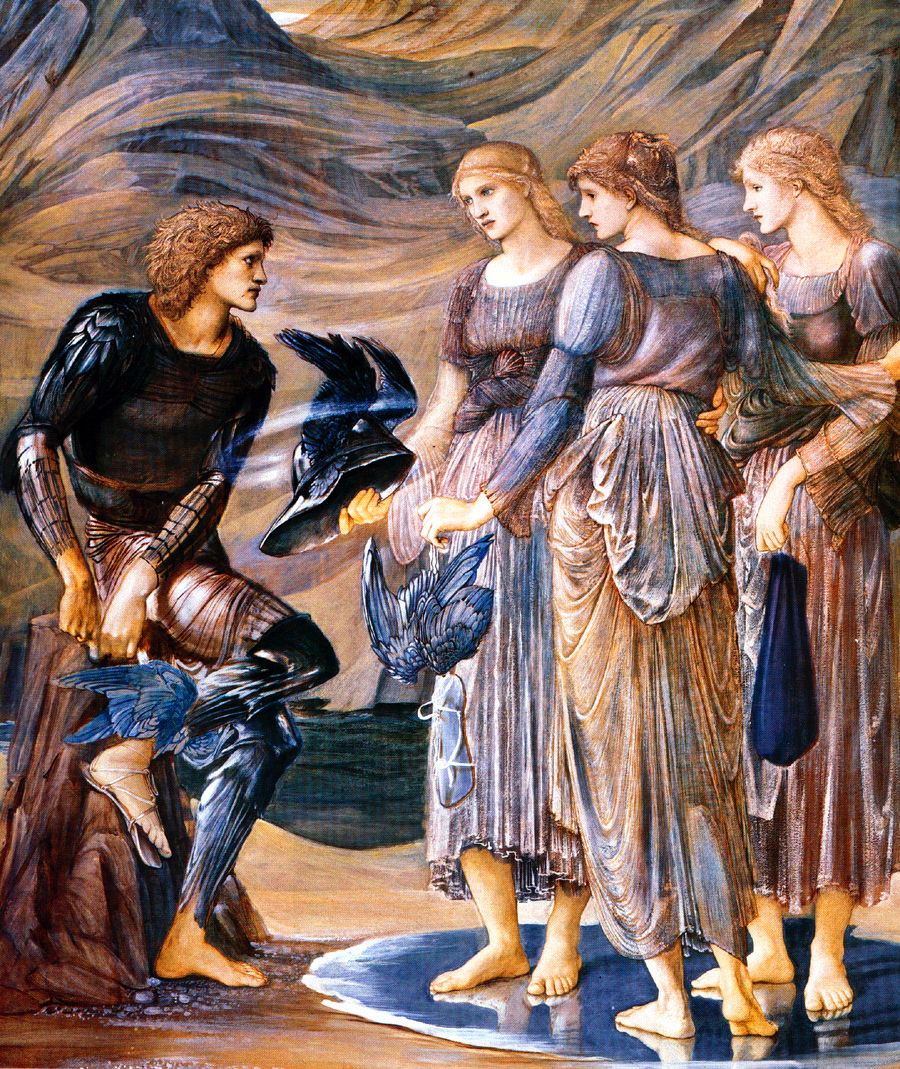
In Edward Burne-Jones’ Perseus Series, the hero’s winged sandals are one of its less consistent features.
burnejonesperseus2
Edward Burne-Jones (1833–1898), The Perseus Series: Perseus and the Sea Nymphs (1877), bodycolour, 152.8 × 126.4 cm, Southampton City Art Gallery, Southampton, England. Wikimedia Commons.

The third painting, Perseus and the Sea Nymphs (1877), shows the Hesperides equipping Perseus with the kibisis at the far right. Burne-Jones combines with that his donning the winged sandals (centre) and Hades’ helmet, as provided by Hermes and Zeus.

burnejonesperseus8b
Edward Burne-Jones (1833–1898), The Perseus Series: The Doom Fulfilled (1888), oil on canvas, 155 × 140.5 cm, Staatsgalerie Stuttgart, Stuttgart. Wikimedia Commons.

Further on in the series, in his finished oil version of The Doom Fulfilled (1888), the sandals are shown clearly as Perseus takes on Cetus.

leightonperseuspegasus
Frederic, Lord Leighton (1830–1896), Perseus On Pegasus Hastening To the Rescue of Andromeda (c 1895-6), oil on canvas, 184 x 189.6 cm, New Walk Museum & Art Gallery, Leicester, England. Wikimedia Commons.

In one of Frederic, Lord Leighton’s last paintings, of Perseus On Pegasus Hastening To the Rescue of Andromeda from about 1895-96, the wings on his sandals are tiny but distinctive.