



惯性聚合 高效追踪和阅读你感兴趣的博客、新闻、科技资讯
阅读原文 在惯性聚合中打开

推荐订阅源

N
News | PayPal Newsroom
IT之家
IT之家
钛媒体:引领未来商业与生活新知
钛媒体:引领未来商业与生活新知
大猫的无限游戏
大猫的无限游戏
GbyAI
GbyAI
Threat Intelligence Blog | Flashpoint
L
LangChain Blog
S
SegmentFault 最新的问题
CTFtime.org: upcoming CTF events
Project Zero
Project Zero
P
Privacy & Cybersecurity Law Blog
V
Vulnerabilities – Threatpost
博客园 - 三生石上(FineUI控件)
Recorded Future
Recorded Future
The Hacker News
The Hacker News
C
CXSECURITY Database RSS Feed - CXSecurity.com
C
CERT Recently Published Vulnerability Notes
宝玉的分享
宝玉的分享
aimingoo的专栏
aimingoo的专栏
T
Tor Project blog
T
The Exploit Database - CXSecurity.com
Schneier on Security
H
Help Net Security
cs.AI updates on arXiv.org
M
MIT News - Artificial intelligence
W
WeLiveSecurity
P
Proofpoint News Feed
A
About on SuperTechFans
S
Securelist
I
InfoQ
G
Google Developers Blog
博客园 - 司徒正美
博客园 - 叶小钗
Latest news
Latest news
F
Fortinet All Blogs
G
GRAHAM CLULEY
腾讯CDC
Jina AI
Jina AI
S
Schneier on Security
I
Intezer
V
Visual Studio Blog
美团技术团队
V2EX - 技术
V2EX - 技术
freeCodeCamp Programming Tutorials: Python, JavaScript, Git & More
The Cloudflare Blog
Microsoft Security Blog
Blog — PlanetScale
Blog — PlanetScale
P
Proofpoint News Feed
罗磊的独立博客
Y
Y Combinator Blog

The Eclectic Light Company

Apple has released an update to XProtect for all macOS Hero or hooligan: Theseus’ later years BSD flags are incompatible with iCloud Drive Apple has released macOS Tahoe 26.5.1 In memoriam Mary Cassatt: 1, 1868-1880 Solutions to Saturday Mac riddles 362 What Location Services do in macOS Eclectic paintings of Joseph Stella: 2 European myths Last Week on My Mac: Razzle and dazzle Eclectic paintings of Joseph Stella: 1 American landscapes Saturday Mac riddles 362 Protect files with the Locked or Immutable flag Reading Visual Art: 252 Dragonfly What happens in the log when an app crashes as it starts up? Portraits of trees: Introduction On Reflection: Conclusions and contents Which tasks require mains power? Medium and message: Vast canvases Online reference to external displays for Apple silicon Macs What’s in that phishing email? Hero or hooligan: Theseus and Ariadne Solutions to Saturday Mac riddles 361 How to search document versions Rubens’ Consequences of War Rubens’ Peace and War Saturday Mac riddles 361 How to search Time Machine backups? Naturalists: Contents and artists On Reflection: Extending the image Tackle QuickLook problems Medium and message: Pottery Hero or hooligan: Theseus and the sandals How QuickLook provides thumbnails and previews Last Week on My Mac: Syncing metadata in iCloud Drive Paintings of visits to India 1778-1877 Saturday Mac riddles 360 Naturalists: Sorolla and Zorn On Reflection: Pierre Bonnard 1909-1946 SpotTest 1.2 can display Spotlight metadata directly On Reflection: Pierre Bonnard 1899-1908 How to preserve versions, and how to create versioned PDFs Medium and message: Sculpture What gets synced in iCloud Drive? Solutions to Saturday Mac riddles 359 Last Week on My Mac: snapshots, the elephant in APFS Paintings of Beatrice Portinari: to 1862 Saturday Mac riddles 359 Naturalists: Into the 20th century How to check whether Spotlight is getting the right metadata On Reflection: Mirror play Hero or hooligan: Perseus 1 The bicentenary of Frederic Edwin Church: 1857-77 Solutions to Saturday Mac riddles 358 macOS virtual machines and audio-video syncing A walk in the parks of Rome, Vienna, Manhattan and Brooklyn Saturday Mac riddles 358 Naturalists: Photography Use Finder tags for categories Control what gets written to the log Medium and message: Tapestry Virtualisation on Apple silicon Macs is different Jerusalem Delivered: Overview and contents The bicentenary of Frederic Edwin Church: 1849-57 Solutions to Saturday Mac riddles 357 Painting Pandora and her box: 1883-1919 Painting Pandora and her box: 1550-1882 Saturday Mac riddles 357 Reading Visual Art: 250 Winged sandals The secret life of the xattr The macOS Natural Language framework and Nalaprop Medium and Message: Stained glass The MACL extended attribute Jerusalem Delivered: 13 Leading characters Solutions to Saturday Mac riddles 356 Privacy: How locations are protected Painting Spring blossom 2 Last Week on My Mac: Don’t be a victim of fraud Painting Spring blossom 1 Saturday Mac riddles 356 Explainer: Recovery Reading Visual Art: 249 Mask Naturalists: Urban poverty On Reflection: Cézanne Privacy: Which folders are protected in Tahoe? Medium and Message: Mosaic Jerusalem Delivered: 12 Delivery Solutions to Saturday Mac riddles 355 Centaurs 2: Revenge Centaurs 1: Fights Saturday Mac riddles 355 Explainer: sandboxes Naturalists: The modern meal Why you can’t trust Privacy & Security Apple has just released an update to macOS Tahoe, to version 26.4.1 On Reflection: Divisionism Please help update CPU frequencies for Apple silicon Macs Commemorating the centenary of the death of John Ferguson Weir Privacy: Files & Folders or Full Disk Access? Jerusalem Delivered: 11 Into Jerusalem Privacy: protected folders
Hero or hooligan: Perseus 2
hoakley · 2026-05-11 · via The Eclectic Light Company

Peter Paul Rubens (1577–1640), Perseus and Andromeda (c 1622), oil on canvas, 99.5 x 139 cm, Hermitage Museum, Saint Petersburg, Russia. Wikimedia Commons.

The legendary hero Perseus was the son of Danaë, conceived when Zeus/Jupiter impregnated her in a shower of gold. He had been sent by Polydectes on a mission to bring him the head of Medusa, and on his return with that secured in a kibisis, he stopped off in Ethiopia, where the princess Andromeda was awaiting sacrifice to the sea monster Cetus.

titianandromeda
Titian (Tiziano Vecelli) (1490–1576), Perseus and Andromeda (1553-9), oil on canvas, 179 × 197 cm, The Wallace Collection, London. Wikimedia Commons.

Titian’s Perseus and Andromeda (1553-59) shows the height of the action, remaining largely faithful to Ovid’s account of this story. All three actors are present, with Andromeda still shackled and Perseus attacking Cetus from the air using a sword with a curved blade.

veroneseperseus
Paolo Veronese (1528–1588), Perseus Rescuing Andromeda (1576-78), oil on canvas, 260 × 211 cm, Musée des Beaux-Arts, Rennes, France. Wikimedia Commons.

Paolo Veronese’s Perseus Rescuing Andromeda followed soon afterwards, in 1576-78. His composition is similar to Titian’s, and equally faithful to the text, but his additional attention to the details of Perseus and Cetus brings this to life.

burnejonesperseus8b
Edward Burne-Jones (1833–1898), The Perseus Series: The Doom Fulfilled (1888), oil on canvas, 155 × 140.5 cm, Staatsgalerie Stuttgart, Stuttgart. Wikimedia Commons.

In the ninth painting in Edward Burne-Jones’ series, The Doom Fulfilled (1888), Perseus is swathed in Cetus’ coils with their almost calligraphic form, brandishing his sword and ready to slaughter the monster and bring its terror to an end.

vallottonperseuskillingdragon
Félix Edouard Vallotton (1865-1925), Perseus Killing the Dragon (1910), oil on canvas, 160 x 233 cm, Musée d’art et d’histoire de Genève, Geneva. By Codex, via Wikimedia Commons.

In the early twentieth century, the former Nabi artist Félix Edouard Vallotton painted a series of narrative works, including his Perseus Killing the Dragon, from 1910, a thoroughly contemporary interpretation that is exceptionally free with Ovid’s account.

As with most classical myths, several variants of the story have developed over time. All painted accounts that I have seen follow the action-packed version in which Perseus slays Cetus with his sword, but some literary versions report that the sea monster was turned to stone by Medusa’s face, which would have made far duller paintings.

A more recent variant has the hero flying to Andromeda’s aid not with his winged sandals, but on the back of the winged horse Pegasus.

rubensperseusandromeda
Peter Paul Rubens (1577–1640), Perseus and Andromeda (c 1622), oil on canvas, 99.5 x 139 cm, Hermitage Museum, Saint Petersburg, Russia. Wikimedia Commons.

By the time that Rubens came to paint Perseus and Andromeda in about 1622, the newer revised version including Pegasus seems to have become popular. Andromeda is at the left, unchained from her rock where she had been placed as a delightful morsel for Cetus, which has just been killed by Perseus and now lies at the lower edge with its fearsome mouth wide open. Perseus is in the process of claiming Andromeda’s hand as his reward, for which he is being crowned with laurels. Although he clearly flew in on Pegasus, he is still wearing his winged sandals, and holds the polished shield reflecting Medusa’s face and snake hair.

pierodicosimofreeingofandromeda
Piero di Cosimo (1462–1521), Andromeda freed by Perseus (c 1510-15), oil on panel, 70 x 123 cm, Galleria degli Uffizi, Florence. Wikimedia Commons.

Piero di Cosimo uses multiplex narrative to show most of the story in his large Andromeda Freed by Perseus (c 1510-15). Centred on the great bulk of Cetus, Perseus stands on its back and is about to hack at its neck with his curved sword. At the upper right, Perseus is shown a few moments earlier, as he was flying past in his winged sandals. To the left of Cetus, Andromeda is still secured to the rock by red fabric bindings, not chains, and is bare only to her waist.

In the foreground in front of Cetus are Andromeda’s parents stricken in grief. Near them is a group of courtiers with ornate head-dress. But in the right foreground the wedding party is already in full swing, complete with musicians and dancers.

Perseus’ reward for rescuing Andromeda and saving the kingdom of Ethiopia was naturally the hand of the princess in marriage. There was only one obstacle, that she had already been promised to Phineus, who was clearly no match when it came to killing sea monsters. Whether or not Phineus was invited, he and his friends turned up at the wedding of Andromeda and Perseus, and trouble soon broke out. The punch-up turned lethal when the weapons came out, and Perseus decided it was time to show Medusa’s face to the unwelcome guests.

ricciperseusconfronts
Sebastiano Ricci (1659–1734), Perseus Confronting Phineus with the Head of Medusa (c 1705-10), oil on canvas, 64.1 × 77.2 cm, The J. Paul Getty Museum, Los Angeles, CA. Courtesy of J. Paul Getty Museum.

Sebastiano Ricci’s Perseus Confronting Phineus with the Head of Medusa (c 1705-10) shows the final moments of the battle, as Phineus cowers next to two of his henchmen who have almost completed the process of changing into stone. Although not shown here, Athena herself turned up to make sure that no one got the better of Perseus.

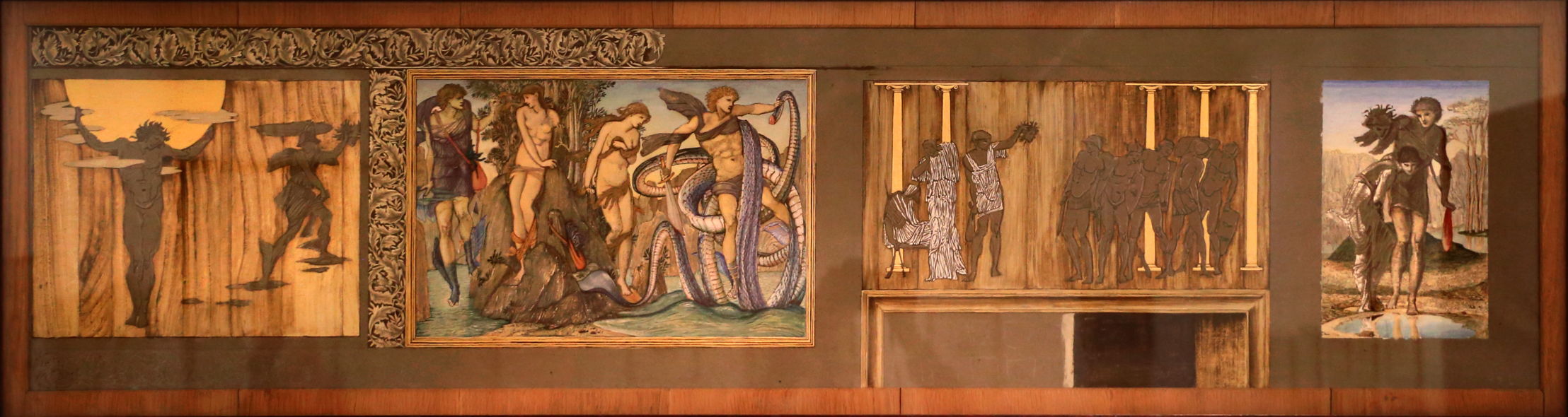
Edward Burne-Jones worked on many sketches and preliminary designs for his series, among which were gouache and gold layouts to show how his paintings would fit into their carved surrounds in his patron’s Music Room.
burnejonesperseusstudy
Edward Burne-Jones (1833–1898), Atlas Turned to Stone; The Rock of Doom and the Doom Fulfilled; The Court of Phineas; The Baleful Head (designs for The Story of Perseus) (1875-76), gouache, gold paint, graphite and chalk on paper, 36.7 x 148.7 cm, The Tate Gallery, London. Image by Sailko, via Wikimedia Commons.

This design shows an outline of the whole series, which had originally been intended to include Phineus and the wedding. The scenes shown are, from the left, Atlas Turned to Stone, The Rock of Doom and the Doom Fulfilled, The Court of Phineas, and The Baleful Head, shown below.
burnejonesperseus9b
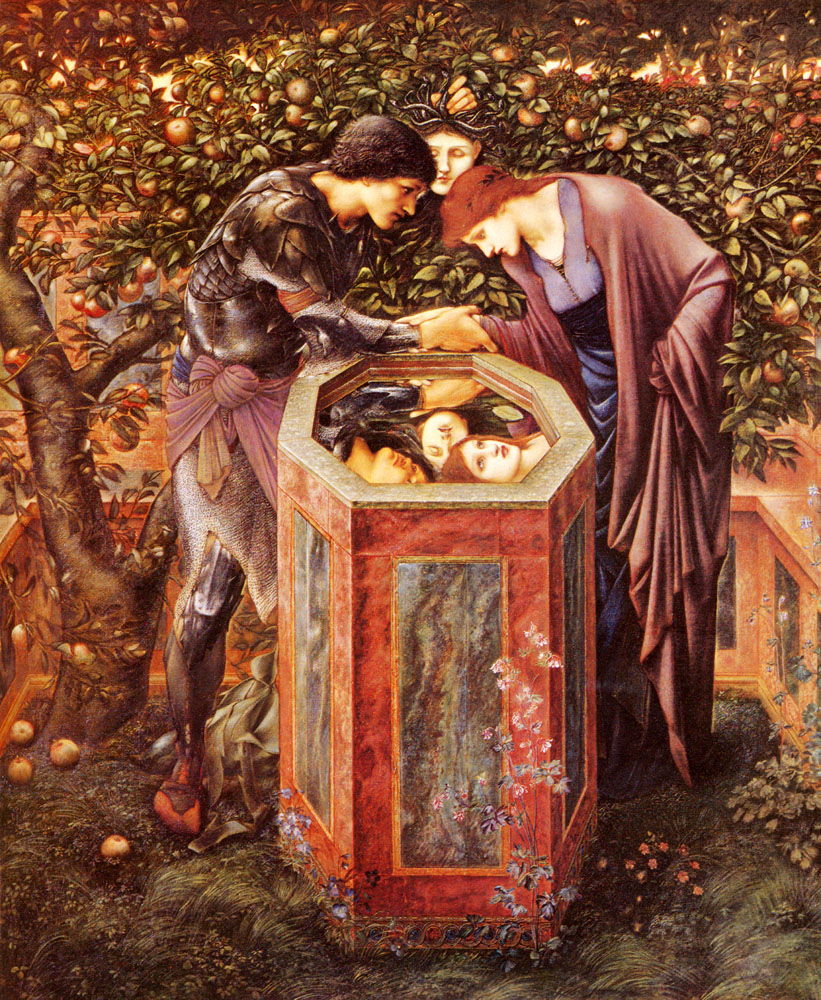
Edward Burne-Jones (1833–1898), The Perseus Series: The Baleful Head (1886-7), oil on canvas, 155 × 130 cm, Staatsgalerie Stuttgart, Stuttgart. Wikimedia Commons.

The tenth and final painting in Burne-Jones’ series, The Baleful Head (1885), shows Perseus and Andromeda, their right hands clenching one another’s wrists, looking at the image of Medusa’s face reflected in the surface of a well. This is set in a peaceful garden, with a fruit-laden apple tree behind, and flowers springing up from the grass beneath them.

Literary accounts take the couple on to live at Tiryns in Argos, from where Heracles/Hercules later undertook his Twelve Labours. They had seven sons and two daughters, and among their descendants were Heracles, Castor and Pollux, Clytemnestra, and the Achaemenid Persians.

When Perseus returned to Seriphos, he discovered Polydectes was still trying to seduce his mother Danaë. Perseus therefore used Medusa’s face to turn him to stone, and made Dictys king and his mother’s consort. His mission accomplished, Perseus returned the weapon and equipment loaned by the gods, and gave Athena the head of Medusa, which she then set in her shield as the Gorgoneion, more commonly referred to as the Aegis.
rubensjudgementparis
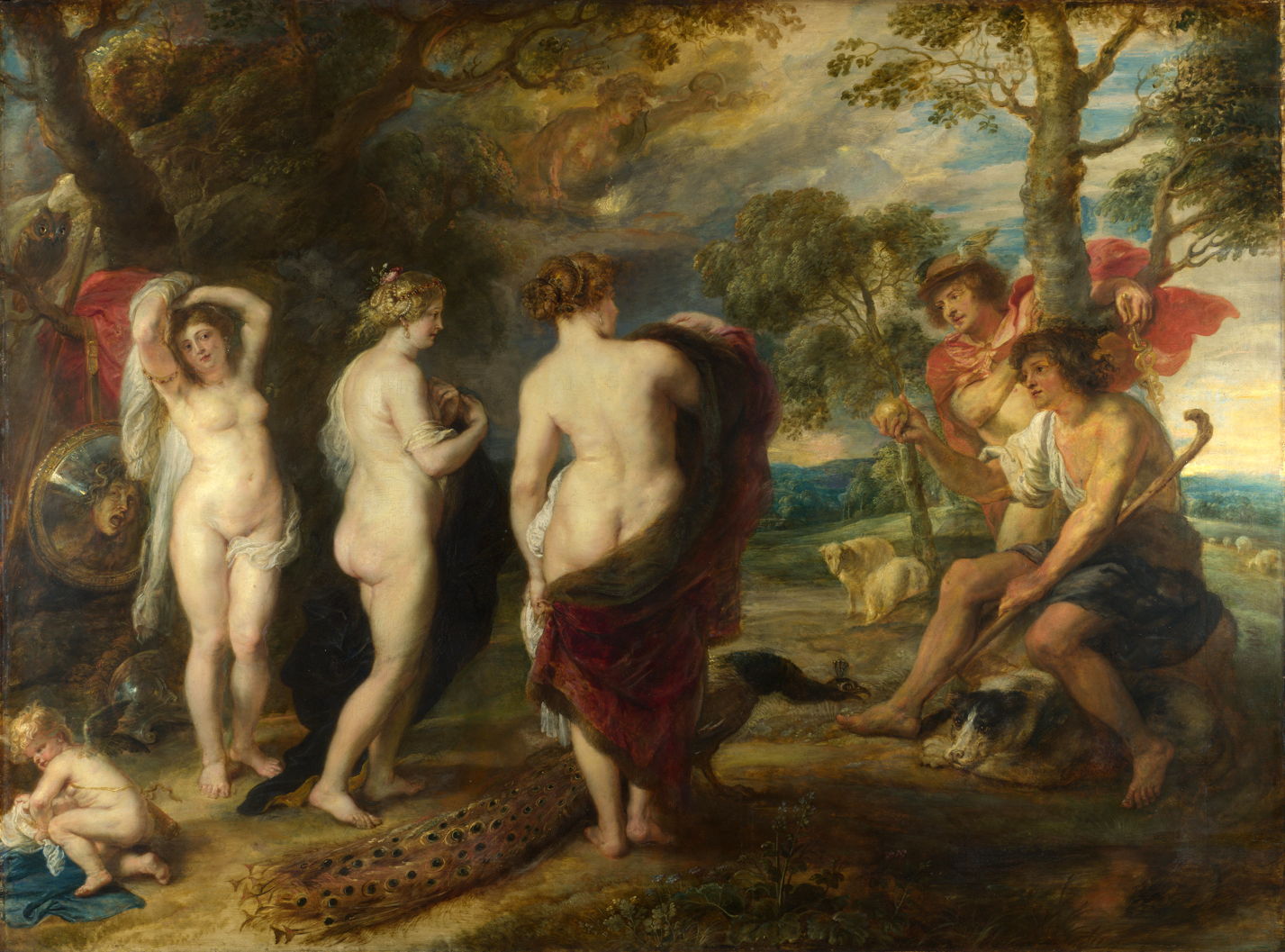
Peter Paul Rubens (1577–1640), The Judgement of Paris (1632-35), oil on oak, 144.8 x 193.7 cm, National Gallery, London. Wikimedia Commons.

Distinguishing the three goddesses taking part in The Judgement of Paris, shown in Rubens’ late account from 1632-35, often relies in part on the aegis. The three goddesses are, from the left, Athena with her shield, Aphrodite, and Hera with her peacock.

There was still one loose end to be tied, though: the prediction that Perseus would kill his father Acrisius. Various accounts are given of this, but consensus is that Perseus threw a quoit or discus that unintentionally struck Acrisius and killed him. Thereafter, he ruled a kingdom until he and Andromeda died. They were both catasterised into their own constellations, where they can still be seen today.