
惯性聚合 高效追踪和阅读你感兴趣的博客、新闻、科技资讯
阅读原文 在惯性聚合中打开

推荐订阅源

K
Kaspersky official blog
T
Threat Research - Cisco Blogs
N
News and Events Feed by Topic
Hacker News: Ask HN
Hacker News: Ask HN
Project Zero
Project Zero
Application and Cybersecurity Blog
博客园 - 叶小钗
Security Latest
Security Latest
Spread Privacy
Spread Privacy
aimingoo的专栏
aimingoo的专栏
N
News and Events Feed by Topic
Webroot Blog
Webroot Blog
U
Unit 42
Cyberwarzone
Cyberwarzone
小众软件
小众软件
Scott Helme
Scott Helme
Engineering at Meta
Engineering at Meta
Microsoft Security Blog
T
The Blog of Author Tim Ferriss
A
About on SuperTechFans
爱范儿
爱范儿
S
Schneier on Security
让小产品的独立变现更简单 - ezindie.com
Schneier on Security
Latest news
Latest news
GbyAI
GbyAI
cs.CV updates on arXiv.org
Simon Willison's Weblog
The Register - Security
WordPress大学
WordPress大学
博客园_首页
Blog — PlanetScale
Blog — PlanetScale
PCI Perspectives
PCI Perspectives
Jina AI
Jina AI
AI
AI
NISL@THU
NISL@THU
I
Intezer
G
GRAHAM CLULEY
B
Blog
S
Secure Thoughts
IT之家
IT之家
宝玉的分享
宝玉的分享
Recent Announcements
Y
Y Combinator Blog
奇客Solidot–传递最新科技情报
奇客Solidot–传递最新科技情报
酷 壳 – CoolShell
酷 壳 – CoolShell
有赞技术团队
有赞技术团队
V2EX - 技术
V2EX - 技术
Recorded Future
Recorded Future
Hacker News - Newest:
Hacker News - Newest: "LLM"

The Eclectic Light Company

Apple has released an update to XProtect for all macOS Hero or hooligan: Theseus’ later years BSD flags are incompatible with iCloud Drive Apple has released macOS Tahoe 26.5.1 In memoriam Mary Cassatt: 1, 1868-1880 Solutions to Saturday Mac riddles 362 What Location Services do in macOS Eclectic paintings of Joseph Stella: 2 European myths Last Week on My Mac: Razzle and dazzle Eclectic paintings of Joseph Stella: 1 American landscapes Saturday Mac riddles 362 Protect files with the Locked or Immutable flag Reading Visual Art: 252 Dragonfly What happens in the log when an app crashes as it starts up? Portraits of trees: Introduction On Reflection: Conclusions and contents Which tasks require mains power? Medium and message: Vast canvases Online reference to external displays for Apple silicon Macs What’s in that phishing email? Hero or hooligan: Theseus and Ariadne Solutions to Saturday Mac riddles 361 How to search document versions Rubens’ Consequences of War Rubens’ Peace and War Saturday Mac riddles 361 How to search Time Machine backups? Naturalists: Contents and artists On Reflection: Extending the image Tackle QuickLook problems Medium and message: Pottery Hero or hooligan: Theseus and the sandals How QuickLook provides thumbnails and previews Last Week on My Mac: Syncing metadata in iCloud Drive Saturday Mac riddles 360 Naturalists: Sorolla and Zorn On Reflection: Pierre Bonnard 1909-1946 SpotTest 1.2 can display Spotlight metadata directly On Reflection: Pierre Bonnard 1899-1908 How to preserve versions, and how to create versioned PDFs Medium and message: Sculpture What gets synced in iCloud Drive? Hero or hooligan: Perseus 2 Solutions to Saturday Mac riddles 359 Last Week on My Mac: snapshots, the elephant in APFS Paintings of Beatrice Portinari: to 1862 Saturday Mac riddles 359 Naturalists: Into the 20th century How to check whether Spotlight is getting the right metadata On Reflection: Mirror play Hero or hooligan: Perseus 1 The bicentenary of Frederic Edwin Church: 1857-77 Solutions to Saturday Mac riddles 358 macOS virtual machines and audio-video syncing A walk in the parks of Rome, Vienna, Manhattan and Brooklyn Saturday Mac riddles 358 Naturalists: Photography Use Finder tags for categories Control what gets written to the log Medium and message: Tapestry Virtualisation on Apple silicon Macs is different Jerusalem Delivered: Overview and contents The bicentenary of Frederic Edwin Church: 1849-57 Solutions to Saturday Mac riddles 357 Painting Pandora and her box: 1883-1919 Painting Pandora and her box: 1550-1882 Saturday Mac riddles 357 Reading Visual Art: 250 Winged sandals The secret life of the xattr The macOS Natural Language framework and Nalaprop Medium and Message: Stained glass The MACL extended attribute Jerusalem Delivered: 13 Leading characters Solutions to Saturday Mac riddles 356 Privacy: How locations are protected Painting Spring blossom 2 Last Week on My Mac: Don’t be a victim of fraud Painting Spring blossom 1 Saturday Mac riddles 356 Explainer: Recovery Reading Visual Art: 249 Mask Naturalists: Urban poverty On Reflection: Cézanne Privacy: Which folders are protected in Tahoe? Medium and Message: Mosaic Jerusalem Delivered: 12 Delivery Solutions to Saturday Mac riddles 355 Centaurs 2: Revenge Centaurs 1: Fights Saturday Mac riddles 355 Explainer: sandboxes Naturalists: The modern meal Why you can’t trust Privacy & Security Apple has just released an update to macOS Tahoe, to version 26.4.1 On Reflection: Divisionism Please help update CPU frequencies for Apple silicon Macs Commemorating the centenary of the death of John Ferguson Weir Privacy: Files & Folders or Full Disk Access? Jerusalem Delivered: 11 Into Jerusalem Privacy: protected folders
Paintings of visits to India 1778-1877
hoakley · 2026-05-16 · via The Eclectic Light Company

Edward Lear (1812–1888), Benares (1873), watercolor with pen in brown ink over graphite and gouache on moderately thick, rough, beige wove paper, 34.3 x 50.8 cm, Yale Center for British Art, New Haven, CT. Wikimedia Commons.

Trade between Europe and India had been established by the time of the Roman Empire, but it wasn’t until European trading companies, including the English East India Company, established outposts on the Indian coast in the early eighteenth century that many Europeans visited the sub-continent. Colonisation by Britain developed from the 1820s until the East India Company was disbanded in favour of direct colonial administration in 1858. From then until independence was achieved in 1947, a succession of predominantly British painters visited. This weekend I show a small selection of their work.

In 1778, William Hodges (1744–1797) travelled to India, where he painted under the patronage of the British statesman Warren Hastings. He stayed in the country for six years, visiting many locations ideal for landscape views. A selection were engraved for his book about his travels in India, published in 1793.

hodgesmarmalongbridge
William Hodges (1744–1797), The Marmalong Bridge, with a Sepoy and Natives in the Foreground (c 1783), oil on canvas, 88.3 x 108.6 cm, Yale Center for British Art, New Haven, CT. Wikimedia Commons.

The Marmalong Bridge, with a Sepoy and Natives in the Foreground (c 1783) shows the oldest bridge across the Adyar River in Chennai (formerly Madras), Tamil Nadu, now known as the Maraimalai Adigal Bridge. This was originally constructed by an Armenian merchant in 1728, and wasn’t replaced until 1966.

hodgestajmahal
William Hodges (1744–1797), The Taj Mahal (c 1788), oil on canvas, 89 x 149.5 cm, National Gallery of Modern Art, New Delhi, India. Wikimedia Commons.

Several years after his return to Britain, in about 1788, Hodges painted this curious view of the world-famous white marble mausoleum, The Taj Mahal. I suspect this image is slightly on the incline, and the artist set its horizontals more level. But most views of the Taj Mahal show its impressive formal garden; Hodges instead painted it from the opposite bank of the River Yamuna. The mausoleum had only been completed just over a century earlier, in 1648.

hodgesstormganges
William Hodges (1744–1797), Storm on the Ganges, with Mrs. Hastings near the Col-gon Rocks (c 1790), oil on canvas, 127 x 182.9 cm, Yale Center for British Art, New Haven, CT. Wikimedia Commons.

Hodges painted this Storm on the Ganges, with Mrs. Hastings near the Col-gon Rocks in about 1790. The Mrs. Hastings of the title was his patron’s wife. She was formerly Mary Buchanan, the widow of one of the victims of the ‘Black Hole of Calcutta’ incident in 1756.

In 1872, the intrepid natural history painter Edward Lear (1812–1888) set off for India, but only got as far as Suez, where the canal had only been officially opened three years previously. He eventually undertook his tour of India and Sri Lanka in 1873-75, after which he returned to Britain. Although now known almost exclusively for his ‘nonsense’ poetry, Lear was an outstanding artist who survived a troubled childhood and overcame the combination of grand mal epilepsy, asthma, bronchitis, bouts of depression and failing eyesight.

leargwaliorindia
Edward Lear (1812–1888), View of Gwalior, India (1840), oil on canvas, 23.5 × 46.3 cm, location not known. Wikimedia Commons.

This View of Gwalior, India is allegedly dated 1840, although Lear did not visit India until 1873. It is also painted in oils, which in any case makes it later than about 1852. Gwalior is a major city in northern central India, about 200 miles to the south of Delhi, with a particularly rich range of historic buildings, seen to the left of the large plateau.
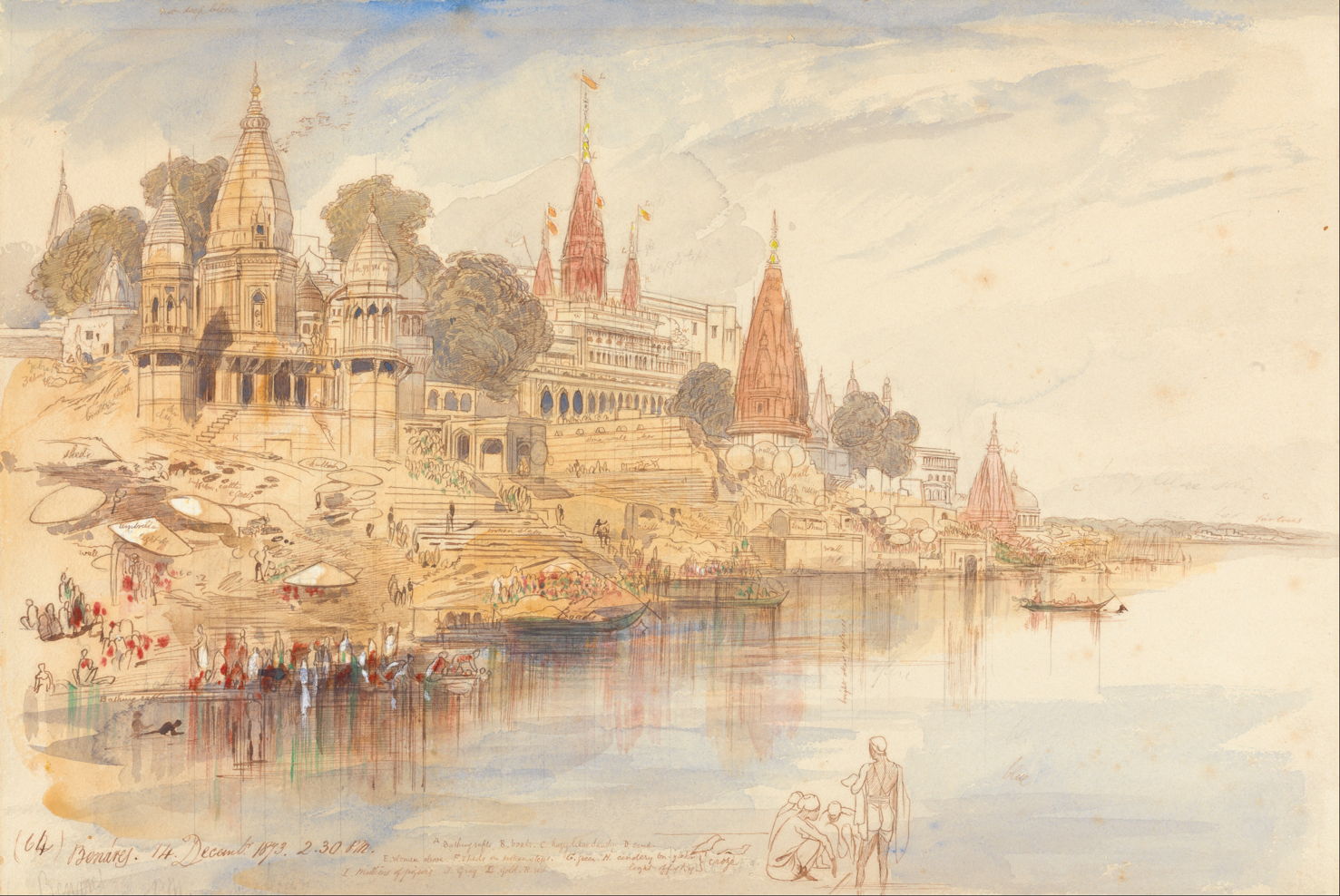
learbenares
Edward Lear (1812–1888), Benares (1873), watercolour with pen in brown ink over graphite and gouache on moderately thick, rough, beige wove paper, 34.3 x 50.8 cm, Yale Center for British Art, New Haven, CT. Wikimedia Commons.

Lear’s watercolour of Benares (1873) shows another city in northern central India, to the east of Gwalior, on the banks of the River Ganges. Now better known as Varanasi, it is a religious centre, being the holiest of seven sacred cities of the Hindu and Jain faiths, and an important location in the history of Buddhism as well.
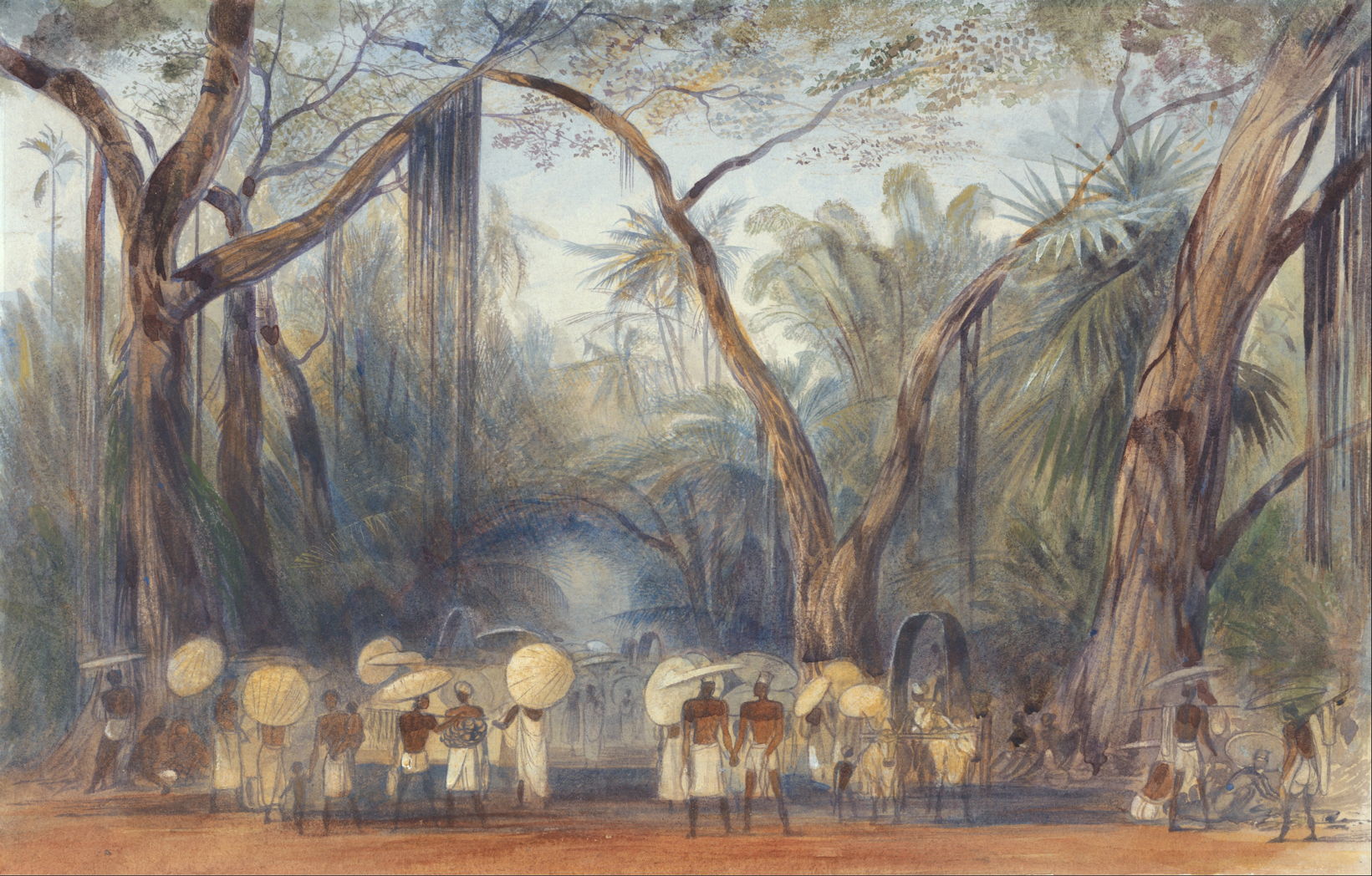
learcooliesonroadkalicut
Edward Lear (1812–1888), Coolies on the Road near Kalicut, Malabar (date not known), watercolour with body color and gum arabic on wove paper on medium, moderately textured, cream wove paper, 25.4 x 39.5 cm, Yale Center for British Art, New Haven, CT. Wikimedia Commons.

Although undated, I suspect that Lear’s watercolour of Coolies on the Road near Kalicut, Malabar was painted at around this time. Calicut or Kozhikode is a city in the state of Kerala, on the Malibar coast of south-west India, nearly two hundred miles to the west of Bangalore. The city is a major trade centre for locally-produced commodities like pepper, coconut, coffee, and rubber, and the labourers shown here were probably engaged in the production and transport of those products.
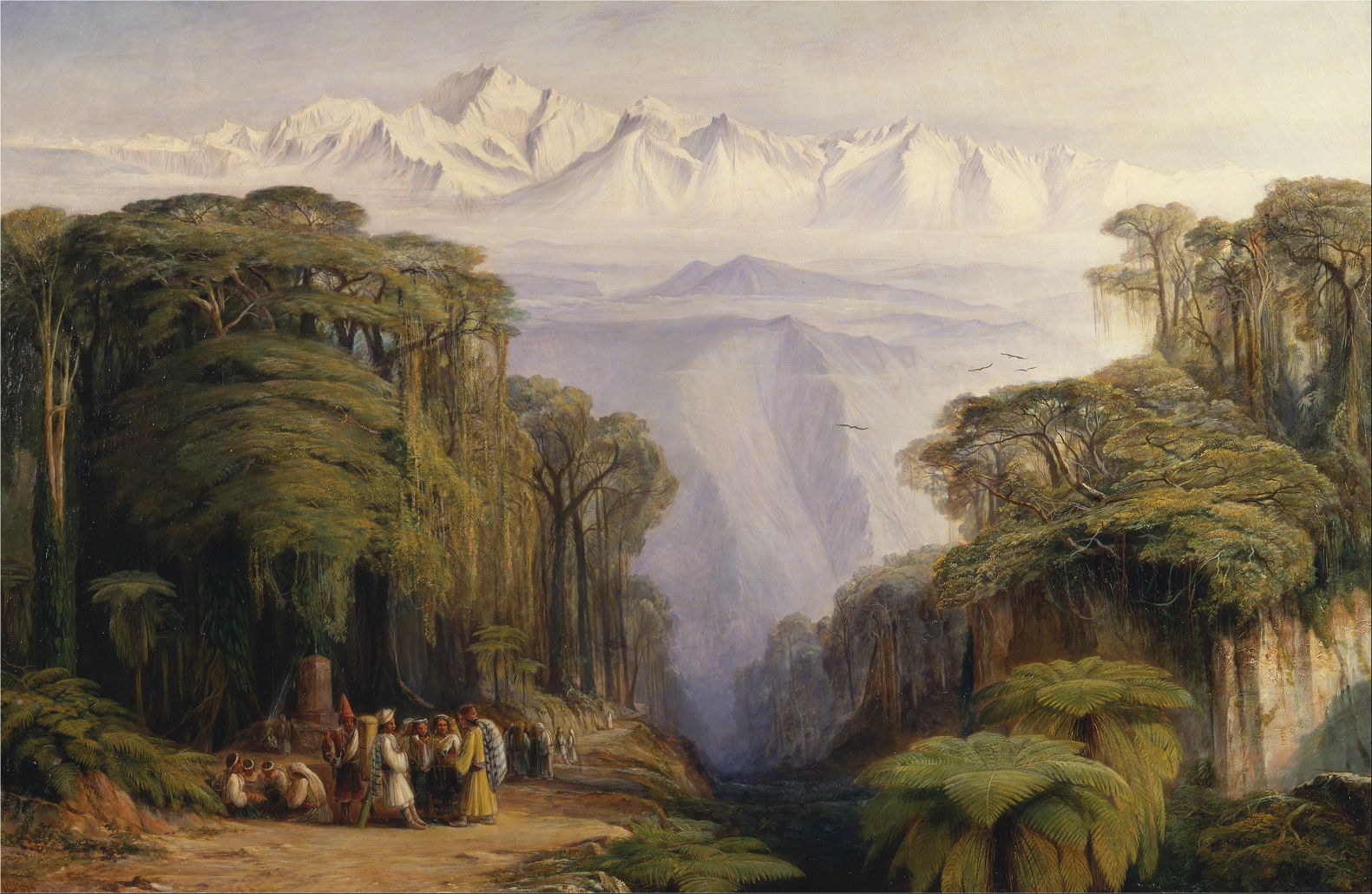
learkangchenjunga
Edward Lear (1812–1888), Kangchenjunga from Darjeeling (1879), oil on canvas, 119.7 x 182.9 cm, Yale Center for British Art, New Haven, CT. Wikimedia Commons.

My final selection from Lear’s extensive landscape paintings is among his most spectacular, showing the great mountain Kangchenjunga from Darjeeling (1879).

Darjeeling is high in the Lesser Himalaya, at an elevation of just over two thousand metres (over 6,500 feet), in the far north of West Bengal. Famed for its tea plantations, it became a ‘hill station’ for British residents of India in the early nineteenth century, and just a couple of years after Lear painted this view, it was connected by the Darjeeling Himalayan Railway to New Jalpaiguri.

Kangchenjunga is now, and was then, ranked the third highest mountain in the world, with an elevation of 8,586 metres (28,169 feet). Its first successful ascent wasn’t made until 1955; because it is a sacred mountain, teams who attain the summit stop short to avoid its violation. The Kangchenjunga massif is best viewed from Darjeeling, which is about eighty miles away. Kangchenjunga itself is the obviously highest peak, to the left of the centre of the ice-covered massif seen here.

Vasily Vasilyevich Vereshchagin (1842–1904) was another seasoned traveller who was also an accomplished war artist for the Russian Empire. In late 1874 he started an extensive tour of the Himalaya and the Indian sub-continent.
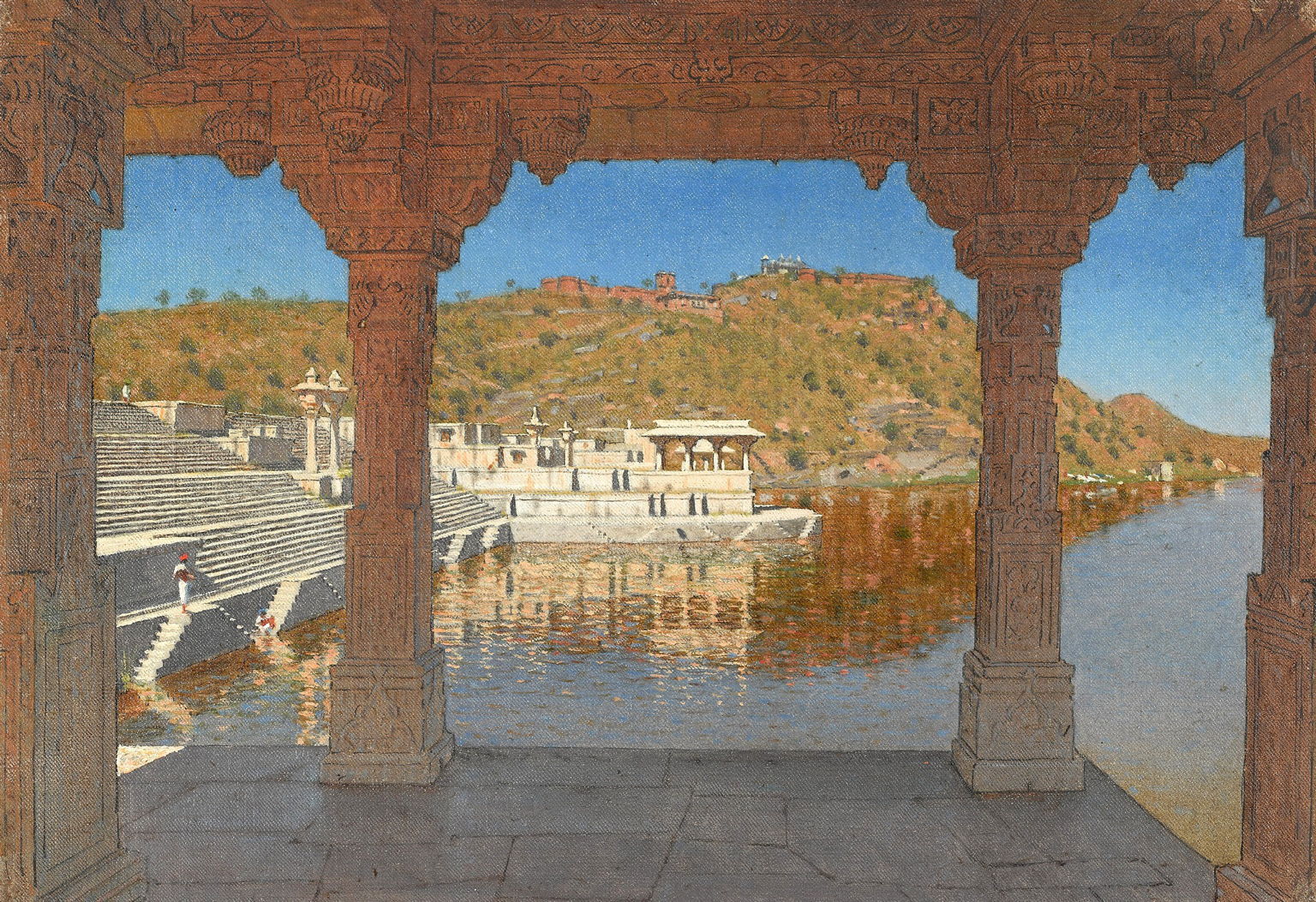
vereshchaginudaipur
Vasily Vasilyevich Vereshchagin (1842–1904), Rajnagar. Marble Embankment Decorated with Bas-Reliefs on a Lake in Udaipur (1874), media and dimensions not known, Tretyakov Gallery Государственная Третьяковская галерея, Moscow, Russia. Wikimedia Commons.

Rajnagar. Marble Embankment Decorated with Bas-Reliefs on a Lake in Udaipur (1874) shows one of the palaces in Udaipur, in Rajasthan. This city is surrounded by seven lakes, several of which have palaces on the shore.
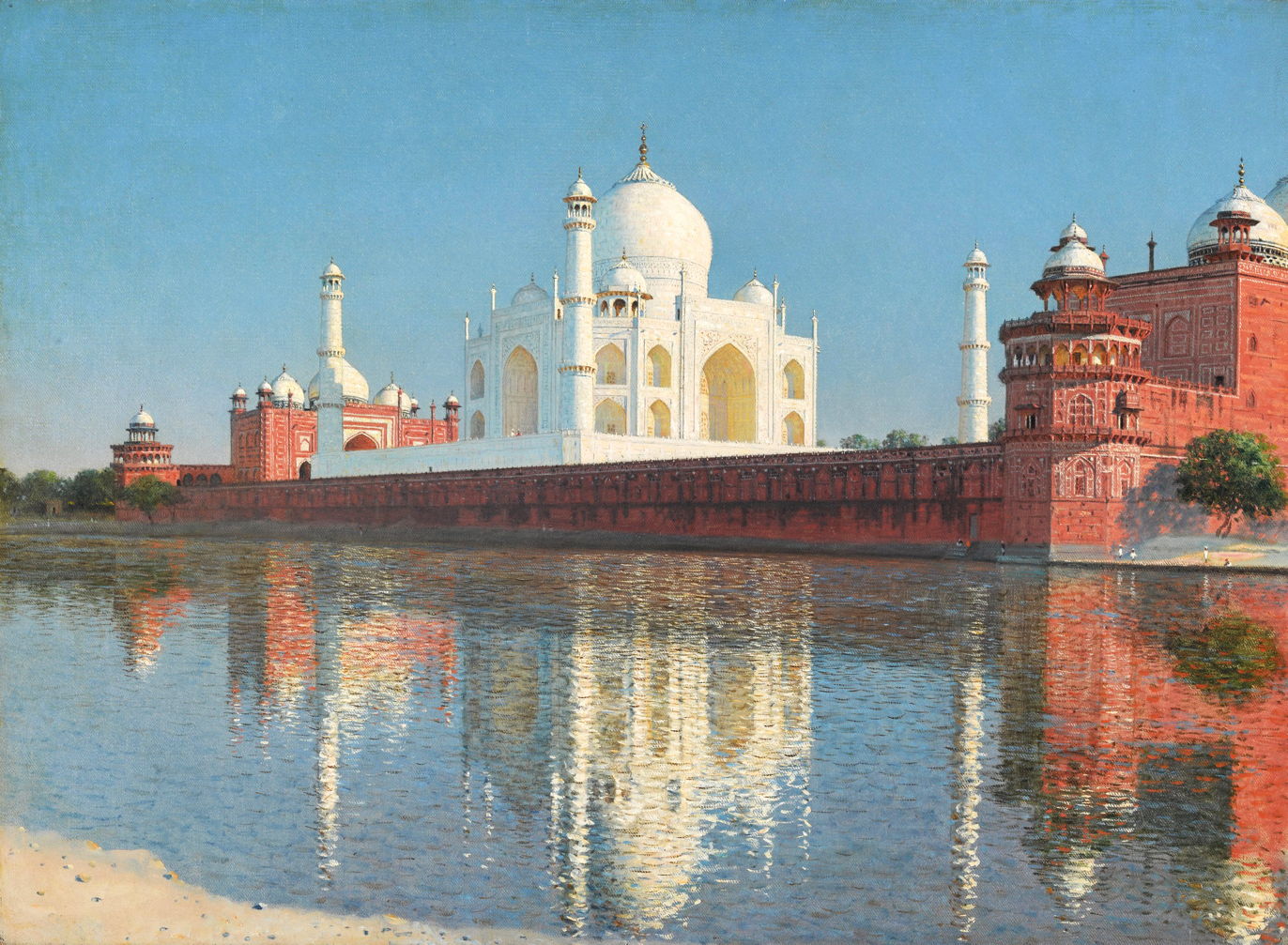
vereshchagintajmahal
Vasily Vasilyevich Vereshchagin (1842–1904), Taj Mahal Mausoleum, Agra (1874-76), oil on canvas, 38.7 x 54 cm, Tretyakov Gallery Государственная Третьяковская галерея, Moscow, Russia. Wikimedia Commons.

Taj Mahal Mausoleum, Agra (1874-76) is another view of this white marble mausoleum in the city of Agra, built to house the tomb of the Mughal emperor’s favourite wife, Mumtaz Mahal, between 1632-1653. It’s probably the most painted and photographed building in the whole of the sub-continent.

Vereshchagin returned to Europe in late 1876, where he turned some of his studies into more substantial finished paintings.
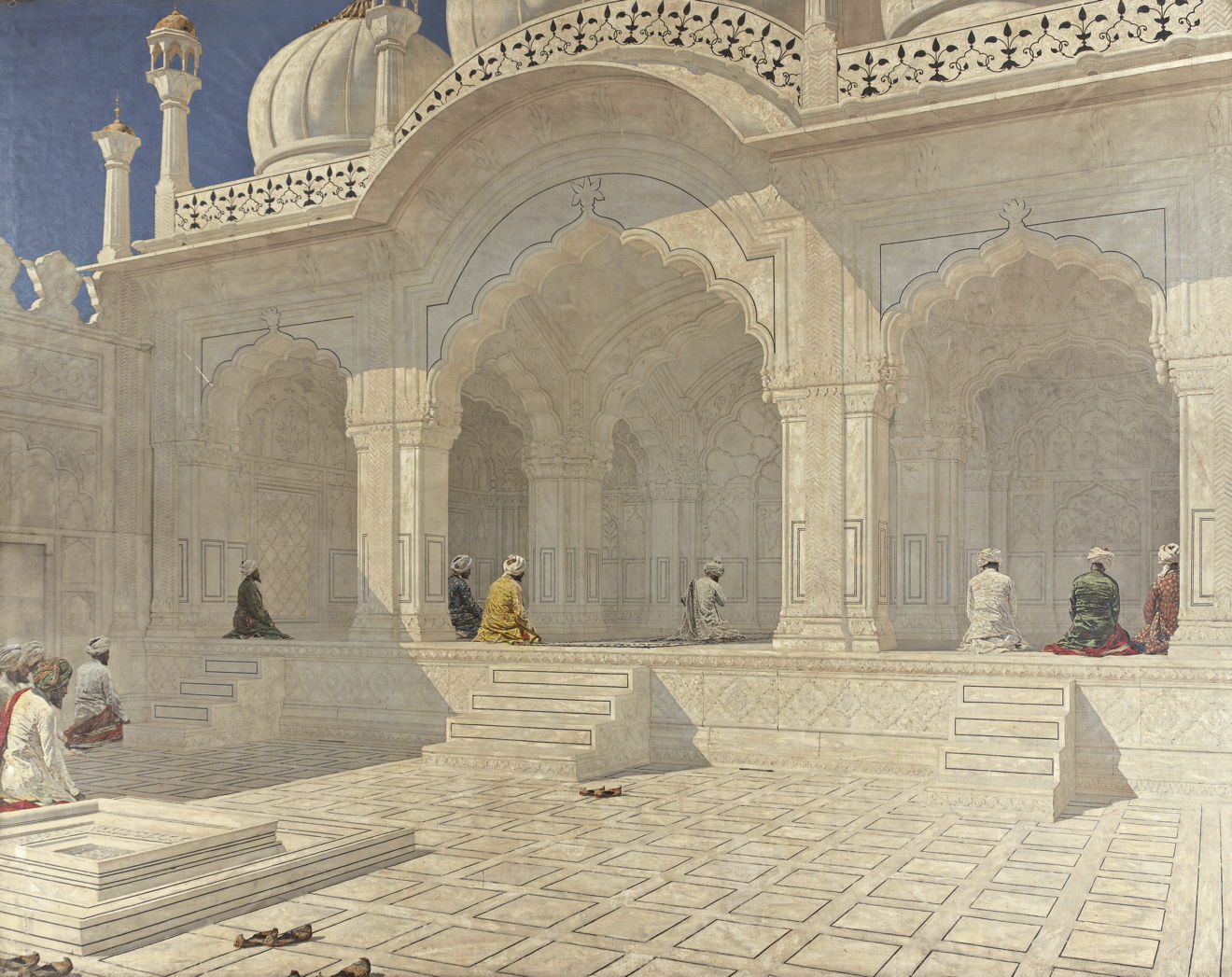
vereshchaginpearlmosque
Vasily Vasilyevich Vereshchagin (1842–1904), Pearl Mosque, Delhi (1876-79), oil on canvas, 395 x 500 cm, Museum of Fine Arts Boston, Boston, MA. Wikimedia Commons.

Many of his travel paintings are surprisingly small, either completed in front of the motif or in an improvised local studio. This huge painting of the Pearl Mosque, Delhi must have been made entirely in his studio in Paris in 1876-79. The Moti Masjid is built from white marble, and is inside the Red Fort complex in Delhi. It was constructed by the Mughal emperor Aurangzeb for his second wife and the ladies of the household, in 1659-60.