



惯性聚合 高效追踪和阅读你感兴趣的博客、新闻、科技资讯
阅读原文 在惯性聚合中打开

推荐订阅源

罗磊的独立博客
Forbes - Security
Forbes - Security
Blog — PlanetScale
Blog — PlanetScale
P
Proofpoint News Feed
Apple Machine Learning Research
Google DeepMind News
MyScale Blog
MyScale Blog
GbyAI
GbyAI
B
Blog RSS Feed
S
SegmentFault 最新的问题
freeCodeCamp Programming Tutorials: Python, JavaScript, Git & More
cs.AI updates on arXiv.org
CTFtime.org: upcoming CTF events
小众软件
小众软件
The Last Watchdog
The Last Watchdog
W
WeLiveSecurity
Webroot Blog
Webroot Blog
S
Security @ Cisco Blogs
Hugging Face - Blog
Hugging Face - Blog
Microsoft Security Blog
月光博客
月光博客
博客园 - 聂微东
F
Fortinet All Blogs
H
Hacker News: Front Page
A
About on SuperTechFans
Application and Cybersecurity Blog
C
Check Point Blog
V
V2EX
Threat Intelligence Blog | Flashpoint
Y
Y Combinator Blog
酷 壳 – CoolShell
酷 壳 – CoolShell
N
News | PayPal Newsroom
Cisco Talos Blog
Cisco Talos Blog
Exploit-DB.com RSS Feed
The Cloudflare Blog
P
Privacy & Cybersecurity Law Blog
N
Netflix TechBlog - Medium
C
CXSECURITY Database RSS Feed - CXSecurity.com
Recorded Future
Recorded Future
Cyber Security Advisories - MS-ISAC
Google DeepMind News
大猫的无限游戏
大猫的无限游戏
美团技术团队
Security Latest
Security Latest
钛媒体:引领未来商业与生活新知
钛媒体:引领未来商业与生活新知
I
InfoQ
Recent Announcements
The GitHub Blog
The GitHub Blog
Google Online Security Blog
T
The Exploit Database - CXSecurity.com

Rapid7 Cybersecurity Blog

Rapid7 Rapid7 Sunsetting the Public AttackerKB Platform | Rapid7 Rapid7 Rapid7 Labs: Investigating Persistence Mechanisms in AWS Rapid7 Rapid7 and Mindware Partner Across the Middle East Rapid7 Security Teams Are Ready To Become More Preemptive. What’s Holding Them Back? A Day With Your Vector Command Red Team Pod Rapid7 Formalizing Red Teaming Offensive Methodology as a Multi-Agent AI Architecture 5 Myths About AI in the SOC Security Teams Need to Rethink Modernizing Global Vulnerability Standards For The Age Of AI Rapid7 Why AI and Compliance Are Forcing A New Security Operating Model, with Rapid7's Corey Thomas & Sabeen Malik Why SIEM is Moving Toward Unified Security Operations: Rapid7 Named a Major Player in IDC MarketScape Rapid7 Why Security Teams Need To Start Earlier: New eBook on the Need for Preemptive Security Malware à la Mode: Tracking Dropping Elephant Tradecraft Through a China-Themed Loader Chain NIS2 is raising the bar. Here’s how to turn readiness into resilience. Does Your Security Programme Align With NIS2 Requirements? Beyond the Score: Using AI to Translate CVEs into Real-World Business Risk Weekly Metasploit Update: New Kerberos/Certificate tracing options, and multiple new modules Active Exploitation of Oracle PeopleSoft Zero-Day (CVE-2026-35273) Automated Threat Hunting: Turning Threat Intelligence into Executable Hunt Plans Criminal AI-as-a-Service in 2026: How the Underground Market Is Operationalizing Cybercrime CVE-2026-10520, CVE-2026-10523 - Multiple critical vulnerabilities affecting Ivanti Sentry Patch Tuesday - June 2026 Critical Check Point VPN Zero-Day Exploited in the Wild (CVE-2026-50751) Weekly Metasploit Update: Apache ActiveMQ RCE, Gogs Rebase RCE, and Windows Kernel Pointer Enum How the “Swiss Cheese” model can help you choose the right MDR provider A Day in the Life of an MDR Analyst: Inside the Modern SOC Rapid7 Gains Access To Anthropic’s Project Glasswing To Explore Frontier AI For Cybersecurity CVE-2026-0826: How an Old Bug Can Feed AI-Powered Impersonation CVE-2026-0826: Critical unauthenticated stack buffer overflow in HP Poly VVX and Trio VoIP Phones (FIXED) Rapid7 and Exclusive Networks Expand Partnership Across the Nordics Metasploit Wrap Up 05/29/2026 Rapid7 Observed Exploitation of PAN-OS GlobalProtect Authentication Bypass Vulnerability (CVE-2026-0257) Experts on Experts: Why Compliance is becoming Continuous CVE-2026-52806: Authenticated RCE via Argument Injection in Gogs (FIXED as of June 7, 2026) How Security Leaders Cut Through Complexity to Drive Better Outcomes Metasploit Wrap Up 05/22/2026 Q1 2026 Threat Landscape Report: Zero-clicks, geopolitical tensions, and some wins for law enforcement Operationalizing CTEM Faster: Build Surface Command Dashboards in Minutes Rapid7’s 2026 Global Cybersecurity Summit: Key Takeaways for Security Leaders Metasploit Wrap-Up 05/15/2026 CVE-2026-0265: Authentication Bypass in Palo Alto Networks PAN-OS CVE-2026-20182: Critical authentication bypass in Cisco Catalyst SD-WAN Controller (FIXED) When Network Controllers Become "God Mode" for Attackers Pluribus and the Path to Domain Compromise: A ModeloRAT Case Study Rapid7 Drives Partner Impact with Stevie Award-Winning Certifications Patch Tuesday - May 2026 Last Chance to Join the Rapid7 Global Cybersecurity Summit Metasploit Wrap-Up 05/08/2026 How Rapid7 is Bringing Cyber GRC Closer To Security Operations Scaling Detection Engineering at the Speed of Software, with Detection As Code Rapid7 and OpenAI: Advancing AI For Preemptive Security Why Security in 2026 Requires Continuous Threat and Exposure Management (CTEM) at Scale Critical Buffer Overflow in Palo Alto Networks PAN-OS User-ID Authentication Portal (CVE-2026-0300) Muddying the Tracks: The State-Sponsored Shadow Behind Chaos Ransomware A Walkthrough of the 2026 Global Cybersecurity Summit Agenda Metasploit Wrap-Up 05/01/2026 Five Things we Took Away from Gartner SRM Sydney 2026 CVE-2026-41940: cPanel & WHM Authentication Bypass Experts on Experts: The 2026 Threat Landscape is Moving Faster than Defenders Expect Get Motivated: What to Expect from Our Keynote at Rapid7's Global Cybersecurity Summit MDR Selection is a Partnership Decision Metasploit Wrap-Up 04/25/2026 3 Reasons to Attend our Global Cybersecurity Summit if you’re Focused on AI, Threats, and CTEM AI is Changing Vulnerability Discovery and your Software Supply Chain Strategy has to Change with it Kyber Ransomware Double Trouble: Windows and ESXi Attacks Explained From Bulk Export to AI-ready Security Workflows: Introducing Rapid7’s Open-Source MCP Server and Agent Skill Project Glasswing and the Next Challenge for Defenders: Turning Faster Discovery into Faster Action Metasploit Wrap-Up 04/17/2026 CVE-2026-33032: Nginx UI Missing MCP Authentication Rapid7 Analysis: ClickFix-style Phishing Campaign Uses Fake Claude Installer Rapid7 Exposure Command and Remediation Hub: A Clearer Path from Exposure to Patch Patch Tuesday - April 2026 Your Cloud Detection Strategy in 2026: What to Expect at the Global Cybersecurity Summit Turning Log Lines into Answers: Instant Clarity for SOC Teams Metasploit Wrap-Up 04/10/2026 Project Glasswing: What Security Leaders Should Know and Do Now What’s New in Rapid7 Products and Services: Q1 2026 in Review Investigating FortiGate CVE-2025-59718 Exploitation: IR Tales from The Field A First Look at Our Speaker Lineup and Agenda for the Rapid7 2026 Global Cybersecurity Summit Metasploit Wrap-Up 04/03/2026 You Don’t Have a Security Problem, You Have a Visibility Problem New Whitepaper: Stealthy BPFDoor Variants are a Needle That Looks Like Hay What CISOs Should Expect from AI Powered MDR in 2026, According to Rapid7 CEO Corey Thomas Initial Access Brokers have Shifted to High-Value Targets and Premium Pricing Red Teaming in 2026: What to Expect at our 2026 Global Cybersecurity Summit Metasploit Wrap-Up 03/27/2026 Why CVSS is No Longer Enough for Exposure Management From Vectors to Verdicts: Web App Testing with Vector Command Rapid7 Completes BSI C5 Type 2 Examination: Stronger Cloud Security for DACH Organizations New Whitepaper: Exploiting Cellular-based IoT Devices CVE-2026-3055: Citrix NetScaler ADC and NetScaler Gateway Out-of-Bounds Read Metasploit Wrap-Up 03/20/2026 Negotiating with the Board: Translating Active Risk into Financial Exposure
CVE-2026-55040: Microsoft SharePoint JWT Token Authentication Bypass (FIXED)
Rapid7 · 2026-07-14 · via Rapid7 Cybersecurity Blog

Overview

Rapid7 Labs conducted a zero-day research project against Microsoft SharePoint, resulting in the discovery of two new vulnerabilities that, when chained together, achieve unauthenticated remote code execution (RCE) against a vulnerable SharePoint server. Today, both Rapid7 and Microsoft are disclosing the first vulnerability in this chain, the authentication bypass vulnerability CVE-2026-55040. The RCE component of the exploit chain is expected to be patched by Microsoft in the next update cycle for August 2026. The exploit chain was developed as an entry for the recent Pwn2Own Berlin hacking competition – part of Rapid7 Labs' continued effort to raise the bar in Vulnerability Intelligence and our commitment to the preemptive protection of our customers through original vulnerability research.

A remote unauthenticated attacker can leverage CVE-2026-55040 to bypass authentication on a vulnerable SharePoint server and perform operations as a SharePoint site user or administrator. The vulnerability is due to several issues in the JWT token validation pipeline.

CVE-2026-55040 has a CVSSv3.1 score of 5.3 (Medium), and a Common Weakness Enumeration (CWE) of CWE-1390: Weak Authentication.

Product description

Microsoft SharePoint is a ubiquitous, web-based collaboration and document management platform deeply integrated into the Microsoft 365 ecosystem. Serving as the central hub for corporate intranets, internal file sharing, and workflow automation, it is trusted by enterprises worldwide to store and manage vast repositories of sensitive business data. Because SharePoint acts as a critical bridge between internal users, active directories, and cloud infrastructure, vulnerabilities within its architecture present a high-risk attack surface.

Impact

By leveraging CVE-2026-55040, a remote unauthenticated attacker can assume the identity of any SharePoint site user; the prerequisite is the attacker must know in advance the user they wish to identify as. This can be achieved in a number of ways, including via a user’s Active Directory (AD) Security ID (SID), or via a user’s AD User Principal Name (UPN). A UPN is the primary logon name for a user in either Windows AD or Microsoft Entra ID, and is formatted similar to that of an email address, e.g. [email protected].

In the example screenshot below, with identifying information redacted, a Rapid7 Labs proof-of-concept script discovers potential SharePoint users via SID enumeration and then leverages CVE-2026-55040 to bypass authentication on the target SharePoint site to assume the identity of that user — ultimately identifying the SharePoint site administrator user account.
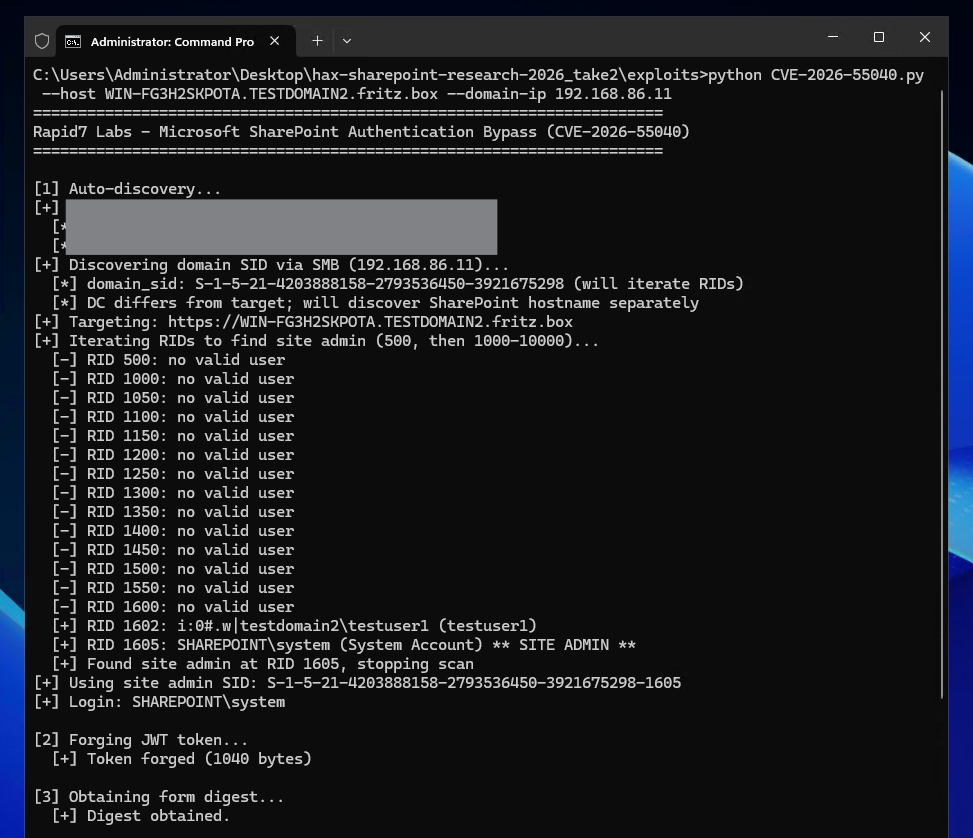
Rapid7-Labs-PoC-CVE-2026-55040.png Figure 1: The Rapid7 Labs PoC for CVE-2026-55040.

An attacker who successfully exploits CVE-2026-55040 can perform operations against the target SharePoint site as the user they identify as. Furthermore, this authentication bypass can be chained to additional vulnerabilities within the authenticated attack surface of the target site.

Rapid7 Labs has chained the authentication bypass CVE-2026-55040 with a separate RCE vulnerability for unauthenticated RCE. Patching CVE-2026-55040 will successfully break this exploit chain. The RCE component has been disclosed to Microsoft and is expected to be patched in the scheduled August patch cycle. The chaining of vulnerabilities highlights that even though the authentication bypass has been assigned a medium severity CVSS score by Microsoft, the impact of successfully chaining a medium severity authentication bypass to an RCE component is significant. This also underscores the importance of patching vulnerabilities such as authentication bypasses, which can break complex and high impact exploit chains.

Leveraging AI

To develop our SharePoint exploit chain, Rapid7 Labs undertook a research project divided into two main sprints, the first in January and the second in March, 2026. While both sprints did encompass more traditional vulnerability research such as manual code review and reverse engineering, a significant amount of the work was undertaken through an agent. Over 24 active days of agentic work, we leveraged 96 sessions, issued 256 prompts, and generated approximately 80,000 agentic tool calls.

The initial January sprint was unsuccessful, resulting in no findings that could be leveraged for an exploit chain. We used this sprint to experiment with several different publicly available models, along with different workflows to navigate and reason across a massive and complex codebase. However, our second sprint in March was successful and yielded, through a heavily prompted agent, a two-vulnerability exploit chain that achieved unauthenticated RCE.

The improvement in quality between January and March in terms of agentic work, along with our improved workflows, was noticeable. This highlights the speed at which this field is evolving, how publicly available models are improving, and how as research teams develop their workflows, the results begin to compound.

Credit

This vulnerability was discovered by Stephen Fewer, Senior Principal Security Researcher at Rapid7 and is being disclosed in accordance with Rapid7's vulnerability disclosure policy.

Vendor statement

The following statement has been provided by Microsoft:

“We would like to thank Rapid7 for responsibly reporting this issue through coordinated vulnerability disclosure.”

Technical analysis

Rapid7 will be publishing full technical details for CVE-2026-55040 within 30 days of this disclosure.

Customers are advised to apply the latest available updates for the impacted product to ensure they are protected.

Rapid7 customers

Exposure Command, InsightVM and Nexpose customers will be able to assess their exposure to CVE-2026-55040 with Authenticated vulnerability checks available in the July 14 content release

Disclosure timeline

  • May 18, 2026: Rapid7 discloses an unauthenticated RCE exploit chain to Microsoft. Microsoft acknowledges receipt of the disclosure the same day.

  • May 20, 2026: Microsoft confirms the findings and indicates that the exploit chain will be patched across two scheduled update cycles - the authentication bypass component in July, and the RCE component in August.

  • May 21, 2026: Rapid7 acknowledges the disclosure schedule and requests supporting information. Microsoft requests a 30 day stay on disclosure of technical details and publication of PoC.

  • May 29, 2026: Rapid7 agrees to a 30 day stay on technical details with a proviso to publish earlier should either exploitation in-the-wild or third-party publication of details occur within the 30 days. Microsoft confirms the disclosure plan the same day.

  • June 30, 2026: Rapid7 requests supporting information for the upcoming disclosure.

  • June 30, 2026: Microsoft provides supporting information to Rapid7.

  • July 14, 2026: This disclosure for CVE-2026-55040.