




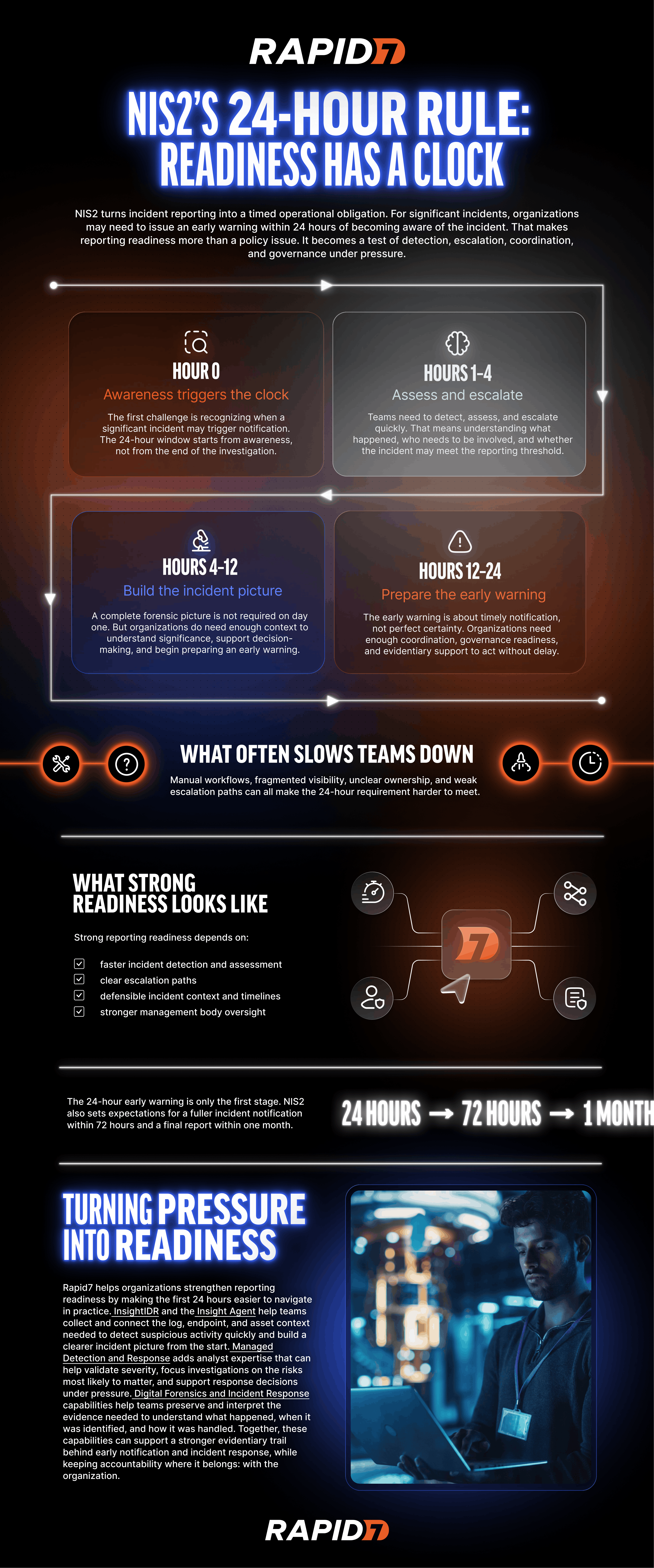
The NIS2 directive asks covered organizations to take a more structured approach to risk management, governance, supply chain security, and incident reporting. It expands the scope of who may be covered, raises expectations around management body accountability, introduces clearer and more enforceable requirements, and increases pressure on organizations to show that security is being managed in a consistent, defensible way. Reporting timelines are one of the most visible parts of that shift, with early warning required within 24 hours of awareness for significant incidents, incident notification within 72 hours, and a final report within one month. It also arrived in a landscape that is still uneven, with member states continuing to implement the directive in different ways across the EU.
That combination has created a familiar challenge for CISOs and security teams, as the questions coming from boards and leadership are no longer just about whether the organization understands the regulation, but whether it can meet the requirements in practice. NIS2 reaches into risk management, reporting, governance, and supply chain oversight, which means readiness depends on how well security works across the business, not just on how well a policy is written.
That is why the most useful way to think about NIS2 is as an operational resilience exercise. Compliance still matters, of course, and teams need to know what the directive requires. What tends to make the difference over time is whether security leaders can connect those requirements to the real conditions of the environment: what is exposed, where ownership sits, how incident response works in practice, how supply chain risk is monitored, and how quickly the organization can move when something material happens.
Regulations are easier to absorb than operating model changes. A team may understand that NIS2 raises expectations around governance and incident handling, while still finding it difficult to answer basic questions quickly when pressure rises. Which business services are most critical? Which third parties matter most? Who owns the decision when a serious issue lands? How prepared are we to investigate, communicate, and report inside the timelines the directive expects? Those are the questions that separate a compliance project from a resilience program.
That is also why we have been building practical content to help teams move from interpretation to action.
Our ebook is the best place to start if you want the wider context. It is designed to help security leaders understand what NIS2 means in practical terms, how to think about the directive beyond a narrow checklist, and how to connect compliance obligations to a broader resilience strategy. If your team needs a stronger narrative for internal stakeholders, or a clearer way to explain why NIS2 should influence operational priorities, the ebook is the most useful first read.
Next, our NIS2 Readiness Toolkit is built for teams that want to assess where they are and what to do next. iIt is as a way to bridge the gap between NIS2 requirements and operational reality, with a focus on risk, reporting, and governance. It is designed to help teams spot gaps, focus effort, and simplify the path from regulatory complexity to a more defensible security strategy. In other words, it gives you a practical framework for understanding where readiness is strong, where it is uneven, and what deserves attention first.
Our infographic, seen below, is the quickest asset to use when you need to communicate one of the most tangible parts of NIS2: the 24-hour reporting requirement. Some stakeholders need the long-form explanation. Others need a practical view of what has to happen between incident awareness and early notification. The infographic helps teams bring that operational pressure into planning conversations, leadership updates, and internal alignment without requiring everyone to start with a longer asset first.
⠀
Taken together, these assets are useful because they serve different parts of the same problem. The ebook gives you a strategic view, the toolkit helps you assess readiness and prioritize action, and the infographic helps communicate the big picture quickly and clearly.
Enforcement expectations, reporting maturity, and national interpretation continue to evolve, and security teams are working through those changes at the same time as the wider threat landscape becomes more complex. A stronger response starts with clarity, but it needs to move quickly into coordination, ownership, and repeatable process if it is going to hold up under pressure.
If your organization is still treating NIS2 as a point-in-time compliance exercise, now is a good moment to widen the lens. The directive is pushing security leaders beyond a comply-once approach and toward a model of being continuously secure. Teams that build better visibility, stronger governance, and clearer response processes for NIS2 will be better prepared not only for regulatory scrutiny, but for the wider operational demands that are already shaping the market.
此内容由惯性聚合(RSS阅读器)自动聚合整理,仅供阅读参考。 原文来自 — 版权归原作者所有。