惯性聚合 高效追踪和阅读你感兴趣的博客、新闻、科技资讯
阅读原文 在惯性聚合中打开

推荐订阅源

奇客Solidot–传递最新科技情报
奇客Solidot–传递最新科技情报
V
Vulnerabilities – Threatpost
有赞技术团队
有赞技术团队
小众软件
小众软件
O
OpenAI News
C
Cyber Attacks, Cyber Crime and Cyber Security
I
Intezer
NISL@THU
NISL@THU
D
Darknet – Hacking Tools, Hacker News & Cyber Security
N
News and Events Feed by Topic
MongoDB | Blog
MongoDB | Blog
阮一峰的网络日志
阮一峰的网络日志
Hacker News: Ask HN
Hacker News: Ask HN
D
Docker
WordPress大学
WordPress大学
Security Archives - TechRepublic
A
About on SuperTechFans
Stack Overflow Blog
Stack Overflow Blog
C
CERT Recently Published Vulnerability Notes
L
LINUX DO - 最新话题
Application and Cybersecurity Blog
M
MIT News - Artificial intelligence
Blog — PlanetScale
Blog — PlanetScale
S
Security @ Cisco Blogs
Cloudbric
Cloudbric
钛媒体:引领未来商业与生活新知
钛媒体:引领未来商业与生活新知
V
V2EX
Hacker News - Newest:
Hacker News - Newest: "LLM"
G
Google Developers Blog
cs.AI updates on arXiv.org
W
WeLiveSecurity
Google DeepMind News
OSCHINA 社区最新新闻
OSCHINA 社区最新新闻
H
Hackread – Cybersecurity News, Data Breaches, AI and More
G
GRAHAM CLULEY
S
Schneier on Security
T
Tor Project blog
Spread Privacy
Spread Privacy
PCI Perspectives
PCI Perspectives
Microsoft Security Blog
cs.CL updates on arXiv.org
F
Fortinet All Blogs
L
Lohrmann on Cybersecurity
Cyber Security Advisories - MS-ISAC
T
The Exploit Database - CXSecurity.com
TaoSecurity Blog
TaoSecurity Blog
Apple Machine Learning Research
T
Threat Research - Cisco Blogs
T
Troy Hunt's Blog
罗磊的独立博客

PostHog's RSS Feed

Training our own AI models - PostHog From 270GB RAM to 5GB: Moving local flag evaluation from Django to Rust The best analytics stack for vibe-coded apps The do's and don'ts of minimum viable product marketing - PostHog The best MCP servers for startups, by workflow 4,063 errors closed without a human opening PostHog – here's what we learned - PostHog PostHog Code and the self-driving product - PostHog Why attacking your competitors online is dumb - PostHog The best real-time analytics platforms for developers, compared DuckDB vs ClickHouse: Why we use both at PostHog - PostHog PostHog's next chapter - PostHog Making Claude Cowork actually useful - PostHog PostHog vs Matomo in-depth tool comparison You're doing lifecycle emails wrong Untangling Tokio and Rayon in production: From 2s latency spikes to 94ms flat The best HIPAA-compliant A/B testing tools - PostHog A beginner's guide to testing AI agents - PostHog I hate the standup bot (so I built an agent to do it for me) - PostHog The best CDPs for developers, compared The best error tracking tools for developers, compared The best feature flag software for developers, compared 7 best session replay tools for mobile apps 7 best free open source business intelligence tools right now 7 best free and open source LLM observability tools PostHog vs LogRocket in-depth tool comparison The most popular PostHog alternatives, compared Open source (and self-hosted) session replay tools - PostHog The 9 best GA4 alternatives for apps and websites - PostHog PostHog vs Google Analytics 4 in-depth tool comparison How we built automatic clustering for LLM traces - PostHog The 7 best HIPAA-compliant analytics tools 8 best open source analytics tools you can self-host - PostHog The best product analytics tools for startups, compared PostHog vs FullStory in-depth tool comparison The best in-app survey tools for product teams, compared The 7 best mobile app analytics tools PostHog vs Hotjar in-depth tool comparison The 8 best free and open-source feature flag services - PostHog The best mobile app A/B testing tools, compared What is a feature flag? Feature Flags vs Remote Config vs A/B Testing PostHog is now available in Vercel’s v0 The best Heap alternatives & competitors, compared PostHog vs Heap in-depth tool comparison PostHog vs Pendo in-depth tool comparison PostHog × Vercel: feature flags, minus the plumbing Your logs' final destination is in GA. You always end up here anyway Behind the scenes of a PostHog hackathon - PostHog The most popular Mixpanel alternatives & competitors, compared PostHog vs Mixpanel in-depth tool comparison The 9 best GDPR-compliant analytics tools How we use Logs at PostHog The best web analytics tools for developers, compared Stop AI slop: Run evals with LLM-as-a-Judge - PostHog You product data just got a job: Workflows is now out App onboarding: How to fix drop-off points Meet Logs (beta) – logs with all the tools you’re already using Why small teams crush tiger teams How we built user behavior analysis with multi-modal LLMs (in 5 not-so-easy steps) - PostHog The best Contentsquare alternatives & competitors, compared 8 learnings from 1 year of agents – PostHog AI - PostHog Why we killed our AI product assistant Workflows graduate to beta! Product data, meet automation The best Rollbar alternatives & competitors, compared Workflows are now in Alpha and I already broke mine - PostHog I've consistently underestimated how important communication is as a CEO - PostHog How we made feature flags even faster and more reliable The best session replay tools for developers, compared What I learned attending my first ever hackathon - PostHog Did you know AI is answering our community questions? - PostHog How not to be boring - PostHog We built an internal tool to generate changelog images for social media - PostHog What we built at our windswept Mykonos hackathon - PostHog How we built our onboarding email flow (with actual performance data) - PostHog We're building a better PostHog community by closing our public Slack - PostHog Introducing Notebooks for PostHog - PostHog Why we've launched PostHog user surveys - PostHog How we made feature flags faster and more reliable - PostHog In-depth: ClickHouse vs Redshift - PostHog Introducing HouseWatch: An open-source toolkit for ClickHouse - PostHog Introducing HogQL: Direct SQL access for PostHog - PostHog What we built at our sun-kissed Aruba hackathon - PostHog In-depth: ClickHouse vs BigQuery - PostHog In-depth: ClickHouse vs Elasticsearch - PostHog HogMail #22: Why do companies over-hire?" - PostHog Our simpler goal: Help engineers to be better at product - PostHog In-depth: ClickHouse vs Snowflake - PostHog HogMail #21: Avoiding the "Product Death Cycle" - PostHog Sunsetting Kubernetes support for PostHog - PostHog Why 'Product Engineer' is the most fun role I've had in tech - PostHog HogMail #20: Why do startups fail? - PostHog The best Google Optimize alternatives for apps and websites - PostHog Array 1.43.0: Massive performance improvements! - PostHog In-depth: ClickHouse vs Druid - PostHog HogMail #19: Which meetings should you kill? - PostHog CEO diary: The things I learned in 2022 - PostHog The essential tools used by product engineers - PostHog HogMail #18: What can SaaS learn from the New York Times? - PostHog What is a product engineer? - Product Engineer Handbook - PostHog Array 1.42.0: Get beta features via our roadmap! - PostHog HogMail #17: The personal traits that can't be taught - PostHog
The 5 best free and open-source A/B testing tools - PostHog
Hanna Crombi · 2026-02-17 · via PostHog's RSS Feed

Also known as split testing or multivariate testing, A/B testing is the practice of splitting your audience to test variations of a product design, new feature, call to action, landing page – anything you can imagine, really.

There are dozens of A/B testing tools available, but what they offer varies widely. Many lean toward marketing use cases (i.e. testing website landing pages) and aren't useful for product feature testing, or only support specific platforms like Shopify or WordPress.

In this guide, we're looking at the best free and open-source A/B testing tools. Open-source tools are mainly built for developers, so we recommend marketers read our guide to the best alternatives to VWO.

A good open-source A/B testing tool lets you experiment with changes to your product and measure their impact on real users without locking you into a proprietary platform. Most solid tools include:

  • A/B and multivariate testing for comparing different variations
  • Statistical analysis to determine when results are significant
  • Feature flags for safely rolling out changes to specific user segments
  • SDKs for your stack (JavaScript, Python, React, mobile, etc.)
  • Self-hosting options so you keep full control of your data

More advanced tools go further with:

  • Bayesian and Frequentist statistics so you can choose the approach that fits your team's workflow
  • Multi-armed bandit experiments that automatically allocate traffic to the winning variation
  • Holdout groups to measure the long-term cumulative impact of your experiments
  • Visual editors for creating variations without code changes
  • Warehouse-native architecture that connects directly to your existing data infrastructure
  • Product analytics integration so you can analyze experiment results alongside broader user behavior

Here's how the most popular open-source A/B testing tools compare:
1. PostHog

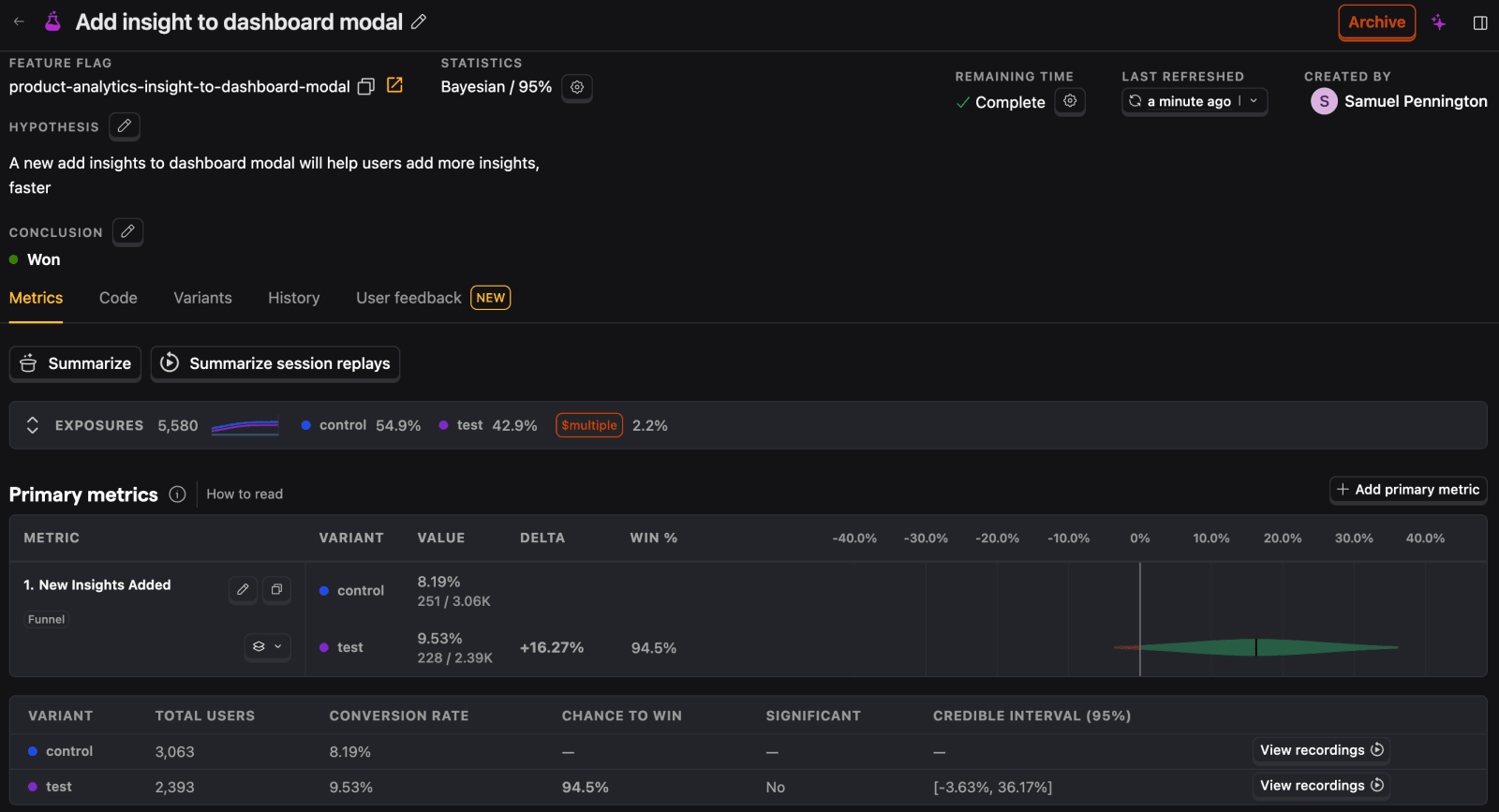
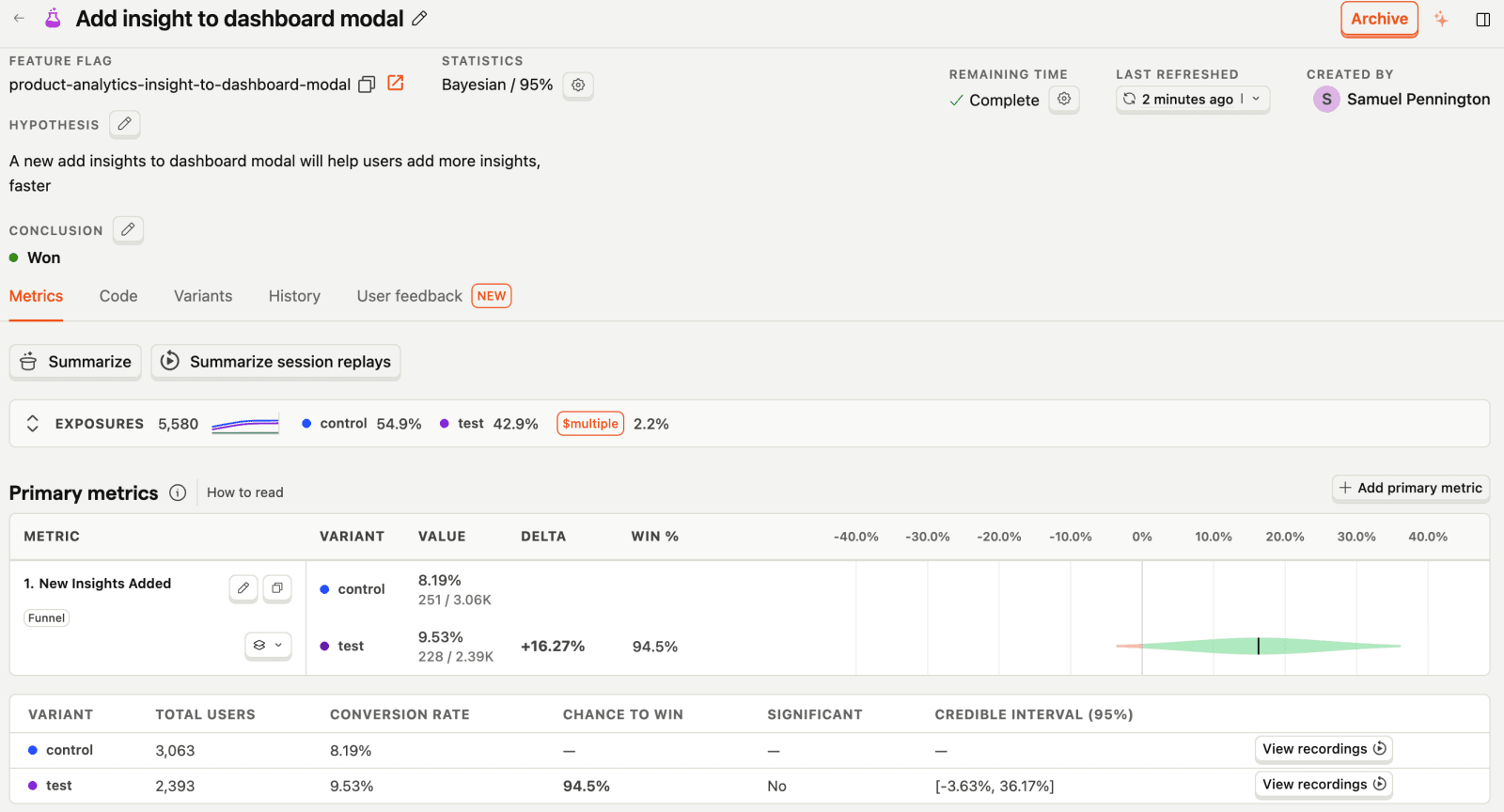
PostHog ExperimentsPostHog Experiments

PostHog is an all-in-one developer platform that integrates a comprehensive A/B testing suite with many other tools, such as Product Analytics, Feature Flags, Session Replay, Error Tracking, and more. It's designed for product-minded engineers, growth teams, and product managers who need to move fast and iterate based on reliable, actionable insights.

PostHog’s experimentation suite supports multivariate experiments, and targeting by geography, user cohorts, and person properties – all of which is built atop PostHog's multivariate feature flags. PostHog supports both Bayesian and Frequentist statistical approaches, so you can choose the method that fits your team's workflow.

Who is PostHog for?

PostHog is ideal for product teams and engineers, particularly those who don't want to assemble a complicated stack of analytics tools. As an all-in-one platform, PostHog includes everything a team needs to measure user behavior, test new features, and roll them out. It's also one of the best open-source session replay tools available.

Features and benefits

  • A/B and multivariate testing
  • Unlimited experiments
  • Multivariate feature flags
  • Bayesian and Frequentist statistics engines
  • Full product analytics suite
  • Ability to select segments for experiments
  • Event pipelines for integration with data warehouses
  • Traffic visualization with user path analysis

How much does PostHog cost?

Experiments are billed under feature flag requests, which are free up to 1 million requests per month alongside 1 million analytics events and 5,000 session recordings. After the free monthly allowance, you'll pay $0.0001/request, and requests cost progressively less the more you use. You can set billing limits to ensure you don't get surprise bills.

While PostHog is open source, its A/B testing features aren't included in the open source release – you'll need the free cloud tier to access them.

Bottom line

For teams looking for all the tools they need to experiment and improve their products, PostHog is a great choice. This is especially true for startups and scaleups thanks to its generous free tier.

Further reading: New to A/B testing? Read a software engineer's guide to A/B testing and our guide to common A/B testing mistakes. Looking for mobile testing tools? See our guide to the best mobile app A/B testing tools.
GrowthBook - best open source ab testing tools

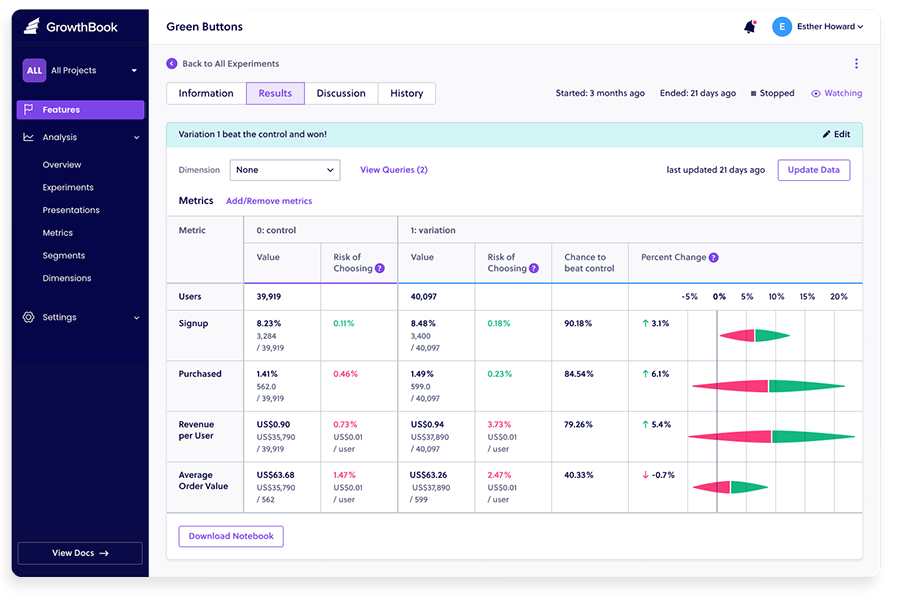
GrowthBook is an open-source platform for feature flags and A/B tests that helps teams to deploy code efficiently and analyze experiments. Built by engineers who wanted better insights on new releases, it is a modular solution that promotes feature flagging as an essential step in the development process. This means it can be used as a full-stack platform, a plugin feature flagging tool, or an analysis engine.

Who is GrowthBook for?

GrowthBook is built for data, engineering, and product teams who need the power of a customizable platform without having to build it in house.

Features and benefits

  • Warehouse-native architecture – connects directly to BigQuery, Redshift, Snowplow, and more
  • Both Bayesian and Frequentist statistics engines with CUPED variance reduction
  • Visual A/B test editor for no-code experiments (Pro plan)
  • Multi-arm bandits and safe rollouts (Pro plan)
  • Lightweight SDKs for speed
  • Easy to implement – no need for data or engineering resources
  • Self-hosted and managed options available

How much does GrowthBook cost?

GrowthBook open source (MIT license) is free and includes unlimited experiments. Their cloud Starter plan is free for up to 3 users with unlimited experiments. The Pro cloud plan costs $40 per user per month and adds advanced statistics (CUPED, sequential testing), a visual A/B test editor, and multi-arm bandits.

Bottom line

GrowthBook is the best choice for data and engineering teams that already have a data warehouse and want to run experiments on top of their existing infrastructure. Its warehouse-native approach means you never have to send raw user data to a third party.
Unleash - best open source ab testing tools

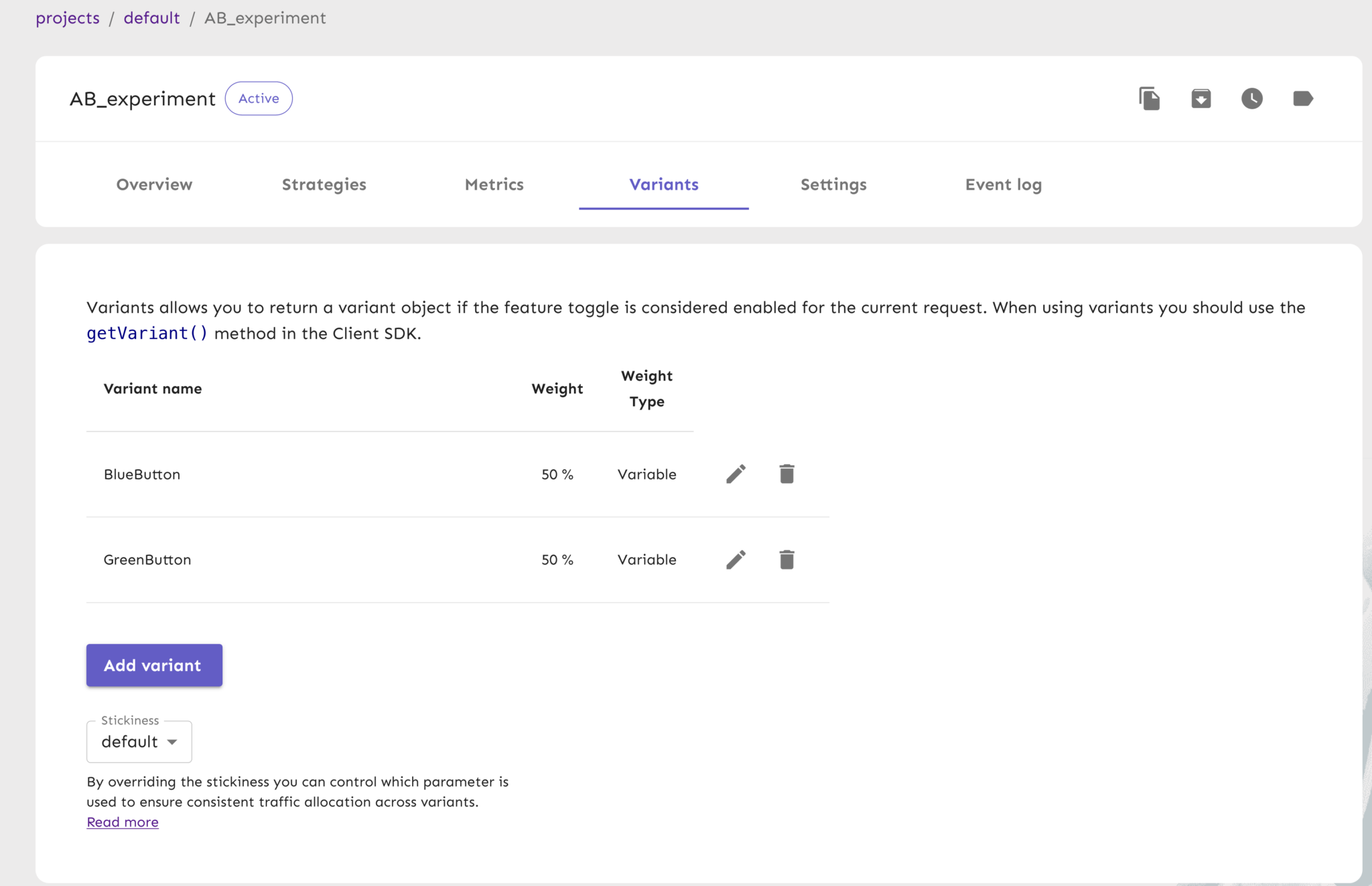
Unleash is a feature management platform that provides an overview of all features across your applications and services. The platform empowers engineering teams to implement A/B tests via feature toggles and offers accurate user targeting. It's particularly popular with privacy-conscious organizations since it doesn't require you to share user data with third parties.

You can use Unleash to define the rules of your experiments, but the platform doesn’t provide all the tools you need to manage A/B tests end-to-end. Instead, you'll need to connect your experiment with an analytics platform like PostHog, Google Analytics or Mixpanel in order to visualize results.

Who is Unleash for?

Unleash is for autonomous development teams who want a lightweight way to test, validate, and rollout new features safely.

Features and benefits

  • Accurate user targeting
  • Fast toggle evaluation, so performance issues are spotted fast
  • Extensive APIs
  • 25+ official SDKs covering all major languages and frameworks
  • Privacy-first architecture (no user PII leaves your infrastructure)
  • Integrations with Jira, Datadog, Microsoft Teams, and Slack
  • Self-hosted and managed service available

How much does Unleash cost?

Unleash's open source self-hosted plan is free with unlimited feature flags and experiments. A self-service Enterprise plan starts at $75 per seat per month with a 5-seat minimum, available as cloud-hosted or self-hosted. Custom Enterprise pricing is available for teams that want annual contracts and dedicated support.

Bottom line

Unleash is the best open-source option for teams that primarily need feature flag management and want to add basic A/B testing on top.
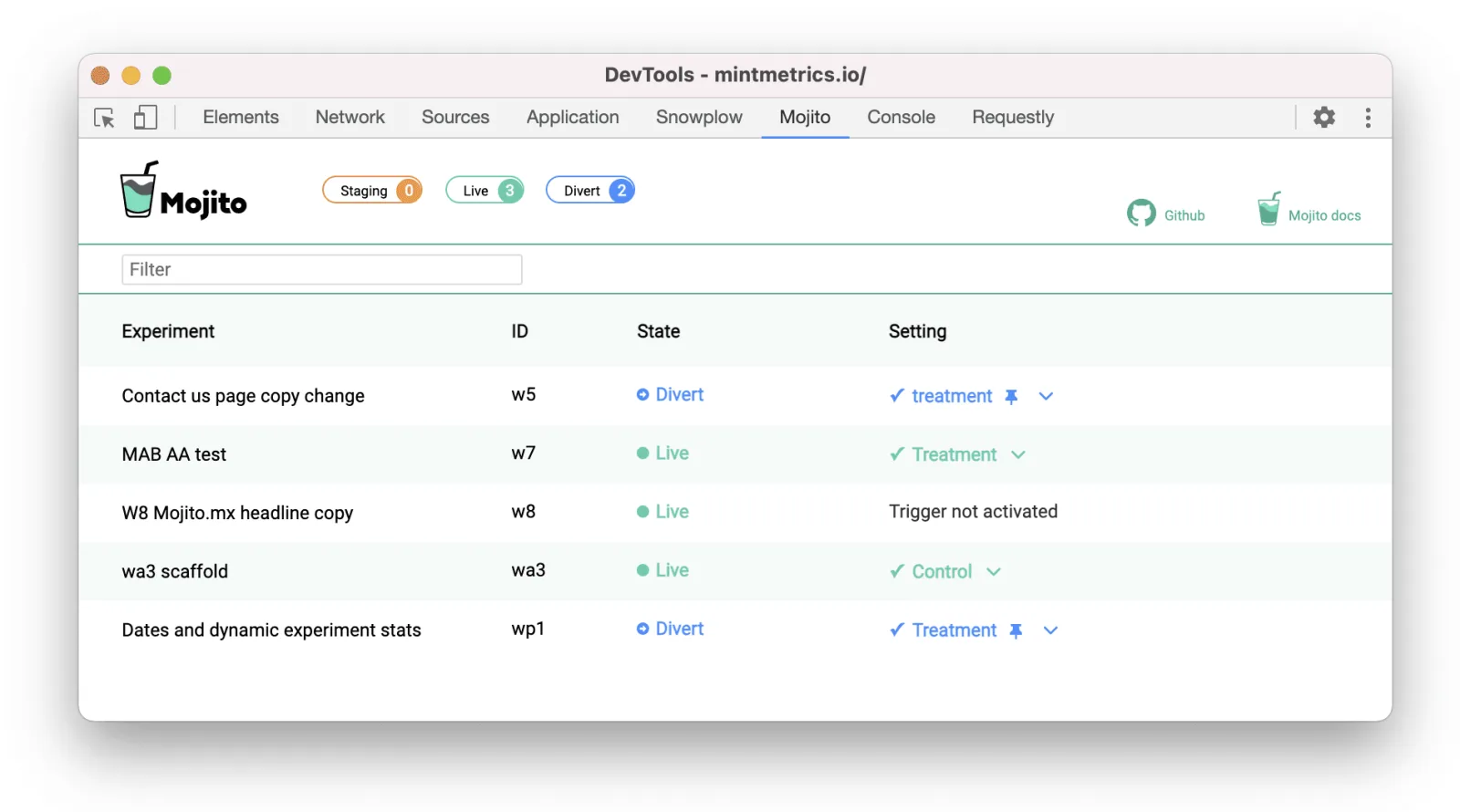
Mojito - best open source ab testing tools

Mojito is an open source split testing stack that lets you build, launch, and analyze experiments via Git/CI. The stripped-down tool consists of three modular components – a front-end library for bucketing users and tracking them, data models and events for fast reporting, and reporting templates and functions, so you can build your own visualizations for experiment analysis.

It's worth noting that Mojito is maintained by a small consultancy and has a slower development cadence than the other tools on this list. That said, its simplicity is part of the appeal – it's a lightweight, dependency-free option for teams that want full source control over their testing stack.

Who is Mojito for?

Mojito is a fully source-controlled stack for developers and technical product teams who want a simple solution with unlimited customization.

Strengths

  • Simple APIs and unlimited customization
  • No need for 3rd party analytics
  • ~5kb front-end library for minimal page load impact
  • Error tracking and handling
  • No account required – deploy from your own infrastructure
  • Lightweight solution for optimized page load speed

How much does Mojito cost?

Mojito is completely free and open source, and you don’t need an account to get started. It's distributed under a BSD 3-clause license.
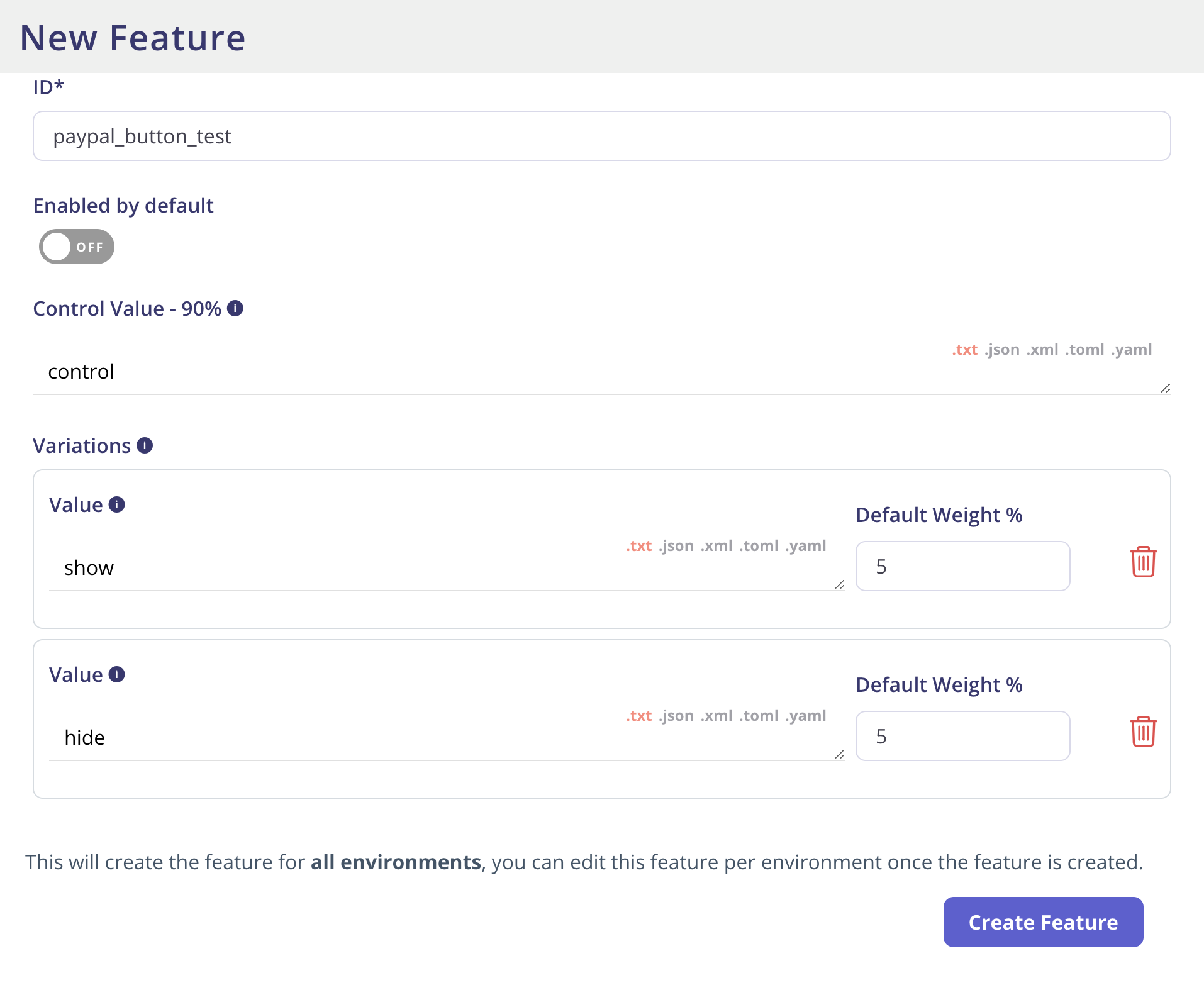
Flagsmith - best open source ab testing tools

Flagsmith is an open-source feature flag and remote configuration service that lets you manage features across mobile, web and server-side applications. You can use Flagsmith’s multivariate flags as a bucketing engine to place users into testing buckets and control the specific user experience that is being tested. Flagsmith doesn’t provide analytics for multivariate tests, however, so you’ll need to use a third-party provider to receive the stream of event data derived from the behavior of the user.

Who is Flagsmith for?

Flagsmith is targeted at data-driven front end and user experience teams who want to increase efficiency in their feature development.

Features and benefits

  • Manage flags across multiple platforms
  • Powerful segmenting rules
  • Integrations with a number of popular analytics platforms
  • Remote configuration allows you to toggle features without changing code
  • On-premises hosting for maximum infrastructure control
  • Integrations with Amplitude, Heap, Mixpanel, and more for analytics

How much does Flagsmith cost?

Flagsmith is open source and available on a BSD 3-clause license. It can be hosted entirely on-premises with pricing available on request. Their cloud free plan includes up to 50,000 requests per month for 1 team member with unlimited flags, environments, and segments. The Start-Up cloud plan is $45 per month for up to 1 million requests.

  • Want an all-in-one platform that integrates A/B testing with product analytics, session replays, feature flags, and more? Go with PostHog.
  • Already have a data warehouse and want to run experiments on top of your existing data? Choose GrowthBook.
  • Primarily need feature flag management with basic A/B testing and a privacy-first architecture? Unleash is your best bet.
  • Need open-source feature flags with remote configuration and on-premises hosting? Try Flagsmith.
  • Want a minimalist, fully source-controlled split testing stack with zero vendor dependencies? Mojito is for you.

Is PostHog right for you?

Here's the (short) sales pitch.

We're biased, obviously, but we think you'll love PostHog if:

  • You value transparency (we're open source and open core)
  • You want tools to ship, track, and analyze new features – like A/B testing, feature flags, and session replays
  • You want try before you buy (we're self-serve with a generous free tier)

It's completely free to get started – no credit card required. Our setup wizard handles configuration in minutes, or you can check out our docs to do it yourself.

What is the best free A/B testing tool?

It depends on what you need.

PostHog is the best option for product teams that want experimentation alongside product analytics, session replay, and feature flags in one platform – its free tier includes 1 million feature flag requests per month.

GrowthBook is the best choice for teams that already have a data warehouse and want a dedicated, warehouse-native experimentation tool – it's completely free to self-host with no limits. If you're looking for more options beyond open source, check out our guide to the best mobile app A/B testing tools.

What's the difference between feature flags and A/B testing?

Feature flags let you toggle features on or off for specific users without deploying new code. A/B testing uses feature flags to randomly split users into groups (variants) and then measures which variant performs better against a goal metric.

In practice, most A/B testing tools on this list – PostHog, GrowthBook, Unleash, Flagsmith – are built on top of a feature flagging engine. The distinction matters because tools like Unleash and Flagsmith are primarily feature flag tools that can be used for A/B testing, while PostHog and GrowthBook provide end-to-end experimentation with built-in statistical analysis.

Is GrowthBook really free?

Yes, with caveats. GrowthBook's self-hosted open-source version (MIT license) is genuinely free with unlimited users, experiments, and feature flags. The cloud-hosted Starter plan is free for up to 3 users. If you need advanced features like CUPED variance reduction, a visual editor, or multi-arm bandits, you'll need the Pro plan at $40/user/month.

Can you do A/B testing without code?

Some tools on this list offer visual editors that let you set up web experiments without writing code. GrowthBook includes a visual A/B test editor on its Pro plan. For fully no-code A/B testing, you'll likely want a marketing-focused tool like VWO or Optimizely instead, though these are neither free nor open source.

You can also use a combination of an AI agent and MCP to help you do this.

Do I need a separate analytics tool with open-source A/B testing?

It depends on the tool. PostHog includes full product analytics alongside experimentation, so you don't need anything else. GrowthBook is warehouse-native and pulls experiment results from your existing data warehouse, so you'll need an analytics pipeline already in place. Unleash and Flagsmith are primarily feature flag tools – you'll need a separate analytics platform (like PostHog, Google Analytics, or Mixpanel) to analyze your experiment results. Mojito includes its own reporting templates but requires you to set up a data storage layer.

What's the difference between Bayesian and Frequentist A/B testing?

These are two statistical approaches for analyzing experiment results.

  • Frequentist testing uses p-values and confidence intervals – you define a sample size upfront, run the test, and check if results are statistically significant at the end.

  • Bayesian testing calculates the probability that one variant is better than another and updates continuously as data comes in, making it easier to interpret mid-experiment.

PostHog and GrowthBook support both approaches. Most other open-source tools on this list don't include built-in statistical analysis at all – you'll need to calculate significance yourself or use a separate tool.

Can I self-host an A/B testing tool?

Yes – that's one of the main advantages of open-source A/B testing tools. GrowthBook offer both cloud and self-hosted options with full experimentation features. Unleash and Flagsmith can be self-hosted for free with their open-source editions. Mojito is self-hosted only. Self-hosting gives you complete control over your data, which is particularly important for teams with strict privacy requirements or regulatory compliance needs.

Subscribe to our newsletter

Product for Engineers

Read by 100,000+ founders and builders

We'll share your email with Substack