


惯性聚合 高效追踪和阅读你感兴趣的博客、新闻、科技资讯
阅读原文 在惯性聚合中打开

推荐订阅源

Y
Y Combinator Blog
The GitHub Blog
The GitHub Blog
云风的 BLOG
云风的 BLOG
Engineering at Meta
Engineering at Meta
Google DeepMind News
aimingoo的专栏
aimingoo的专栏
Recent Announcements
A
About on SuperTechFans
U
Unit 42
MyScale Blog
MyScale Blog
J
Java Code Geeks
博客园_首页
Blog — PlanetScale
Blog — PlanetScale
D
Docker
Microsoft Azure Blog
博客园 - 司徒正美
量子位
月光博客
月光博客
G
Google Developers Blog
V
V2EX
博客园 - 聂微东
宝玉的分享
宝玉的分享
IT之家
IT之家
Vercel News
Vercel News

Let's Encrypt

The difficulty of making sure your website is broken Simplifying Certificate Renewals for Millions of Domains with ACME Renewal Information (ARI) Six-Day and IP Address Certificates Available in Certbot Shorter Certificate Lifetimes and Rate Limits DNS-PERSIST-01: A New Model for DNS-based Challenge Validation On the Importance of "Hello" and "Thanks" 6-day and IP Address Certificates are Generally Available 10 Years of Let's Encrypt Certificates Decreasing Certificate Lifetimes to 45 Days New "Generation Y" Hierarchy of Root and Intermediate Certificates Ten Years of Community Support ACME Renewal Information (ARI) Published as RFC 9773 Native ACME Support Comes to NGINX End of Life Plan for RFC 6962 Certificate Transparency Logs OCSP Service Has Reached End of Life We've Issued Our First IP Address Certificate Expiration Notification Service Has Ended Reflections on a Year of Sunlight How We Reduced the Impact of Zombie Clients Sustaining a More Secure Internet: The Power of Recurring Donations Ending TLS Client Authentication Certificate Support in 2026 How Pebble Supports ACME Client Developers Ten Years of Let's Encrypt: Announcing support from Jeff Atwood We Issued Our First Six Day Cert Encryption for Everybody Scaling Our Rate Limits to Prepare for a Billion Active Certificates Ending Support for Expiration Notification Emails Announcing Six Day and IP Address Certificate Options in 2025 Announcing Certificate Profile Selection Ending OCSP Support in 2025
Let's Encrypt Root to be Trusted by Mozilla
2016-08-05 · via Let's Encrypt

By Josh Aas, ISRG Executive Director ·

The Let’s Encrypt root key (ISRG Root X1) will be trusted by default in Firefox 50, which is scheduled to ship in Q4 2016. Acceptance into the Mozilla root program is a major milestone as we aim to rely on our own root for trust and have greater independence as a certificate authority (CA).

Public CAs need their certificates to be trusted by browsers and devices. CAs that want to issue independently under their own root accomplish this by either buying an existing trusted root, or by creating a new root and working to get it trusted. Let’s Encrypt chose to go the second route.

Getting a new root trusted and propagated broadly can take 3-6 years. In order to start issuing widely trusted certificates as soon as possible, we partnered with another CA, IdenTrust, which has a number of existing trusted roots. As part of that partnership, an IdenTrust root “vouches for” the certificates that we issue, thus making our certificates trusted. We’re incredibly grateful to IdenTrust for helping us to start carrying out our mission as soon as possible.
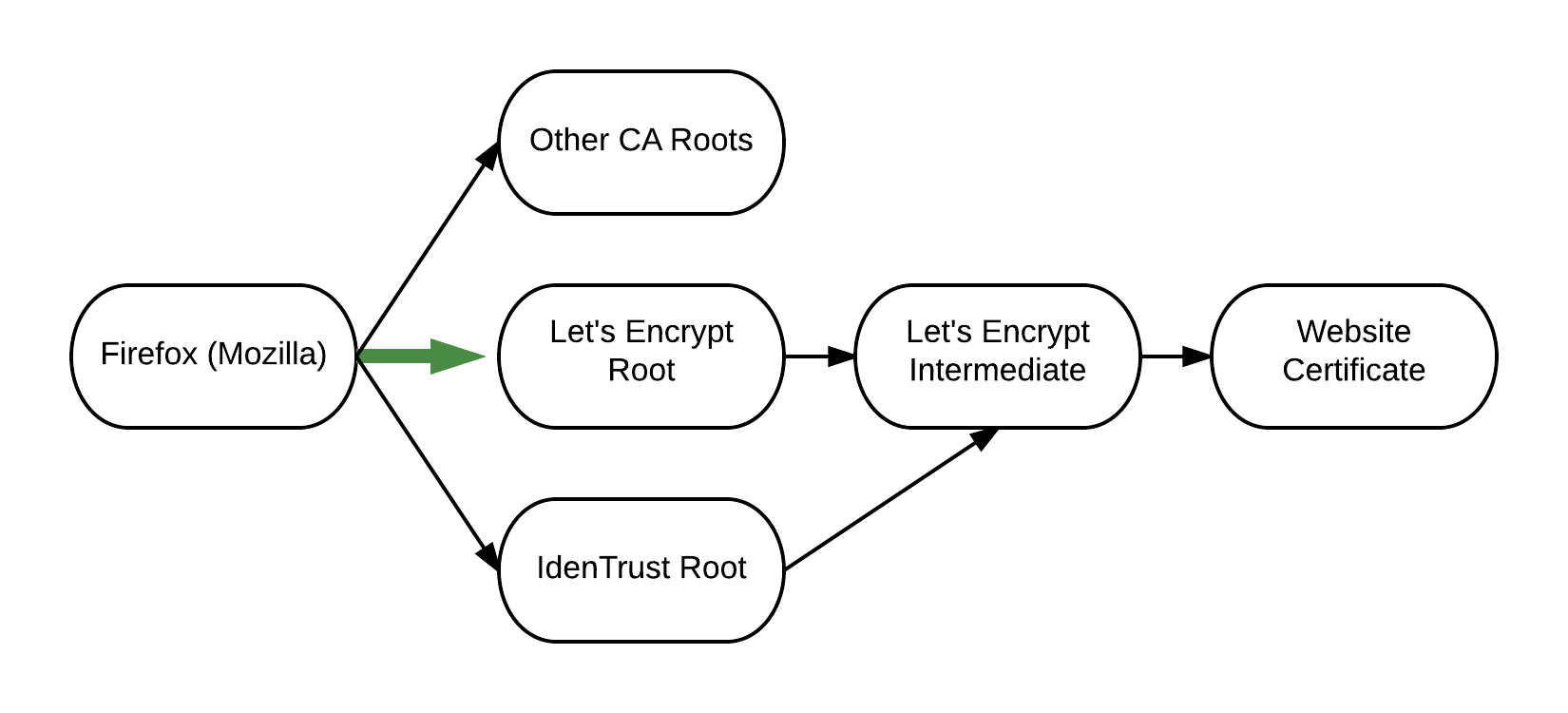
Chain of trust between Firefox and Let's Encrypt certificates.
Chain of Trust Between Firefox and Let's Encrypt Certificates

However, our plan has always been to operate as an independently trusted CA. Having our root trusted directly by the Mozilla root program represents significant progress towards that independence.

We have also applied to the Microsoft, Apple, Google, Oracle and Blackberry root programs. We look forward to acceptance into these programs as well.

Let’s Encrypt depends on industry and community support. Please consider getting involved, and if your company or organization would like to sponsor Let’s Encrypt please email us at sponsor@letsencrypt.org.