

The Chips Got Faster. The Stack Didn't.
Explore why faster chips have shifted the bottleneck to AI infrastructure, and what that means for teams running production workloads.
All





Runpod introduces Configurable Templates, a powerful feature that allows users to easily deploy and run any large language model.
With this feature, users can provide the Hugging Face model name and customize various template parameters to create tailored endpoints for their specific needs.
Configurable Templates offer several benefits to users:
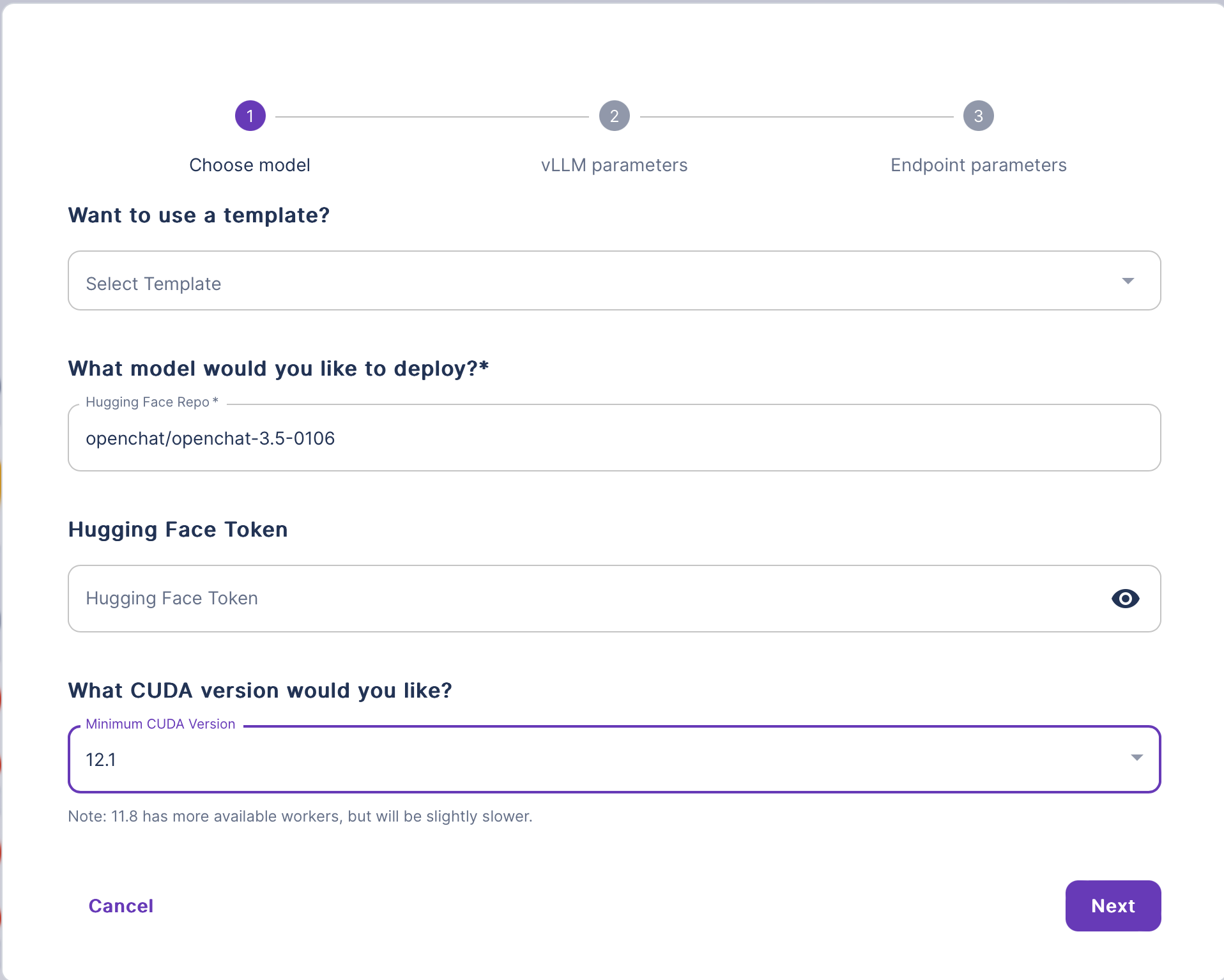
Follow these steps to deploy a large language model using Configurable Templates:
Once the deployment is complete, your LLM will be accessible via an Endpoint. You can interact with your model using the provided API.
💡
Runpod supports any model architecture that can run on vLLM with configurable templates.
By integrating vLLM into the Configurable Templates feature, Runpod simplifies the process of deploying and running large language models. Users can focus on selecting their desired model and customizing the template parameters, while vLLM takes care of the low-level details of model loading, hardware configuration, and execution.
Author profile: Brendan McKeag
Explore why faster chips have shifted the bottleneck to AI infrastructure, and what that means for teams running production workloads.
All
.jpeg)
With MIG, we can partition RTX 6000 Pro cards into isolated 24 GB instances. Here's when it makes sense for your workloads.
All
.jpeg)
How 1,100 researchers beat OpenAI's own baseline with 16 megabytes and 10 minutes.
All
Build, train, and scale AI workloads on Runpod with cloud GPUs, Serverless, and Clusters.

此内容由惯性聚合(RSS阅读器)自动聚合整理,仅供阅读参考。 原文来自 — 版权归原作者所有。