





More than 300 humanoid robots participating in China's second robot half-marathon on Sunday will be facing tougher terrain designed to test their technical advancements, as Beijing seeks to develop the industry into a major pillar of its economy.
Over 70 teams, almost five times as many as last year, will be competing in the 21 km (13 miles) race in Beijing that includes paved slopes and parkland.
"It will certainly be interesting to see the progress in durability of components and battery lifetime compared to last year," said Georg Stieler, Asia managing director and head of robotics at Stieler, a technology consultancy.
"Humanoid robot makers need to find a balance between quality in products which are still under constant evolution and price pressure."
 |
|
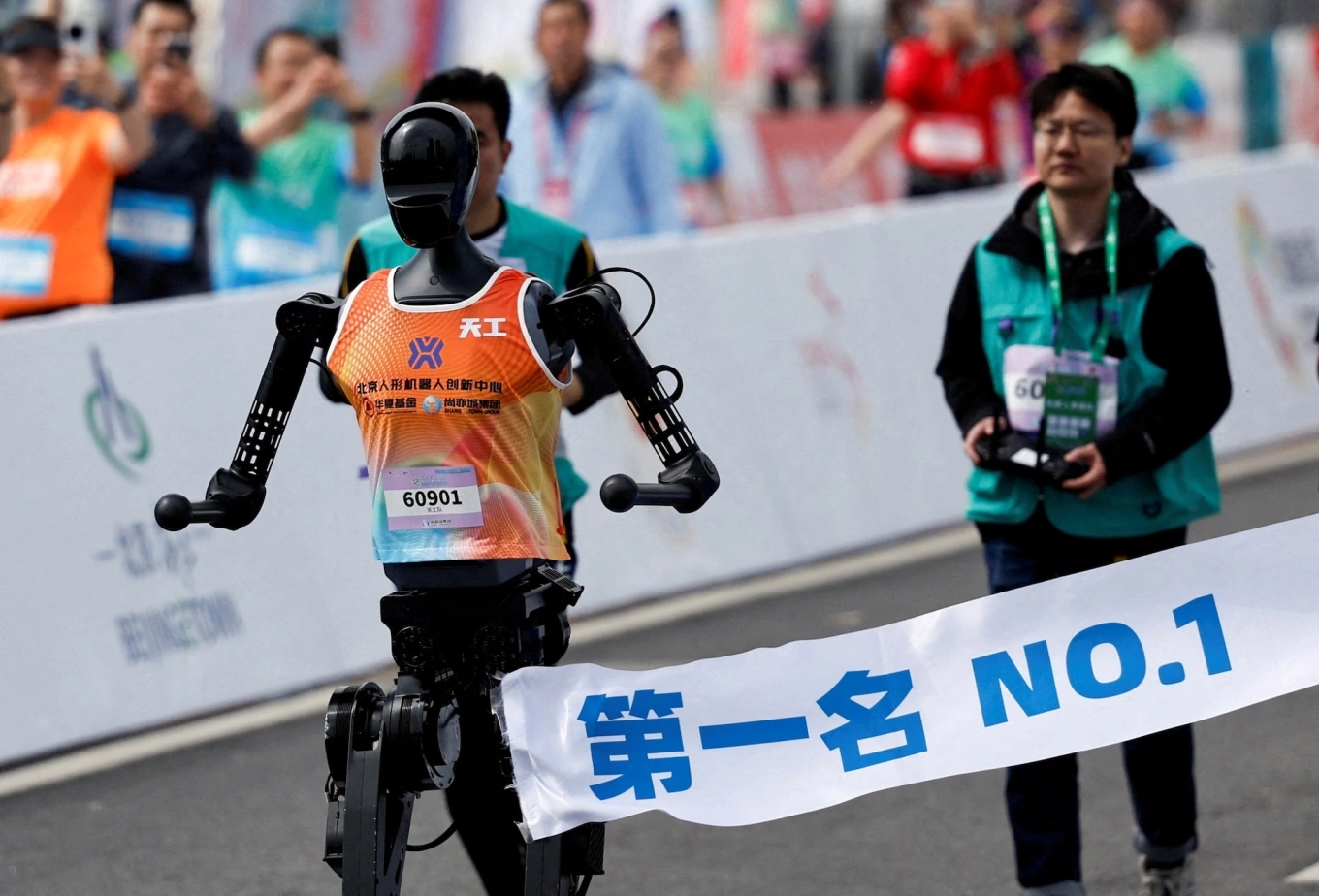
Tiangong Ultra, a humanoid robot, runs across the finish line while securing the first position during the E-Town Humanoid Robot Half Marathon, in Beijing, China, April 19, 2025. Photo by Reuters |
While all of last year's entrants were remotely controlled, this time almost 40% of the robot participants will navigate the course autonomously, the organisers have said, in a high-profile demonstration of the industry's growing capabilities. But the event is also likely to highlight the challenges Chinese firms face as they try to create robots that can effectively mimic human movement and performance.
In last year's race some robots crashed and fell near the starting line, while the winning Tiangong Ultra model, developed by the state-backed Beijing Innovation Center of Humanoid Robotics in collaboration with UBTech, finished in 2 hours and 40 minutes, comfortably ahead of its humanoid rivals but more than double the time of the human winner of the conventional race.
Tiangong Ultra will navigate "fully autonomously" this year, relying solely on its sensors to avoid obstacles, and closely mimic the human gait through large-scale data simulation training, the Center of Humanoid Robotics said in a statement.
"When the robot runs at speeds approaching those of professional human athletes, the time window for perception and decision-making is extremely short, placing very high demands on computing power, algorithms, and system response speed," it said.
Social media videos of the robots training in Beijing at night this month showed some models successfully imitating human running and reaching speeds of 14 km per hour, but others' movements were more jerky and some fell over or crashed into railings, suggesting they might struggle to make it to the finishing line.
China dominates global humanoid robot installations, accounting for more than 80% of the 16,000 units installed worldwide in 2025, according to Counterpoint Research. The top U.S. vendor, Tesla, only accounted for 5% of global humanoid installations, the report said.
Domestic market leaders AgiBot and Unitree each shipped more than 5,000 units last year - the highest globally - while Unitree has pledged to expand production capacity to 75,000 humanoid robots annually.
'Dancing disguised as working'
While the half-marathon might make for entertaining viewing, experts say the skills on display do not translate to the widespread commercialisation of humanoid robots in industrial settings, where manual dexterity, real-world perception and capabilities beyond small-scale, repetitive tasks are crucial.
Currently, Unitree's humanoid models are primarily used by research institutions, for dance performances and as interactive guides in service establishments, according to its IPO prospectus.
And while some humanoids might be able to complete a half-marathon, even in China they remain years away from widespread domestic or industrial deployment, experts say.
"The reason our applications aren't taking off is that the robots' IQ is too low. The models are poor, their success rates are low," said Tang Wenbin, founder of embodied intelligence startup Yuanli Lingji at a Beijing tech forum last month.
"Honestly, the whole industry's level is still at a very elementary stage ... Right now, a lot of what we see is 'dancing disguised as working'."
The Chinese government has named embodied intelligence, or physical AI, as one of the key industries it wants to nurture as it looks to automation to boost economic productivity and upgrade traditional manufacturing.
Chinese robotics firms are still struggling to develop the AI software that would enable humanoids to match the efficiency of human factory workers, while components manufacturers are contending with cost pressures, analysts said.
As they seek to improve the software, firms are ploughing resources into large-scale real-world data collection, using human workers fitted with sensors and deploying more humanoids to factory floors.
In 2024, UBTech had fewer than 10 humanoids in factories. Last year, that number jumped to more than 1,000.
This year, it aims to launch 10,000 full-size humanoid robots, including new models tailored for a variety of commercial settings, Chief Business Officer Michael Tam said during a media tour to the company’s Shenzhen showroom in southern China.
"When we talk about AI, it relies on how much data, especially high-quality data, we can collect," he said.
此内容由惯性聚合(RSS阅读器)自动聚合整理,仅供阅读参考。 原文来自 — 版权归原作者所有。