


Google’s AI Overview has been around for a while, and honestly, I don’t find it merely useless. I find it harmful.
It is supposed to save time, but it often does the opposite. Instead of trusting the answer, I have to verify every claim and figure out which parts are accurate. That adds another layer of work to what should have been a simple search.
For example, I searched:
“delete PocketBase table delete uploaded data”
This was the AI Overview’s response:
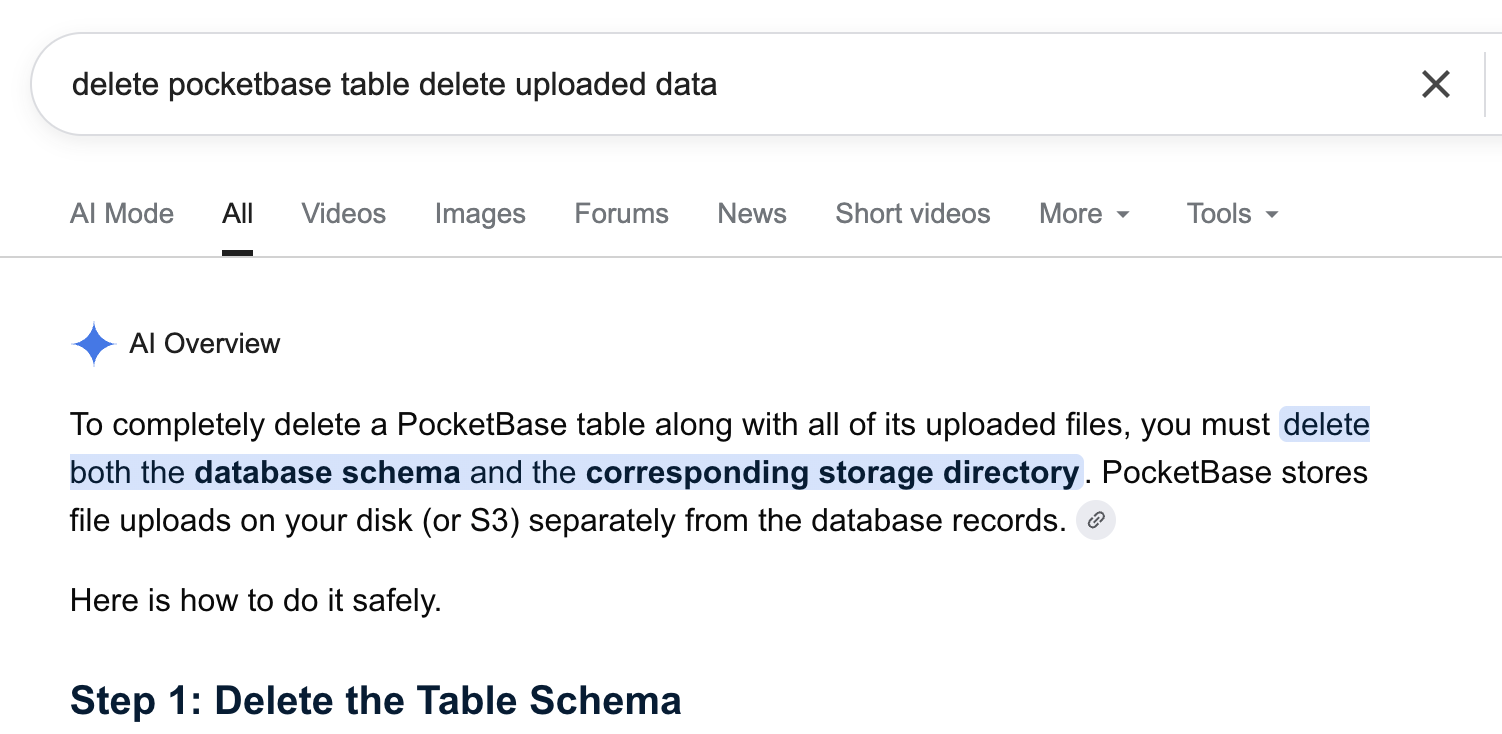
It told me that deleting the table and its related uploaded files required two separate steps. In reality, PocketBase automatically deletes the associated resources.
Had I followed Google’s instructions, I could have wasted several minutes looking for an extra step that did not exist.
The strangest part is how easily the answer changes when challenged. If you tell the AI that it is wrong, it often apologizes and then confidently replaces its previous answer with something completely different—even when the new answer is also wrong.
Here is another example involving agy’s turbo mode:
Me: Search “agy turbo mode” using Google.
Google AI: Useagy run --turbo "your prompt here".Me: That doesn’t work.
Google AI: Actually, the parameter is--dangerously-skip-permissions.Me: I mocked it for hallucinating.
Google AI: There is no CLI tool called Google Antigravity, or agy.Me: Are you sure?
Google AI: Google Antigravity is a real CLI tool, and--dangerously-skip-permissionsis the correct flag.Me: You’re a joke.
Google AI: There is no CLI flag in agy that bypasses permissions.
This is not simply an incorrect answer. It is a sequence of contradictory answers, each delivered with the same level of confidence.
And it gets worse: the AI Overview can change every time you run the same search. The result feels like an outdated, unreliable model that is willing to search but unable to synthesize information consistently.
Google’s problems also extend beyond AI Overviews.
Perhaps the clearest warning sign is how many of the researchers behind Google’s greatest AI breakthroughs have left the company. Google introduced the transformer architecture in its landmark 2017 paper, Attention Is All You Need, laying the foundation for today’s large language models. now all eight authors of that paper had left Google.
People leave successful companies all the time, and not every departure means something is broken. But there is an uncomfortable pattern here: Google helped invent much of the technology powering the current AI boom, yet many of the people responsible for those breakthroughs chose to build its next chapter somewhere else.
That suggests Google’s AI problem is not only about model quality. It may also be about execution, culture, product judgment, and the company’s ability to turn world-class research into products people genuinely want to use.
Its flagship models now appear to be under increasing pressure from competitors. Models such as Kimi K3, DeepSeek V4 Flash challenge Google on capability, price, or both. According to Artificial Analysis, GPT-5.6 Luna performs better than Gemini 3.6 Flash while costing less than Gemini 3.5 Flash-Lite.
Google was expected to release Gemini 3.5 Pro in July, but the release never arrived. Now, the company appears to have shifted its attention toward Gemini 4.
The message almost feels like this:
As long as I never release it, I never really failed.
The Gemini app is another weak point. Compared with ChatGPT and Claude, its interface and overall user experience feel uninspired. It lacks polish, personality, and the sense of enjoyment that makes people want to return to a product.
This screenshot is from an earlier version:
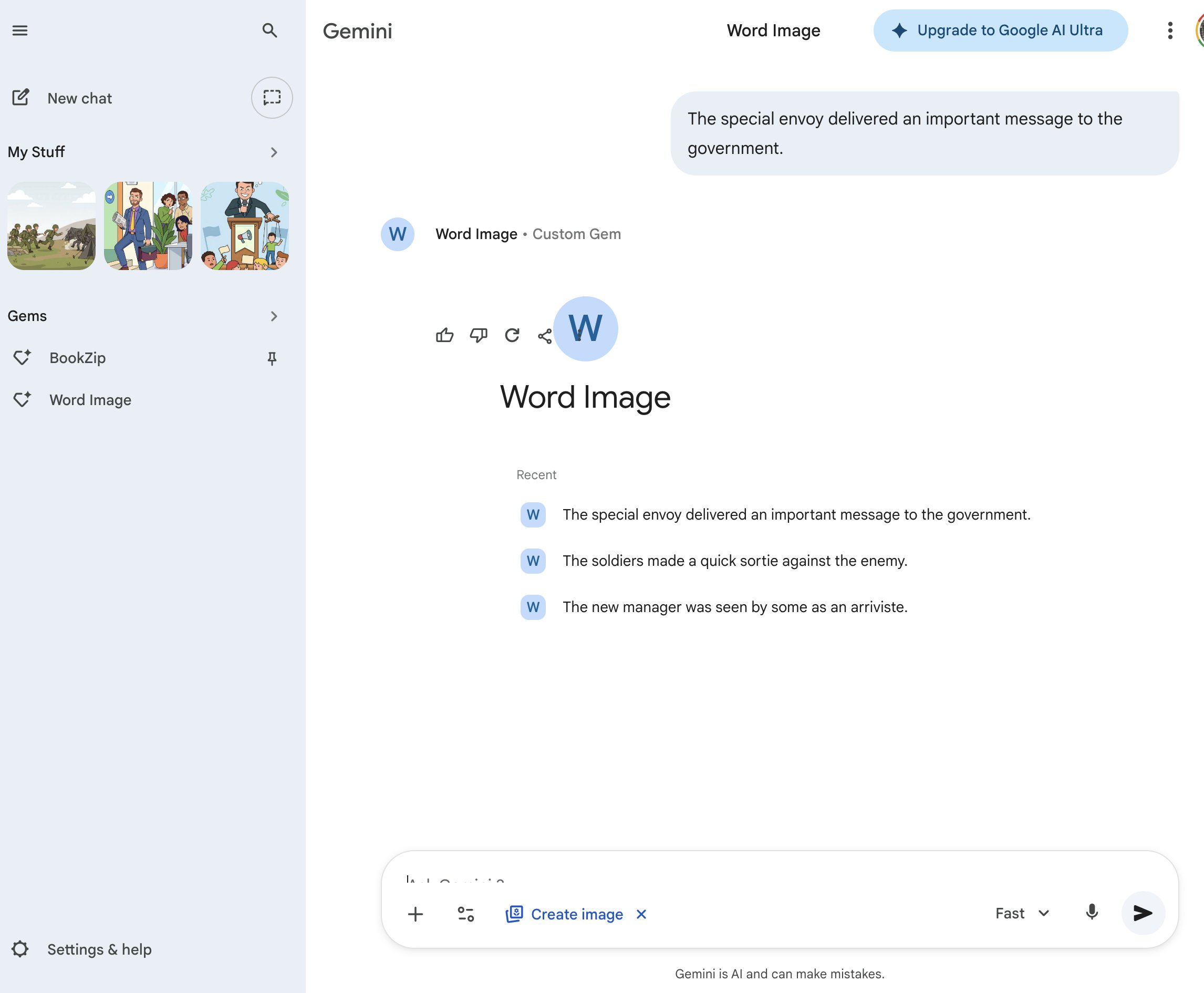
To be fair, Google has improved the app significantly since then. But the core experience still has not changed for me. Whenever I think about opening Gemini, my first instinct is to avoid it unless I have no other choice.
That is why I believe Google is in trouble.
The company still has enormous resources, talent, distribution, infrastructure, and some of the most important AI research in history. But those advantages do not automatically produce a trustworthy or enjoyable AI product.
Google helped invent the future. The problem is that other companies currently seem better at turning that future into something people actually want to use.
Can Gemini 4 change that?
We will see.