


惯性聚合 高效追踪和阅读你感兴趣的博客、新闻、科技资讯
阅读原文 在惯性聚合中打开

推荐订阅源

Hacker News: Ask HN
Hacker News: Ask HN
WordPress大学
WordPress大学
GbyAI
GbyAI
T
Tailwind CSS Blog
Know Your Adversary
Know Your Adversary
小众软件
小众软件
Security Latest
Security Latest
博客园 - 聂微东
P
Privacy International News Feed
L
Lohrmann on Cybersecurity
爱范儿
爱范儿
云风的 BLOG
云风的 BLOG
阮一峰的网络日志
阮一峰的网络日志
C
Cyber Attacks, Cyber Crime and Cyber Security
博客园 - 叶小钗
Last Week in AI
Last Week in AI
The Register - Security
奇客Solidot–传递最新科技情报
奇客Solidot–传递最新科技情报
V
Vulnerabilities – Threatpost
Jina AI
Jina AI
AWS News Blog
AWS News Blog
L
LINUX DO - 热门话题
D
Darknet – Hacking Tools, Hacker News & Cyber Security
NISL@THU
NISL@THU
Spread Privacy
Spread Privacy
Google DeepMind News
P
Palo Alto Networks Blog
S
Schneier on Security
H
Hackread – Cybersecurity News, Data Breaches, AI and More
Cyber Security Advisories - MS-ISAC
T
The Exploit Database - CXSecurity.com
月光博客
月光博客
C
CERT Recently Published Vulnerability Notes
G
GRAHAM CLULEY
N
Netflix TechBlog - Medium
量子位
K
Kaspersky official blog
T
Threatpost
Latest news
Latest news
The Cloudflare Blog
MyScale Blog
MyScale Blog
C
Cisco Blogs
T
Tor Project blog
S
Securelist
Cisco Talos Blog
Cisco Talos Blog
The GitHub Blog
The GitHub Blog
A
Arctic Wolf
T
Threat Research - Cisco Blogs
H
Help Net Security
C
CXSECURITY Database RSS Feed - CXSecurity.com

Kotlin : A concise multiplatform language developed by JetBrains | The JetBrains Blog

Kotlin Turns 15: Celebrate the Kotlin Effect - The JetBrains Blog The History of Kodee, Kotlin’s Mascot - The JetBrains Blog In Conversation With the Golden Kodee Winners - The JetBrains Blog Kotlin Comes to BlueJ - The JetBrains Blog Kodee’s Kotlin Roundup: Kotlin Turns 15, Kotlin 2.4.0, and the Kotlin Toolchain - The JetBrains Blog Kotlin Notebook Sunset - The JetBrains Blog Kotlin Toolchain 0.11: The Next Step for Amper - The JetBrains Blog Kotlin 2.4.0 Released | The Kotlin Blog Koog 1.0 Is Out: Stable Core, Better Interop, and Multiplatform Observability | The JetBrains AI Blog KotlinConf’26 Keynote Highlights: Advances in Language Design, Tooling, AI-Driven Workflows, and Multiplatform Development | The Kotlin Blog Introducing a Security Support Policy for the Kotlin Standard Library | The Kotlin Blog Official Kotlin Support for Visual Studio Code Is Now Available in Alpha | The Kotlin Blog Built for Productivity: What the Data Finally Shows About Kotlin | The Kotlin Blog A New Default Project Structure for Kotlin Multiplatform | The Kotlin Blog Help Shape the Future of Kotlin in the Age of AI | The Kotlin Blog Compose Multiplatform 1.11.0 Is Now Available | The Kotlin Blog The Road to Name-Based Destructuring | The Kotlin Blog JetBrains 推出的 Kotlin 专业认证现已登陆 LinkedIn Learning | The Kotlin Blog Kotlin Ecosystem Mentorship Program: Results and Winners | The Kotlin Blog Kodee’s Kotlin Roundup: Golden Kodee Finalists, Kotlin 2.4.0-Beta2, and New Learning Resources | The Kotlin Blog Next-Level Observability with OpenTelemetry | The Kotlin Blog 如何避免使用 JPA 和 Kotlin 时的常见陷阱 | The IntelliJ IDEA Blog Kotlin Professional Certificate by JetBrains – Now on LinkedIn Learning | The Kotlin Blog Helping Decision-Makers Say Yes to Kotlin Multiplatform (KMP) | The Kotlin Blog Introducing Koog Integration for Spring AI: Smarter Orchestration for Your Agents | The JetBrains AI Blog KotlinConf’26 Speakers: In Conversation With Lena Reinhard | The Kotlin Blog Kodee's Kotlin Roundup: Kotlin 2.3.20, Interview With Josh Long, and More | The Kotlin Blog Amper 0.10 – JDK Provisioning, a Maven Converter, Custom Compiler Plugins, and More | The Amper Blog KotlinConf’26 Speakers: In Conversation with Josh Long | The Kotlin Blog KotlinConf 2026: Talks to Help You Navigate the Schedule | The Kotlin Blog Google Summer of Code 2026 Is Here: Contribute to Kotlin | The Kotlin Blog Kotlin 2.3.20 Released | The Kotlin Blog Introducing Tracy: The AI Observability Library for Kotlin | The Kotlin Blog 15 Things To Do Before, During, and After KotlinConf'26 | The Kotlin Blog Java to Kotlin Conversion Comes to Visual Studio Code | The Kotlin Blog Kodee’s Kotlin Roundup: KotlinConf ’26 Updates, New Releases, and More | The Kotlin Blog Building Modular Monoliths With Kotlin and Spring | The Kotlin Blog
Introducing the Kotlin Benchmark for AI Coding Agents - The JetBrains Blog
Alyona Chernyaeva · 2026-07-08 · via Kotlin : A concise multiplatform language developed by JetBrains | The JetBrains Blog
Kotlin logo

A concise multiplatform language developed by JetBrains

AI

Introducing the Kotlin Benchmark for AI Coding Agents

Agentic coding benchmarks are getting closer to real-world software development. For Kotlin teams, the most important question is how reliably AI agents can complete end-to-end Kotlin tasks, from reading an issue to producing a solution that passes validation.

We’re taking the first step in addressing that gap by releasing the Kotlin Benchmark, JetBrains’ official benchmark for evaluating AI coding agents on Kotlin software engineering tasks. Our goal is to give developers a credible, public way to assess how different agents perform on Kotlin and compare agent setups using tasks that are closer to day-to-day dev work.

Alongside the benchmark release, we’re publishing the benchmark assets on GitHub and launching the official leaderboard to track the evaluation results.

Explore the benchmark on GitHub

See the first results on the leaderboard

How the Kotlin Benchmark works

The first public iteration of the Kotlin Benchmark is based on the SWE-bench methodology and focuses on repository-level Kotlin software engineering tasks.

Kotlin already has strong model-focused evaluation assets, including Kotlin_HumanEval and Kotlin_QA, which help measure a model’s understanding of the language’s syntax and core concepts. The Kotlin Benchmark looks at a different layer: how well an AI coding agent can complete validated software engineering tasks in existing Kotlin projects.

The dataset features 105 engineering tasks sourced from active open-source repositories. Each task requires the AI agent to interpret a real issue description, navigate the project’s context, and generate a functional patch. Solutions are strictly verified in containerized environments, and a task is only marked as resolved when the generated solution passes the required test verification.

You can read more about our environment setup and data collection on the Methodology page.

First results

The first evaluations show that leading coding agents can complete a large share of the current Kotlin Benchmark tasks. These results reflect the first public iteration of the benchmark and do not yet include the most recent model releases. We are already working on the second iteration and will update the leaderboard as newer evaluations are added.

In this run, the top result came from Claude Code with Opus 4.7 xhigh, which resolved 90 of 105 tasks, an 85.71% resolution rate. JetBrains Junie with Opus 4.7 max (81.9%) and Codex with GPT 5.5 xhigh (81.9%) followed closely.

The full leaderboard is available on kotlinlang.org/benchmark, where you can compare agents and configurations in detail.
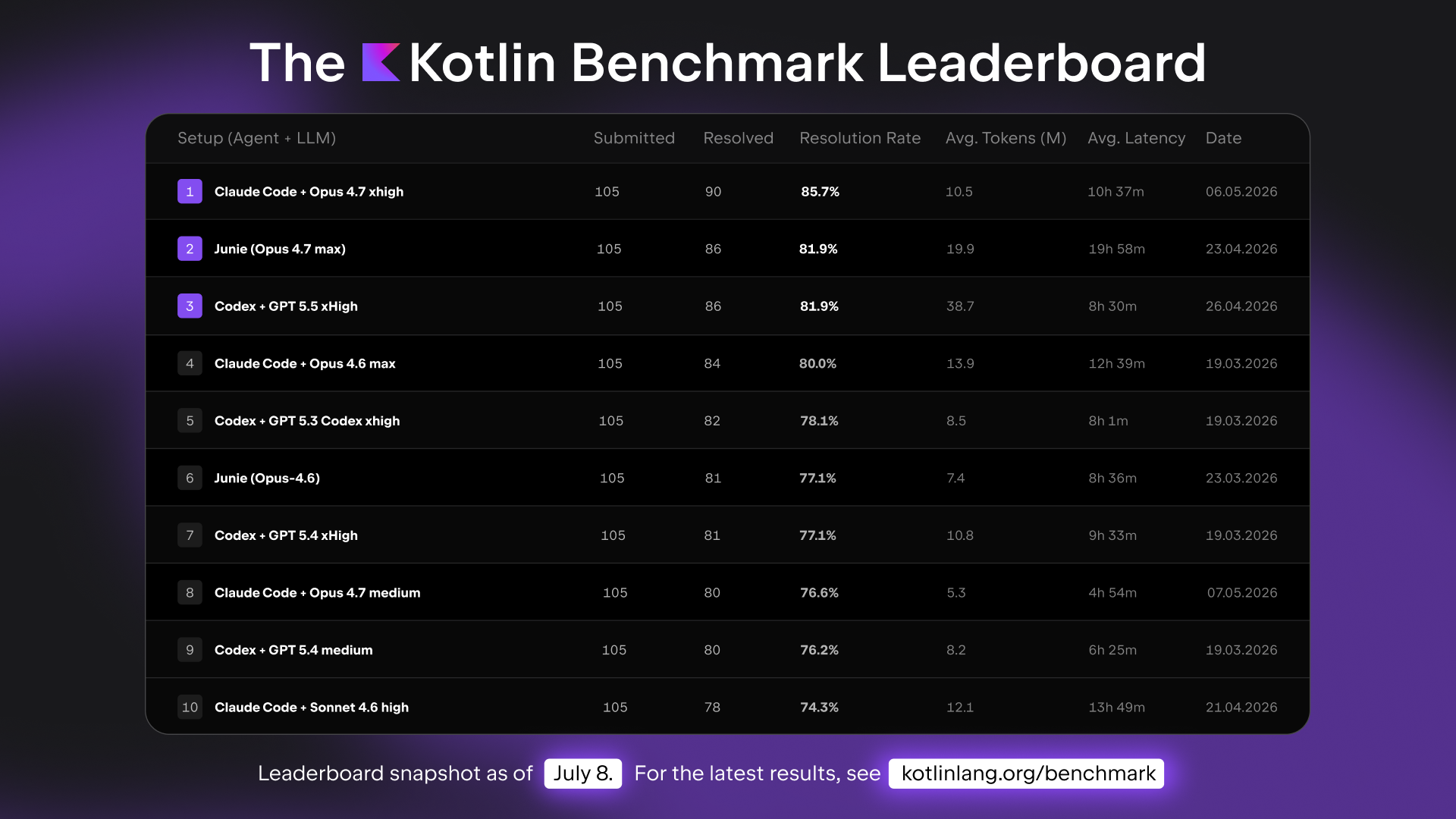
Results shown here reflect the first public iteration of the Kotlin Benchmark. The leaderboard will be updated as newer model evaluations are added.

For teams evaluating coding agents, the benchmark provides a shared frame of reference for comparing setups on Kotlin tasks instead of relying only on vendor claims. The scores are intended as a signal, not a guarantee for every codebase. Real-world results depend on your architecture, internal APIs, coding standards, tooling, and validation process.

What’s next

We value an open approach, which is why we built this benchmark on the open-source Multi-SWE-bench infrastructure and made all datasets and test harnesses publicly available.

We treat benchmarks as a continuous quality measurement pipeline. Moving forward, we plan to expand the framework in these areas:

  • Broader Kotlin ecosystem coverage: We want the task mix to better reflect how Kotlin is used in practice, including areas such as Android and Kotlin Multiplatform, and cover a wider range of task difficulty levels.
  • More evaluation metrics: Passing tests is a useful correctness signal, but it is only one part of agent evaluation. Future iterations will look at cost, performance, maintainability, and code quality.
  • More agents and model setups: We plan to evaluate more commercial agents, agent-model configurations, and open-weight models, so teams can compare a wider range of setups.

The benchmark is open, so you can inspect the tasks, compare results, and tell us which Kotlin scenarios we should cover next.

Subscribe to Kotlin Blog updates

Discover more