



Advisory: I am not a legal expert and there could likely be inaccuracies in this post.
Today Gumroad announced that they’ve become open source, with this being echoed by the founder and on social sites like Hacker News:
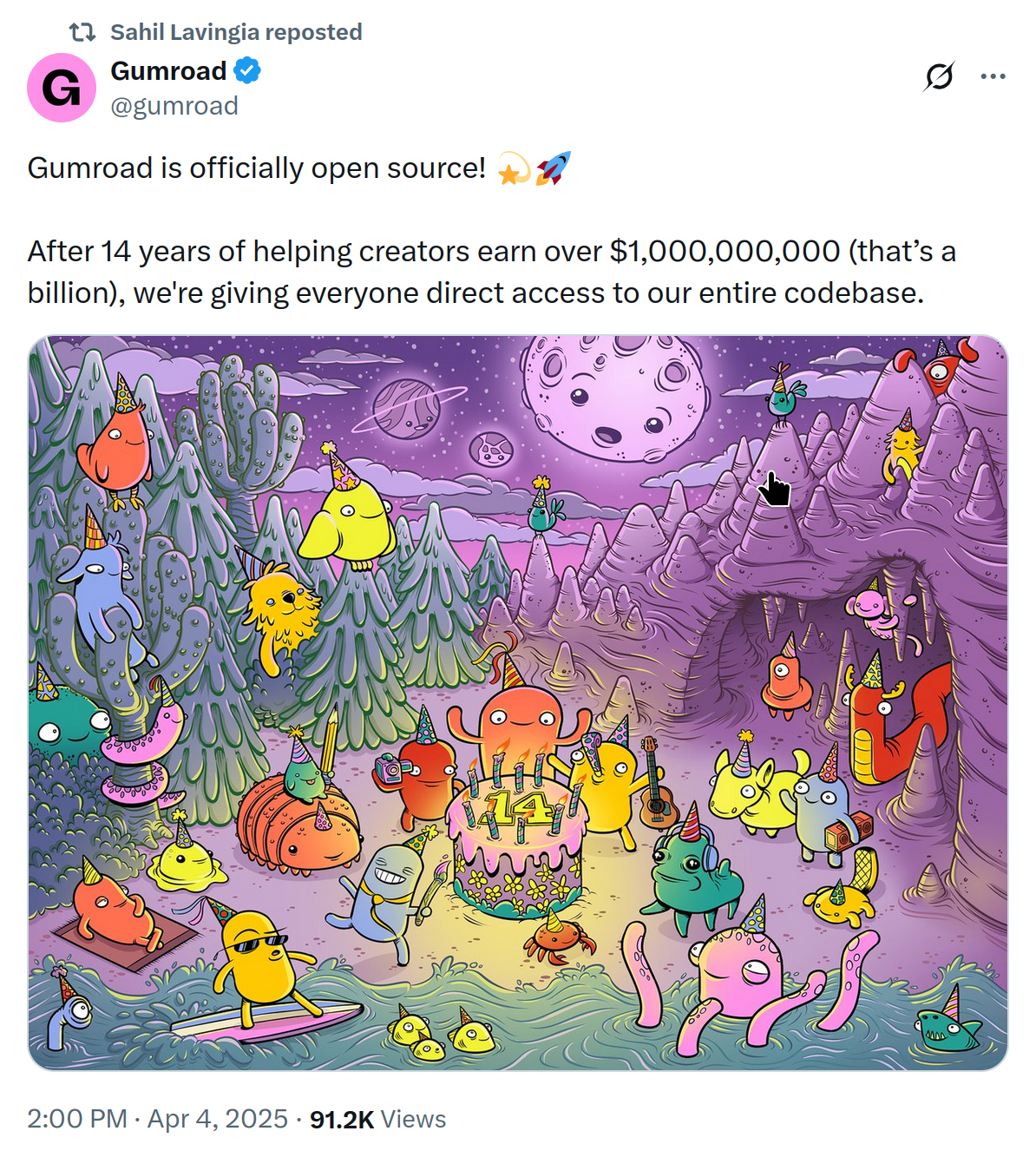
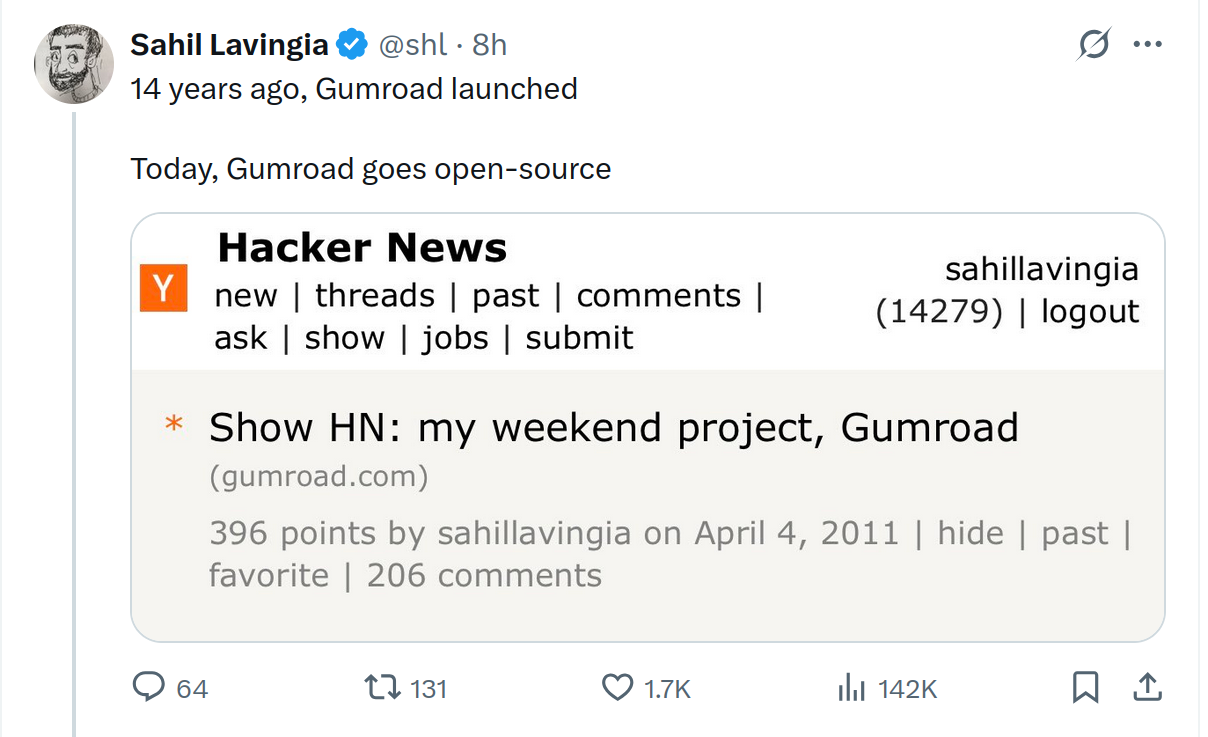

Unfortunately though, this uses a custom license which wouldn’t meet the widely regarded definition of open source, and therefore wouldn’t be widely regarded as open source so calling this open source could be misleading to many.
The license sets limits upon open rights:
Small Business and Exempt Organizations
You may use the software under this license only if (1) your company has less than 1 million USD (2024) total revenue in the prior tax year, and less than 10 million USD (2024) GMV (Gross Merchandise Value), or (2) you are a non-profit organization or government entity. Adjust the revenue threshold for inflation according to the United States Bureau of Labor Statistics’ consumer price index for all urban consumers, U.S. city average, for all items, not seasonally adjusted, 1982–1984=100 reference base. If you are a company and exceed either of the limits in (1), your license ends. You may contact the licensor to discuss an alternative license.
Redistribution is also questionable from my non-legal-expert understanding since the license explicitly allows distribution while also not allowing sublicensing or license transfer:
These terms do not allow you to sublicense or transfer any of your licenses to anyone else, or prevent the licensor from granting licenses to anyone else.
These parts of the license go against the following requirements of the open source definition:
Sure! I personally believe that it’s fair for folks to license their own efforts however they wish. The issue isn’t that the license exists, it’s that it’s misrepresented as open source.
This appears to be another example of a business wanting to use “open source” for its marketing & reputation potential, while not wanting to give away the rights usually afforded in open source to limit risk. But it’s the risk taken and rights given by other developers & projects which has given open source that reputation and marketing power.
Not to say that it’s the intention to mislead or be malicious though, this can easily be done by not understanding, or not considering, the commonly regarded open source definition.
All of the rights provided to users depend on being within the “Small Business and Exempt Organizations” conditions quoted above. With open source, rights are provided evenly, without specific targeting of software users.
While you may think that the requirements won’t impact normal users, their wider effects can do so. For example, this could limit possibilities of service providers providing the software as a service, meaning less hosting options for users. It also can impact forking, a crucial part of open source which allows software to thrive and survive beyond it’s original author, especially on a larger project like this since development & maintenance efforts would be limited to those that fit their conditions.
With the specific wording used here, these conditions may have wider impact than you expect. Looking at their definitions:
Your company is any legal entity, sole proprietorship, or other kind of organization that you work for, plus all organizations that have control over, are under the control of, or are under common control with that organization.
This is quite broad. For example, if you just worked for a $1M revenue company, you wouldn’t have rights to use/modify/redistribute the software as a side project, for self-hosting, or for other uses like a community-project/charity etc… $1M revenue isn’t a lot when it comes to business, and I think there’s a considerable overlap in admins & developers able to work with the code-base, and those working for $1M+ revenue business.
Just don’t call it open source. “Source Available” is a common term for the wider scope of software which has been made available to viewing. There are some more focused movements like Fair-code, fair source, and source first but I’m not sure it fits into any of those. The commons clause is kind of similar without a threshold.
Alternatively, a license meeting the OSD could be used instead.
Upon the mentioned questionable distribution rights of the license, there are other things in this custom license which just appear quite strange.
Firstly, the USD specific condition is just odd. I can’t see any mention of equivalent or other currency. Going by the text, it seems like you might not be subject to some of the conditions if you don’t deal with USD. This requirement is also a bit complex, having to adjust it for inflation following the “United States Bureau of Labor Statistics’ consumer price index”. What if the Bureau of Labor Statistics is dismantled? Wouldn’t say that’s out of the question at the current state of things.
Secondly, the way rights are afforded are a little strange:
The licensor grants you a copyright license for the software to do everything you might do with the software that would otherwise infringe the licensor’s copyright, but only as long as you meet all the conditions below.
Normally licenses provide specific rights, but this allows “everything you might do with the software that would otherwise infringe the licensor’s copyright”. The “licensor” is specifically defined as “Gumroad, Inc.” but this otherwise seems very broadly scoped. Thinking out a scenario, I could modify the software to consume other content & repos from “Gumroad, Inc.”, then republish that as my own? Usually that’s be infringing on their copyright but here I’ve been provided permissions to infringe their copyright in “everything you might do with the software”. Not sure it’d hold up in court, but seems like a questionable approach to provide rights in a license.
此内容由惯性聚合(RSS阅读器)自动聚合整理,仅供阅读参考。 原文来自 — 版权归原作者所有。