


惯性聚合 高效追踪和阅读你感兴趣的博客、新闻、科技资讯
阅读原文 在惯性聚合中打开

推荐订阅源

H
Hackread – Cybersecurity News, Data Breaches, AI and More
让小产品的独立变现更简单 - ezindie.com
V
V2EX
T
The Blog of Author Tim Ferriss
腾讯CDC
Hugging Face - Blog
Hugging Face - Blog
雷峰网
雷峰网
爱范儿
爱范儿
GbyAI
GbyAI
H
Help Net Security
I
InfoQ
罗磊的独立博客
酷 壳 – CoolShell
酷 壳 – CoolShell
钛媒体:引领未来商业与生活新知
钛媒体:引领未来商业与生活新知
cs.AI updates on arXiv.org
人人都是产品经理
人人都是产品经理
J
Java Code Geeks
Microsoft Security Blog
Threat Intelligence Blog | Flashpoint
N
Netflix TechBlog - Medium
Last Week in AI
Last Week in AI
宝玉的分享
宝玉的分享
云风的 BLOG
云风的 BLOG
Project Zero
Project Zero
P
Privacy & Cybersecurity Law Blog
A
Arctic Wolf
Know Your Adversary
Know Your Adversary
G
Google Developers Blog
freeCodeCamp Programming Tutorials: Python, JavaScript, Git & More
T
Tor Project blog
V
Vulnerabilities – Threatpost
Y
Y Combinator Blog
WordPress大学
WordPress大学
V
Visual Studio Blog
博客园_首页
G
GRAHAM CLULEY
K
Kaspersky official blog
T
Tailwind CSS Blog
T
Threat Research - Cisco Blogs
博客园 - Franky
D
Docker
Security Latest
Security Latest
I
Intezer
有赞技术团队
有赞技术团队
Application and Cybersecurity Blog
博客园 - 【当耐特】
B
Blog RSS Feed
T
The Exploit Database - CXSecurity.com
cs.CV updates on arXiv.org
OSCHINA 社区最新新闻
OSCHINA 社区最新新闻

Louis C Deng's Blog

CS231n Lecture Note: Generative Models CS231n Lecture Note: Self-Supervised Learning CS231n Lecture Note: Large Scale Distributed Training 自動微分 | DIY 實現自己的 PyTorch From RNNs to Transformers CS231n Lecture Note VII: Recurrent Neural Networks Uncovering Batch & Layer Normalization CS231n Lecture Note VI: CNN Architectures and Training CS231n Lecture Note V: Convolution Neural Networks Basics Demystifying Softmax Loss: A Step-by-Step Derivation for Linear Classifiers Backpropagation: A Vector Calculus Perspective CS231n Lecture Note IV: Neural Networks and Backpropagation CS231n Lecture Note III: Optimization CS231n Lecture Note II: Linear Classifiers CS231n Lecture Note I: Image Classification CSAPP Cache Lab II: Optimizing Matrix Transposition CSAPP Cache Lab I: Let's simulate a cache memory! CS188 Search Lecture Notes II How to Use TouchID for Sudo Commands on macOS CS188 Search Lecture Notes I RECAP2025: 留白 CSAPP Bomb Lab 解析 x64 暫存器速查表 CSAPP Data Lab 解析 矩陣的 Modified Gram Schmidt 方法 聊一聊位掩碼(Bit Mask) 整數溢位與未定義行為 快速排序 幾種劃分方法討論 等待 記夢(DeepSeek 輔助創作) 午夜飛行 橋樑 黎明 或 2012 RECAP2024: 水檻臥聽雨 太陽、潮落 RECAP2023: 泡沫 題解 P1622 釋放囚犯 題解 P5888 傳球遊戲 殘陽似火 再會 飢餓藝術家 卡夫卡 Python 中的 zip() 和 enumerate() 泡沫 “救救孩子……”——談魯迅和《狂人日記》 想念 淺灘 蟬 · 夏 微風 觀星 浮塵 復活 【摘錄 | 轉載】普魯斯特 《追憶似水年華》第一卷 《在斯萬家那邊》(一) Time - Pink Floyd - The Dark Side of the Moon 【轉載】靜夜思變調 高樓 幻夢 冰 RECAP2022: 流星雨 清夜 割點 Tarjan 演算法 P3147 USACO16OPEN 262144 P 題解 P3354 Riv 河流 題解 馬拉車演算法 夜雨 層霧 從愚人節玩笑到真的玩笑(bushi): 淺談 lsnotes I made my own Hexo theme 題解 紀念品分組 題解 導彈攔截 如何高效使用搜尋引擎 用 GitHub Actions 格式化 C/C++ 程式碼 四季的天空 洛谷 7 月月賽 Div.2 總結 題解 最近公共祖先 (LCA) 用簡單的物理方法證明牛頓萊布尼茨公式 簡評榮耀手環6 海上生明月,天涯共此時。 我為什麼重新拿出了 iPod Swift 中的 SharedPreferance —— UserDefaults 凝視那一輪明月 用 GitHub Actions 部署 Hexo 部落格 遲來的日誌 - WWDC 2020 獎學金 vcpkg - 方便的 C/C++ 庫管理器 vimrc 配置指南 NextCloud - DIY NAS 解決方案 sudo shutdown -r now sudo shutdown -r now
CS188 Search Lecture Notes III
Louis C Deng · 2026-01-28 · via Louis C Deng's Blog

Here are the notes for CS188 Local Search.

Local Search algorithms allow us to find local maxima or minima to find a configuration that satisfies some constraints or optimizes some objective function.
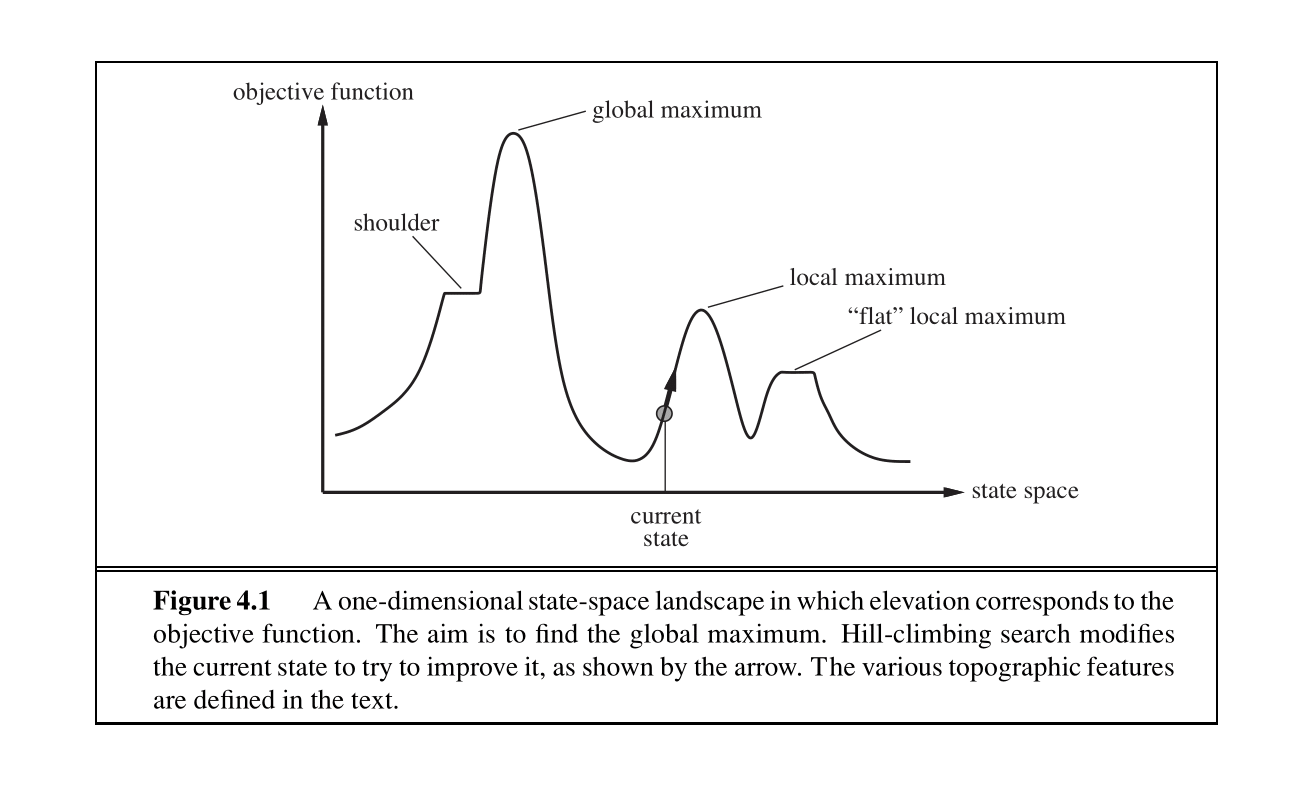
Local Search

The hill-climbing search algorithm (or steepest-ascent) moves from the current state towards the neighboring state that increases the objective value the most.

The “greediness” of hill-climbing makes it vulnerable to being trapped in local maxima and plateaus.

There are variants of hill-climbing. The stochastic hill-climbing selects an action randomly among the possible uphill moves. Random sideways moves, allows moves that don’t strictly increase the objective, helping the algorithm escape “shoulders.”

1
2
3
4
5
6
7
function HILL-CLIMBING(problem) returns a state
current ← make-node(problem.initial-state)
loop do
neighbor ← a highest-valued successor of current
if neighbor.value ≤ current.value then
return current.state
current ← neighbor

The algorithm iteratively moves to a state with a higher objective value until no such progress is possible. Hill-climbing is incomplete.

Random-restart hill-climbing conducts a number of hill-climbing searches from randomly chosen initial states. It is trivially complete.

Simulated annealing aims to combine random walk (randomly moving to nearby states) and hill-climbing to obtain a complete and efficient search algorithm.

The algorithm chooses a random move at each timestep. If the move leads to a higher objective value, it is always accepted. If it leads to a smaller objective value, the move is accepted with some probability.

This probability is determined by the temperature parameter, which initially is high (allowing more “bad” moves) and decreases according to some “schedule.”

Theoretically, if the temperature is decreased slowly enough, the simulated annealing algorithm will reach the global maximum with a probability approaching 1.

1
2
3
4
5
6
7
8
9
function SIMULATED-ANNEALING(problem,schedule) returns a state
current ← problem.initial-state
for t = 1 todo
T ← schedule(t)
if T = 0 then return current
next ← a randomly selected successor of current
ΔE ← next.valuecurrent.value
if ΔE > 0 then current ← next
else current ← next only with probability e^(ΔE/T)

Local beam search is another variant of the hill-climbing search algorithm.

The algorithm starts with a random initialization of kk states, and at each iteration, it selects kk new states. The algorithm selects the kk best successor states from the complete list of successor states from all the threads. If any of the threads find the optimal value, the algorithm stops.

The threads can share information between them, allowing “good” threads (for which objectives are high) to “attract” the other threads to that region as well.

1
2
3
4
5
6
7
8
9
10
11
12
13
14
function LOCAL-BEAM-SEARCH(problem, k) returns a state
states ← k randomly generated states
loop do
if any state in states is a goal then return that state

all_successors ← an empty list
for each state in states do
all_successors.add( all successors of state )

current_best ← the highest valued state in all_successors
if current_best.value ≤ max(states).value then
return the highest valued state in states (Local Maxima Reached)

states ← the k highest-valued states from all_successors

Genetic Algorithms

Genetic Algorithms are a variant of local beam search.

Genetic algorithms begin as beam search with kk randomly initialized states called the population. States (called individuals) are represented as a string over a finite alphabet.

Their main advantage is the use of crossovers — large blocks of letters that have evolved and lead to high valuations can be combined with other such blocks to produce a solution with a high total score.

1
2
3
4
5
6
7
8
9
10
11
12
13
14
15
function GENETIC-ALGORITHM(population, FITNESS-FN) returns an individual
inputs: population, a set of individuals
FITNESS-FN, a function that measures the fitness of an individual

repeat
new_population ← empty set
for i = 1 to SIZE(population) do
x ← RANDOM-SELECTION(population, FITNESS-FN)
y ← RANDOM-SELECTION(population, FITNESS-FN)
child ← REPRODUCE(x, y)
if (small random probability) then child ← MUTATE(child)
add child to new_population
population ← new_population
until some individual is fit enough, or enough time has elapsed
return the best individual in population, according to FITNESS-FN
1
2
3
4
5
function REPRODUCE(x, y) returns an individual
inputs: x, y, parent individuals

n ← LENGTH(x); c ← random number from 1 to n
return APPEND(SUBSTRING(x, 1, c), SUBSTRING(y, c + 1, n))