


惯性聚合 高效追踪和阅读你感兴趣的博客、新闻、科技资讯
阅读原文 在惯性聚合中打开

推荐订阅源

www.infosecurity-magazine.com
Vercel News
Vercel News
G
Google Developers Blog
MyScale Blog
MyScale Blog
The Register - Security
I
InfoQ
Blog — PlanetScale
Blog — PlanetScale
D
DataBreaches.Net
Microsoft Security Blog
V
Visual Studio Blog
V2EX - 技术
V2EX - 技术
F
Fortinet All Blogs
博客园_首页
S
Secure Thoughts
GbyAI
GbyAI
S
Security Affairs
N
News | PayPal Newsroom
Forbes - Security
Forbes - Security
Recent Announcements
H
Hackread – Cybersecurity News, Data Breaches, AI and More
Security Archives - TechRepublic
宝玉的分享
宝玉的分享
Hugging Face - Blog
Hugging Face - Blog
Hacker News - Newest:
Hacker News - Newest: "LLM"
H
Heimdal Security Blog
A
About on SuperTechFans
P
Proofpoint News Feed
H
Help Net Security
Application and Cybersecurity Blog
Exploit-DB.com RSS Feed
Y
Y Combinator Blog
L
LINUX DO - 最新话题
Apple Machine Learning Research
L
LangChain Blog
博客园 - 叶小钗
A
Arctic Wolf
Cisco Talos Blog
Cisco Talos Blog
T
The Exploit Database - CXSecurity.com
人人都是产品经理
人人都是产品经理
T
Threat Research - Cisco Blogs
N
News and Events Feed by Topic
Security Latest
Security Latest
The Hacker News
The Hacker News
T
Tor Project blog
O
OpenAI News
博客园 - 三生石上(FineUI控件)
PCI Perspectives
PCI Perspectives
量子位
大猫的无限游戏
大猫的无限游戏
Stack Overflow Blog
Stack Overflow Blog

Nautilus

These Ancient Baby Predators Challenge Our Understanding of Evolution This “Roasted Exoplanet” Has a Wild Orbit Today Was the Day Galileo Caved See the Southern Lights from Space in New ISS Video Qatari Sand Cats Caught on Camera for the First Time How to Protect Earth Against Violent Space Weather In the Midst of Tornado Season, a Surprisingly Short History of Predicting Twisters Can “Dante’s Inferno” Tell Us Something About Space Rocks? How to Dodge a Mountain Lion The Inventor of the Thinking Machine Didn’t Worry. Neither Should You Science Is Political—and Spiritual Take a Gander at an Ancient Supernova in the Heart of the Milky Way The Model for Botticelli’s Venus Died at 23 The Birth-Control Pill May Encourage Binge Eating This Shark Can Walk on Land Aliens Probably Have Consciousness If You’re Counting on Calcium and Vitamin D Supplements to Prevent Fractures, Think Again Saving a Tiny Endangered Porpoise One Pixel at a Time This Cosmonaut Was the First Woman in Space Does This Protein Hold the Key to Differences in Aging Between Males and Females? The Nautilus Reading List of Books on Evolution Does Cooperation Beat Cheating After All? Is This the King of GLP-1s? What Is a Trillion, Really? Bad Third-Grade Behavior Could be a Preview of Educational Failure These Ancient Millipedes Paved the Way for Terrestrial Life ISS Astronaut Shares Incredible Photos of Volcanoes Taken From Space Goblin Sharks Caught on Camera in Their Natural Habitat for the First Time The Ancient Roots of Modern Winemaking How to Feel at Home in the Modern World The Surprising Things You Find Digging Through Frozen Prehistoric Squirrel Poop What Makes Sloths So Slow? Why Robots Still Can’t Do Science Hidden Fungal Networks Could Stretch from the Earth to the Sun a Billion Times Over Turning the Psychedelic Experience into a Math Problem These Overlooked Pollutants Cause About 15 Percent of Global Warming The Venus Flytrap Mystery That Vexed Darwin, Solved Inside the Largest Whale Graveyard on Earth How to Stop a Killer Asteroid 274 Years Ago Today, Benjamin Franklin Flew a Kite Listen to the Sound of the Most Massive Organism on Earth Looking for Signs of Intelligence in Chatbots The Healing Power of Dreaming Under Anesthesia Hawaii’s False Killer Whales Are Wasting Away How These Supergiant Sea Creatures Survive More Than 5 Years Without Eating Mysterious Web-Footed “Ghost Dog” Caught on Camera How to Heal People with Science Fiction Here’s Why Our Walking Gets Slower as We Age See the First-Ever Photos of Cozumel’s Mysterious Dwarf Fox Koalas Were in Trouble Before Humans Arrived in Australia Dogs Could Be Humanity’s Best Friend in the Fight Against This Invasive Species Vast Hidden Structure Discovered Beneath Antarctica Human Ancestors Were Using Fire Earlier Than Previously Thought Check Out the Newest Fluorescent Amphibian Your Saliva Knows How Sleepy You Are Lessons in Chemistry, 19th-Century Style Newly Discovered Four-Winged Dinosaur Didn’t Need to Fly to Hunt Birds Ice Age CSI: Mammoth Cold Case Files Check Out This New Colorful Sea Slug the Size of a Sesame Seed The Soul of Numbers Hell Heron: An Illustrated Story This Towering Fir Is the Tallest Tree in East Asia Why Doesn’t Coffee Taste Like Caffeine? Screwworms Are Back. Here’s How We Eliminated Them the First Time Who Was Nancy Grace Roman? Bumblebees Have Chimp-Like Problem-Solving Abilities Despite Tiny Brains Solving Feynman’s Formula for Eating Well, Parking Your Car, and Finding a Mate Newly Discovered Active Fault Line Could Threaten New Zealand’s Biggest City The Cold War’s Accidental Whale Observatory Watch How “Trashy” City Bowerbirds Attract Their Mates Stupid in the Land of Oz Food Noise Goes Quiet with GLP-1s The Iceman’s Microbiome Ancient DNA Illuminates the Uniqueness of the Extinct Cave Lion Rare Meteorite Hints at Ancient Planetary Collision in Our Solar System How Animals Pick and Choose the Sex of Their Offspring This Non-Movie-Star Shark Is Feeding Close to Shore Beavers Don’t Just Build Dams, They Build Nations Tadpoles Use a World War I Naval Strategy to Dazzle Predators See the Gravity Waves from a Super Typhoon 9 Books We’re Excited About This June Did a Roman Legionnaire Wear Eyeliner? See Saturn Like You’ve Never Seen it Before How the “Perfectionism Pandemic” Is Crushing Young People What Happened When the First Animals Started to Move After the Black Death, Italy’s Oak Trees Came Back Editing the Pesky Bones Out of a Popular Farmed Fish This Blood-Sucking Fly Drastically Transforms When It Finds Its Prey These Stars Swallowed Their Earth-like Planets Nightmarish Heron-like Dinosaur Unearthed in Patagonia How a Tiny Bird Might Tell the Tale of Island Giants How Right-Wing Politics Make You Physically Ill The Cephalopods Are Coming The Moon Bases of Yesteryear This Is What Gives Pigeons Their Excellent Sense of Direction The Genetic Secrets of a Shark That Lives for 500 Years The Many Ways to Build a Black Hole Wearing DEET Might Be Like Ringing the Mosquito Dinner Bell This “Feathered Dragon” Shook Its Tail Feathers in the Time of Dinosaurs The Supernova That Sparked the Original Scientific Revolution
The Physics Behind the Poo Emoji’s Shape
Jake Currie · 2026-06-24 · via Nautilus

Everyone poops, but not everyone poops in the same direction. Take lugworms, for example. These beach-dwelling annelids live in U-shaped burrows dug with their head in one tunnel and their tail in the other. When nature calls, the lugworm excretes a thick stream of wet, sandy excrement upward, right on to the beach (“no dumping” signs be damned). Now this humble worm’s gravity-fighting method of doing its business is shedding light on the physics of feces in a new study published in Nature Communications.
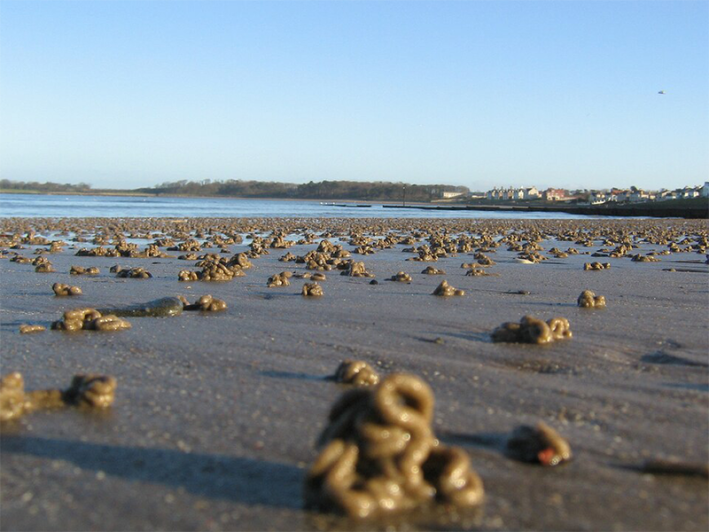
WATCH YOUR STEP: This photo of a beach in Northern Ireland shows many casts from lugworms. Credit: Nick Veitch / Wikimedia Commons.

“Anyone who has observed animal excreta has likely wondered about the characteristic coiled morphologies that appear across diverse species,” reads the first line of the study. While “anyone” is probably painting with too broad a brush, it was a particular fascination of a certain someone: Charles Darwin. In his later years, the 19th-century scientist became spellbound by earthworms and marveled at their spiral-shaped castings.
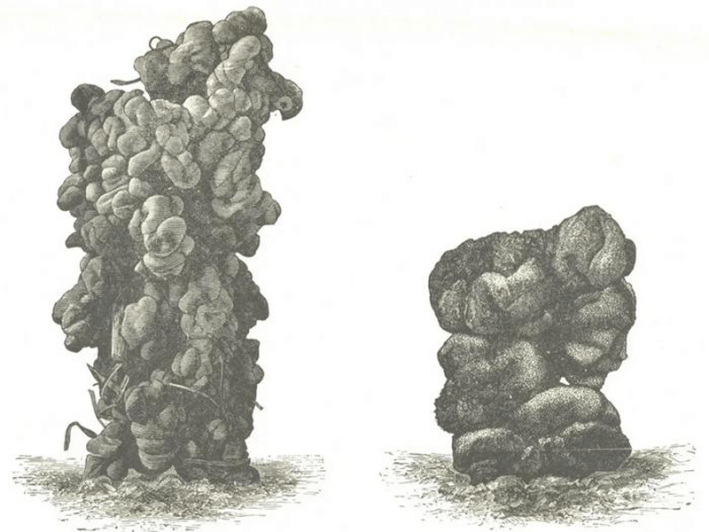
DARWIN’S DRAWING: These drawings of earthworm poo were featured in Darwin’s 1881 publication “The formation of vegetable mould through the action of worms, with observations on their habits.” Credit: Public Domain.

This coiled shape, which pops up (or heaps up?) in excrement across the animal kingdom, has its roots in some very real physics, the researchers say. Unlike the lugworm, most animals defecate downward, with gravity. As the feces pile up, the height between the landing site and, um, “extrusion site” decreases, reducing the size of each subsequent coil and resulting in a familiar shape: 💩. Lugworms, like the earthworms Darwin observed, produce a different kind of pile. Their coil sizes are independent of height, yielding a cylindrical fecal tower.

Read more: “Beaches Are Blankets of Fish Poop” 

According to the international team of physicists, both mounds of poop are obeying the same laws of physics—elastic rope-coiling theory, which describes how ropes and other materials coil. The only difference in which shape forms, they found, is the stiffness of the material and the direction of the stuff relative to gravity. They even tested it out on fecal simulacra, like pasta and pea dough (made from chickpeas and water). 

It’s another reminder that, while Darwin’s natural selection may be able to shape many living forms to different ends, some things are outside of its control. Everyone poops, but everyone also follows the laws of physics.

Enjoying Nautilus? Subscribe to our free newsletter.

Lead image: Lukas Kernell