


惯性聚合 高效追踪和阅读你感兴趣的博客、新闻、科技资讯
阅读原文 在惯性聚合中打开

推荐订阅源

雷峰网
雷峰网
L
LangChain Blog
GbyAI
GbyAI
F
Fortinet All Blogs
腾讯CDC
Last Week in AI
Last Week in AI
A
About on SuperTechFans
J
Java Code Geeks
Microsoft Azure Blog
博客园 - Franky
B
Blog
D
Docker
G
Google Developers Blog
月光博客
月光博客
博客园 - 三生石上(FineUI控件)
S
SegmentFault 最新的问题
Apple Machine Learning Research
酷 壳 – CoolShell
酷 壳 – CoolShell
freeCodeCamp Programming Tutorials: Python, JavaScript, Git & More
T
Tailwind CSS Blog
宝玉的分享
宝玉的分享
U
Unit 42
Blog — PlanetScale
Blog — PlanetScale
B
Blog RSS Feed

Nautilus

Can the Sugar Molecules That Coat Our Cells Predict Our Health? These Ancient Baby Predators Challenge Our Understanding of Evolution This “Roasted Exoplanet” Has a Wild Orbit Today Was the Day Galileo Caved See the Southern Lights from Space in New ISS Video Qatari Sand Cats Caught on Camera for the First Time How to Protect Earth Against Violent Space Weather In the Midst of Tornado Season, a Surprisingly Short History of Predicting Twisters Can “Dante’s Inferno” Tell Us Something About Space Rocks? How to Dodge a Mountain Lion The Inventor of the Thinking Machine Didn’t Worry. Neither Should You Science Is Political—and Spiritual The Model for Botticelli’s Venus Died at 23 The Birth-Control Pill May Encourage Binge Eating This Shark Can Walk on Land Aliens Probably Have Consciousness If You’re Counting on Calcium and Vitamin D Supplements to Prevent Fractures, Think Again Saving a Tiny Endangered Porpoise One Pixel at a Time This Cosmonaut Was the First Woman in Space Does This Protein Hold the Key to Differences in Aging Between Males and Females? The Nautilus Reading List of Books on Evolution Does Cooperation Beat Cheating After All? Is This the King of GLP-1s? What Is a Trillion, Really? Bad Third-Grade Behavior Could be a Preview of Educational Failure These Ancient Millipedes Paved the Way for Terrestrial Life ISS Astronaut Shares Incredible Photos of Volcanoes Taken From Space Goblin Sharks Caught on Camera in Their Natural Habitat for the First Time The Ancient Roots of Modern Winemaking How to Feel at Home in the Modern World
Take a Gander at an Ancient Supernova in the Heart of the...
Jake Currie · 2026-06-18 · via Nautilus

Earth’s atmosphere absorbs X-rays, which is a good thing because this high-energy electromagnetic radiation can damage DNA. It’s not good, however, for those interested in observing cosmic phenomena. Just like light (a lower energy electromagnetic radiation), X-rays are emitted by a number of different celestial bodies, from stars to black holes. To properly observe these emissions, we need to launch telescopes—like NASA’s Chandra X-ray Observatory—into space to get a better look. Now, an international team of astronomers studying data from Chandra may have found the remnants of an ancient supernova in the heart of our galaxy. 

The ruins of the exploded star were located 26,000 light-years away in the Sagittarius C complex, close to Sagittarius A*, the supermassive black hole at the center of the Milky Way. If it’s indeed a supernova, it’s the closest one to the Milky Way’s galactic center ever discovered. According to the team’s analysis, the star responsible for the supernova blew up around 1,700 years ago, sending stellar debris flying at rates of around 1.8 million miles per hour. 
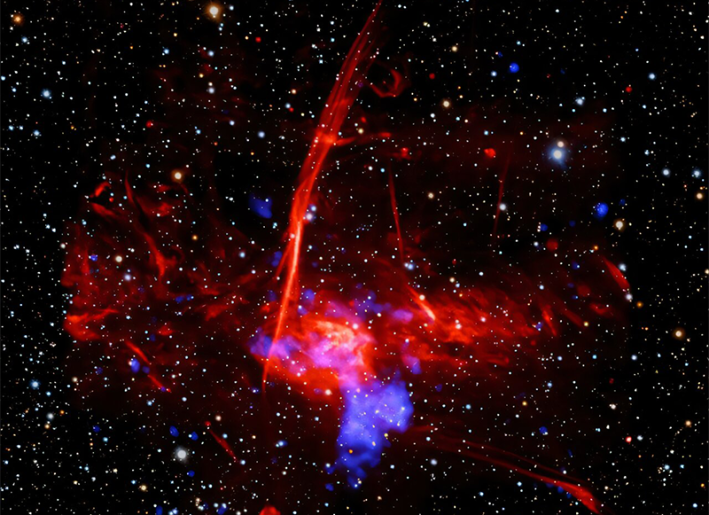
Credit: NASA/CXC/UCLA/Z. Zhu et al. using data from ESA/XMM-Newton, PanSTARRS, and MeerKAT. Image Processing: NASA/CXC/SAO/L. Frattare and P. Edmond

The image above is a composite created from data collected by two space-based X-ray telescopes (NASA’s Chandra and the European Space Agency’s XMM-Newton) as well as telescopes that detect light waves (PanSTARRS in Hawai’i) and radio waves (MeerKAT in South Africa) here on Earth.

When put together, it certainly makes for an incredible singular image.

Enjoying Nautilus? Subscribe to our free newsletter.

Lead image: NASA/CXC/UCLA/Z. Zhu et al. using data from ESA/XMM-Newton, PanSTARRS, and MeerKAT. Image Processing: NASA/CXC/SAO/L. Frattare and P. Edmond