



惯性聚合 高效追踪和阅读你感兴趣的博客、新闻、科技资讯
阅读原文 在惯性聚合中打开

推荐订阅源

腾讯CDC
Microsoft Azure Blog
L
LangChain Blog
Y
Y Combinator Blog
Microsoft Security Blog
宝玉的分享
宝玉的分享
B
Blog RSS Feed
MongoDB | Blog
MongoDB | Blog
Jina AI
Jina AI
D
Docker
B
Blog
Engineering at Meta
Engineering at Meta
Last Week in AI
Last Week in AI
OSCHINA 社区最新新闻
OSCHINA 社区最新新闻
I
InfoQ
G
Google Developers Blog
博客园 - Franky
freeCodeCamp Programming Tutorials: Python, JavaScript, Git & More
让小产品的独立变现更简单 - ezindie.com
The GitHub Blog
The GitHub Blog
T
The Blog of Author Tim Ferriss
大猫的无限游戏
大猫的无限游戏
阮一峰的网络日志
阮一峰的网络日志
U
Unit 42

Nautilus

Can the Sugar Molecules That Coat Our Cells Predict Our Health? These Ancient Baby Predators Challenge Our Understanding of Evolution This “Roasted Exoplanet” Has a Wild Orbit Today Was the Day Galileo Caved See the Southern Lights from Space in New ISS Video Qatari Sand Cats Caught on Camera for the First Time How to Protect Earth Against Violent Space Weather In the Midst of Tornado Season, a Surprisingly Short History of Predicting Twisters Can “Dante’s Inferno” Tell Us Something About Space Rocks? How to Dodge a Mountain Lion The Inventor of the Thinking Machine Didn’t Worry. Neither Should You Science Is Political—and Spiritual Take a Gander at an Ancient Supernova in the Heart of the Milky Way The Model for Botticelli’s Venus Died at 23 The Birth-Control Pill May Encourage Binge Eating This Shark Can Walk on Land Aliens Probably Have Consciousness If You’re Counting on Calcium and Vitamin D Supplements to Prevent Fractures, Think Again Saving a Tiny Endangered Porpoise One Pixel at a Time This Cosmonaut Was the First Woman in Space Does This Protein Hold the Key to Differences in Aging Between Males and Females? The Nautilus Reading List of Books on Evolution Does Cooperation Beat Cheating After All? Is This the King of GLP-1s? What Is a Trillion, Really? Bad Third-Grade Behavior Could be a Preview of Educational Failure These Ancient Millipedes Paved the Way for Terrestrial Life ISS Astronaut Shares Incredible Photos of Volcanoes Taken From Space Goblin Sharks Caught on Camera in Their Natural Habitat for the First Time The Ancient Roots of Modern Winemaking
This “Feathered Dragon” Shook Its Tail Feathers in the Ti...
Jake Currie · 2026-05-28 · via Nautilus

When a male king bird-of-paradise seeks a mate, it puts on an elaborate show. Perching on a branch, it puffs out its white chest, stretches its wings, and sways two spindly tail feathers with iridescent green disks. Of course, it’s not alone. The tail-feather shake is the go-to move for plenty of male birds, including the argus pheasant, the marvelous spatuletail hummingbird, and the white-booted racket-tail. It’s also an avian courtship strategy that dates back to the time of dinosaurs, according to a prehistoric bird species newly described in PLOS One

Featured Video

Paleontologist Alex Clark from Chicago’s Field Museum discovered the eye-catching specimen while sifting through fossils at China’s Shandong Tianyu Museum. The bird was a member of the enantiornithines, the most diverse bird group living 120 million years ago, and one that died out along with the dinosaurs. Impressively, it boasted two magnificent tail feathers twice the length of its body.
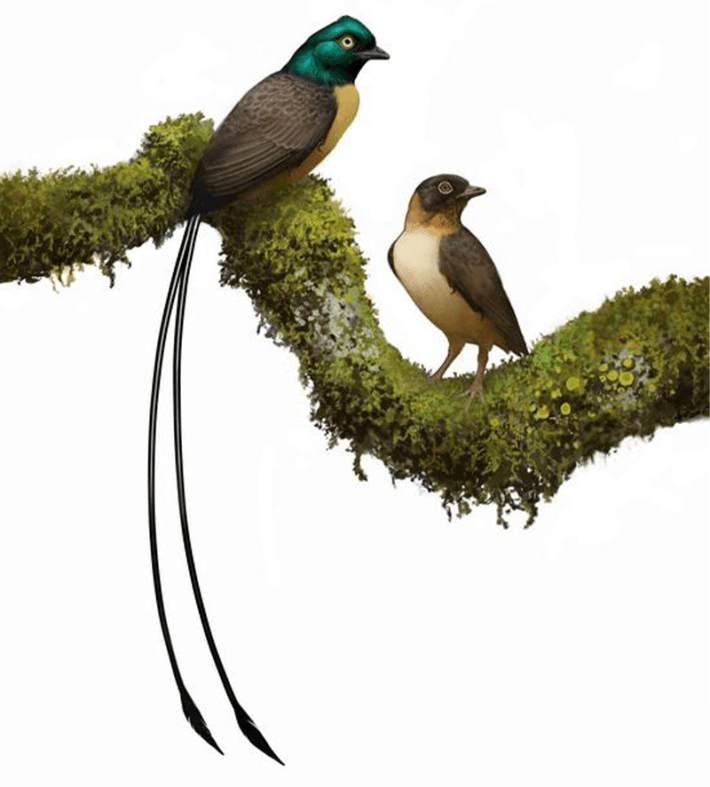
FEATHERED DRAGON: An illustration imagining what a male and female Plumadraco may have looked like, based on an analysis of fossilized pigments. Credit: Ville Sinkkonen.

“I saw this little guy, and I did a double-take when I saw the tail feathers,” Clark said in a statement. “I’m really interested in the way birds do displays to attract mates, and I thought that these tail feathers were so crazy, they had to be used for something like that.”

Read more: “Why Females Decide What’s Beautiful

After determining the long-tailed bird was in fact a new species, Clark and his team gave it the genus name Plumadraco—”feathered dragon.” According to their analysis of the fossil, Plumadraco’s two tapered tail feathers, with stiff shafts and rounded tips, were ideal for flicking around to entice a mate. “The fossils of some other enantiornithine birds show remnants of muscle tissue along the tail region, and based on those muscles, birds like Plumadraco would have had pretty limited movement for their tails,” Clark said. “However, they could pump their tail feathers up and down, and that’s a behavior that we see across birds today.”

It’s a tail as old as time.

Enjoying Nautilus? Subscribe to our free newsletter.

Lead image: Ville Sinkkonen