








How do you go about capturing a monster? The search for Bigfoot, or Sasquatch – often referred to as Bigfooting – may sound like a whimsical endeavour: an activity of tall tales and cartoonish representations. Yet if you spend time listening to what Bigfooters themselves have to say, you discover a different picture.
We did exactly that. To research our book, Bigfooters and Scientific Inquiry: On the Borderlands of Legitimate Science (2026), we conducted more than 160 interviews, mostly with classical Bigfooters, who spend time in the forests of North America, collecting evidence and, as they see it, acting responsibly, rationally and scientifically.
As sociologists of science, we began with a simple premise: whatever one thinks about whether Bigfoot actually exists as a biological creature, Bigfooting undeniably does. If Bigfooting is a community – or set of communities – that are collecting, analysing, sharing, validating and contesting evidence, then Bigfooting is a suitable object of sociological enquiry. And so, we went on our own hunt to track down Bigfooters and make sense of how they themselves make sense of the world.
Before we began our sociological exploration of Bigfooting, we were cautioned that Bigfooters were anti-science. The truth is much more complex. Yes, Bigfooters work in opposition to mainstream institutional science, making claims about the world that do not accord with the scientific consensus. However, our research revealed that Bigfooters are not dismissive of scientific principles. In fact, many are dedicated empiricists who employ methodologies modelled on those found in professional scientific research. As George Eberhart, a cryptozoologist and Bigfooter, explained to us: ‘It’s not a part of mainstream science, it really isn’t. But you can apply a scientific method, or a journalistic method to it, to get some good science out of it.’
Yet Bigfooters are not ‘citizen scientists’ in the way we might be familiar with, due to their counter-establishment orientation and alternative vision of what ‘good’ science means. To a degree, the Bigfooter scientific model echoes that of the natural philosophers of previous centuries, in which individualism was valorised, and where testimony, anecdote and personal experience carried evidential weight.
So, how do contemporary Bigfooters use scientific technologies and techniques in their pursuit of evidence – and, ultimately, proof? And what makes their commitment to empiricism different from mainstream science?
Following our interviews, one particular line stuck with us as an apt description of the empirical Bigfooter’s mindset. It came from Cliff Barackman, the presenter of the US TV series Finding Bigfoot (2011-) and the owner of the North American Bigfoot Center in Boring, Oregon. ‘There is this foolish statement, that is still thrown around, that there is no evidence for Bigfoot,’ Barackman said. ‘There’s plenty of evidence, there’s no proof. There’s a big difference.’
Bigfooters have collected thousands of witness testimonies, cast hundreds of footprints, recorded scores of howls
This is what we might call the Bigfooter’s lament, and maybe the most concise summary of the frustration – and perhaps sadness – that Bigfooters experience when it comes to making empirical claims for Bigfoot’s existence.
Because there is ‘plenty of evidence’; Bigfooters have collected thousands of witness testimonies, cast hundreds of footprints, recorded scores of howls, and have even captured the occasional photograph or video. Of course, none of these are convincing if starting from the position that Bigfoot does not exist as a biological creature.
Bigfooters are thus faced with an evidential challenge that cannot be resolved with witness testimonies, photos, footprints or recorded sounds and groans. Implicitly and explicitly, both the general public and the scientific community make a simple request: Habeas corpus. Show the body.
‘On the side of science, they’re absolutely right. “Where’s the body? Where are the bones?” That’s what everybody asks, right?’ says Les Stroud, creator of the Canadian TV series Survivorman (2005-), which focused on Bigfoot for a season in 2015.
Over the decades, bodies have been presented, but these are almost unanimously considered to be hoaxes. For example, in the 1960s, the promoter Frank Hansen showcased a hairy humanoid figure encased in ice, initially supposedly found in Siberia and dubbed the Sibirskoye Creature, but more commonly known as the Minnesota Iceman. It had dubious provenance, but some took it seriously. Bernard Heuvelmans and Ivan T Sanderson, two of the founders of cryptozoology, examined the ‘body’, and wrote rival papers. In 1969, Heuvelmans published his description in Bulletin de L’Institut Royal des Sciences Naturelles de Belgique in which he claimed it was a new species, Homo pongoides, while Sanderson wrote up his findings in the US magazine Argosy and the Italian journal Genus, in which he claimed the body was that of Homo erectus. The primatologist John Napier, impressed by Heuvelmans’s description, attempted to get the Smithsonian Institution involved, and reports suggested that the FBI had an interest in the body. Napier, however, concluded that the Iceman was a fake, in line with the overwhelming consensus. Nevertheless, some Bigfooters maintain that the Iceman had been at some point a genuine body, and both Heuvelmans and Sanderson held to the belief that the body they had examined was only later replaced by a fake.
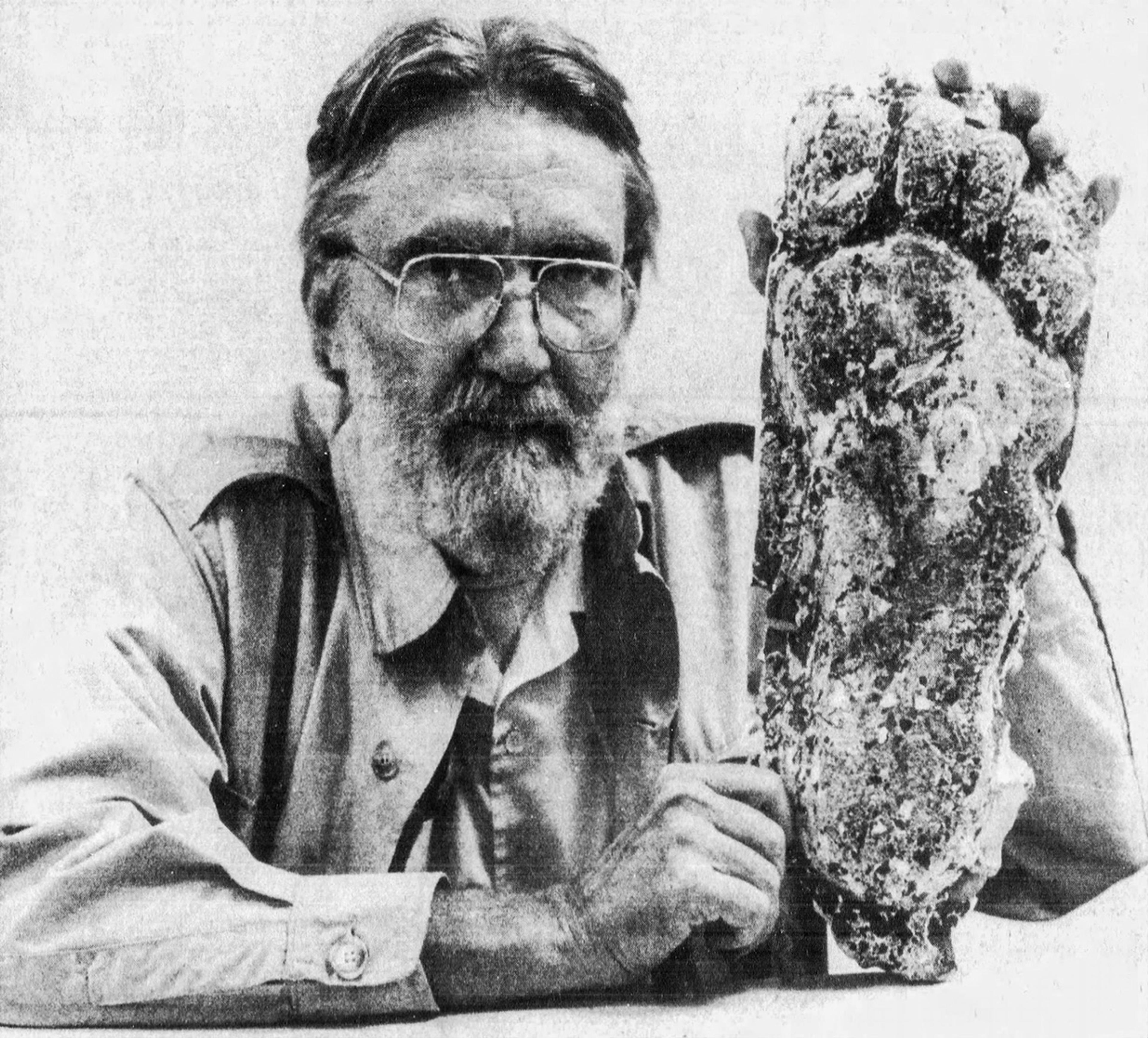
The anthropologist Grover Krantz with the cast of a rumoured Bigfoot imprint, 1982. Courtesy Wikipedia
This continued absence of a body has led Bigfooters to weigh ethical dilemmas, outside the strict frameworks of university ethics committees. In particular, to kill, or not to kill? Bigfooters have fiercely discussed the question, with some advocating the merits of hunting Bigfoot, and others for a programme of foraging for traces. The anthropologist Grover Krantz, one of Bigfoot’s rare academic champions, supported efforts to find a specimen, up to and including the killing of a Bigfoot. One Bigfooter told us that Krantz even offered him money. ‘I won’t tell you how much, but a considerable amount of money to go work with him and try to collect a specimen in the Blue Mountains,’ said John Mionczynski, a notable outdoorsman who has been involved in mainstream conservation projects, and has been studying Bigfoot since the 1970s. They parted company over the issue. Others we interviewed were more bullish. Angelo Capparella, a member of the North American Wood Ape Conservancy (NAWAC), argued that killing a Bigfoot and bringing back the body is a scientific necessity. ‘Maybe it’s my bias as being trained as a museum scientist – one of my degrees – but a physical specimen is what it is going to take,’ Capparella told us. ‘We’re going to be spinning our wheels forever if we don’t get a specimen.’
However, most Bigfooters that we spoke to are, in principle, against killing a Bigfoot. Craig Woolheater, the co-founder of the Texas Bigfoot Research Centre, the precursor to NAWAC, told us that, since the Bigfoot population is unknown, killing one ‘may doom a family group, you know? [It] may doom their population.’
You may wonder, though, how do Bigfooters explain why no one has found a body whose owner died of natural causes? Not even a body part. Thousands of hikers and outdoorspeople have reported Bigfoot encounters, so why has not one of them found a corpse, a skeleton or even a bone? Some Bigfooters claim that this is naivety, based on ignorance of the natural world. The Bigfooter Russell Jones maintained that ‘hikers don’t find dead bears in the woods, and they’re not finding skeletons.’ These explanations may be unconvincing. Regardless of how infrequently hikers might stumble over a bear’s body, their corpses do exist; from private homes, to hotels, to museums, North America is replete with taxidermied examples.
Yet this absence itself can form the basis of a knowledge claim about Bigfoot. Among the explanations for the absence of a body or bones is the claim that Bigfoot is an intelligent, social creature. As the Bigfooter Todd Prescott told us: ‘I don’t know why that is [why we have not found a body], and I can guess, I can say what others have said: that they’re very careful and they’re never alone. So, when one dies, possibly they take that carcass away, they eat it, they bury it, and they bury it high and they bury it deep, so the chances of finding it on a mountaintop buried, you know, six feet under are remote at best.’
So, without bodies or bones, in recent years Bigfooters have sought smaller fragments of evidence – and it is here that empirical methods have blossomed.
The hope is that wrapped within the threads of Bigfoot hair is the veritable ‘blueprint’ of the creature itself
For starters, Bigfooters in the field routinely collect hair, which can now be brought back and examined, both under a microscope and by more sophisticated techniques. Bigfooters claim that Bigfoot hair has distinctive features compared with the hair of other animals, and only a skilled and knowledgeable observer can distinguish between them. A member of the Olympic Project, a Bigfoot research group, told us that ‘Sasquatch hair will be between 60 to 90 micrometres in width, flexible, [with] usually the same colour running the lengths of the hair. Under the microscope, the root has to be round or egg-shaped. The length of the hair usually will not have a core or medulla, it’ll be translucent, unless it’s really, really black, then it’s hard to see through the hair … but you look at the scale pattern on the hair. It has to be what we call imbricate scale pattern, just like a human.’
This is a detailed taxonomic description. For Bigfooters, the credibility of these knowledge claims is supported by a sliver of endorsement from institutional science. The late zoologist Wolf Henner Fahrenbach of Oregon Regional Primate Research Center is cited as the source of the claim that Bigfoot hair samples are those of a primate, but not those of any known primate.
For Bigfooters seeking such samples, the hope is that wrapped within the threads of Bigfoot hair is the veritable ‘blueprint’ of the creature itself: its genetic material. All other forms of evidence, witness statements, footprint casts, even microscopic examination of the hairs themselves, would be superseded by the certainty attached to genetics – and especially to the three letters, DNA – a science inextricably linked in the popular imagination to resolving questions of identity and identification.
Samples of hair, putatively that of a Bigfoot, have been analysed by the laboratories of institutional science, but the results have been inconclusive so far. Somewhat famously, the geneticist Bryan Sykes, then at the University of Oxford, conducted DNA testing on several examples of ‘Bigfoot’ hair for the UK TV series Bigfoot Files (2013). However, in a paper on the topic, he concluded that ‘the hairs were from a range of known extant mammals’.
Some Bigfooters argue that putative Bigfoot hair samples characteristically lack a central medulla, making it difficult to extract a DNA sample. Others reject the technique for other reasons. Alex Solunac, co-founder of the Vancouver Island Sasquatch Society, told us that, while ‘for years … I always had all my equipment ready for any kind of hair samples we’d come across,’ he came to realise ‘that, really, hair samples won’t do anything.’ Even if an unidentifiable sample were found and it ‘doesn’t match with anything else, it doesn’t mean that it’s Sasquatch, right?’
Yet hair is not the only possible source of Bigfoot genetic material. Shelly Covington-Montana, frustrated with the evidential value of witness accounts, resolved to do something to add scientific weight to Bigfooting. ‘When I showed up at the Olympic Project,’ she told us, ‘I decided “OK, if I’m going to bring gifts, why not wildlife DNA kits?”’ Covington-Montana looked into buying commercially available wildlife DNA kits, but ‘they were super expensive. That’s why I made my own, and I’ve gone through probably, I think, about six different upgrades, and now they’re up to human standards completely. I order in bulk from medical suppliers.’
In developing her own kits for Bigfooters in the field, Covington-Montana drew inspiration from empirical forms of knowledge-making outside institutional science, describing how she ‘talked to police officers and detectives, and anybody that I could get information from about how to go about it the best I could.’ In this, we can hear an echo of the way in which the Bigfoot Field Researchers Organization, the most prominent Bigfooting group, legitimises the use of witness testimonies by pointing out that they’re used in journalism and in law courts. Covington-Montana, however, makes a distinction, not only in that DNA is material evidence, but ‘it’s about spreading that idealism of the science, [and that] doing it through a citizen science aspect is way more interesting than making stuff up or promoting something you heard.’
Genetic evidence will allow Bigfooters to make definitive, material connections between Bigfoot encounters across North America
But if putative Bigfoot hair is not a good source of DNA, given that it characteristically lacks a central medulla, how might Bigfooters obtain genetic material? Covington-Montana works closely with Doug Hajicek – the producer of the US TV series MonsterQuest (2007-10) – who told us: ‘Oh, there’s some new types of evidence. One that I’ve identified is very important is skin sebum. Or just, you know, skin oil of possible Sasquatches. One, they seem to have a thicker, waxier-appearing, lighter skin oil. So, when they touch a surface – a car door, a window, a camper, an object, a cooler – they’re leaving these big handprints, including also face prints on houses, windows of cabins, and so on.’
Covington-Montana and Hajicek explained to us that, while in the past, Bigfooters had only used these oily impressions to attempt to draw finger- and handprints, they were now able to conduct chemical analyses – with Hajicek maintaining that ‘every great ape, including humans, has different amounts of things like triglycerides, cholesterol … So, we can get the latent details. We can get the chemical compounds of these prints.’
Now Bigfooters even hope to collect skin cells for DNA analysis. As Hajicek told us: ‘I’m in conversations every week with the top DNA labs all over the country. They feel they can pull a whole sequence if we can get up to 20 skin cells.’ Hajicek describes this as ‘much better than any photographic or video evidence. Or footprint evidence’ – as genetic evidence will allow Bigfooters to make definitive, material connections between encounters with Bigfoot across North America.
Underpinning these efforts is the democratisation of biotechnologies, which has put genetic analysis in the hands of people outside the boundaries of institutional science. Not only has there been a proliferation of contract research organisations of the kind discussed by Hajicek, but also a rise of direct-to-consumer genetic services. Of course, none are set up to analyse Bigfoot DNA. As Haskell Hart, technical consultant at the Bigfoot Enigma Research Center and Museum in Oklahoma, told us, this has led Bigfooters down molecular dead ends, since these labs deal only with human DNA. ‘No matter what sample [they] sent in there, it would only give human contamination,’ he said.
So, alongside cell analysis, Bigfooters have begun to look to other advances in institutional science, in this case ‘environmental DNA’ (eDNA) analysis, which is used in, for example, conservation projects. This could, in principle, allow putative Bigfoot habitats to be screened for the barest of molecular traces. Solunac notes that even the smallest threads of genetic evidence legitimise larger claims. ‘Maybe that DNA won’t match anything else,’ he said, ‘but we have DNA, we can look at the structure of it and see what it’s close to. Ah, it’s close to human, but it’s not; … it’s close to the orangutan but it’s not that either.’
The search for physical evidence of Bigfoot has been disappointing, tipping some into scepticism
While collecting and analysing eDNA requires expertise, it does not require individual Bigfooters to understand precise details. The Bigfooter Robert Leiterman describes eDNA analysis as being like ‘black magic right now’. As he tells it: ‘They go to a water source and anything that urinates in it, defecates in it, swims in it, slops off cells, is in the water, and they collect the sample and they come up with “Oh, these animals use this area”.’ It’s not black magic, of course, but black-boxed science – but here the Bigfooters can rely on the commercial bioscience sector to provide the necessary knowledge.
The feeling among Bigfooters appears to be that eDNA will not itself be ‘proof’ but will legitimise and extend existing claims, building what Hajicek described as ‘3D evidence’. For example, Barackman, the TV presenter, sees potential in linking genetic analysis with the study of putative nests and footprints found on the Olympic Peninsula in Washington state. ‘I think eDNA is going to be a huge key to unlocking this puzzle in the future,’ he said; ‘eDNA is going to be key in studying [Bigfoot] and learning about their behaviours over the long term.’
For many Bigfooters committed to a programme of naturalistic enquiry, the search for physical evidence of Bigfoot has been disappointing, sometimes to the point of disillusionment, tipping some into scepticism. But for others, all these recent advances in biotechnology have provided new capacities, new possibilities.
What makes analysing genetic material particularly appealing to Bigfooters is that it is not just a fragment of a body, but something that stands in for the body as a whole. It may not be the corpse, bones or hair of a hulking, hirsute creature, but chains of amino acids can represent the ‘blueprint’ of a whole organism. And genetics could, in principle, be used to position a species vis-à-vis other species. With a sample of Bigfoot DNA, we could know what-it-is-not and could also know what-it-is-nearly.
This is one of the lesser-known stories of the search for Bigfoot; a series of disappointments to which Bigfooters have responded by co-opting the power of institutional science, the capacities of which have expanded and, more importantly, have become routinised and commercialised.
One of the key aspects of material evidence is that it can be brought back from the field and subjected to sceptical enquiry, in ways that witness accounts resist. The search for material traces, aided by the miniaturisation and portability of new technologies, allows Bigfooters to collect evidence without an immediate, close encounter with the elusive creature. Bigfoot does not need to be hunted if traces can be gathered in its absence. A field that has long been dominated by hunters and outdoorsmen is today also inhabited by a form of ‘citizen scientist’, armed with a pipette rather than a rifle. However, unlike the typical citizen scientist, these ones are not motivated to support the institutions of mainstream science.
So, how exactly are Bigfooters engaged in scientific work? Bigfooting is clearly empirical; it centres on the collection and interpretation of evidence, and we hope readers of this essay, and of our book, appreciate how seriously Bigfooters take this dimension of their work, even in the face of derision. Yet empiricism alone does not constitute ‘science’. From a sociological perspective, science is a social practice – one that is embedded in institutions, structured by norms, and sustained through processes of consensus-building and the demarcation of intellectual territories. Contemporary science is characterised by social features such as peer review, formal training, credentialing, and competition for funding, all of which are absent from the social worlds of Bigfooting.
The contrast is instructive. Not everyone can become a primatologist, at least not without years of specialised education and institutional affiliation, whereas virtually anyone can become a Bigfooter. Indeed, you, the reader, could begin tomorrow, perhaps not by joining an expedition in the Pacific Northwest, but certainly by taking part in discussions that assess and contest claims about evidence. This openness is a significant source of Bigfooting’s appeal, but it also limits its capacity to accrue wider epistemic credibility and authority. Whereas established fields demarcate themselves and exclude others in order to maintain legitimacy, in a process once described by the sociologist Thomas Gieryn as ‘boundary work’, Bigfooting is a much looser form of sociality. Further, many Bigfooters are constitutionally hostile to such boundaries as, in their minds, it is by just such boundary work that Bigfoot has been rendered an unfit object of scientific enquiry. Given their commitment to empiricism, it is not irrational for them to regard the process that has been key to their own marginalisation as contrary to the doing of good science.
And yet, Bigfooting collects evidence and makes claims that could be relatively easily incorporated into mainstream, institutional science. This is not parapsychology; Bigfoot demands no new forces be theorised. This is not ghost-hunting; Bigfoot requires no new classes of entity. This is not UFOlogy; the existence of Bigfoot as a newly discovered ape would not challenge our understanding of our place in the Universe. The irony is that, should Bigfooters succeed, Bigfooting will be undone as an activity. As Joshua Blu Buhs wrote in Bigfoot: The Life and Times of a Legend (2009): ‘Science would still be science; anthropological theory would have a new wrinkle but remain mostly intact. Scientists would move in once America’s great ape was captured, and the amateurs would be out.’
Illustration by Mike Roberts
此内容由惯性聚合(RSS阅读器)自动聚合整理,仅供阅读参考。 原文来自 — 版权归原作者所有。