







Scaling AI across your organization depends on knowing where the budget is going and who’s using it. While a subscription cap keeps your total spend within budget, it can’t tell you how much AI was used by individual teams. And predicting future budget needs ahead of business needs gets more challenging as teams grow. Without per-user data you can’t set a fair cap on AI spend, explain a spike, or show a department what it consumed.
GitLab 19.4 makes GitLab Credits manageable per user: Set individual budgets, see the spend, and export a detailed report that explains the invoice. You can give each team its own budget and each developer their own consumption view. If a power user risks draining the team’s shared credit pool, you can limit usage, and pull exact session data behind your last spike. As consumption changes, you can adjust spend caps, so no teams need to slow down to renegotiate whose work gets priority.
The need for AI spend controls is urgent. In GitLab's AI Accountability Report, 98% of respondents have allocated or expect to allocate budget to AI governance. Committed AI budgets across departments require clear, explainable, and reportable usage data.
GitLab Transcend returns in October
Coding agents are increasing your speed of development, but your reviews, security policies, and release cycles still have to keep pace. Our Transcend event on October 6 will demonstrate how GitLab is helping teams close that gap and explore what it takes to carry the speed of agentic AI across the software lifecycle.
Every GitLab Credit tracks spend by user, namespace, and project (where applicable) with a timestamp. The record that controls when a user hits their cap is the same one that answers which team consumed how credits, on what activity, and when. The platform that ran the agent session is the one that recorded the credits, so you don’t have to reconcile two systems to produce that record.
Showback is the practice of reporting each team's consumption back to that department. Show each team what it consumed and let departments judge whether they are using what they already paid for. Most teams make adjustments once they see their consumption, and you keep the record for future chargeback.
Before agentic flows move through your CI pipelines, you need to know what a team of 200 developers consume in a typical month. And you need per-user data to understand the cost of the credits consumed based on the model before you can compare two teams' usage.
Platform engineering teams spent the last decade making it safe for delivery teams to work independently in CI/CD and security by pairing autonomy with boundaries that are visible and enforced. Agentic automation scales the same way. You give a team its own budget, see what it spends, and approve the next set of flows based on your visibility into its cost.
Reach the subscription cap and credit-consuming features are suspended for all users until the next billing period or an administrator raises it. Reach a personal cap and only an individual is impacted.
You receive clear warnings. The GitLab Credits dashboard notifies admins via email at 50%, 80%, and 100% of credit usage, and again when a subscription cap is reached. One caveat: Usage syncs periodically rather than in real-time, so spend already in flight can cross a cap before enforcement catches up.
GitLab Flex adds a second control layer. You mark each capability Restricted, Usage cap, or Unlimited against your shared reservation, so one capability's overage stops drawing down what every other capability needs.
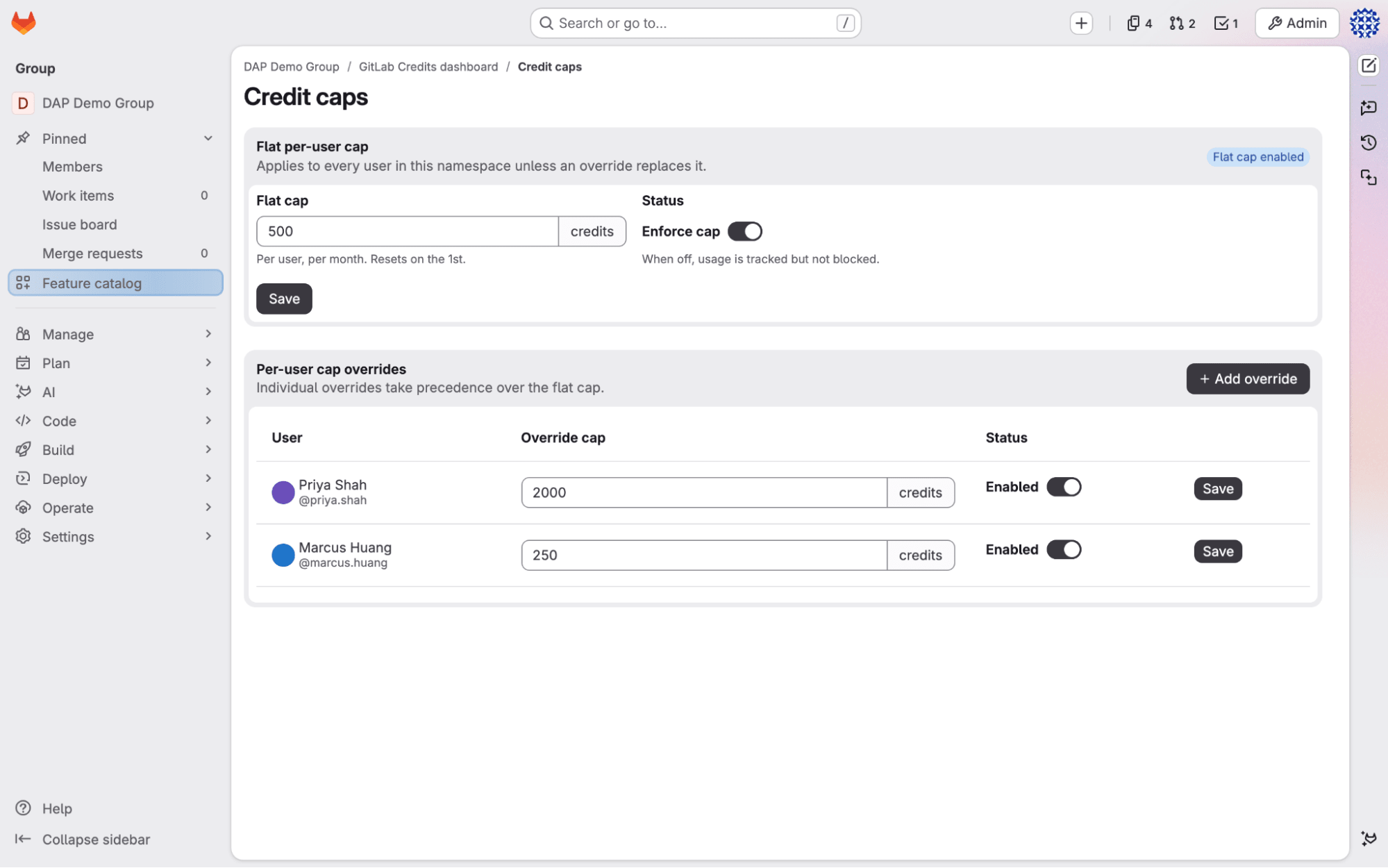
The Credit caps page puts both per-user controls on one screen. Set a default for everyone, then raise or lower it for individuals.
The flat cap toggle remains the master switch: Turn it off and overrides stop applying too.
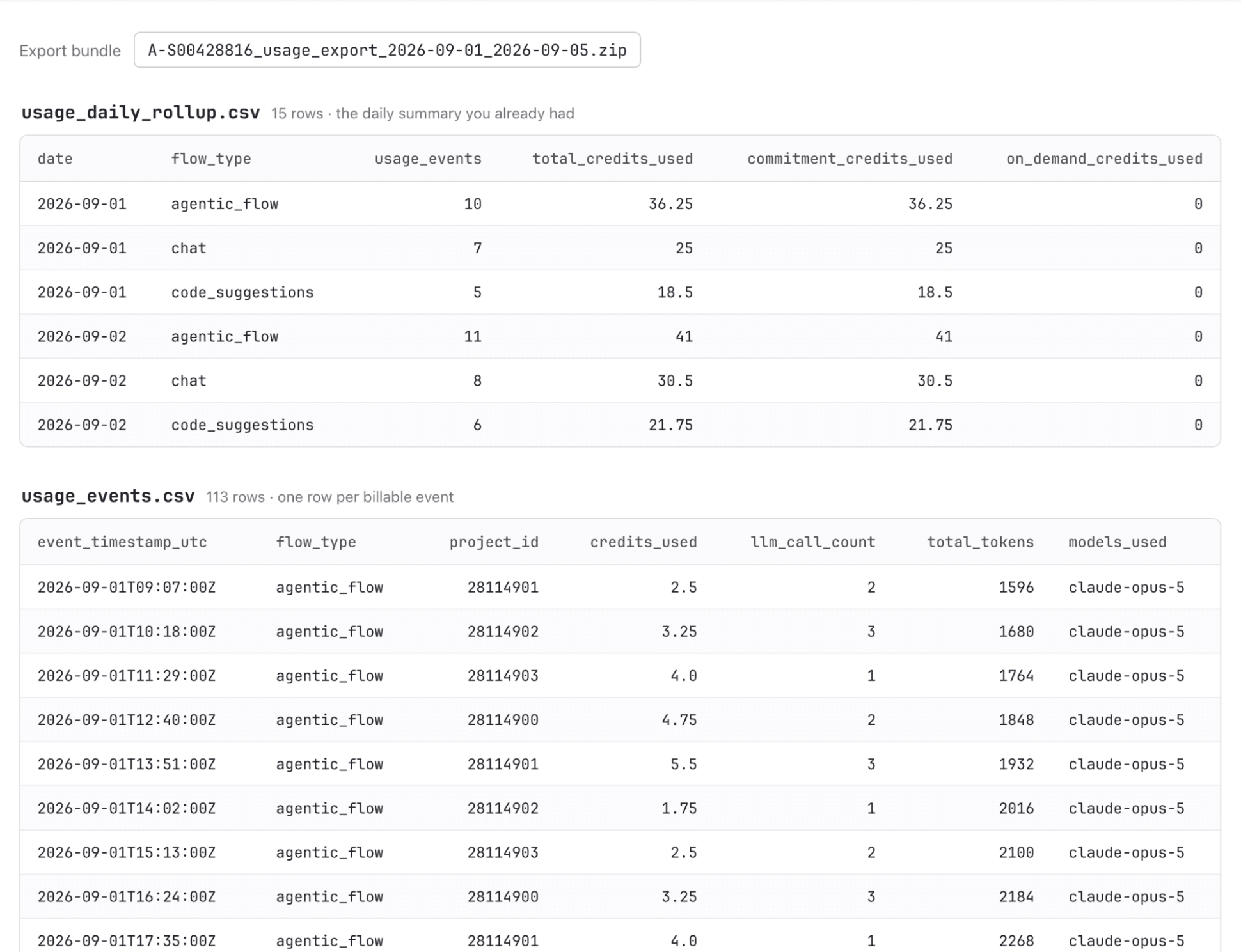
Exports now run in the background and arrive by email with a secure download link. Each export covers up to 31 days and contains three files: the daily summary you already use, a new per-event file, and a manifest.
Where a group has turned off Display GitLab Credits user data, the user columns follow that setting.
Group by namespace ID and you have a department's line, which is what showback runs on. Filter by user ID and date and you have the session behind last Tuesday's spike. Because namespaces seldom match finance cost centers directly, you can perform a one-time mapping so future monthly exports seamlessly reflect your cost structure.
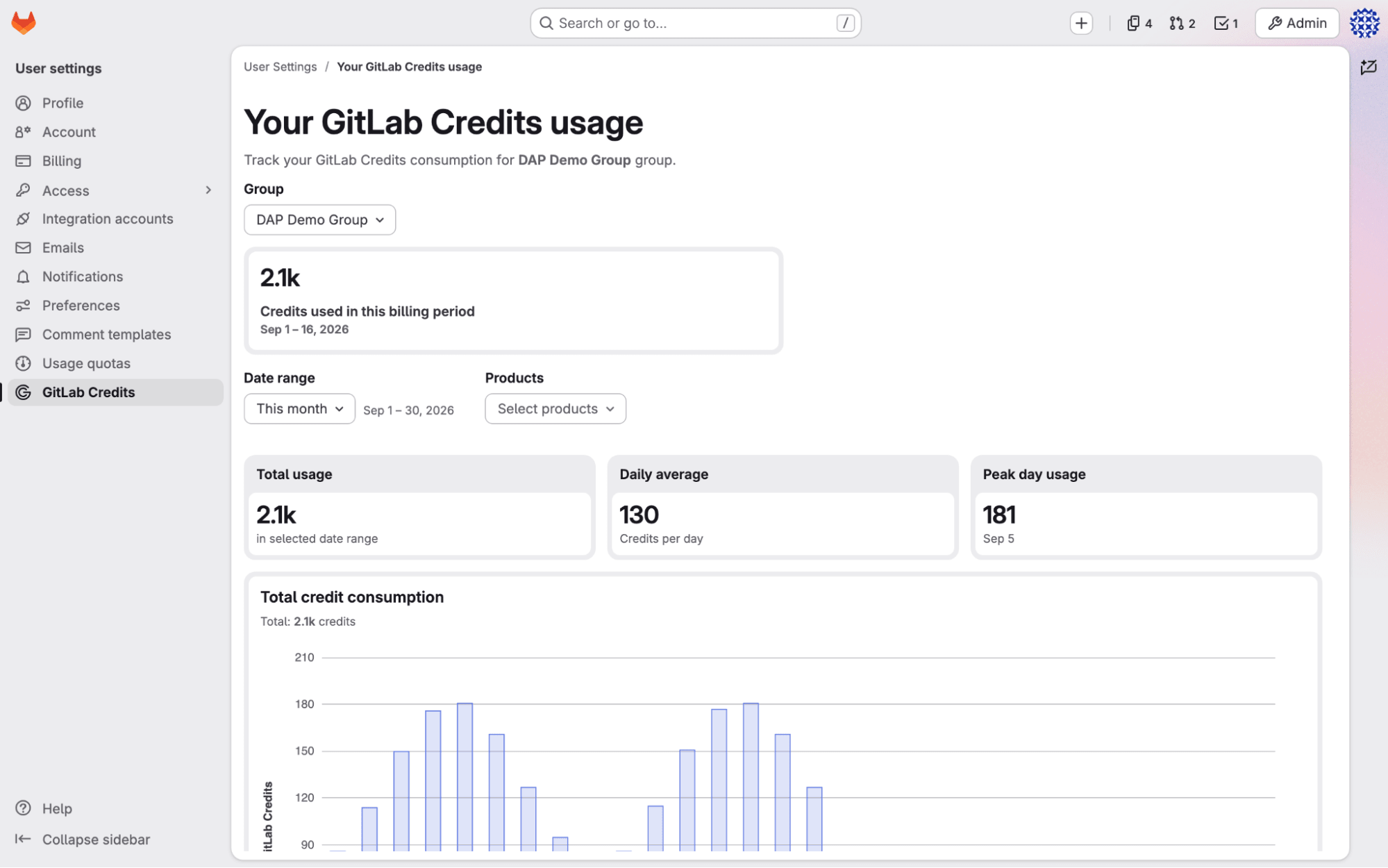
Any member of your top-level group can open their own GitLab Credits view under User settings and see a daily chart of their consumption, with the same product filter and date range controls as the group dashboard, scoped to their own events.
Included promotional monthly credits are now applied on a per-user basis before any shared evaluation credits are used, so each user spends what they are already entitled to first. Included credits are 12 per Premium seat and 24 per Ultimate seat per month. The evaluation pool is shared across the subscription. Your invoice does not change: Monthly Commitment Pool, One-Time Charge, and On-Demand credits keep their order.
To fund one team's heavy usage without opening the budget to everyone, set a low flat cap, then override it for the people doing agentic work. Everyone under the flat cap still gets their full included credits every month because caps are enforced only after included credits run out. Your shared pool pays for the exceptions, not for everybody.
GitLab Credits usage visibility is included and already available with Premium and Ultimate subscriptions.
1. Set the subscription ceiling. Billing account managers, this appears in the Customers Portal under GitLab Credits dashboard > Spend controls. Caps On-Demand credits across everyone.
2. Set per-user limits. Group Owners, on the Credit caps page, go to Settings > GitLab Credits > Credit caps for a top-level group; administrators on GitLab Self-Managed, go to Admin> GitLab Credits> Credit caps. One default for everyone, plus overrides.
3. Export what happened. From the GitLab Credits dashboard or the GitLab Flex month overview, select Export usage data. One row per billable event, up to 31 days, delivered by email.
To report per-user data, ensure Display GitLab Credits user data is turned on for your top-level group on GitLab.com or your Self-Managed instance. This setting is on by default, so most groups need no change.
None of the settings you’ve already set up changes. The subscription cap works as it did, enforcement behavior is unchanged, and the GraphQL API still writes to the same records the page reads, so existing automation continues working. The usage order documentation sets out the full sequence across every credit type.
Set your subscription cap today, then get started by exporting and analyzing last month's usage.
New to GitLab Duo Agent Platform? Start a free trial. Already on Premium or Ultimate? Turn on Duo Agent Platform and use the credits included with your subscription.
此内容由惯性聚合(RSS阅读器)自动聚合整理,仅供阅读参考。 原文来自 — 版权归原作者所有。