



There is a quiet crisis playing out inside distributed enterprises: retailers with dozens of stores, manufacturers with regional plants, utilities serving substations, and healthcare networks spanning clinics and campuses. It is not a cyberattack or cloud outage. It is simpler, and in many cases more disruptive: organizations cannot get the servers they ordered.
The AI infrastructure boom has created a demand shock across the server supply chain. Hyperscalers and cloud providers are buying GPU-dense systems at unprecedented scale, consuming manufacturing capacity, DRAM, and critical components. As a result, server lead times that once averaged four to six weeks now routinely stretch to six months or more, hitting distributed organizations especially hard.
For enterprises managing ten, twenty, or fifty edge sites, a six-month delay is not just an inconvenience. A failed server at a remote branch can take a store offline, stop a manufacturing cell, or disrupt local healthcare operations. At the same time, DRAM prices have surged 90 to 95 percent in 2026, tier-1 OEM list prices climbed 15 to 20 percent, and server configurations that cost around $7,000 last year are now approaching double that amount. Across 24 sites, that is not a line-item variance; it is a budget crisis.
Three Forces That Broke the Old Distributed It Playbook
Distributed IT has always operated under different constraints than the central data center. Edge sites and remote offices run lean: minimal hardware, limited on-site technical staff, simple architectures, and very little tolerance for downtime. For years, the standard playbook worked: two servers, a hypervisor license, maybe a small NAS, refresh every four years, done.
That playbook is now breaking under three converging forces.
First, hardware inflation: the cost of refreshing a two-server edge cluster has nearly doubled in twelve months, creating a severe capex problem when multiplied across twenty or fifty sites.
Second, virtualization repricing: Broadcom’s VMware subscription shift has hit distributed IT especially hard, with Forrester analysts reporting midmarket renewal increases of three to ten times prior-year rates and ITPro citing some European organizations seeing increases of up to 1,500 percent.
Third, architectural lock-in: Major HCI platforms often bind storage tightly to the hypervisor, so switching one means renegotiating both. At the edge, where simplicity and operational independence matter most, that lock-in is especially damaging. When one vendor controls both compute virtualization and storage across every remote site, organizations have little leverage at renewal and no easy exit.
When hardware lead times hit six months and licensing costs triple, the distributed enterprise cannot refresh its way out of the problem. It needs a different approach entirely.
The Refresh Cycle Was Never the Right Answer at the Edge
The hardware refresh cycle was built for centralized IT: plan every three to four years, buy in volume, depreciate, repeat. At the edge, that model was always a compromise: too slow for workload growth, too disruptive across remote sites, and too expensive when multiplied by location.
Today’s market disruption has exposed the weakness of that model. The economics no longer work when a two-node edge cluster has doubled in cost and hypervisor licensing has tripled. A server from 2019 or 2020, paired with modern NVMe storage and well-architected software, can often support retail, branch, or manufacturing workloads for years beyond its expected refresh date.
The real constraint is not the hardware generation. It is the cost and complexity of the software running on top of it. Across ten or twenty ROBO sites, the difference between a forklift refresh and modern software-defined infrastructure on existing servers does not simply add up; it compounds. That makes refresh planning less of a procurement habit and more of a capital allocation decision.

Squeeze the Juice: The Edge Infrastructure Doctrine for 2026
“Squeezing the juice” means extracting the full value from infrastructure you already own before spending on new hardware. For distributed enterprises managing multiple sites, this is not a cost-cutting compromise. It is the smarter response to a market where hardware refreshes have become slower, more expensive, and less predictable.
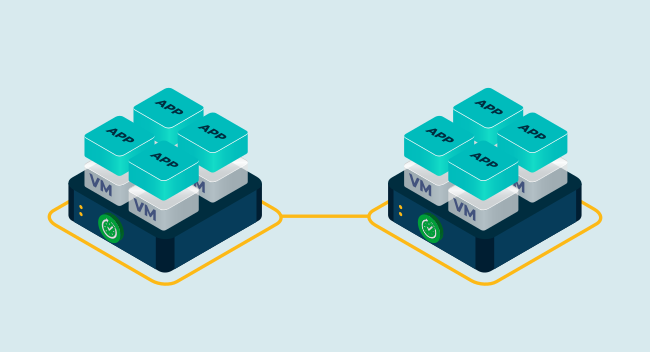
The architecture that makes it possible is software-defined hyperconverged infrastructure (HCI) running on existing commodity x86 servers. It converges compute, storage, and storage networking onto the hardware already in each rack, mirrors data synchronously between two nodes for high availability, and provides automatic failover without on-site IT intervention. It also removes the need for an external SAN, dedicated storage network, or complex quorum design.
The two-node model is where this architecture shines at the edge: two servers actively mirroring each other, with no third witness node required. If one node fails, workloads keep running automatically on the surviving node. Just as important, hypervisor flexibility gives organizations the freedom to choose or change platforms without rebuilding the storage architecture, turning vendor negotiations into real choice.
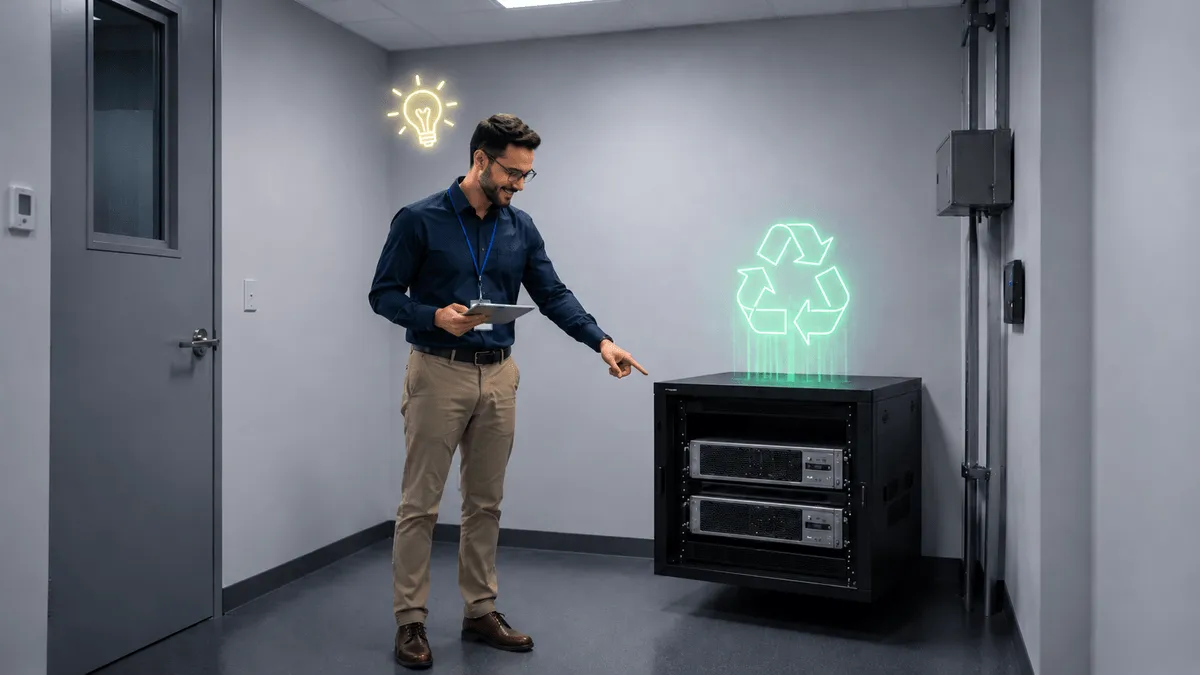
At 20 edge sites, every dollar of per-site licensing and every day of hardware lead time multiplies. The math doesn’t just favor the software-defined path; it demands it.
This is not a theoretical architecture. Organizations across distributed industries — utilities, retailers, multi-site healthcare, etc. — are already running it. StarWind by DataCore offers two software-defined routes to get there. One adds a high-availability storage layer to your existing environment. The other delivers a complete, pre-configured hyperconverged stack. Both running on the servers already in your racks.
1 StarWind Virtual SAN: High-Availability Storage on the Servers You Have
StarWind Virtual SAN is a software-defined storage layer that runs directly on existing x86 servers, creating highly available shared storage without external SAN hardware. It mirrors data synchronously between two nodes, so if one node fails, the other keeps applications running automatically. Most edge and ROBO deployments can start with a 2-node cluster, with no witness or quorum node required.
It supports VMware vSphere, Microsoft Hyper-V, Proxmox VE, and XCP-ng, giving distributed IT teams flexibility to choose the hypervisor that best fits their operating model and licensing economics. With iSCSI and NVMe-oF support, synchronous 2-way and 3-way mirroring, automated failover, failback, and self-healing rebuild, teams can deploy production-grade HA storage on existing hardware far faster and more affordably than waiting for a full hardware refresh.
2 StarWind Virtual HCI Appliance: The Full HCI Stack, Site-Ready
For organizations that want a complete hyperconverged platform rather than a storage layer alone, StarWind Virtual HCI Appliance delivers a pre-packaged, deployment-ready HCI stack on the commodity hardware already at each site. It bundles StarWind Virtual SAN with a hypervisor of choice — Microsoft Hyper-V, VMware vSphere, or Proxmox VE — into a single pre-configured solution.
Guided installation, configuration support, and migration services reduce the burden on distributed IT teams and help move workloads from existing infrastructure with minimal disruption. With only a 2-node cluster needed to get started, organizations can deploy a modern, resilient, fully converged infrastructure platform across edge and ROBO sites without waiting months for new hardware, absorbing the cost of forklift refreshes, or locking into a proprietary hardware vendor.
Conclusion
The infrastructure disruption of 2026 is forcing distributed enterprises to rethink hardware refresh cycles, hypervisor choices, and per-site cost models. The winners will not be the organizations that simply absorb doubled hardware costs and tripled licensing bills, but those that treat this moment as an inflection point toward software-defined, hardware-agnostic infrastructure. The servers in your racks are already capable. The juice is there. Squeeze it.
Contact DataCore to learn how you can extend the life of your existing edge infrastructure, reduce refresh costs, and keep critical sites running without waiting on new hardware.