惯性聚合 高效追踪和阅读你感兴趣的博客、新闻、科技资讯
阅读原文 在惯性聚合中打开

推荐订阅源

The Last Watchdog
The Last Watchdog
C
Cyber Attacks, Cyber Crime and Cyber Security
L
LINUX DO - 热门话题
G
GRAHAM CLULEY
S
Schneier on Security
钛媒体:引领未来商业与生活新知
钛媒体:引领未来商业与生活新知
S
SegmentFault 最新的问题
IT之家
IT之家
阮一峰的网络日志
阮一峰的网络日志
Recorded Future
Recorded Future
I
Intezer
云风的 BLOG
云风的 BLOG
博客园 - Franky
月光博客
月光博客
大猫的无限游戏
大猫的无限游戏
T
Tenable Blog
The Hacker News
The Hacker News
T
The Blog of Author Tim Ferriss
Attack and Defense Labs
D
DataBreaches.Net
freeCodeCamp Programming Tutorials: Python, JavaScript, Git & More
N
News and Events Feed by Topic
有赞技术团队
有赞技术团队
Exploit-DB.com RSS Feed
N
News and Events Feed by Topic
Threat Intelligence Blog | Flashpoint
S
Secure Thoughts
The Register - Security
B
Blog
Security Archives - TechRepublic
The Cloudflare Blog
Webroot Blog
Webroot Blog
W
WeLiveSecurity
H
Heimdal Security Blog
博客园 - 三生石上(FineUI控件)
V
Vulnerabilities – Threatpost
G
Google Developers Blog
O
OpenAI News
V
V2EX
罗磊的独立博客
博客园_首页
N
News | PayPal Newsroom
cs.CL updates on arXiv.org
CTFtime.org: upcoming CTF events
TaoSecurity Blog
TaoSecurity Blog
Cloudbric
Cloudbric
H
Hacker News: Front Page
博客园 - 叶小钗
T
Tor Project blog
AI
AI

Apptio

How IBM Apptio Delivers Data Center Value in the Age of AI - Apptio Managing K8s Agent Updates at Scale with Helm and Terraform - Apptio GitOps with IBM Kubecost: Preventing Argo CD Rollbacks - Apptio GitOps with IBM Kubecost: API-Driven Rightsizing - Apptio It’s Here: Meet the New IBM Apptio Report Studio – A Faster, More Intuitive Approach to Reporting - Apptio New Tech, Same Rules: Cloud Lessons for an AI Advantage - Apptio IBM Cloudability Advanced Containers for Kubernetes FinOps - Apptio The Next Era of IT Financial Management Reporting with the New IBM Apptio Report Studio - Apptio From Guesswork to Confidence: Introducing Intelligent Forecasting for Tech Spend Planning - Apptio Smarter Technology Spend with AI-Driven Financial Intelligence - Apptio Budgets Are Up, Confidence Isn't: 2026 Global Tech Investment Insights - Apptio IBM Kubecost 3.1: Kubernetes Resource Quota Rightsizing - Apptio Driving FinOps Forward in 2025 and Beyond - Apptio ITFM Maturity: The Next CIO Imperative in the Age of Innovation - Apptio How Banks Can Optimize IT Spend Without Sacrificing Impact - Apptio Introducing IBM Apptio Product TCO: Turn Product Spend into Strategic Investments with Clear, End-to-End Total Cost of Ownership and Unit Costs: Creating a Strategic Lens for IT Investment Decisions - Apptio Workforce Management: The Engine of Strategic Portfolio Management - Apptio FinOps for AI: Enabling the Next Wave of Cloud Innovation - Apptio IBM Kubecost 3.0: Faster, Smarter, and Built for Scale - Apptio Introducing IBM Apptio Mainframe TCO: Complete Visibility into Mainframe Costs and Usage - Apptio Essential K8s Cost Metrics for Reducing Spend - Apptio The New Standard for Strategic Portfolio Management: Financial Visibility at Every Level - Apptio Kubecost 2.8: Centralized Custom Pricing and a Big Performance Leap with ClickHouse - Apptio Unlock the Power of IT Financial Management with IBM Apptio Essentials - Apptio Full Transparency for Smart AI Investments with IBM Apptio’s AI Total Cost of Ownership & Usage - Apptio What’s New in IBM Apptio Planning - Apptio Labeling in Kubernetes: From Metadata to Money-Saving Insights - Apptio Innovative Approaches to Drive Tech Spend Management with AI, Analytics, and Automation - Apptio Discover Kubecost on Apptio’s Website: Enhancing FinOps with Kubernetes Insights - Apptio How Kubecost Collections Works: From the Engineers Who Built It - Apptio Kubecost 2.7 Release Highlights - Apptio Introducing Hybrid IT TCO Impact: IBM Apptio’s Newest Solution to Manage Your Evolving Hybrid Environment - Apptio FinOps Essentials: Best Practices for Finance Teams - Apptio Upgrading Your Kubecost Experience - Apptio Kubecost 2.6 Release Highlights - Apptio Kubernetes Efficiency: Cut Waste, Not Performance - Apptio FinOps Essentials: Best Practices for Product Teams - Apptio Optimizing GPU Monitoring for AI Efficiency - Apptio Kubecost 2.5 Release Highlights - Apptio FinOps Essentials: Strategies for Smarter Cloud Spending - Apptio Achieving Cost-Effective Scaling in Kubernetes - Apptio Celebrating OpenCost’s Journey to CNCF Incubation - Apptio Unlocking Technology Value: The Essential Role of TBM in Modern IT Management - Apptio The Complex Costs of AI: Investments, Funding, and ROI Tracking - Apptio Addressing Carbon Emissions in IT: The New Business Imperative - Apptio Kubecost Brings NVIDIA GPU cost monitoring for AI workloads in 2.4 - Apptio Kubecost Launches Support for Oracle Cloud - Apptio Kubecost 2.4 Release Highlights - Apptio Evolving Container Cost Visibility with IBM Cloudability - Apptio Transforming the Way You Manage Your Digital Portfolios: IBM Apptio and ServiceNow - Apptio Maximizing Kubernetes Cost Efficiency with Kubecost and Amazon EKS - Apptio FinOps Foundations: Strategies for Cross-Team Alignment - Apptio Managing Kubernetes Costs in a Multi-Cloud Environment - Apptio Unlock Kubernetes Savings with Kubecost’s Automated Actions - Apptio Celebrating a Milestone: Kubecost Surpasses 10 Million Installs - Apptio Kubernetes Pricing: On-Premises Versus Cloud Environments - Apptio Maximizing Multi-Cloud Efficiency with Kubecost APIs - Apptio Aligning Tech Financials and Labor Resources - Apptio Kubecost 2.3 Release Highlights - Apptio IBM Cloudability Introduces New Innovations for FinOps Practitioners - Apptio Kubecost Launches the First Kubecost Certification - Apptio Enhancing Cloud Reporting: Attributing Costs to Kubernetes Applications - Apptio Building a FinOps Solution for All - Apptio Navigating the Growing Complexities of Technology Spend Management - Apptio Apptio Introduces New Products to Elevate Technology Value - Apptio Developing a Strategy for Kubernetes Cost Monitoring - Apptio Visualize your Kubernetes Network Costs - Apptio Getting Highly Accurate and Granular Cost Metrics with Kubecost - Apptio 8 Steps to Achieve Enterprise Agile Planning Success - Apptio FinOps and TBM at Public Sector Summit - Apptio Introducing Kubecost Collections - Apptio Apptio & ServiceNow launch new Application Portfolio Management capabilities - Apptio Beyond the Hype: A Balanced View of AI Adoption - Apptio 2.1 Release Highlights - Apptio Starting your Technology Business Management Journey: A Guide for Smart Technology Investments with Apptio Cost Management - Apptio IBM Cloudability: 2023 Innovation in Review - Apptio Kubecost 2.0 Packaging - Apptio Kubernetes Readiness Probe: Tutorial & Examples - Apptio Kubernetes Health Check - How-To and Best Practices - Apptio Introducing Kubecost 2.0 - Apptio Kubernetes Liveness Probe: Tutorial & Examples - Apptio Kubernetes Cluster Size: Your Guide to Optimization - Apptio EKS Cost Monitoring: The Kubecost and AWS Solution - Apptio Kubernetes Deployment Strategies: Tutorial & Examples - Apptio Guide to Kubernetes Management Tools - Apptio Automate Your Rightsizing Workflows with IBM Cloudability and ServiceNow - Apptio Kyverno and Kubecost: Real-time Kubernetes Cost Management - Apptio Making Smarter IT Decisions With Apptio Plus ServiceNow Breaking Down Silos Between Finance and Agile Teams With Lean Budgeting - Apptio Maximize Cloud Savings Without Running Afoul of AWS RI Marketplace Enforcements - Apptio Cost-Effective Deployment Policies With Kyverno - Apptio Tracking Waste on Kubernetes Clusters - Apptio Blending FinOps With Observability - Apptio 3 Key Opportunities for Finance Teams in SAFe 6.0 - Apptio Kubecost Predict Part 2: Introducing the Admission Controller - Apptio The CEO as the Chief Transformation Officer - Apptio Client Challenge Client Challenge Client Challenge
K8s Cost Ownership: Who’s Responsible and How to Make It Work - Apptio
Mohammad Azharuddin · 2025-07-25 · via Apptio

Kubernetes Costs: From Nobody’s Problem to Everybody’s Problem

Kubernetes makes a lot of things easier. Teams can deploy faster, scale automatically, and share infrastructure without thinking too hard about what’s running underneath. But all that abstraction comes at a cost.

When compute, storage, and network resources are pooled across services and teams, the lines between who used what start to blur. You might know your app is running smoothly, but you probably don’t know how much it’s costing you/your company. Or who’s technically responsible for that spend. Then when a surprise cloud bill shows up, it’s usually nobody’s fault, which quickly turns into nobody’s job to fix. But that money has to come from somewhere, forcing everyone to re-evaluate their budgets and potentially make difficult choices. Worse still, with nobody owning the original issue, the surprise bills become a regular occurrence.

That’s the problem.

Cost visibility in Kubernetes is notoriously tricky. And without clear ownership, it’s almost impossible to act on it.

Why Cost Ownership Is So Hard in Kubernetes

Shared Infrastructure Obscures Responsibility

Kubernetes is designed for flexibility, pooling compute, storage, and network resources across many services and teams. But when multiple workloads share the same nodes and clusters, the boundary between owners becomes murky. Without clear segmentation, it’s difficult to determine who is responsible for what, and even harder to drive accountability.

Labeling Is Manual and Often Inconsistent

Kubernetes relies on user-defined labels to organize workloads and enable cost allocation. But without strict standards and enforcement, teams apply labels inconsistently or not at all. The result is fragmented metadata that breaks reporting logic, introduces gaps in usage tracking, and skews downstream cost data.

Dynamic Workloads Break Traditional Tracking

Pods are constantly spinning up, shutting down, and shifting across nodes. Even persistent workloads are rescheduled frequently due to scaling events, deployments, or health checks. These ephemeral patterns make it hard to trace resource usage over time without real-time, granular telemetry.

What Cost Ownership Should Look Like in Kubernetes

Clear Lines of Responsibility

Assigning cost ownership starts with defining who’s responsible for what. That means deciding how workloads are grouped and tracked—by namespace, label, or controller.

It helps to be explicit. For example, a namespace might represent a team or a service. Labels like team=kubecost or owner=platform give you a way to track cost back to an individual or group. Once that connection is in place, cost data becomes accountable.

Cost Accountability Without Finger-Pointing

The point of assigning ownership isn’t to blame anyone. It’s to give teams even deeper insights into the impact of the decisions they’re already making. Without that context, engineers are unable to balance performance and cost.

Cost accountability works best when it’s built into workflows. Teams should be able to see what they’re spending, identify what’s driving that spend, and adjust as needed. That feedback loop doesn’t need to be formal. Sometimes it’s just a dashboard or an alert that shows up during a sprint retro.

Alignment With FinOps Principles

This kind of visibility and accountability lines up well with FinOps practices. Showback is the idea of giving teams a view into the cost of their infrastructure, without charging them directly. Chargeback goes a step further and actually allocates budget or spend to the team itself. Either approach can work, depending on your culture.

What matters more is the collaboration between FinOps and DevOps. Finance can help guide strategy, but Engineering teams need to be empowered to take action. That collaboration is essential for the most efficient use of resources, so Engineering has the resources they need while managing spend as effectively as possible.

Strategies for Defining and Assigning Cost Ownership

Use Namespaces and Labels Strategically

To assign ownership, you need a way to group workloads consistently. The most common method is leveraging namespaces and labels.

Namespaces provide a natural boundary. Many organizations use them to represent teams or environments. Labels offer more granularity, helping map workloads to applications, environments, or owners.

The key is consistency. Without automated enforcement, labels often get applied haphazardly. CI/CD tools like ArgoCD, GitHub Actions, or Terraform can help inject required labels at deployment. For runtime validation, Kubernetes admission controllers like OPA or Kyverno can be used to enforce labeling standards before workloads are admitted to the cluster.

Develop a Governance Model

Beyond labeling, cost ownership needs policy and accountability. Start by defining who’s responsible for what. Assign ownership at the team, namespace, or service level—typically a lead engineer or platform manager.

Then build the rules. Governance should define what labeling standards are required, how shared resources are attributed, and how cost accountability is structured. Use automation to enforce these standards, and ensure your policies are version-controlled alongside your infrastructure code.

Treat governance as a living framework. Document your rules and revisit them as your org and architecture evolves.

Communicate Cost Impact Regularly

Give engineers visibility into the cost of the workloads they manage. Share filtered dashboards and usage reports by team or namespace and make sure to surface insights during sprint planning or retros.

The goal isn’t to penalize teams; it’s to give them context. Engineers can’t make smart trade-offs around performance and efficiency without understanding the cost impact. When cost becomes part of day-to-day engineering culture, optimization stops being a one-time cleanup and starts becoming a habit. There are fewer surprise cloud bills and fewer hard choices to make after spend has already ballooned.

How IBM Kubecost Helps Teams Establish and Enforce Cost Ownership

Kubecost gives platform, engineering, and FinOps teams the tools they need to understand, assign, and enforce cost ownership in Kubernetes. The features below help teams track spend, hold the right people accountable, and take action.

Visibility Into Resource Spend with the Allocations Dashboard

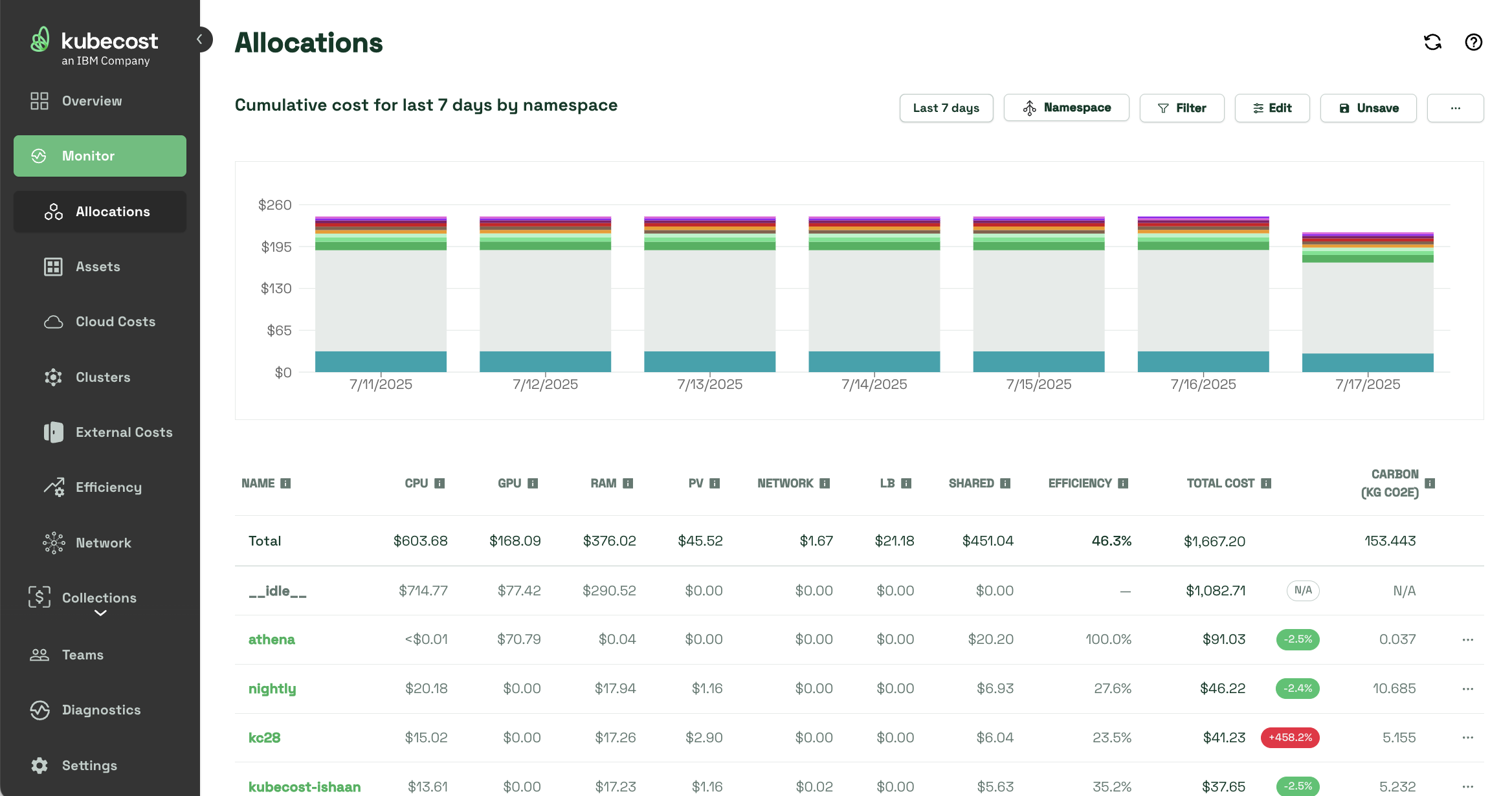
The Allocations Dashboard is the foundation of cost ownership in Kubecost. It surfaces real-time Kubernetes spend across native concepts like namespaces, deployments, services, and labels. Teams can group costs by team, department, or environment—assuming consistent labeling practices—and filter spend to match how their org actually operates.

Kubecost Allocations - K8s Cost Ownership: Who’s Responsible and How to Make It Work - Apptio

Engineers can drill down into specific workloads, explore shared cost breakdowns, and view right-sizing recommendations. The dashboard also supports visibility into:

  • Idle resources: Show or distribute unused capacity across nodes or clusters.
  • Efficiency metrics: Track requested vs. actual resource usage.
  • Shared resources: Allocate costs for platform-wide services like logging or ingress.
  • Historical and forecasted spend: Understand past trends and predict future costs.

Structuring Ownership with Collections

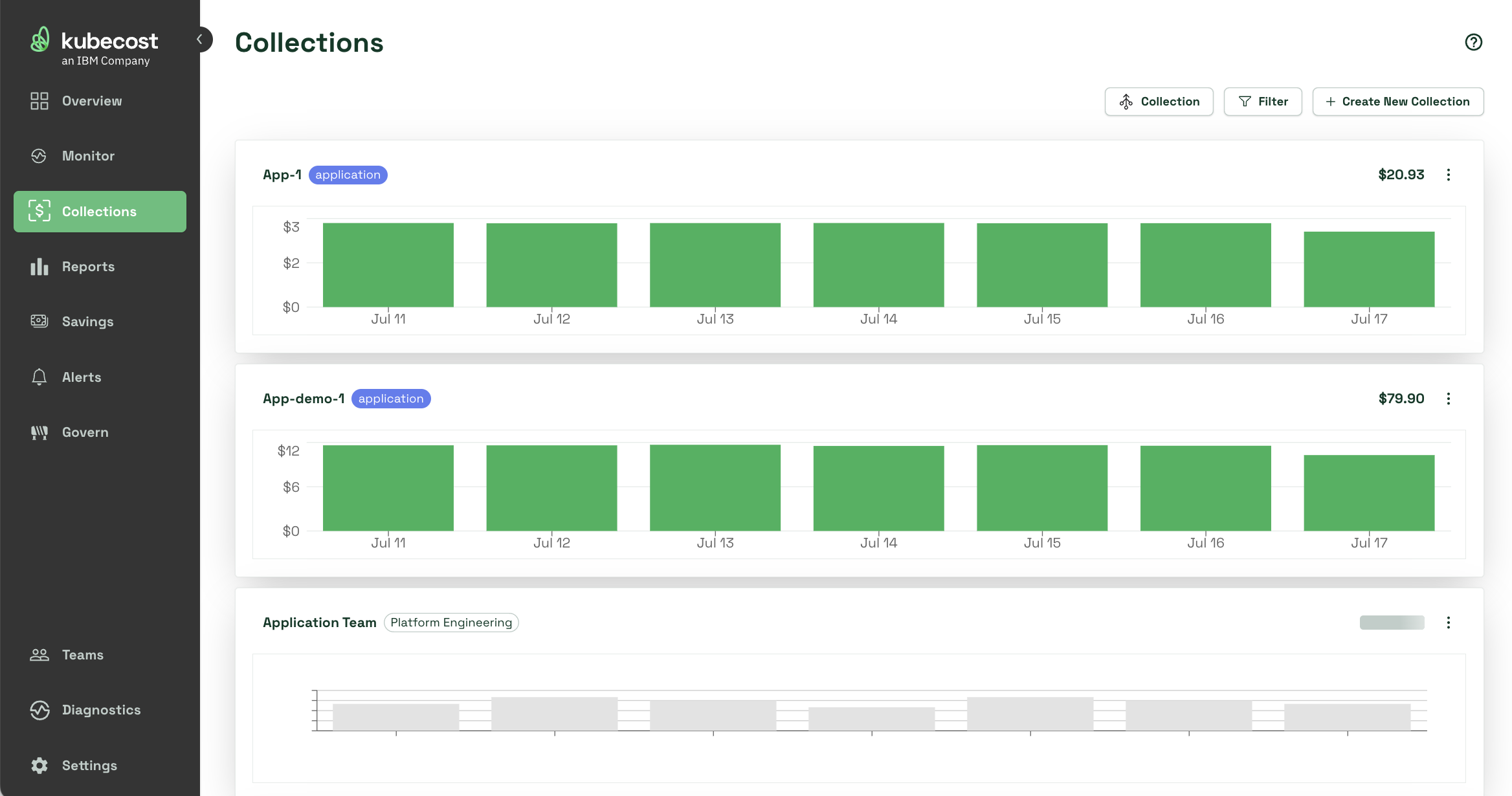
Once spend is visible, the next step is grouping it meaningfully and assigning it to the right teams. Collections make this possible by letting you combine Kubernetes and external cloud resources under a single logical unit: a team, an app, a business unit, or any function that spans infrastructure.

Kubecost Collections - K8s Cost Ownership: Who’s Responsible and How to Make It Work - Apptio

Collections are built using Kubernetes metadata (like labels or namespaces) and cloud provider tags. Kubecost automatically deduplicates overlapping resources across collections, so shared services aren’t double-counted.

Starting in version 2.7, enhancements to Collections support:

  • Shared cost allocation across collections (weighted or evenly split).
  • Chargeback categories that group collections and assign final costs per owner.
  • Improved accuracy for overlapping resources, ensuring collections reflect true usage.

Identifying Spending Gaps with Diagnostics

Even with strong cost models, gaps happen—misconfigured clusters, missing data, or untracked workloads. Diagnostics makes it easy to spot these problems before they show up in reports.

The Diagnostics view shows which clusters are reporting incorrectly, flags errors or telemetry gaps, and simplifies debugging. This helps ensure every team’s costs are visible and accurate.

Enforcing Accountability with Granular RBAC

Ownership doesn’t mean much if the wrong people have access to the wrong data—or if everyone has access to everything. Kubecost provides role-based access control (RBAC) that allows admins to customize the platform experience for each user.

Admins can filter what individual users or groups are allowed to see and do based on their role or scope of responsibility. Engineers can focus on the namespaces and workloads they manage, while finance and leadership teams can view filtered reporting tied to their domains.

This enforces the principles of least privilege, improves security, and eliminates distraction from irrelevant data. For organizations practicing cost ownership at scale, RBAC is essential for governance, compliance, and operational clarity.

Staying Informed with Budgets, Alerts, and Automated Reporting

Kubecost gives teams multiple ways to stay on top of cloud spend—without manual oversight. Budgets, alerts, and automated reporting work together to keep teams informed in real time. Complete clarity without the risk of manual error.

Budget Enforcement

With Budgets, you can define spend limits by namespace, cluster, label, collection, and more. Budgets can reset monthly or weekly and trigger alerts at predefined thresholds (e.g., 80% of budget used).

Custom Alerts

Alerts can notify teams when spend exceeds thresholds, efficiency drops below target, or usage spikes unexpectedly. They can be delivered by email, Slack, or Microsoft Teams, making it easy to integrate into existing channels.

Automated Reporting

For teams integrating Kubecost into broader workflows, APIs and export options make it easy to pull cost data into reports, audits, and planning tools. You can also configure Kubecost to automatically send scheduled CSV or PDF reports to key stakeholders, ensuring teams always have access to the latest cost data.

Collaborative, Clear Spend Management without Sacrificing Speed

Kubernetes cost ownership starts with visibility and ends with accountability. When workloads are dynamic and shared across teams, it’s easy for cloud costs to go untracked. But with consistent labeling, clear ownership boundaries, and the right tools to support governance, teams can take control of their spend without sacrificing speed.

Want to put these ideas into action? Install Kubecost for free to get real-time visibility, define ownership boundaries, and give every team the insights they need to spend smarter.