


Reading Time: 9 minutes
Building a podcast community is much like launching a new business. It requires research, planning, and action – let’s take a look at eight practical methods to grow your podcast community today!
They’ll help you tap into what your audience wants so you can focus on creating content they’ll consume. You’ll also discover how to reach a larger audience to grow your brand, and which levers to pull to produce promotional content that attracts more eyeballs, and more.
But first, why should you invest time into building a podcast community anyway?
There’s an old African proverb about the power of community. It goes like this: “If you want to go fast, go alone. If you want to go far, go together.” And this rings true for content creators. A solo journey is less likely to get you as far as you want to go.
Building a community around your podcast is about supporting your brand with a base of customers, fans, and enthusiasts who want to learn more about what you offer.
But there’s more to building a community. Let’s discuss why wrapping one around your brand is beneficial:
Communities enable content creators to extend their reach beyond their immediate network, attracting potential customers or followers. People like, share, and comment on content they love. This behavior is backed by research by a world-renowned Austrian psychologist Ernest Dichter.
Dichter found that people are motivated to make recommendations for four reasons. These are the same reasons your podcast community will tap into.
People are more likely to recommend products, and services with which they have had a positive personal experience, make them appear as connoisseurs, and position themselves as nice people, or a source of interesting topics.
The more impactful your content, the greater the chance that people will share it, leading to more reach with less effort on your part.
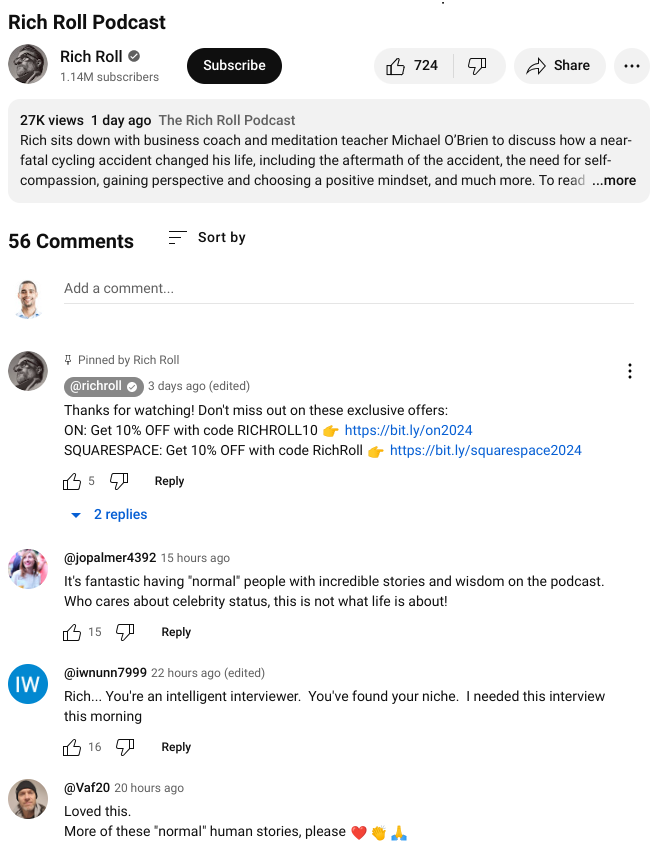
Engaging with a community can spark new ideas for content creation, leading to more innovative and relevant material. Finding new ideas isn’t hard to do either. People tend to share and make requests about topics and issues that are close to their hearts. Stuff they want to see more of.
Rich Roll’s podcast has over 1.14 million subscribers on YouTube, and it’s common for people to share ideas they want to see more of on the show. Like these:
The comments section isn’t the only place to search for new ideas. You can run surveys, and reach out to listeners via email for feedback too, leveraging email marketing strategies.
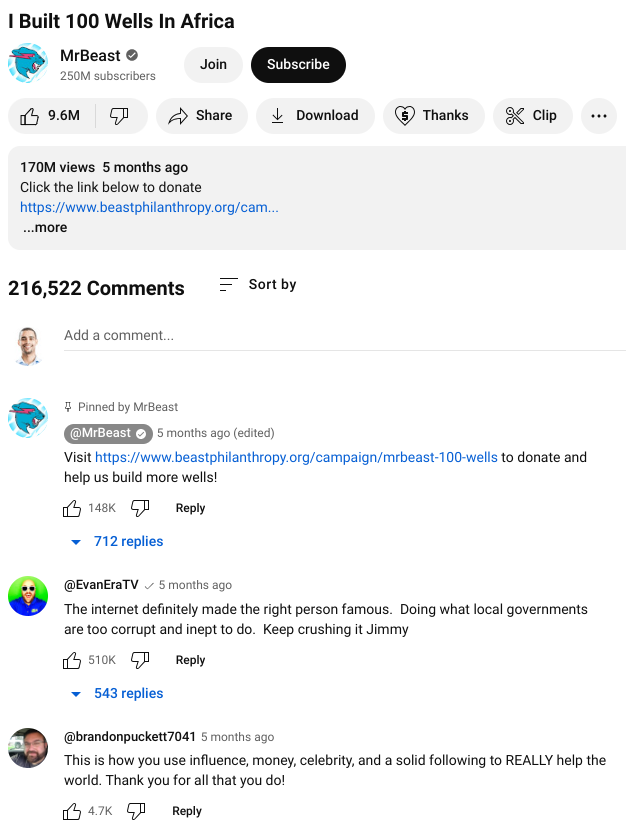
Giving back to your podcast community enhances your image as a content creator, fostering goodwill among audiences. Hosting events, whether virtual meetups, live Q&A sessions, or exclusive webinars, allows you to directly engage with your community and show your appreciation for their support. Everyone knows Mr. Beast and everyone knows how generous he is too. His ability to give is a powerful branding tool because he appears more accessible to a wider audience. This appearance makes him seem more like a normal person and therefore more likable.
But there’s a deeper neurological connection between giving and why people love to see or experience it. Generosity activates happiness in the giver. It does the same for people observing the act. All you need to do is watch a Mr. Beast video for proof.
You don’t have to be Mr. Beast to be generous on your podcast. All you need to do is give what you can. The more you give, the more you feel good. The more you share, the more people experiencing your kindness experience the same sense of happiness. It’s contagious.
Take a look at just three comments on Mr. Beast’s “I Built 100 Wells In Africa” video:
Communities provide a platform for knowledge sharing and learning, benefiting creators and their audiences. This learning experience includes exposure to new ideas, perspectives, and people with similar interests. Moreover, communities serve as a hub for social proof, where members validate and endorse each other’s content, enhancing credibility and attracting more listeners to your podcast.
As a creator, your opportunity to develop a community where you can facilitate learning experiences is priceless. It offers members permission to connect and grow, ultimately providing a fertile ground to monetize the videos you produce.
Being a creative is often described as a rollercoaster. Most creatives, professionals included, refer to a sense of imposter syndrome as a constant feature of daily life. This is why support from a community is crucial.
The creative work you do is displayed for the world to see. And sure, there will be some bad apples, but there are always people who come across your work and fall in love with it.
Some stumble upon it, others search for it. And when they find, experience, and love what you share, that’s the ultimate form of validation that all creatives seek.
Most of what you’ll hear about success in business echoes the value of growing your network. Surrounding yourself with the right people helps propel your professional and personal growth.
The same applies to expanding your podcast community. But there are other equally valuable ways to reach more listeners, too. Here are 8 practical steps to grow your audience with the help of creators and smart marketing.
Collaboration could be your goal, however, it’s more of a catalyst for greater success. Real, more effective goals would be to tie collaboration to outcomes. These can include more downloads, increased engagement with content, sponsorship deals, and product or service sales.

Reading Time: 5 minutes In a guest post from podcast production company Soundstripe, Drew Gula shares 3 ways to improve your show’s production value and create a quality podcast that will attract new listeners and keep them listening.
How do you pick the right goals for your podcast? Focus on goals that would deliver growth.
You’ll have to take the time to examine your numbers. Look for specifics and how improving in an area would translate into better results. For instance, if you wanted more downloads, you’d need to know how many downloads your podcast averages monthly.
Next, you would consider all factors that influence the number of downloads you receive. One particular factor would be promotion. Here are simple questions you could use to determine how to get more downloads:
Answers to these questions, along with some digging into how competitors promote their podcasts will show where there’s room for improvement. And once you’ve identified how to grow, all you need to do is take action to generate results.
Test new places to promote your work. Try publishing more promotional content. Results will point to what works and what doesn’t.
An effective way of growing your podcast community is to work with similar podcasts and their creators. This approach works because you’re focusing on podcasts with similar, aligned, or related niches, audiences, and most importantly audience sizes.
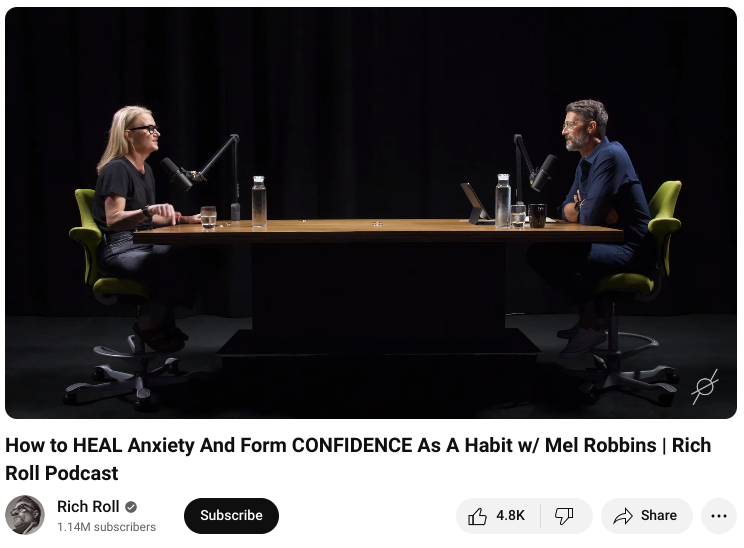
Take Rich Roll’s podcast episode with Mel Robbins. Both creators have over 1 million subscribers on YouTube and produce content on how to live your healthiest, most rewarding life. They achieve this with interviews of well-known people who share their stories, successes, and failures
Partnerships are only rewarding when they are mutually beneficial. That said, a larger podcast with millions of downloads may not see the value in collaborating with a newer podcast with a couple of thousand downloads.
But a smaller podcast will see it as an opportunity to scale. Cross-promotion introduces your work to communities that may not have experienced it. And because of the parity between your content and audience interests, there’s a greater chance of more people engaging with your content and joining your community.
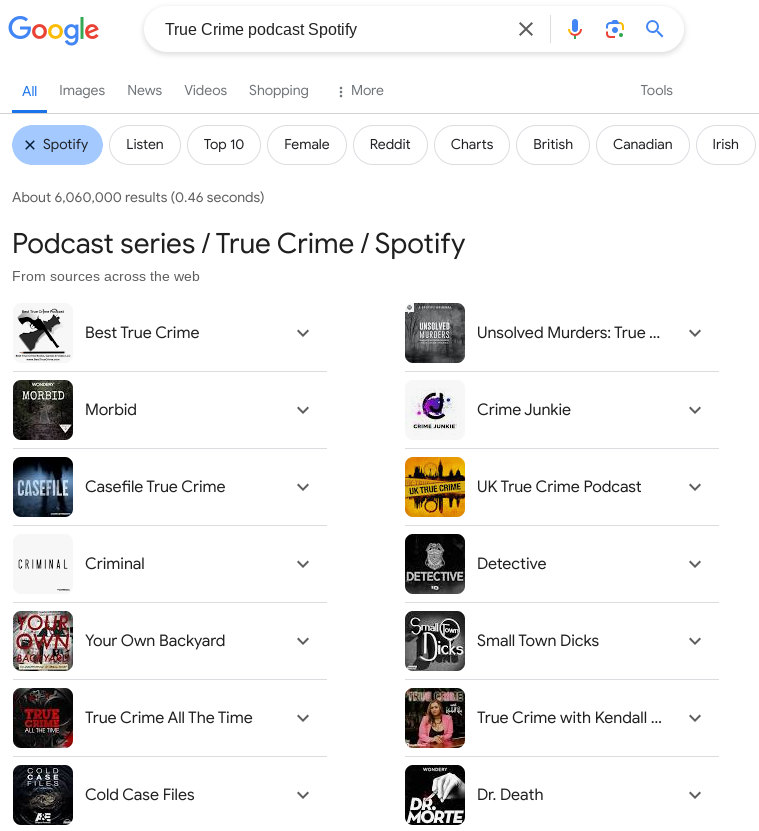
To find similar podcasts, just head over to Google and search for your niche and add “+ podcast”. Here’s an example of true crime podcasts that could become great collaboration opportunities. Pay attention to the number of downloads, subscribers, and engagement to find the best possible partners.
People want to work with people they like. They also want to work with people who are results-oriented. If you can be both, you’re closer to realizing your collaboration goals than you think.
Relationships start with engagement and a desire to offer real value. Not every relationship you pursue with other creators will result in a business deal or be wildly lucrative, and that’s not the point. What you’re aiming for is to build relationships that are genuine and mutually beneficial.
Starting these relationships is as simple as posting a comment or sending an email with praise for the work a creator has produced.
This small act of appreciation is also a show of interest that goes a long way toward cultivating a meaningful bond.
A note on forming bonds with other creators: it’s okay to offer a compliment and pitch an idea. Most creators expect that. Just don’t be pushy. And if your idea is well received, show up as your best self. The relationship you form could easily open doors to bigger and better opportunities.
Get clear on who you’re creating content for. The sooner you do, the easier it will be to zero in on what interests your audience and what to spend your time creating.
If you’ve never given customer or audience research a chance, it’s less complicated than most think. Here are 3 questions to answer to point you to what your audience wants more of:
These are basic, yet powerful questions, and finding answers to these isn’t difficult. Consume content your competitors produce, check their comments sections, use Google search, use Amazon reviews, and more. There’s a world of accessible, real-life insight into your audience’s needs at your fingertips.
A major and often overlooked aspect of marketing is promoting content. Most marketers would argue that you should spend more time promoting your content than creating it. However, promotion isn’t about posting or sharing your content anywhere.
You have to be selective about the platforms you choose. Pick channels where your audience is. Mel Robbins has a brand that appeals to a broad audience. She can share her content across many platforms and does.

Beautiful and Bothered, a podcast about the makeup industry covered in a more satirical fashion, is less likely to find its audience on LinkedIn. Instead, it is shared on YouTube, Spotify, Apple Podcasts, and TikTok.
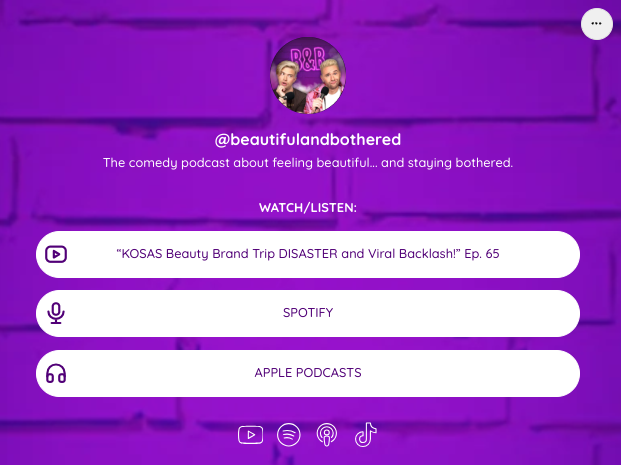
How do you find the right platforms to promote your podcast? Start by visiting each platform and search for content related to your audience and niche. Next, look at the engagement content received. Are there a fair amount of likes, shares, and comments? Can you tell how many times it has been viewed?
Engagement acts as a strong signal of the success of content on a specific platform. Once you’ve identified platforms where content similar to yours is successful, promote your podcast episodes there.
Because of the amount of content that appears on social media platforms, anything you post has to be engaging to grab the attention of your audience.
There are several ways to create engaging content. Stephen Barlett runs Diary of a CEO (DOAC), a podcast where he interviews celebrities and leading public figures. As part of their practice for reaching the largest audience possible, his social media manager produces 150 thumbnail images which are tested using paid ads.
Reading Time: 8 minutes Discover how to use podcasts for marketing & branding – boost visibility, improve audience connection & drive business success. Dive in now!
You don’t have to commit to producing that many thumbnails, however, testing several using paid media could help you better understand what audiences find appealing.
If you’d like to produce your most engaging social posts, here are 3 tips to test out:
People are drawn to faces, especially on thumbnails. Faces communicate emotions that can be amplified with text. Tim Dillon (a comedian) appearing serious alongside the word “Gen-Z has exposed society’s scam” is enough to stop you from scrolling.
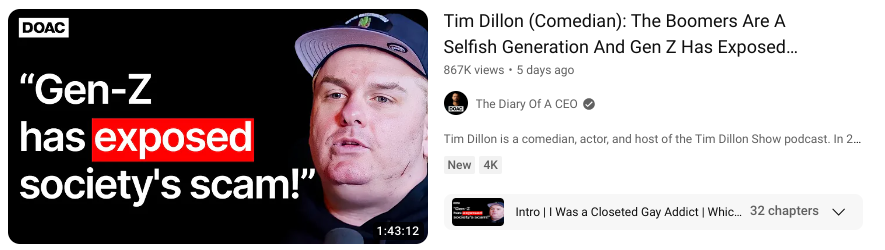
What’s more compelling in Tim Dillon’s example is the text. It’s a strong statement. The red highlight of the word “exposed” also grabs attention because of the contrast of colors.
Podcasts typically include tons of information. The best bits are what people are interested in. Ideas that resonate with their experiences, challenges, or ideas of the future. Pull these from your podcast and package them into short posts for social media.
This DOAC clip of an interview with Simon Sinek does just that. Sinek explores this idea of finding a job that meets your expectations for work-life balance if you don’t want to be a careerist. This clip is poignant because of the evolution of today’s workplace. More people want to be treated and compensated fairly. They also want to have the flexibility to work hard and longer when needed, but not to overwork themselves.
EMBED LINK IN COMMENT.
Increase discoverability by using hashtags your audience searches for. Adding these to relevant posts can help more people find your content, exposing it to a larger audience.
To find hashtags people use, take a peek at what your competitors use. Don’t focus on posts related to podcasts only, look at content related to your topic or ideas shared in your episode, too.
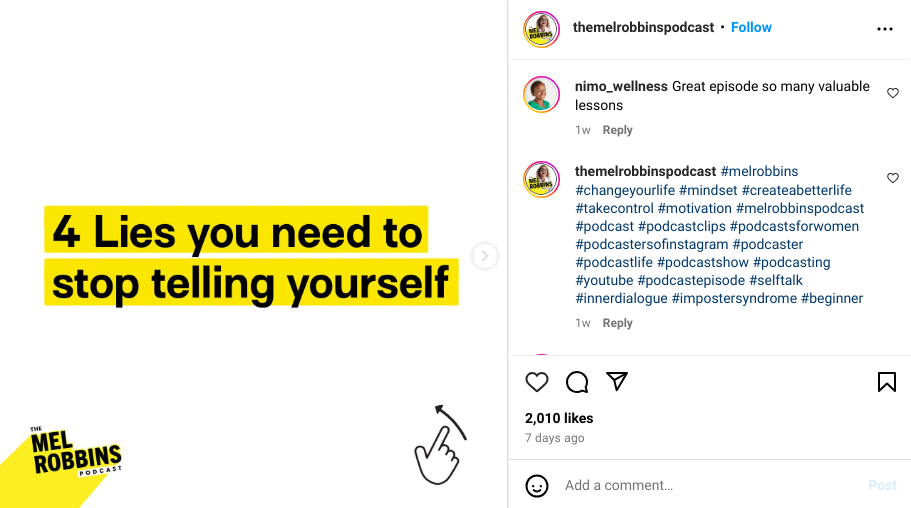
In this post titled “4 Lies your need to stop telling yourself” Mel uses 19 hashtags (excluding branded hashtags). These are all hashtags a creator in the same niche can use to promote their content.
Keep your content fresh and engaging using different tactics that include:
A note on running experiments and gathering data: published is better than perfect. Resist the temptation to create the perfect landing page, ad or email, because there’s always one more thing you can do to improve content. Instead, get your experiments in front of your audience to gather data. Data will show you what works and what doesn’t.
And if you need inspiration, take to each platform for ideas. You don’t only have to look at the competition, instead consider what other creators are doing in different niches. Porting successful ideas into your niche is a smart way to stand out.
Growing your podcast community may seem a little daunting, even with 8 practical tips to follow, but don’t let fear hold you back. Instead, think about the investment of time you’ll make as a part of a long-term goal.
People often overestimate what they can achieve in a short period and underestimate what’s possible over a longer stretch. Thinking long-term will give you the mental space to plan, test new ideas, and learn what works as you grow your audience.
此内容由惯性聚合(RSS阅读器)自动聚合整理,仅供阅读参考。 原文来自 — 版权归原作者所有。