


惯性聚合 高效追踪和阅读你感兴趣的博客、新闻、科技资讯
阅读原文 在惯性聚合中打开

推荐订阅源

Microsoft Azure Blog
H
Hacker News: Front Page
A
About on SuperTechFans
云风的 BLOG
云风的 BLOG
aimingoo的专栏
aimingoo的专栏
Martin Fowler
Martin Fowler
博客园 - 叶小钗
Last Week in AI
Last Week in AI
Recent Announcements
P
Palo Alto Networks Blog
Webroot Blog
Webroot Blog
Hacker News: Ask HN
Hacker News: Ask HN
IT之家
IT之家
K
KPMG report finds enterprise disconnect between AI and its ROI | CIO
T
Threat Research - Cisco Blogs
C
CERT Recently Published Vulnerability Notes
Google DeepMind News
Hugging Face - Blog
Hugging Face - Blog
H
Help Net Security
P
Privacy & Cybersecurity Law Blog
C
Cisco Blogs
罗磊的独立博客
The GitHub Blog
The GitHub Blog
M
MIT News - Artificial intelligence
人人都是产品经理
人人都是产品经理
The Cloudflare Blog
Y
Y Combinator Blog
AWS News Blog
AWS News Blog
H
Hackread – Cybersecurity News, Data Breaches, AI and More
钛媒体:引领未来商业与生活新知
钛媒体:引领未来商业与生活新知
K
Kaspersky official blog
博客园 - 司徒正美
Threat Intelligence Blog | Flashpoint
Security Archives - TechRepublic
The Last Watchdog
The Last Watchdog
Jina AI
Jina AI
MyScale Blog
MyScale Blog
TaoSecurity Blog
TaoSecurity Blog
大猫的无限游戏
大猫的无限游戏
cs.CL updates on arXiv.org
Cisco Talos Blog
Cisco Talos Blog
美团技术团队
T
Tor Project blog
cs.CV updates on arXiv.org
博客园 - 【当耐特】
博客园 - 聂微东
V2EX - 技术
V2EX - 技术
I
Intezer
V
Visual Studio Blog
酷 壳 – CoolShell
酷 壳 – CoolShell

IDC

IDC On the Ground: Inside GITEX AI Europe 2026's Race to Build Sovereign AI Infrastructure IDC Quanta Launch: The 3-Minute Recap The strategy behind today's launch Dashboards Are Dead: The Future of Business Intelligence Lives in the Workflow Introducing IDC Quanta: The Intelligence Fabric of the AI-Enabled Enterprise How Wearables and AI Will Reshape Healthcare Who operates your meeting rooms now: AV, IT, or an AI agent? Beyond Check-the-Box: Choosing a Security Framework for the AI and Quantum Era DX Software in Transition: AI Investment Trends by Sector Japan's AI Supercycle Is Here — Are You Ready to Lead It? Beyond the Data Dump: Why Cybersecurity Metrics Are Failing, and How AI Fixes It From Wait-and-See to All-In: How SMBs Are Rewriting Their AI Story Your AI Platform Knows the Market. Does It Know Your Business, and Can You Trust It with Your Strategy? Start Here: Six Best Practices for Foundational AI Training Physical AI and Robotics Take Center Stage at Computex Taipei 2026 for Semiconductor Vendors Trump's Quantum EO: What It Means for the U.S. Market The sovereignty conversation vendors need to have - but rarely do Q&A: Your Pipeline Conversion Questions, Answered by IDC Analysts The Intelligence Gap Is Widening. Here's What the Data Says. Anthropic, Trump, and Fable 5: The Dispute That Makes the Case for Frontier AI Studies IDC Quanta: The Next Era of Tech Intelligence The $22.5 Trillion AI Opportunity Why the memory market is still tight: what comes next Indonesia PC Market Grows 9.4% in Q1 2026 Despite Component Pressures But Headwinds Are Building The Dawn of Just-in-Time Software Agent Supplier or Featureware: The Choice Every SaaS Vendor Faces Now SpaceX, Cursor, and the Race to Build the Best Coding LLM in the World NVIDIA Becomes #1 in Datacenter Ethernet Switching as 1Q26 Market Surges 39.8% to $15.4 Billion Wi-Fi 7 Captures 44% of Enterprise WLAN Dependent Access Point Revenue as 1Q26 Market Grows 15.9% to Nearly $2.7 Billion AI Is Ready. Enterprises Are Not. Vendors Need to Fix It. Smart Glasses Surge: The XR Market Is Rewriting Its Own Rules WWDC 2026: Apple’s AI Credibility Test AI Is Making MSPs More Efficient. Here’s How to Share in the Gains. The Dark Funnel: How Answer Engine Optimization is Reshaping B2B Brand Visibility Agentic AI Is Breaking Your ROI Model. Here’s How to Fix It When the Question Can’t Wait: How Kyndryl Delivers Enterprise Intelligence at Speed Why the Grey Market Won’t Disappear in the Middle East and Africa: The Case of Notebooks Print, AI, and the expanded buying committee: highlights from IDC’s Print Executive Dinner in London AI in telecommunications: Why it is becoming an infrastructure priority From AI pilots to business value: what EMEA digital leaders are doing differently in 2026 Why India’s PC Market Surged 31.1% in Q1 2026 and What Comes Next PC Market Enters Volatile Territory as Memory Shortage Persists Through 2027 Agentic AI Ecosystems: Navigating the Megatrend That’s Reshaping Enterprise Technology Markets Leaning into disruption: How Perficient delivers real outcomes in an AI-first world Google’s Fitbit Air and Google Health: The Software Platform Play That Matters More Than the Hardware Why Fast and Trustworthy Aren’t Mutually Exclusive in AI Research The Middle East Conflict Just Rewrote the Rules of Business Continuity Ecosystem strategy in 2026: turning AI disruption into partner-led growth Worldwide Smartphone Market to Decline 13.9% in 2026 as Memory Crisis and US-Iran War Constrain Growth The AI Supercycle Has Started. Where Does Asia/Pacific Stand? Devices at Google I/O 2026: Android XR Glasses, Googlebooks, and Gemini Intelligence Why Research Alone Isn’t Enough: The Delivery Problem No One Is Talking About Digital Accessibility in the Workplace: From Compliance to Competitive Advantage When Pinocchio Became a Real Boy: Security Platforms Have Grown Up Plotting a Future-Proof Course: How The Resorts Companies Turned a Decade of IDC Partnership into a Competitive Edge European CISO priorities in 2026: AI agents, platformization, and sovereignty Why IDC Directions Is Coming to Hangzhou — and Why You Should Be There Telcos’ Next AI Revenue Play: Monetizing Orchestrated Digital Infrastructure The Workforce Skills Gap That AI Can’t Solve for Itself The Agent Takeover: What Happens When AI Becomes the Primary User of Enterprise Software The AI Answer Gap: Why Fast Answers and Defensible Ones Are No Longer the Same Thing The Market Every Western Executive Should Be Watching. IDC’s CEO Already Is. Ecosystem Strategy in 2026: Why AI Is Rewriting Partner-Led Growth Anthropic, SpaceXAI, and the New Compute Race in AI Navigating a Market Where the Wrong Bet Has Real Consequences Renuka Drummond Named Top 10 Corporate Counsel Worldwide by OnCon Icon Awards From Labor Arbitrage to Platform-Led Outcomes: How Agentic AI Is Rewriting the IT Services Playbook EMEA IT Market 2026 – Q2 Updates: 5 Key Takeaways on AI, IT Spending and Market Trends Japan’s AI Infrastructure Market Is Heading for ¥1 Trillion and Here Is What Comes Next Asia Pacific IT Spending Outlook 2026: How the Middle East War Is Reshaping IT Budgets From Digital Access to Accessibility with AI Enablement From Cost Optimization to Continuity: What IT Buyers Need Now and How Suppliers Must Respond AI as an Organizational Stress Test: What Will Break First in Your Operating Model? Japan’s ¥2.1 Trillion IT Modernization Wave: The Race Has Already Begun Semiconductor Market to Surge Past the Trillion-Dollar Threshold: AI Infrastructure Drives Market Growth Most AI Investments Don’t Deliver Value – Here’s What EMEA Leaders Are Missing Hannover Messe 2026: 7 Insights and 3 Pieces of Advice on Industrial AI, Manufacturing, and the Future of the Factory IDC Directions 2026: The AI Conversation Has Shifted. Here’s How to Catch Up. Coding by Prompt Is Coming to Your Business Units: What CIOs Should Do Next FutureScape 2026: Building Trust, Resilience, and Prosperity in the Agentic Future FutureScape 2026: Charting the Path to Enterprise-Wide Orchestration From Task Execution to Value Creation: What the 2026 Humanoid Robot Half Marathon Reveals About Industry Progress Europe’s AI Story Has a New Problem: It’s Actually Working AI Infrastructure Spending Caps Historic Year at ~$90 Billion in Q4 2025; 2029 Spending to Eclipse $1 Trillion Digital Sovereignty: Why “Sovereign” Is No Longer Enough FutureScape 2026: Navigating the Crosscurrents of Disruption Huawei and Apple Support China Smartphone Market Resilience as Shipments Decline 3.3% in Q1 2026 The Dirty Secret of AI in ITSM: Why Bad Data Wins Every Time Wholesale telecommunications: How platform models are reshaping the market Beyond LLMs: Why AI Strategy Now Requires Multi-Model, Multimodal, and Multi-Agent Architectures It’s a Data Thing: Retail and Restaurant AI Investments Will Miss the Mark if Not Led by Data Modernization Inference to Overtake Training by 2027 – Why Japanese First Movers Are Betting on Sovereign AI Infrastructure The productivity plateau: Why efficiency gains no longer differentiate Why I’m Excited about IDC Directions 2026 GTC 2026: Workstations enter the sidetop era Dispelling the myth of a silver bullet in sovereign AI MacBook Neo: Apple’s strategic play to disrupt the PC market AI sovereignty risk: A five-step agenda for CIOs Data pricing for AI is being negotiated without a stable model From cyber risk to business risk: How CISOs should engage the board in 2026
Do AI Markets Face a Circular Financing Problem? Enterprise Applications Will Determine the Answer.
Eric Newmark · 2026-06-05 · via IDC

The story being written by the AI market is extraordinary by almost any measure. OpenAI’s revenue grew from $2 billion in 2023 to $20 billion in 2025. Anthropic’s annualized revenue run rate surged from $87 million in January 2024 to $30 billion by April 2026, a trajectory that Salesforce took 20 years to achieve. NVIDIA’s revenue grew eightfold from $27 billion to over $216 billion between 2023 and 2026, achieving that growth in just one-third of the time it took Apple to do so during its heyday between 2007 and 2015. By nearly every reported metric, the AI market is delivering growth at a scale and speed that defies historical comparison.

Yet a narrative has emerged about how much of that growth reflects genuine market demand and how much reflects the circular financing structures that have become a defining feature of AI infrastructure investment. Circular financing in AI describes investment structures where the same capital flows simultaneously as vendor payment and equity stake. A company funds its own customer’s revenue while also supplying that customer’s core infrastructure. The result is reported revenue growth that is real but not cleanly separable from investment activity. The answer matters enormously, not just for investors in AI infrastructure companies, but for every enterprise software vendor and technology buyer trying to make sense of what’s actually happening in the market.

Without getting into any financial analysis of the diagram below, I include it simply to demonstrate the extreme complexity and circular nature of these financial relationships.
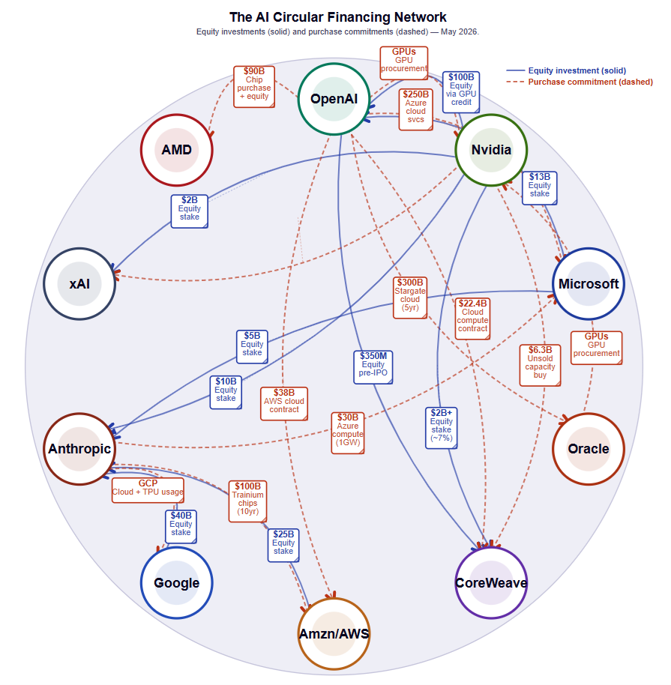
The circular financing problem

Stripping out circular flows to estimate genuine arm’s-length revenue is nearly impossible from the outside because none of these companies has any incentive to disaggregate them. What is clear is that OpenAI’s compute costs, projected to reach tens of billions annually, still dramatically exceed its current revenue. While their internal projections point to massive revenue growth over the longer term, the company is expected to remain unprofitable through at least 2029, with positive cash flow not expected until 2030. The infrastructure layer is being built on a combination of genuine demand and financial engineering, and the two are not currently separable from reported figures alone.

Why the application layer is the real signal

This is why revenue growth on the enterprise application layer has become the most important signal in the entire AI market. Enterprise application software does not carry a circularity problem. When an ERP vendor reports AI-driven ARR expansion, when an HCM platform demonstrates higher attach rates on AI-enabled capabilities, when a finance or procurement solution delivers measurable process efficiency gains that a CFO chooses to fund again at renewal, those signals reflect real buyers making real budget decisions based on perceived business value. There is no investment web distorting the demand signal. The revenue either reflects a genuine willingness to pay for demonstrated outcomes, or it does not.

What’s interesting is that we’ve seen this same exact pattern play out multiple times before during historical tech market revolutions. In each of the last several significant platform transitions, the application layer lagged the infrastructure layer in value creation, but eventually surpassed it as the platform matured.

The historical pattern

During the internet buildout, infrastructure companies captured the overwhelming share of market value. Cisco dominated with networking equipment and briefly became the most valuable company on earth, reaching a market cap of nearly $560 billion in March 2000. Companies like Sun Microsystems and Dell supplied servers, and even fiber optic cable makers like Corning and JDS Uniphase had their moment. Meanwhile, the application layer was largely characterized by money-losing dot-com ventures that collapsed when the bubble burst. But over the long term, application layer players like Amazon, Salesforce, and Google eventually dwarfed those companies.

The cloud era was no different. AWS launched in 2006 and, for years, held a dominant share of the cloud market, while enterprise SaaS applications were still proving their business model viability. IDC’s Worldwide Semiannual Public Cloud Services Tracker shows that by 2020, the SaaS application layer had grown to $148 billion in revenue, nearly half of the total $312 billion public cloud market, while IaaS, despite its faster growth rate, remained a significantly smaller share of the overall pie. Once the cloud infrastructure platform matured, value creation in the application layer far exceeded it.

Looking at the current AI boom, it’s following the same early-stage script. NVIDIA first became the world’s most valuable company in mid-2024, and we are in the middle of an AI infrastructure super cycle with trillions of dollars flowing into compute, datacenter construction, and power generation. Meanwhile, enterprise AI application revenues remain nascent relative to the trillions being invested in the infrastructure layer beneath them.

Agentic AI is triggering a fundamental reconsideration of how companies invest in packaged software, as AI agents effectively become the new enterprise apps. IDC’s spending forecasts project AI investment growing 31.9% annually between 2025 and 2029, reaching $1.3 trillion. These are real demand signals, and they are large enough to sustain significant growth at the application layer if enterprise software vendors can connect their AI capabilities to the business outcomes buyers are seeking.

The monetization gap that still needs closing

The monetization gap, however, remains significant and is not yet closing at the pace the market requires. IDC’s Future Enterprise Resiliency and Spending Survey (FERS) finds that few organizations report measurable financial results from their AI projects, despite widespread improvements in individual productivity. While most organizations aspire to grow revenue through AI initiatives, the majority have yet to achieve that goal. This distinction between individual productivity gains and organizational-level financial outcomes is one that enterprise software vendors have been slow to confront directly. Productivity at the individual level is real, documented, and genuinely valuable. Translating those gains into measurable business results that justify enterprise software pricing premiums is a fundamentally different challenge, and one that buyers are increasingly demanding vendors address more explicitly during renewal and contract-expansion discussions.

What vendors must do now

Closing that gap is the defining commercial challenge for enterprise software vendors over the next 12 months. The most urgent shift is from feature availability to outcome accountability: specific, auditable improvements in process efficiency or cost reduction that survive CFO scrutiny at renewal. Transparent commercial models follow from that. If buyers have to build the business case themselves, or fund significant professional services to reach value, adoption curves will flatten and renewal risk will rise. The competitive differentiator in this environment is not model sophistication. It is workflow transformation. Enterprises evaluate software on whether it changes the workflows that actually drive their business.

The infrastructure layer of the AI market may ultimately prove resilient. The circular financing dynamics, while real, are not unlike the capital formation structures that funded prior technology infrastructure buildouts, and genuine demand for compute at scale is not in dispute. The application layer is not a downstream beneficiary of the AI infrastructure boom. It is the proof point on which the entire narrative depends.

Eric Newmark

Eric Newmark - Group Vice President & General Manager of IDC's SaaS, Enterprise Software, CX and Workplace Solutions Division

Eric Newmark is Group Vice President & General Manager of IDC’s SaaS, Enterprise Software, CX, and Workplace Solutions Division, which includes several teams of analysts covering SaaS, 18 enterprise application markets, software monetization, business platforms, marketplaces, and services firms focused…