



Key questions answered in this article: What is the AI supercycle and what does it mean for Japan? What are the biggest gaps between AI vendors and enterprise buyers in Japan? How is AI changing B2B technology buying decisions?
The energy in the room at IDC Directions Tokyo 2026 on June 23 said it all: Japan’s AI moment is no longer approaching — it has arrived. And the central message from IDC’s Senior Vice President Sandra Ng was both a wake-up call and a roadmap. The question, as she put it bluntly, is not whether AI will reshape the Japan market. It is: who will create the most value in the shortest time?
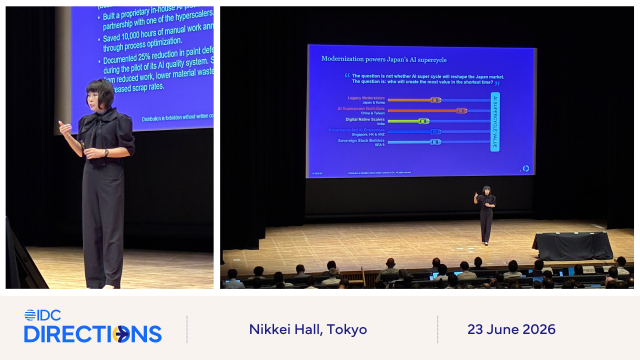
IDC Directions Tokyo 2026 brought together close to 400 attendees, with 65% at Director level or above, a room full of decision-makers, not just observers. Analyst 1-on-1 sessions were fully booked, and the volume of questions from the floor made one thing clear: the conversation was hitting a nerve.
To understand the scale of what is happening, consider this: global IT spending in 2025 is growing at 14% on a $4.2 trillion market base, the strongest IT spending growth since 1996. Back then, that same 14% growth rate applied to a $700 billion market. The numbers are in a different league entirely. (Source: IDC Worldwide Black Book, 31 March 2026)
This is the AI supercycle. While regions like China, Taiwan, and India are racing ahead as “AI Superpower Built-Outs” or “Digital Native Scalers,” IDC positions Japan alongside Korea as a Legacy Modernizer, a market where the path to AI value runs directly through modernization. That is not a disadvantage. It is a specific strategic imperative.
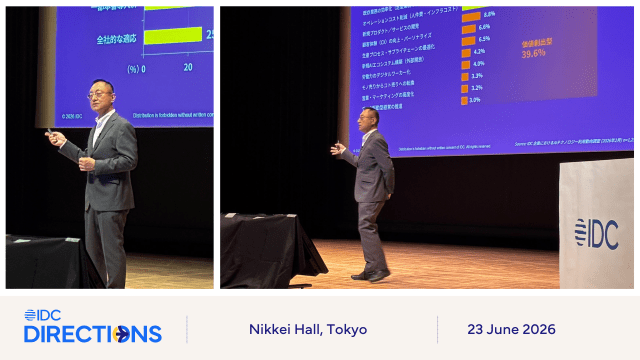
Japan’s AI market reflects this momentum. Domestic AI infrastructure spend is expected to reach $9 billion by end of 2026, growing at a 24% CAGR through 2029. AI services are projected to hit $8 billion by 2030 or 3.2x the 2025 figure. Moreover, 61% of CEOs in Asia Pacific named agentic and generative AI at scale as their number-one new investment priority. (Source: IDC Worldwide AI and Generative AI Spending Guide, Forecast V1 2026; IDC CEO Survey, March 2026)
Here is where the conversation got uncomfortable and important.
Sandra Ng identified four persistent gaps between what enterprise buyers in Japan need and what technology vendors are actually delivering:
Gap #1 — Business case clarity. Buyers want outcomes grounded in their industry, not generic global benchmarks. “Show me what this looks like for a Japanese manufacturer” is a very different ask from a global case study slide.
Gap #2 — Total cost of AI ownership. This one deserves more attention than it typically gets. Hidden AI implementation costs in Japan — covering data preparation, system integration, ongoing model maintenance, compliance monitoring with METI guidelines, and change management, routinely add 50–70% beyond the headline technology price. Vendors who do not address this upfront are losing trust at the CFO conversation.
Gap #3 — AI governance readiness. Japan’s regulatory environment is real and specific. The FSA AI guidance, METI’s AI governance framework, and the Act on Protection of Personal Information (APPI) set high standards. Buyers are moving faster than many vendors’ governance answers can keep up.
Gap #4 — The “show me” moment. Japanese enterprise buyers want a local reference customer, a deployment timeline, and measurable outcomes, not a global success story. Vendors who cannot produce this are losing shortlist positions.
These gaps are not theoretical. IDC’s CxO conversations in 2025–2026 point to concrete examples of how Japan’s most forward-thinking companies are navigating them:
These are not pilots. These are production deployments with documented outcomes—exactly the reference stories buyers are demanding.
One of the most striking data points from Sandra Ng’s presentation is that 84% of global technology buyers agree that AI will change how their companies buy technology in the next 12 months. (Source: IDC B2B Technology Buyer Survey 2025, WW n=406)
The buying journey has already shifted and it looks like this: AI discovery → vendor website check → peer and colleague validation → channel partner consultation → shortlist. If your brand and solutions do not surface clearly when a CIO or CFO uses ChatGPT or Google Gemini to research a purchase decision, you are being eliminated before you even know you are in the running.
This makes Answer Engine Optimization (AEO) and Generative Engine Optimization (GEO) business-critical capabilities, not just marketing experiments. By 2027, 35% of Japanese organizations are projected to have unified, coordinated AI governance in place. The vendors who are visible, credible, and well-structured in AI-generated answers will have a compounding advantage. (Source: IDC FutureScape 2026 – AI-Fueled Business Strategies, Japan)
The broader industry shift reinforces why speed matters. As highlighted in the presentation by IDC Japan’s Takuya Uemura, the AI supercycle is now entering its second investment wave — moving from infrastructure build-out to enterprise application and services adoption. Enterprise AI platform, app, and services spend globally is projected to grow from $400 billion in 2026 to $1 trillion by 2029. (Source: IDC Worldwide AI and Generative AI Spending Guide V1 2026)
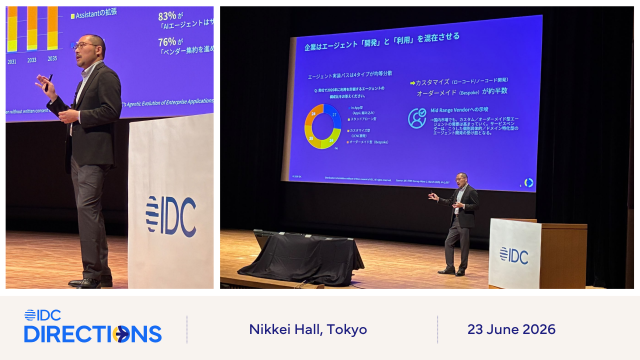
Critically, 83% of buyers surveyed agreed that AI agents are lowering switching barriers between suppliers. The vendors who lock in outcome-based relationships now, before the market commoditizes, will be the ones defining the next competitive moat.
Sandra Ng’s closing framework was direct and actionable:
Do now: Replace generic benchmarks with a single Japan reference customer, one metric, one timeline. Map your go-to-market pitch to the full buying committee, not just the CIO. Fix your AI discoverability gap immediately.
Do this year: Make ROI transparency your competitive weapon. Build deployable agentic workflow stories. Invest in AI-optimized third-party content that earns citations in AI-generated answers.
Bet on this: Position into AI governance, trust, and compliance as a revenue line, or become the vendor that makes compliance an outcome rather than a conversation. Start measuring your share of answer by category, persona, and geography. Execute a layered discovery strategy: SEO + AEO + GEO. (Source: IDC C-suite Survey, September 2025, APJ, n= 300)
The window to establish leadership positioning in Japan’s AI market is open—but it will not stay open indefinitely. The enterprises that move from experimentation to outcome-based deployment, the vendors who close the four gaps, and the organizations that make themselves discoverable in AI-powered buying journeys are the ones who will define the next era of Japan’s technology market.
Join us at IDC Directions Osaka on July 28, 2026 to go deeper on how Japan’s AI supercycle is reshaping your industry, what the data says about where the next wave of value will be created, and how your organization can get ahead of it. Register for IDC Directions Osaka today. Seats are limited.

Mike de la Cruz is Corporate Communications Director for Asia Pacific at IDC, bringing over 25 years of career experience in marketing and communications for the information technology industry. He shapes and amplifies IDC's research-driven narratives, positions executives and analysts as authoritative industry voices, builds relationships with top-tier technology and business media across the region, ensures consistent brand voice and positioning, develops content that drives audience engagement, and leverages social media and digital communications to extend IDC's reach.
此内容由惯性聚合(RSS阅读器)自动聚合整理,仅供阅读参考。 原文来自 — 版权归原作者所有。