






A great SaaS/PaaS platform has the power to propel market penetration and maintain market share by delighting customers. On the other hand, a bad SaaS/PaaS experience can be detrimental to brand image and cause customer churn.
Performance is at the core of the customer experience. It impacts adoption, retention, market share, and brand trust. Without a CDN, SaaS/PaaS companies struggle to achieve the scale, security, and distribution needed to enable fast, secure, and resilient web experiences. Yet, not all CDNs are equal in regard to supporting SaaS/PaaS platforms given their requirements.
In this blog, we will walk through what to consider when selecting a CDN as a SaaS/PaaS company.
Competition between SaaS/PaaS providers has become fierce. The ability for a SaaS/PaaS platform to not only support its customers but drive customer adoption has become a major tenet of Product-Led Growth.
Most SaaS and PaaS companies leverage a CDN solution to distribute their content, build efficiency into their stack via global caching, and secure access to the platform through WAF technologies. These load-bearing qualities of a CDN have become table stakes for SaaS/PaaS.
Not every CDN is equal in its ability to support the variety of SaaS/PaaS platforms as they vie for top position in their sector.
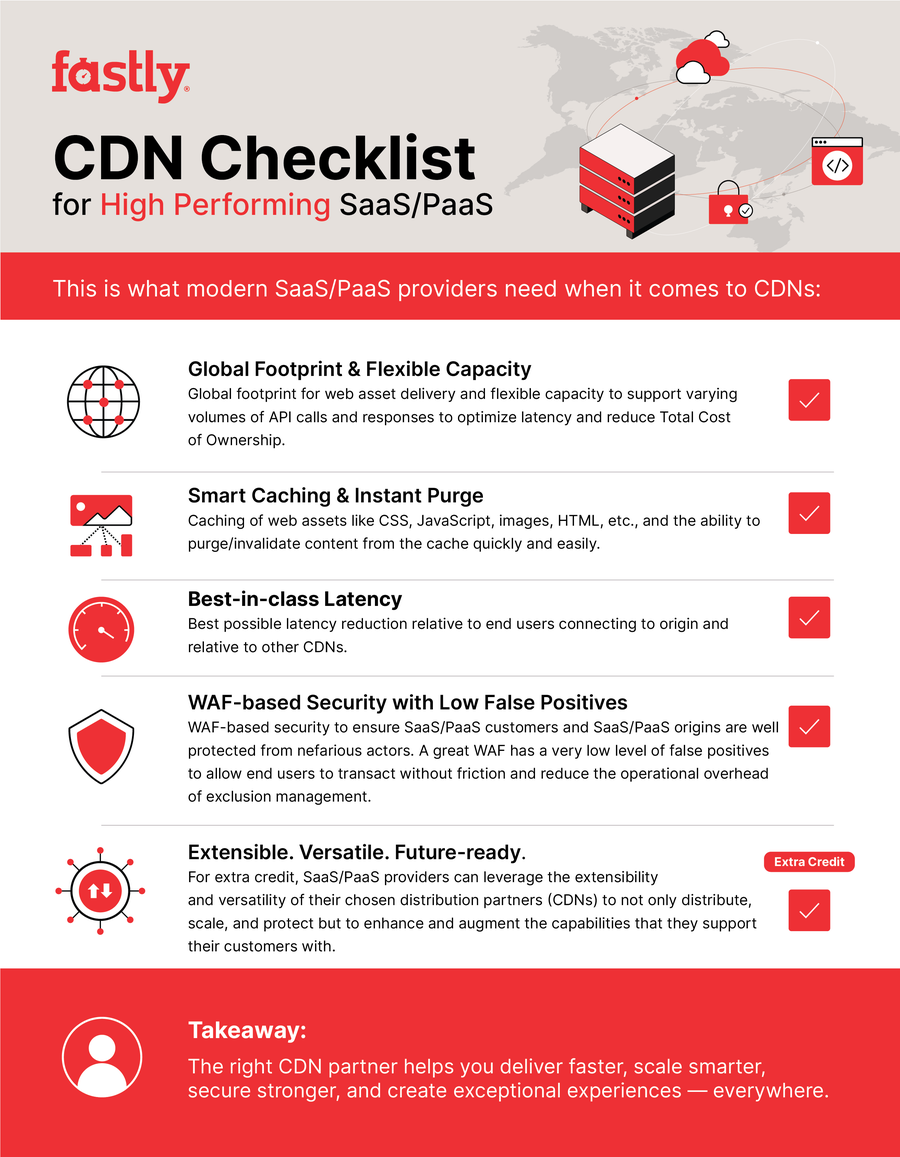
This is what modern SaaS/PaaS providers need when it comes to CDNs:
Global footprint for web asset delivery and flexible capacity to support varying volumes of API calls and responses to optimize latency and reduce Total Cost of Ownership
Caching of web assets like css, javascript, images, HTML, etc., and the ability to purge/invalidate content from the cache quickly and easily
Best possible latency reduction relative to end users connecting to origin and relative to other CDNs
WAF-based security to ensure SaaS/PaaS customers and SaaS/PaaS origins are well protected from nefarious actors. A great WAF has a very low level of false positives to allow end users to transact without friction and reduce the operational overhead of exclusion management
For extra credit, SaaS/PaaS providers can leverage the extensibility and versatility of their chosen distribution partners (CDNs) to not only distribute, scale, and protect but to enhance and augment the capabilities that they support their customers with.
Fastly provides the largest and most extensible edge-network on the planet (532 Tbps at time of writing in April, 2026). The platform offers a unique approach to server and network architecture, which enables SaaS/PaaS providers to achieve the efficiency goals promised by a CDN. Additionally, Fastly makes it possible for SaaS/PaaS providers to rely on the CDN layer to offer their customers novel features to ensure they’re in the best position possible to compete.
Fastly uses Varnish as its ‘caching engine’ and exposes VCL (Varnish Configuration Language) to customers to enable them to implement their own custom request/response dynamic. For SaaS/PaaS, this means they no longer need to have requests terminated at origin to provide responsive/reactive interactions for their end users. An added bonus is that Fastly emits data insights that very closely mirror first-party data. It truly acts as an extension of SaaS/PaaS applications to the edge.
Fastly’s server and network architecture were built for the modern internet and today’s global network topology. Instead of having small POP locations everywhere… as a reverse proxy (every CDN is a reverse proxy), it is better to have very large POPs in strategic locations where we see a high variance of requests in a shorter period of time. This enables our caches to warm up faster and evict content from the cache less readily due to the high cache density we achieve with our server architecture. Fastly also provides the ability to purge/invalidate the global cache in 150ms globally on the 95th percentile, which allows API-heavy SaaS/PaaS platforms to cache as much as possible. To make cache purge/invalidation easy, Fastly offers operators several purge methods (including API-based purge).
In regard to latency optimization, Fastly’s fundamental design principles are specifically architected for maximum performance. Cache servers are all SSD-based with tons of RAM in every box. Every cache node is loaded with tons of ‘under the hood’ optimizations like customer lookup tables for our SSDs, TCP stack optimization, no routers in our network, even rewriting Linux kernels to ensure we’re leaving no stone unturned to make delivery fast for our customers. On the network side, Fastly maintains keep-alive connections to origin, writes its own TLS negotiation stack, maintains its own network of Tier 1 transit providers and peering agreements, and has implemented significant custom code to ensure the network can ‘self-heal’ and ‘self-optimize’.
Every WAF (other than Fastly’s NGWAF) utilizes regex matching to pick up on keywords and block requests that carry them. This results in a high number of false positives, which means that end-user interactions are also blocked. The net effect of that dynamic is that operators of legacy WAF tools are mired in exclusion/policy management.
Fastly’s approach to WAF uses proprietary technology called Smartparse, which performs lexical analysis of every request payload. If that analysis yields an executable, then Fastly blocks it. Fastly also provides the ability to monitor proposed mitigation policies—operators don’t have to be in either Block or Log mode; they can also watch to test the efficacy of proposed mitigation policies using Signals. This allows operators of Fastly to maintain a strong baseline mitigation strategy and add new security policies only when needed.
Over 86% of Fastly WAF customers use NGWAF in blocking mode and is a significant reason why Fastly has received the Gartner Peer Insights Security Customer Choice award for the last 7 years in a row.
Explore how Fastly helps high-tech companies scale faster, deliver better performance, and stay secure.
此内容由惯性聚合(RSS阅读器)自动聚合整理,仅供阅读参考。 原文来自 — 版权归原作者所有。