








For years, news publishers have been hoping someone would force the issue. Google just did - though not quite in the way publishers wanted.
Reports this month reveal that Google has been quietly pitching publishers on a new AI program: sign over broad rights for Google to use your content, including for training its AI models, or eventually lose the payments you've been receiving under its existing Showcase program. For publishers already watching search referral traffic fall off a cliff, it's a stark offer.
But here's the thing: by making the terms explicit, Google has inadvertently handed publishers something they didn't have before - clarity. And with clarity comes leverage.
To understand why Google is moving now, look at what's happened to search over the past two years.
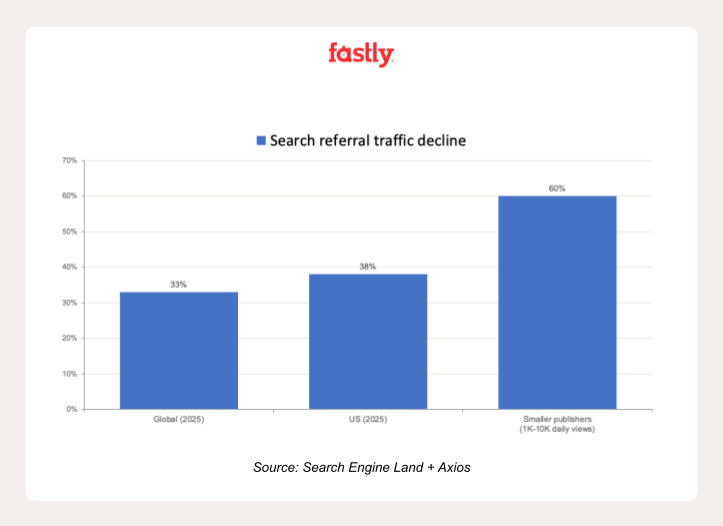
Google's AI Overviews feature has restructured how users interact with search results. When an AI Overview appears at the top of the page, just 1% of users click the sources cited within it. Google search traffic to publishers fell 33% globally in 2025 - 38% in the US. For smaller publishers, the drop has been even more severe: sites with 1,000-10,000 daily page views have lost roughly 60% of search referral traffic over two years.
This is the context in which Google is asking publishers to license their content for AI training. The traffic publishers were implicitly trading content access for has already largely disappeared. What's left is the flat-fee payment from Showcase - and now Google wants significantly expanded rights in exchange for keeping it.
The uncomfortable truth, though, is that AI platforms combined still drive only around 1% of publisher traffic. Neither Google nor anyone else has made publishers whole on what search once delivered. Publishers are being asked to make a long-term bet on AI platforms that have not yet proven they can replace what traditional search provided.
One thing worth noting: Google was notably slower than its competitors to strike formal content deals. For much of 2024, its only major partnership was a $60 million deal with Reddit. OpenAI, by contrast, has signed more than several licensing agreements with publishers. Amazon struck a deal with The New York Times in mid-2025.
Given how quickly the content licensing landscape has moved over the past two years, digital publishers now have more comparison points than ever before signing on. Those who understand this broader context are in a better position to negotiate on their own terms.
Negotiating leverage requires information. Publishers who walk into licensing discussions without knowing how their content is actually being accessed, crawled, and used in AI systems are negotiating blind.
This is where the infrastructure layer matters - not just as a technical problem, but as a business one. Fastly's partnerships with ScalePost and TollBit give publishers two things they need before they can negotiate effectively with anyone, Google included.
Beyond measurement, ScalePost also opens a new revenue stream for publishers. Major advertisers and affiliate networks use publishers' AI visibility analytics from ScalePost to allocate marketing and Answer Engine Optimization (AEO) budgets to the publishers influencing AI answers, so publishers earn from the visibility they're already generating.
TollBit provides a solution for managing AI access to publisher content: rather than simply blocking crawlers or giving access away for free, publishers can meter access and charge AI companies for it. In the first half of 2026, the volume of AI bots hitting TollBit's paywall surpassed 2.6 billion - a sign that publishers are indeed reclaiming control of their content.
The space is also seeing new entrants, such as MonetizationOS and others, underscoring the continued momentum and opportunity beyond our established relationships with both TollBit and ScalePost.
Together, these tools change the nature of the conversation with Google and every other AI platform. A publisher that can say "we know exactly how you're using our content, and we're currently charging others for comparable access" is in a very different negotiating position than one that can only point to declining traffic stats.
What Google's ultimatum has clarified is that the old model - passive content access in exchange for referral traffic - is gone. The new model hasn't fully settled yet. Some publishers will take Google's deal. Others will hold out for usage-based terms. Some will accelerate the shift toward direct audience relationships through subscriptions and newsletters, reducing their exposure to platform risk entirely.
All of them need better data and better infrastructure than most currently have.
The publishers who navigate this period most effectively won't be the ones who made the best deal with Google. They'll be the ones who built the systems to know what their content is worth, enforce who can access it, and capture value when access is granted. That capability - knowing, enforcing, capturing - is what makes any licensing negotiation real.
Google's ultimatum isn't the end of the story for publishers. For those who move quickly, it might be the beginning of a better one.
此内容由惯性聚合(RSS阅读器)自动聚合整理,仅供阅读参考。 原文来自 — 版权归原作者所有。