

惯性聚合 高效追踪和阅读你感兴趣的博客、新闻、科技资讯
阅读原文 在惯性聚合中打开

推荐订阅源

aimingoo的专栏
aimingoo的专栏
让小产品的独立变现更简单 - ezindie.com
博客园_首页
Recent Announcements
A
About on SuperTechFans
云风的 BLOG
云风的 BLOG
T
Troy Hunt's Blog
F
Fortinet All Blogs
Webroot Blog
Webroot Blog
S
Secure Thoughts
D
Docker
Attack and Defense Labs
博客园 - 叶小钗
H
Heimdal Security Blog
S
Security Affairs
Microsoft Azure Blog
The GitHub Blog
The GitHub Blog
T
Tenable Blog
I
InfoQ
Cyber Security Advisories - MS-ISAC
L
LangChain Blog
Project Zero
Project Zero
Cyberwarzone
Cyberwarzone
NISL@THU
NISL@THU
有赞技术团队
有赞技术团队
AWS News Blog
AWS News Blog
Threat Intelligence Blog | Flashpoint
IT之家
IT之家
Vercel News
Vercel News
www.infosecurity-magazine.com
C
CXSECURITY Database RSS Feed - CXSecurity.com
T
Threatpost
cs.CV updates on arXiv.org
Forbes - Security
Forbes - Security
博客园 - 聂微东
Security Latest
Security Latest
T
Threat Research - Cisco Blogs
Latest news
Latest news
Exploit-DB.com RSS Feed
Stack Overflow Blog
Stack Overflow Blog
Cloudbric
Cloudbric
Google DeepMind News
C
CERT Recently Published Vulnerability Notes
N
Netflix TechBlog - Medium
酷 壳 – CoolShell
酷 壳 – CoolShell
T
The Blog of Author Tim Ferriss
J
Java Code Geeks
C
Check Point Blog
Recorded Future
Recorded Future
Jina AI
Jina AI

Fastly Blog

Fastly Fastly Fastly Fastly Fastly Fastly Fastly Fastly Fastly Fastly Fastly Fastly Fastly Fastly Fastly Fastly Fastly Fastly Fastly Fastly Six Common Live Streaming Mistakes (And How to Avoid Them) How Fastly and Skyfire Enable Trusted Agentic Commerce at the Edge Bot Defense is Table Stakes. Machine Traffic Requires a Business Strategy AI Traffic Grew 6.5x Faster Than Human Traffic This Year Python SDK Beta: How the Language of AI Runs Faster and Safer with Fastly Give AI Agents the Markdown They Actually Want How to Configure Local Logging for an On-Prem Next-Gen WAF Agent Accountability Without Control Is Breaking Security Leadership Fastly Joins the Agentic AI Foundation (AAIF) to Guide Edge AI Interoperability The E-commerce Industry in the AI Era: Has the Agentic Flood Hit? No Margin for Error: What the FIFA World Cup Teaches Us About Performance at the Edge Why iGaming Infrastructure is Breaking and What Comes Next The Publishing Industry in the AI Era: Why Bot Strategy is Now a Business Strategy Bad Performance Kills SaaS/PaaS Growth — Why Your CDN Matters Why your code is safe from Copy Fail on Fastly Compute Myth or Marvel: Claude Mythos and What it Means for Security Introducing Compliance Audit Reports Fastly Nearly Half the Web Isn’t Human: Inside Fastly’s Threat Insight Report Media over QUIC: Can Streaming Finally Have Both Scale and Low Latency? Introducing Fastly’s Redesigned Homepage: Your Central Hub for Actionable Insights The False Choice of Indiscriminate Blocking: Why Technical Precision is the New Standard for an Open Internet What is CVE-2026-23869? React Server Components Security Alert Fastly enables first-party tagging for Google Advertisers Shrink Your Bill With Efficient Software Your AI coding agent just got better at Fastly Fastly Ranked as a Leader in the 2026 Forrester Wave™ for Edge Development Platforms Fastly at RSAC 2026: New Advances in AppSec, Bot Management, and Deception Mastering the Edge: What Golf Can Teach Us About Speed, Precision, and Performance Real-Time CDN Monitoring for Live Events with Bronto Imperva Alternatives Fastly + Scalepost: Extending the Fastly platform to manage AI Crawlers Best content delivery networks for bot management Vibe Shift? Senior Developers Ship nearly 2.5x more AI Code than Junior Counterparts Maximizing Compute Performance with Log Explorer & Insights Fastly CDN Expands Scaling Fastly Network: Balancing Requests | Fastly Best Practices for Multi-CDN Implementations | Fastly Compute@Edge: Serverless Insights by Company | Fastly Fastly can teach you about the Wasm future in just 6 talks Fastly's Observability Unleashed: New Updates and Insights Optimizing your multi-CDN infrastructure to improve performance Stay ahead of attackers by pushing your security perimeter to the edge Are APIs the Key to Digital Innovation or a Trojan Horse? Fastly Academy: on-demand learning at your fingertips. | Fastly 30 Years of Web: Building for Tomorrow 4 Ways Legacy WAF Fails to Protect Your Apps Adobe boosts performance and MTTR with Epsagon and Fastly logs | Fastly Beta" A New Serverless Compute Environment Early TLS at Fastly Technical trainings & the future of edge delivery at Altitude 2016: a year in review Innovation Capacity Defined: Tech Stack Values | Fastly Deep Log Visibility Offered by Logentries | Fastly Caching the Uncacheable: CSRF Security Increase Your Hit Ratio With This Simple Tip
Supporting Google Private AI Compute with Privacy-Preserving Edge Infrastructure
Ed Bender · 2026-04-22 · via Fastly Blog

We’re pleased to share more details about Fastly’s work with Google in support of Private AI Compute. 

As described in Google’s announcement, Private AI Compute is the next step in building private and helpful AI. The service is designed to enable users to access Google’s most capable Gemini models from the cloud with the same security and privacy assurances you expect from on-device processing. Google’s commitment to privacy by design and developing world-class security infrastructure closely aligns with how Fastly has approached internet infrastructure for more than a decade.

Fastly is proud to contribute privacy-preserving edge capabilities that help support the goals of Private AI Compute, building on a long history of technical collaboration with Google across performance, security, and privacy-enhancing technologies.
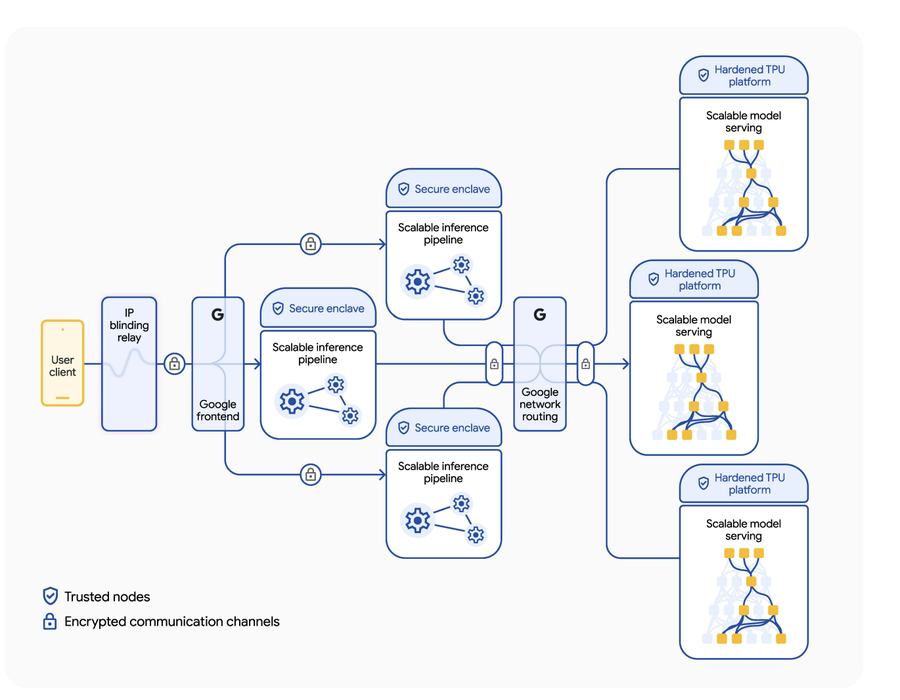
Private AI Compute: Google’s next step in building private and helpful AI

The Role of a Privacy-Preserving Intermediary

As part of this architecture, Google identified the need for independent intermediaries capable of facilitating encrypted, anonymized connections between user devices and private AI execution environments. The intermediaries are designed to operate under a double-blind model, where no single party has access to both identifying metadata and request content.

Key requirements for this layer include:

  • No access to user identity

  • No access to AI prompt, context, or response content

  • Inability to correlate requests across network hops

  • Low-latency performance suitable for interactive AI use

  • Global scale with edge proximity

  • Alignment with modern privacy standards such as OHTTP, encrypted DNS, and MASQUE

Fastly’s globally distributed edge platform supports these requirements and is used as part of Private AI Compute’s privacy-preserving request routing.

MASQUE and Privacy-Preserving Request Routing

MASQUE (Multiplexed Application Substrate over QUIC Encryption) is a modern proxying technology built on QUIC and HTTP/3 that enables encrypted, privacy-preserving traffic forwarding with minimal performance overhead.

In a MASQUE-based double-blind model:

  • The entry proxy does not have visibility into the destination or request content

  • The exit proxy does not have access to user identity or IP address

  • Request metadata exposure is intentionally minimized

  • Traffic benefits from low-latency, edge-optimized delivery

Within Private AI Compute, this approach helps support Google’s goal of allowing users and organizations to access advanced AI capabilities while limiting the exposure of sensitive data across the request lifecycle.

This work builds on prior collaboration between Fastly and Google around encrypted request routing, privacy-enhancing infrastructure, and performance-critical edge services.

Why Privacy-Preserving AI Infrastructure Matters

As AI adoption accelerates, organizations are increasingly looking for ways to deploy advanced models while meeting rising expectations from users, regulators, and internal governance teams. Across industries, there is a growing demand for:

  • Private access models rather than public AI endpoints

  • Cloud-based AI with local-like privacy guarantees

  • Encrypted, edge-aware architectures

  • Strong workload isolation and minimal data exposure

  • Network designs that separate identity from content

Fastly’s role as an independent infrastructure provider helps support architectures where privacy is enforced by design rather than policy alone.

We share a vision for an internet and an AI ecosystem that prioritizes privacy, security, and performance. Private AI Compute represents an important step in that direction, and we’re pleased to support its goals as part of our ongoing collaboration with Google.

A Longstanding Technical Collaboration

While Private AI Compute represents Fastly’s first public collaboration with Google focused specifically on AI workloads, it builds on more than a decade of work across multiple Google teams.

Examples include:

Privacy-Enhancing Technologies and Web Standards: Fastly has collaborated with Google on a range of privacy-focused initiatives, including work related to OHTTP relays, anonymized measurement, and privacy-preserving request handling across web and mobile ecosystems.

Fastly Log Streaming and Google BigQuery: Fastly was among the early platforms to support real-time log streaming into BigQuery, enabling customers to analyze CDN, security, and edge compute data using Google’s analytics platform. 

Google Cloud Storage and Cloud-Native Integrations: Fastly has long supported Google Cloud Storage as an origin for CDN and edge workloads, helping customers build scalable, cloud-native applications on Google Cloud.

These efforts reflect a shared focus on performance, security, and privacy at internet scale.

A Quiet Question for AI Builders

As AI adoption accelerates, teams across industries are being asked to answer a simple, but increasingly consequential, question:

Does our architecture require users to trust us indefinitely, or does it make misuse structurally impossible?

For organizations ready to treat privacy as a core system property rather than an afterthought, this is the bar. Reach out to us if you’d like a privacy check-up.