









Content Marketing Manager, Fastly

Group Product Marketing Manager, Security
Publishers have spent years optimizing for search and social traffic. Now they’re being forced to optimize for AI bots.
Fastly’s latest Threat Insights Report, AI, Bots, and the Agentic Future of the Web, explores how AI, bots, and automation are reshaping the internet – and found that nearly half of all internet requests now come from bots. One of the clearest takeaways from the report is that every industry is experiencing AI differently. Some are seeing more malicious automation. Others are navigating new operational and infrastructure challenges as “wanted” bots like AI completely shift their operating model.
But for publishers, AI isn’t another traffic shift – it’s forcing a reimagining of the core exchange that publishing on the internet has relied on for years: publishers create content, and users click through to the source. As AI systems increasingly answer questions directly, that relationship becomes much less guaranteed.
That’s what makes publishing one of the industries facing the most immediate strategic implications from AI-driven traffic.
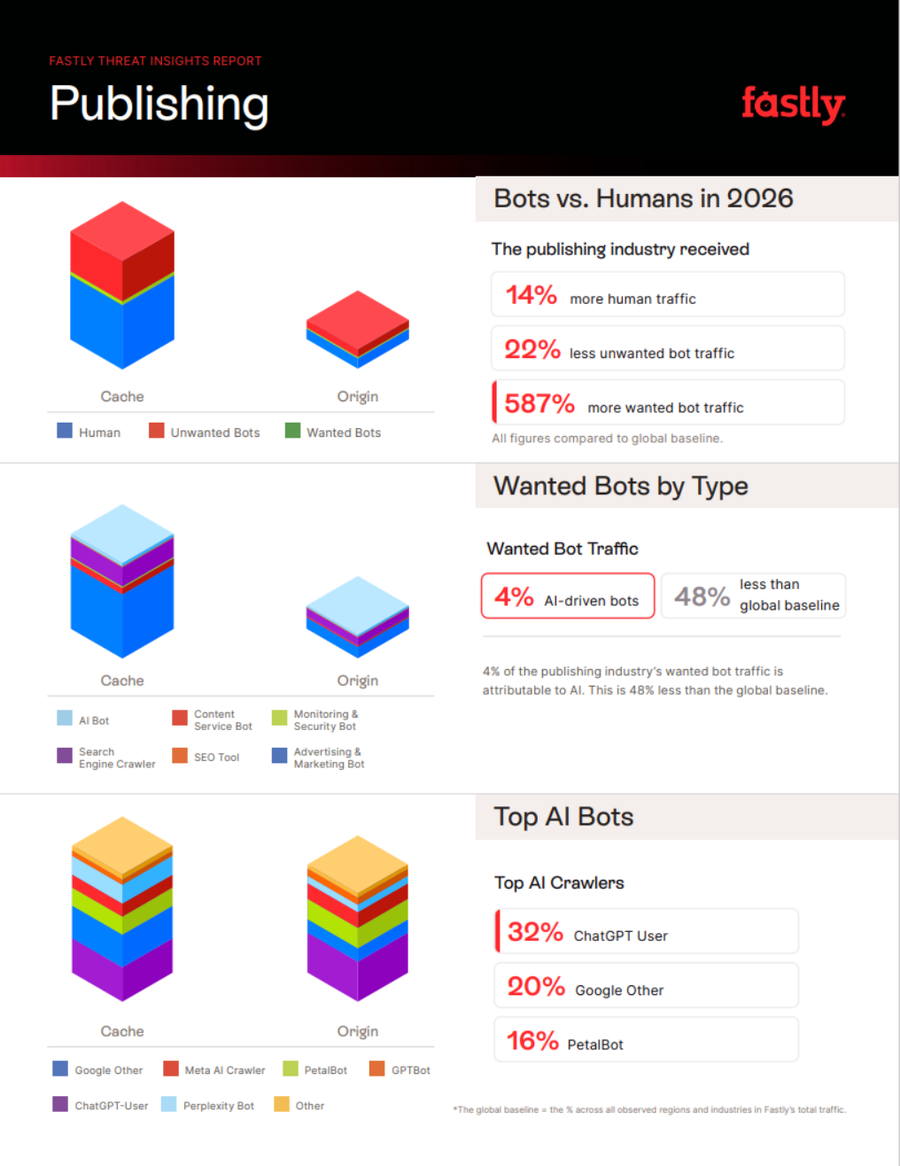
The Publishing business model is often reliant on revenue generated from users clicking through to their domains to subscribe to view the content, view advertisements, etc. but as so much more of their content gets scraped, it’s forcing them to reconsider what “wanted” really means to their business.
Across Fastly’s global network, bots accounted for 49% of all observed traffic in January 2026. Bots also represented:
47% of requests to cached content
60% of requests reaching origin infrastructure
For publishers, those numbers carry significant weight.
Publishing businesses depend on direct audience relationships. Traffic drives subscriptions, advertising, sponsorships, and engagement. But AI crawlers and fetchers increasingly consume publisher’s content without guaranteeing users ever visit the source site.
As the report notes: “One crawl of a publisher’s site means the valuable content can now be served directly from an LLM, and users might never access the source website to gather information.”
That changes the definition of “wanted” traffic.
Publishers face an existential crisis as it pertains to wanted bot traffic, especially in light of them receiving 587% more than the global baseline. Historically, publishers optimized heavily for wanted bots because search indexing helped drive discoverability. But AI systems operate differently. Instead of simply directing users back to the source, they can summarize and serve publisher content directly inside generated responses.
AI bots currently account for roughly 8% of wanted bot traffic globally and 4% of AI bot traffic for Publishers, according to the report. While the overall volume is still relatively small, the strategic impact is significant.
AI fetchers, which retrieve content in response to user prompts, directly influence whether publishers appear inside AI-generated answers. This creates a difficult balance:
Allow AI access and gain visibility in emerging AI experiences
Restrict AI access to preserve direct traffic and audience ownership
Neither option is straightforward.
At the same time, publishers are also seeing growing pressure around their highest-value content. Nearly half of cached traffic now comes from bots, meaning the content most likely to drive engagement: breaking news, trending stories, etc, is also increasingly being ingested for AI retrieval.
For publishers, that means that bot management is no longer just a security issue. It’s becoming a content strategy and monetization issue too.
The report also found that 99% of all bot traffic globally was classified as “unwanted” but Publishers receive 22% less. That means less: unverifiable automation, malicious scrapers, impersonators, scanners, credential abuse tools, and deceptive automation traffic posing as legitimate traffic.
While less unwanted bot traffic is likely a welcome reality, without granular visibility, organizations risk treating all bot-related traffic the same – potentially blocking beneficial traffic or allowing harmful activity.
For publishers, understanding which bots are accessing content and why is critical.
Adapting to AI-driven traffic isn’t about choosing between blocking everything or allowing it all. It’s about building a more intentional strategy around visibility, control, monetization, and protection.
Gain Visibility. Organizations need insight into: which bots are accessing content and what they’re retrieving, whether traffic is hitting cache or origin, and which activity aligns with business goals.
Go beyond blocking. Modern AI traffic requires more purpose-built controls than traditional allow/block approaches. Some automation may create visibility and revenue opportunities. Some may simply create cost and risk.
Consider monetizing AI traffic: As AI platforms continue seeking high-quality publisher content, monetization strategies are becoming increasingly considered. Publishers with strong visibility and governance controls will be best positioned to decide how AI access supports their business goals.
Deceive the unwanted. Fastly’s Deception capabilities are designed to disrupt malicious automation by feeding attackers misleading signals and reducing the effectiveness of automated abuse.
AI is rapidly changing how information is discovered and consumed online, and publishers are at the center of that shift. The organizations best positioned for what comes next won’t simply block all – they’ll strategically govern it.
Download Fastly’s latest Threat Insights Reportto explore the evolving global bot landscape and learn how they’re redefining the web
此内容由惯性聚合(RSS阅读器)自动聚合整理,仅供阅读参考。 原文来自 — 版权归原作者所有。