









Key takeaways:
Quantum is aiding in the race to realize fusion energy by taking a step toward making the fuel for a fusion reactor. New work, released on arXiv on 29 June, uses quantum computing to model molten salt—salt in a liquid phase. When wrapped around a fusion reaction like a blanket, molten salt could produce a rare fuel necessary to sustain that reaction: tritium.
The chemistry involved in extracting tritium from the molten salt is so complex that researchers have not been able to accurately model it using classical compute methods, and molten salt experiments are difficult and expensive, requiring immense energy and specialized equipment. Oak Ridge National Laboratory, Cleveland Clinic, and IBM showed how hybrid quantum-AI methods could yield better results, speeding the pace of fusion research.
This work demonstrates the benefits and potential of partnerships between U.S. Department of Energy national laboratories and private enterprise.
“When we started this work maybe five months ago, I did not expect to be at this place this soon,” said Tom Beck, Section Head for Science Engagement for the National Center for Computational Sciences at Oak Ridge National Laboratory (ORNL).
Two neutrons and a proton make tritium—a heavier, radioactive isotope of hydrogen. It’s the first ingredient in a recipe for fusion power:
Superheat tritium, bind it with powerful magnets into a whirling ring of plasma within a vessel called a tokamak, then stir in deuterium (another more common hydrogen isotope with just one neutron). Bash the tritium and deuterium together so hard they fuse into helium.
The result is an immense amount of energy—fusion is the same reaction that lights the sun. Harness this reaction, and you could produce energy at enormous scale without the waste or meltdown risks involved in nuclear fission power.
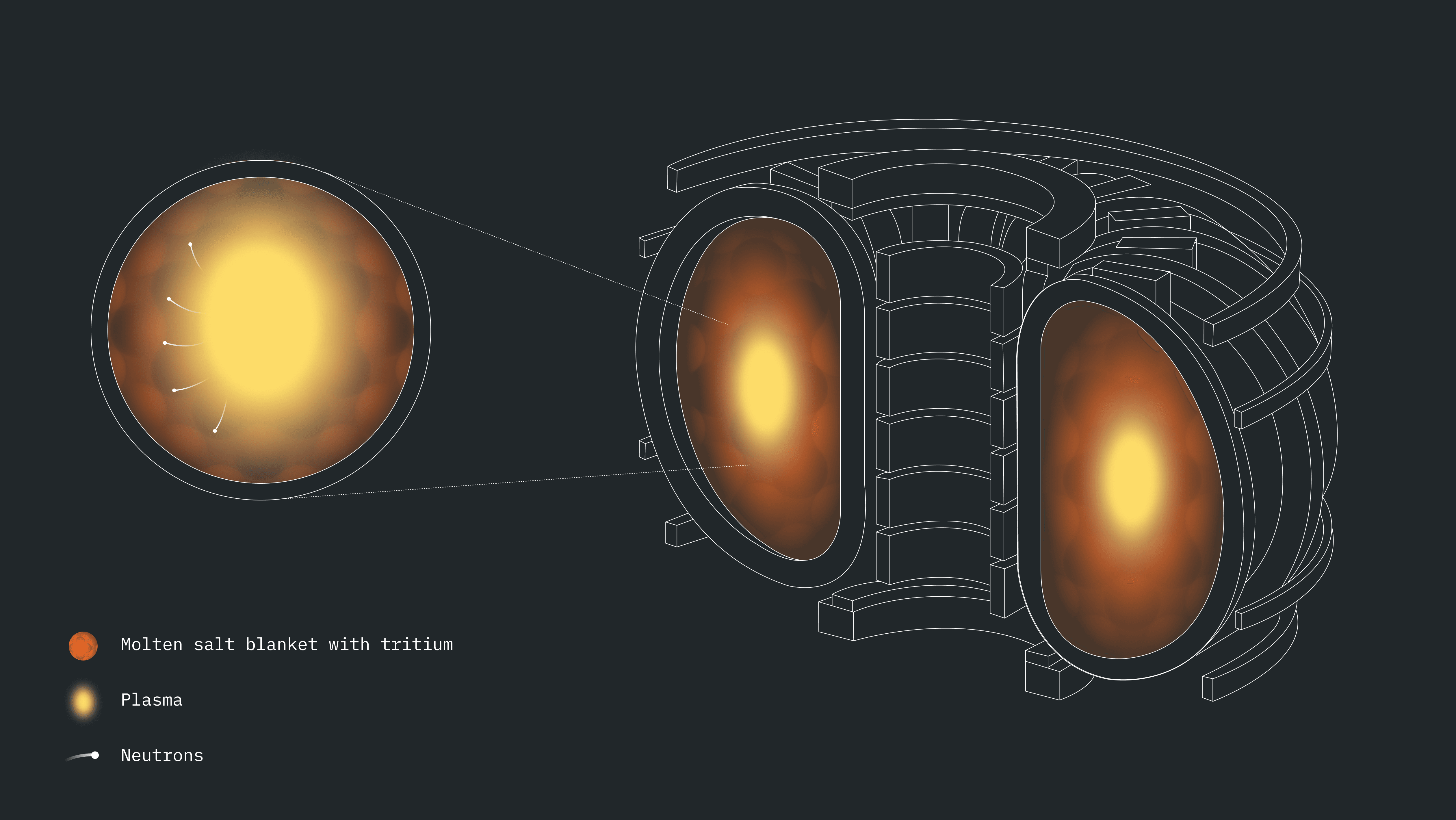
In a future tokamak, neutrons released from the plasma during fusion could bombard the surrounding molten salt blanket to create tritium. This new work uses quantum computers to model the interaction between tritium and a clusters of atoms in the molten salt.
However, producing the fuel for fusion energy is a challenge. Deuterium comes from the ocean, but tritium has no significant natural sources on Earth. Today’s fission-based nuclear power plants produce tritium in small quantities, but the entire world produces only a few pounds of it a year. A single one-gigawatt fusion plant would burn through roughly a pound a day.
The entire global supply would keep that one reactor running for only a matter of weeks, so a future fusion power plant has to make its own tritium as it runs.
That’s where a thick blanket of molten lithium salt comes in. When a neutron flies out of the fusion reaction and strikes a lithium-6 atom in the salt, it splits the atom into helium and fresh tritium. Beryllium in the mixture multiplies the loose neutrons, so the blanket breeds enough fuel to keep the reaction fed. Fluorine and lithium lock together into a salt that stays liquid and stable in the reactor’s heat.
Breeding fuel is only one of the molten salt’s jobs. The same material has to shield the reactor’s magnets from the neutron barrage, cool the wall that faces the plasma, and carry the heat off to spin a turbine.
It has to do all of that while the neutron bombardment alters its chemistry. Designing a salt that holds up under those competing demands and keeps releasing tritium is one of the central materials science problems in building this style of fusion reactor.
“Tritium recovery is a huge part of the engineering challenge for fusion,” Beck said.
The new work from ORNL, Cleveland Clinic, and IBM studies the tritium harvesting, which depends on how the tritium behaves after the lithium atoms split. If tritium grabs onto fluorine in the salt, it forms tritium fluoride, which is corrosive and stubborn to remove. If it stays loose as a gas, it bubbles out on its own.
Predicting which way it goes means modeling the salt’s chemistry with precision and accuracy requirements that challenge classical methods. Quantum-centric supercomputing for fusion power Computational chemists like Beck use density functional theory (DFT) to tackle problems like this on classical computers. DFT approximates how a molecule’s electrons arrange themselves, its electronic structure. DFT is fast, and often useful.
For chemistry in molten salts, however, DFT faces significant challenges. In earlier work, Beck’s group found that DFT can get the salt’s free energy wrong by as much as 10%, where free energy is the quantity that governs molecular binding. Those 10% error bars are nowhere near precise enough to predict whether the tritium locks into corrosive tritium fluoride or drifts free as a gas.
Chemistry is hard to model because nature at that scale is quantum, and governed by many complex, interacting variables. A molecule’s electrons can arrange themselves and interact in many different ways, creating a world of possible arrangements that expands as molecular size grows. Large molecules create possibility spaces too large for even the most powerful classical supercomputers to usefully explore.
Quantum-centric supercomputing (QCSC) offers a new problem-solving paradigm for chemistry that could help crack this problem.
Dr. Kenneth Merz, PhD, co-author of the preprint and leader of the Merz lab at Cleveland Clinic, led work earlier this year with RIKEN and IBM that used quantum and classical computers together to calculate the electronic structure of a 12,635-atom protein.
That workflow relied on a technique called wave function-based embedding (EWF), which fragments the calculation into computationally tractable pieces called “clusters.” Classical computers solve the smaller clusters. Then, a quantum computer uses a method called sample-based quantum diagonalization (SQD) to solve the more complex clusters—those involving more entanglement between atoms. The classical computers then stitch the molecule back together.
“I think it’s a huge contribution,” Beck said of Merz’s work. Without it, the salt clusters would be far too large to fit on today’s quantum hardware.
In the new work, the researchers pulled nine configurations of the molten salt FLiBe out of their simulations, each a small cluster of 21 ions, and computed their energies with and without tritium. Then they checked the results against leading classical methods for solving fragments, and the quantum-centric calculations matched them.
This is a powerful proof of concept for future calculations. However, the full free energy problem requires the study of a large, churning one meter thick blanket of molten salt, on the order of a trillion-trillion particles. That will remain beyond the reach of computational chemistry for the foreseeable future, but simulations can approach the properties of a bulk liquid by increasing the number of atoms. To capture how tritium truly behaves in FLiBe, the workflow will need more pieces.
The quantum chemistry in this paper is one part of a larger workflow. The long term goal is a looping workflow aided by AI agents in three stages.
In the first stage, AI agents propose and screen many candidate salts from an ORNL database of 70 years of molten salt research. or each candidate, a class of calculations called neutronics estimates the tritium breeding ratio, how much fuel the salt would actually make under the neutron barrage, and whether it stays liquid and moves heat well enough to use.
In the second stage, the most promising salts go to supercomputers, which model them atom by atom with DFT. Those simulations are expensive. So the workflow uses AI stand-ins, trained to reproduce the physics, to run them fast enough to be useful.
The third stage brings in the quantum computer where DFT falls short: the high-accuracy chemistry that decides where the tritium binds. That is the quantum step this paper puts to the test. In future experiments, the results would feed back to sharpen the next round of candidates, and the loop would turn again.
This loops aids in the solving of a hard optimization problem, said Al Geist, Corporate Research Fellow and CTO of the Frontier Exascale Computing Project at ORNL and co-author of the paper. A tokamak must pull as much tritium as possible from a salt, even as that salt’s behavior shifts under intense neutron radiation, heat, and magnetic fields.
No single calculation can find the best solution. But the AI-quantum workflow can propose a salt, predict how it breeds tritium and flows, then pin down the chemistry of how that tritium comes loose from the mixture. CPUs, GPUs, and QPUs working together to solve one of the great unsolved problems in engineering.
Beck emphasized that the pace of progress has been a surprise—and a lot of that comes down to the people at IBM and Cleveland Clinic, he said. Beck arrived at ORNL as a high-performance computing specialist with a deep interest in quantum computing. Working with IBM, he’s learned what quantum computers can do today, and the speed with which they are improving.
The team is already looking to scale the quantum step in the workflow. The plan is to grow the clusters well past 21 ions, toward the size of the largest molecules EWF methods have already handled, and to run the hundreds of configurations the full binding free energy demands, not nine.
The same toolkit, the authors expect, will reach well past molten salts to other hard problems in chemistry. Just like Merz’s protein work ended up supporting fusion research, this fusion research will likely support projects that have not yet been considered. The IBM Quantum Network is a key site for this sort of relationship-building and idea sharing.
ORNL’s researchers hope to hand fusion engineers a way to design and vet a molten salt on a computer before they mix and superheat it in a laboratory. This should help close the distance between the idea of fusion and a reactor that can fuel itself.
Several experimental fusion reactors are under construction all over the world today. Researchers hope that they will soon follow quantum computing over the threshold from conceptual technology to practical utility.
此内容由惯性聚合(RSS阅读器)自动聚合整理,仅供阅读参考。 原文来自 — 版权归原作者所有。