







Key takeaways
IBM has long tracked the progression of quantum computing hardware performance across three fundamental dimensions: scale, quality, and speed. Together, they tell us not only what a quantum computer can do, but also how efficiently and cost-effectively it can do it. So, what are the specific metrics we use to quantify these dimensions?
Scale: Programmable qubits. How many qubits can you program directly?
Quality: Qubit operations. How many of the most complex operations can a system reliably execute?
Speed: Maximum circuits per second (circuit throughput). How much useful work can a system perform per second, and at what cost?
These metrics provide a clear picture of the performance, computational capability, scalability, and cost efficiency of today’s quantum computers, regardless of the underlying hardware technology. They capture essential aspects of performance that apply across modalities—from IBM’s superconducting hardware to trapped-ion, quantum-dot, and other quantum computing approaches.
Even as quantum computers grow more powerful and less error-prone, the underlying framework will remain largely the same, though some of the details may change. Let’s take a closer look at what these metrics mean and how we define them for the current generation of quantum hardware.
Today’s chips use hundreds of controllable quantum elements virtually indistinguishable from qubits to function properly. However, many of those components are there only to support the quantum circuit; they aren’t intended for direct use on a computation. Therefore, the number of programmable qubits in a quantum processor provides a more useful measure of a processor’s scale. It tells us how many qubits users can directly control and integrate into quantum algorithms.
A programmable qubit is any qubit that can be:
These are the qubits developers interact with when building quantum applications. We use the term programmable qubits to distinguish the qubits available directly to users from other quantum elements on a processor that support computation but are not themselves programmed as part of an algorithm. Collectively, we refer to both programmable qubits and the supporting quantum elements that surround them as the physical qubits on a quantum chip.
One example of a supporting quantum element is the coupler qubit in IBM quantum hardware. Both programmable qubits and coupler qubits are made from very similar Josephson junction-based transmon circuits that act as artificial atoms. Future systems will include more and more qubit resources supporting computation, communication, error correction, and device control that can’t be directly programmed.
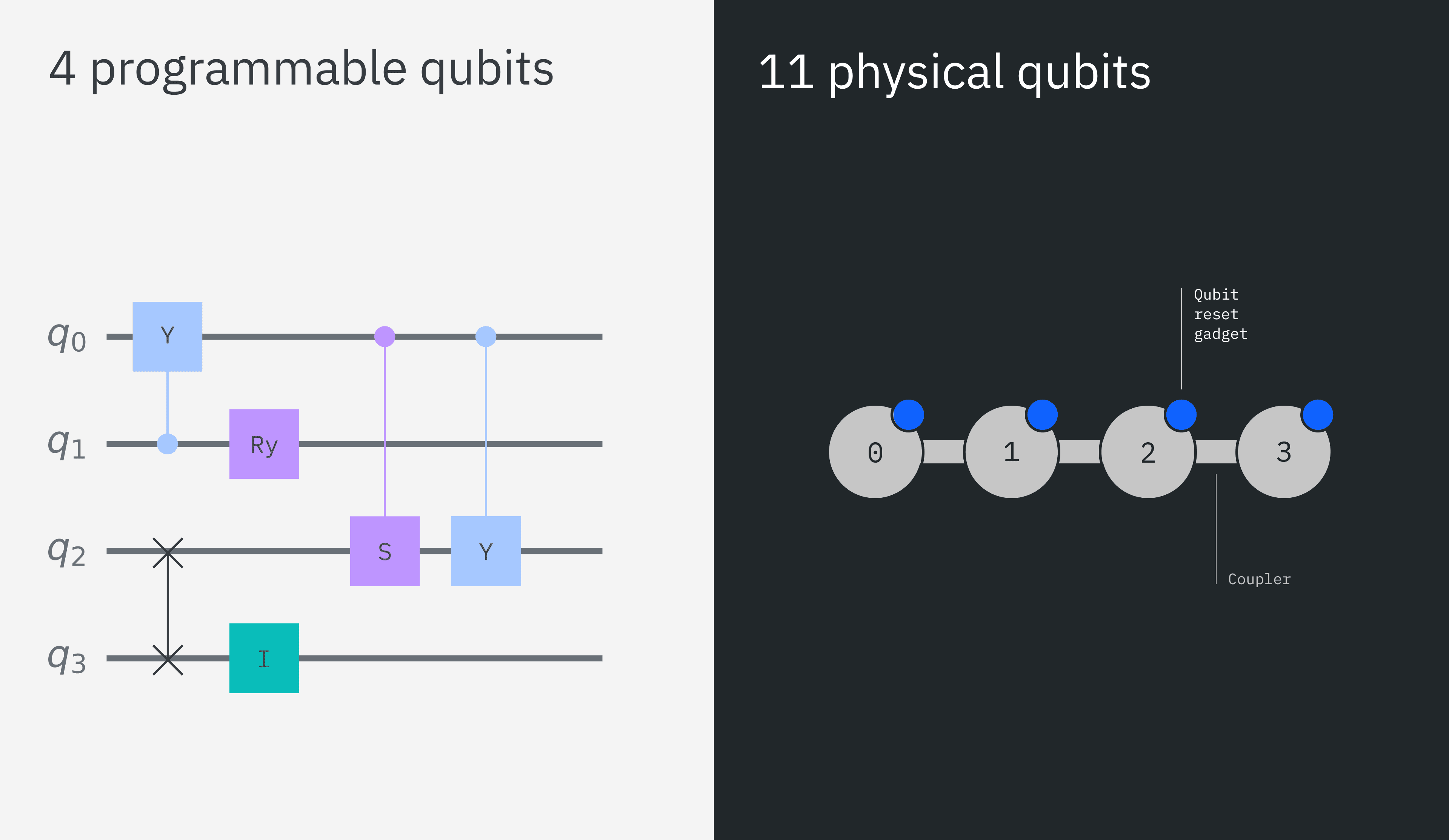
Take the recently announced IBM Quantum Nighthawk r2, for example. Users interact with its 120 programmable qubits, but those qubits are supported by hundreds of additional physical-qubit resources, including coupler qubits and qubit reset gadgets. These supporting quantum elements help improve both the quality and speed of computation without increasing the number of programmable qubits available to users.
Over time, the difference between the number of programmable qubits and the number of physical qubits on a chip may grow significantly. Similar patterns appear in other quantum-computing modalities. For example, some quantum-dot architectures use multiple quantum dots to realize a single programmable qubit.
Users will continue to want a large number of programmable qubits, as that will determine the scale of the problems they can explore and the algorithms they can implement. However, it will also be important to understand how those programmable qubits relate to the supporting hardware ecosystem that surrounds and supports them.
While programmable qubits measure the scale of a quantum processor from the user’s perspective, qubit operations—sometimes known in the field as “QuOps”—quantify the quality of a system by measuring how many of the most challenging operations a quantum computer can reliably execute before errors overwhelm the computation.
Note that, when we refer to “qubit operations,” we’re specifically talking about “two-qubit operations” that involve entanglement of two qubits. These are the most common source of complexity in most quantum circuits users run today, and measuring the number of two-qubit operations a quantum computer can reliably perform is a good proxy for the quality of current quantum hardware.
Eventually, as quantum computers grow more powerful and two-qubit operations become less challenging, the specific benchmarks we use to measure quality may evolve. However, the underlying goal remains the same: understanding the complexity of the computations a system can reliably execute.
Regardless of whether a system is based on superconducting hardware, trapped ions, quantum dots, or some other architecture, support for more qubit operations generally enables exploration of deeper circuits and more sophisticated quantum algorithms. Systems with higher qubit operations can typically solve problems that are inaccessible to systems with more limited capabilities. This gives us a practical measure of the computational frontier of a quantum processor.Further reading: John Preskill's 'Beyond NISQ: The Megaquop Machine' (arXiv:2502.17368) was among the first to discuss future quantum computers in terms of the number of quantum operations they can reliably execute.
Finally, to get a more useful sense of the speed of today’s quantum processors, we need to measure circuit throughput—the maximum number of quantum circuits a system can execute per second. Maximum circuits per second is closely related to a system's shot rate, or repetition rate, which measures how quickly a processor can repeatedly execute and measure circuits. Higher shot rates generally enable higher circuit throughput, though other system-level factors such as circuit loading, measurement, reset, and reinitialization also contribute.
Circuit throughput is ultimately a measure of the price-performance of a quantum computer. It tells us how much useful work a quantum processor can perform in a given period of time, and it also tells us how cost-effectively that computation can be performed.
Put simply: a system that can execute more circuits per second can perform more useful work in the same amount of time and deliver more value from the same hardware resources. Higher throughput means more completed workloads, more generated data, and more useful computation delivered per unit time. As a result, users can explore parameter spaces more efficiently, test hypotheses more quickly, and complete larger computational workloads at lower computational cost.
For example, IBM expects Nighthawk r2 to deliver 25x the circuit throughput of today's Heron fleet. In practical terms, that means the system can perform up to 25x as much computational work in the same amount of time, representing a corresponding improvement in computational efficiency for users.
There are more complex measures of circuit throughput, like CLOPS (circuit layer operations per second) or application-specific benchmarks. These metrics can provide valuable insight into the performance of specific workloads, but they are often difficult to calculate from publicly available specifications, which in turn makes it challenging to draw consistent comparisons across different quantum-computing platforms and hardware modalities.
Maximum circuits per second provides a simple, transparent way of comparing throughput across different quantum systems.
The metrics outlined so far in this article are aimed squarely at measuring the progress of the quantum computers we have today. Will they need to change as quantum computers become more advanced?
The short answer is: not really. Quantum hardware will always be evaluated across the fundamental dimensions of scale, quality, and speed.
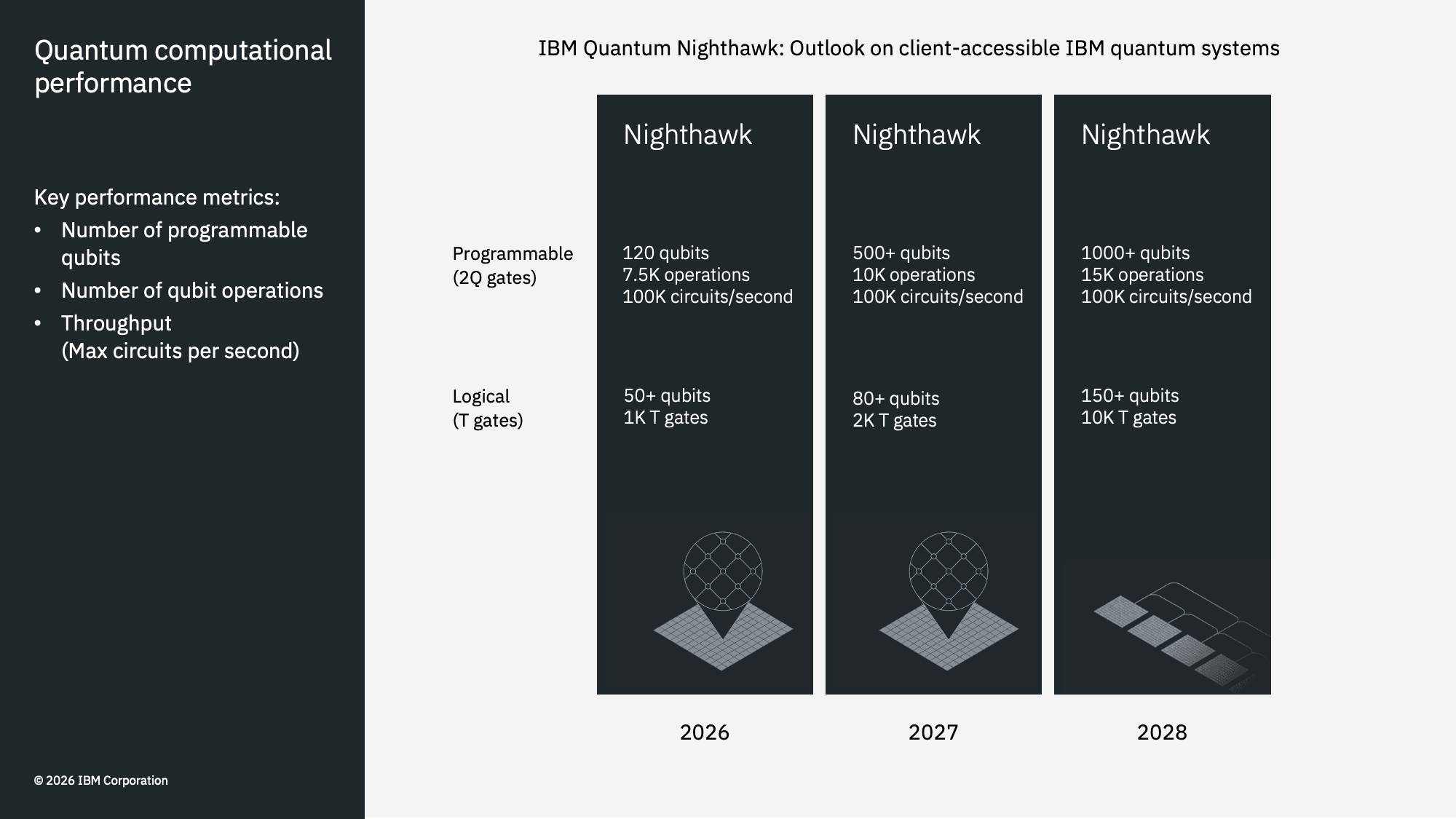
However, as logical circuits become the primary basis for computation, the quantities we measure will evolve. In particular, programmable qubits and logical qubits will be used interchangeably as the relevant measure of scale, while T-gate counts are expected to replace two-qubit operations as the most challenging operations that define a system's computational capability.
Today, two-qubit operations are a useful proxy for quality because they are the most common and most challenging bottleneck for noisy quantum hardware. However, they become a less useful measure of computational capability in fault-tolerant regimes.
That's because quantum algorithms rely on both Clifford gates, which classical computers can simulate efficiently, and non-Clifford gates, which they cannot. While both are essential for quantum computation, non-Clifford gates are what ultimately enable quantum computers to outperform classical methods. Among these, the T gate is particularly costly to implement in most fault-tolerant architectures.Further reading: Recent IBM research on spacetime codes (arXiv:2504.15725) found that error-detection becomes increasingly difficult as circuits grow more non-Clifford, underscoring the importance of T gates in future quantum computations.
This makes T-gate count (or T-count) the defining proxy for quality in the era of fault-tolerant quantum computing. In that context, T-counts provide a useful measure of how many computationally demanding operations a system can reliably execute before errors begin to accumulate.
The metrics described in this article aim to provide a complete picture of current hardware performance and progress toward the more advanced systems we aim to build in the future. Together, they give us a clear sense of any quantum computer’s scale, quality, and speed—regardless of underlying hardware modality—telling us how much useful work it can perform and how efficiently it can perform it.
Progress in quantum computing is increasingly driven by complex advances in architecture, computational capability, and hardware features. These are the advances that will be required for helping quantum computers realize their full potential—advances the entire industry must continue to benchmark.
You can see this progression in our plans for scaling Nighthawk in the years ahead. Our vision for future Nighthawk systems includes substantial increases in computational scale and capability while sustaining high throughput. These are precisely the kinds of advances that the metrics described in this article are designed to capture.
In addition, Nighthawk-based systems provide an excellent testbed for quantum error-correction techniques and will support the execution of logical circuits with increasing numbers of logical qubits and computational complexity measured in T-gate count.
As quantum computers continue to mature, these metrics will help the community better understand how quantum hardware is progressing, and what that progress is making possible. They offer a simple framework for making meaningful comparisons across platforms and modalities. Ask any quantum hardware vendor these three questions:
The answers will tell you a great deal about that system's computational capability, performance, and cost efficiency.
Explore the latest quantum systems on IBM Quantum Platform and learn more about the IBM Quantum Roadmap.
此内容由惯性聚合(RSS阅读器)自动聚合整理,仅供阅读参考。 原文来自 — 版权归原作者所有。