


惯性聚合 高效追踪和阅读你感兴趣的博客、新闻、科技资讯
阅读原文 在惯性聚合中打开

推荐订阅源

Stack Overflow Blog
Stack Overflow Blog
cs.CV updates on arXiv.org
H
Hacker News: Front Page
S
Security Affairs
Google Online Security Blog
Attack and Defense Labs
H
Heimdal Security Blog
S
Securelist
S
Secure Thoughts
N
News and Events Feed by Topic
T
The Exploit Database - CXSecurity.com
Exploit-DB.com RSS Feed
Last Week in AI
Last Week in AI
The Last Watchdog
The Last Watchdog
N
News | PayPal Newsroom
OSCHINA 社区最新新闻
OSCHINA 社区最新新闻
IT之家
IT之家
宝玉的分享
宝玉的分享
有赞技术团队
有赞技术团队
O
OpenAI News
V
Vulnerabilities – Threatpost
S
Schneier on Security
Cyberwarzone
Cyberwarzone
雷峰网
雷峰网
罗磊的独立博客
Threat Intelligence Blog | Flashpoint
J
Java Code Geeks
Google DeepMind News
The Cloudflare Blog
美团技术团队
人人都是产品经理
人人都是产品经理
T
The Blog of Author Tim Ferriss
T
Tor Project blog
P
Privacy International News Feed
CTFtime.org: upcoming CTF events
Google DeepMind News
S
Security @ Cisco Blogs
Project Zero
Project Zero
Security Archives - TechRepublic
Schneier on Security
cs.CL updates on arXiv.org
P
Proofpoint News Feed
K
Kaspersky official blog
P
Privacy & Cybersecurity Law Blog
aimingoo的专栏
aimingoo的专栏
L
LINUX DO - 热门话题
V
V2EX
Blog — PlanetScale
Blog — PlanetScale
www.infosecurity-magazine.com
U
Unit 42

Tenable Blog

SharePoint CVEs FAQ: CVE-2026-56164, CVE-2026-32201, CVE-2026-45659 | Tenable® Build agentic AI security at Tenable Swarm, Black Hat 2026 Understanding Anthropic’s new AI agent Claude Tag’s access model in Slack 5 reasons to integrate AppSec data with your exposure management platform July 2026 Patch Tuesday: Largest Patch Tuesday 569 CVEs FedRAMP High, IL5, and zero trust: How federal agencies can secure cloud environments OMB M-26-14: Why federal agencies must fix asset visibility first CISO’s guide to CISA BOD 26-04 and risk-based security metrics for vulnerability management How much cyber risk does AI create for organizations? 457 million security issues. Here’s what you can do about it. The Developer Credential Economy: An inside look at the Miasma worm campaign Oracle Critical Security Patch Update June 2026 | Tenable® How Tenable helps federal agencies comply with CISA BOD 26-04 Get critical cyber risk context: Understanding control validation, CTEM & Tenable One CISA BOD 26-04: Frequently asked questions about the new risk-based patching directive Microsoft’s June 2026 Patch Tuesday Addresses 198 CVEs ( CVE-2026-49160, CVE-2026-50507) The June 2026 AI Executive Order: What federal agencies need to know and how Tenable can help Tenable joins Anthropic’s Project Glasswing to advance AI-era cyber defense Tenable CTO Vlad Korsunsky Q&A: Countering AI threat multipliers with AI-powered exposure management | Tenable CTO Q&A: C-suite views AI as massive threat, as cyber teams adopt exposure management to counter AI attacks Oracle May 2026 Critical Security Patch Update Addresses 35 CVEs Download pumping: New npm deception technique for supply chain attacks Inside the customer environment: Where threat actors, vulnerabilities, and exposed assets intersect EXPOSURE 2026 prepares cybersecurity professionals for the AI era Mini Shai-Hulud: Frequently asked questions about the TeamPCP npm and PyPI supply chain campaign CVE-2026-9082: Highly Critical SQL Injection Vulnerability in Drupal Core (SA-CORE-2026-004) Tenable One deepens third-party integrations with new Open Connector for unified risk visibility Implement agentic AI in cybersecurity with Tenable Hexa AI: Reduce cyber risk at machine speed Key findings from the Verizon DBIR 2026: Slower vulnerability remediation meets faster exploitation Frequently asked questions about the continued exploitation of Cisco Catalyst SD-WAN vulnerabilities (CVE-2026-20182) Bring out your dead: How agentic AI for cybersecurity helps you rid your cloud of forgotten, risky assets Fragnesia (CVE-2026-46300): Frequently asked questions about new Linux Kernel XFRM ESP-in-TCP privilege escalation Securing data centers in the agentic AI era Microsoft’s May 2026 Patch Tuesday Addresses 118 CVEs (CVE-2026-41103) Dirty Frag (CVE-2026-43284, CVE-2026-43500): Frequently asked questions about this Linux kernel privilege escalation vulnerability chain Why the approaching flood of vulnerabilities changes everything — and what to do about it The AI-vs-AI battle is already happening. Watch it live at EXPOSURE 2026. Anthropic’s CEO warns the “moment of danger” is real. But most are looking in the wrong place. Security for AI: A strategic framework for closing the AI exposure gap Vulnerability remediation: Match CVEs to asset owners in seconds with Tenable Hexa AI Bridging the gap: How to integrate Claude Security into the Tenable One Exposure Management Platform Copy Fail (CVE-2026-31431): Frequently asked questions about Linux kernel privilege escalation vulnerability Mastering agentic AI security through exposure management As the NVD scales back CVE enrichment, here’s what Tenable customers need to know Five steps to become Mythos ready Oracle April 2026 Critical Patch Update Addresses 241 CVEs Beating the Mythos clock: Using Tenable Hexa AI custom agents for automated patching Unlocking foundational visibility for cyber-physical systems with OT vulnerability management Claude Mythos: Prepare for your board’s cybersecurity questions about the latest AI model from Anthropic Microsoft’s April 2026 Patch Tuesday Addresses 163 CVEs (CVE-2026-32201) Crushing the Axios supply chain threat with Tenable Hexa AI: Use cases for agentic AI What to Know About CyberAv3ngers: The IRGC-Linked Group Targeting Critical Infrastructure CVE-2026-35616: Fortinet FortiClientEMS improper access control vulnerability exploited in the wild The developer credential economy: Why exposure data is the new front line in the supply chain war Frequently Asked Questions About the Axios npm Supply Chain Attack by North Korea-Nexus Threat Actor UNC1069 Supply chain attack on Axios npm package: Scope, impact, and remediations What’s new in Tenable Cloud Security: Custom policies, AWS ABAC, and research-driven protection Uncover prompt injection, insider threats with the Tenable One Model Refusal Detection Security for AI: A guide to managing the risks of vibe coding and AI in software development Meet Tenable Hexa AI: Agentic AI for exposure management
SonicWall CVE-2026-15409 and CVE-2026-15410 zero-day exploited | Tenable®
Scott Caveza · 2026-07-16 · via Tenable Blog

SonicWall patched two recently exploited zero-day vulnerabilities in its SMA 1000 Series secure remote access appliances which may have been chained for unauthenticated remote code execution.

Key takeaways

  1. CVE-2026-15409 and CVE-2026-15410 are a pair of exploited vulnerabilities that may have been chained together to allow for code execution on SonicWall SMA1000 series appliances.
     
  2. Zero-day exploitation of these vulnerabilities has been observed and confirmed by SonicWall.
     
  3. Patches and indicators of compromise are available and urgent patching is recommended.

Background

SonicWall's Secure Mobile Access (SMA) 1000 Series appliances are enterprise-grade SSL VPN gateways which serve as the front door to organizational networks. The SMA series models sit at the edge of the network, internet-facing by design. Because SMA 1000 appliances aggregate remote access credentials and sit directly on the internet, they represent high-value targets for attackers. A compromise at the appliance level can yield administrator credentials, VPN session tokens, and detailed knowledge of the internal network architecture sitting behind the gateway.

On July 14, SonicWall disclosed two vulnerabilities that are being exploited together in the wild:

CVEDescriptionCVSSv3
CVE-2026-15409SonicWall SMA 1000 server-side request forgery (SSRF) vulnerability10
CVE-2026-15410SonicWall SMA 1000 remote code execution vulnerability (RCE)7.2

While the advisory does not specify if they were exploited in tandem, together they form a fully remote, unauthenticated path to arbitrary OS command execution on affected appliances.

Analysis

CVE-2026-15409 is a SSRF vulnerability affecting the SMA 1000 Workplace interface. This flaw allows a remote, unauthenticated attacker to make network requests to locations of the attacker's choosing. In practice, SSRF on an internet-facing appliance can serve as a pivot, allowing an attacker to probe internal services, relay authentication material, or reach the AMC in a way that bypasses normal access controls.

CVE-2026-15410 is a code injection vulnerability in the Appliance Management Console (AMC). The AMC is the administrative interface used to configure the appliance, manage users, set access policies, and monitor sessions. While this flaw does require the user to be authenticated, the potential chaining of these vulnerabilities makes the exploitation path possible without authentication.

These flaws have been exploited in the wild as zero-days. While SonicWall has not provided any details on attribution of which threat actors may be behind the attacks, several SonicWall vulnerabilities have been targeted in the past, including the exploitation of zero-days.

Historical exploitation of SonicWall vulnerabilities

SonicWall products have been a frequent target for attackers over the years. Specifically, the SMA product line has been targeted in the past by ransomware groups, as well as being featured in the Top Routinely Exploited Vulnerabilities list co-authored by multiple United States and International Agencies. Last year, a surge in ransomware activity was tied to the exploitation of SonicWall Gen 7 Firewalls, prompting warnings from multiple security vendors.

Given the historical exploitation of SonicWall devices, we put together the following list of known SMA vulnerabilities that have been exploited in the wild:

CVEDescriptionTenable Blog LinksYear
CVE-2019-7481SonicWall SMA100 SQL Injection Vulnerability12019
CVE-2019-7483SonicWall SMA100 Directory Traversal Vulnerability-2019
CVE-2021-20016SonicWall SSLVPN SMA100 SQL Injection Vulnerability1, 2, 3, 4, 52021
CVE-2021-20038SonicWall SMA100 Stack-based Buffer Overflow Vulnerability1, 2, 32021
CVE-2025-23006SonicWall SMA 1000 Deserialization of Untrusted Data Vulnerability12025
CVE-2024-40766SonicWall SonicOS Improper Access Control Vulnerability12025
CVE-2025-40602SonicWall SMA 1000 Privilege Escalation Vulnerability12025

Both CVE-2026-15409 and CVE-2026-15410 have been added to the Cybersecurity and Infrastructure Security Agency (CISA) Known Exploited Vulnerabilities (KEV) Catalog with a remediation date of Friday, July 17, despite only being added on July 14. Given the urgency surrounding these vulnerabilities and the historical exploitation of these devices, immediate patching is recommended.

Proof of concept

At the time this blog was published, no proof-of-concept (PoC) code had been published for CVE-2026-15409 or CVE-2026-15410. If and when a public PoC exploit becomes available for these vulnerabilities, we anticipate an increase in exploitation as attackers will attempt to leverage these flaws as part of their attacks.

Solution

SonicWall has released patches to address this vulnerability in SMA1000 models 6210, 7210 and 8200v as outlined in the table below:

Affected VersionFixed Version
12.4.3-0324512.4.3-03453 and later versions
12.4.3-0338712.4.3-03453 and later versions
12.4.3-0343412.4.3-03453 and later versions
12.5.0-0228312.5.0-02835 and later versions
12.5.0-0262412.5.0-02835 and later versions
12.5.0-0280012.5.0-02835 and later versions

While the advisory does not provide any workarounds, it does include indicators of compromise (IoCs) for threat hunters to determine if any exploitation has impacted their devices. We recommend reviewing the advisory for the most up to date IoCs.

Identifying affected systems

A list of Tenable plugins for these vulnerabilities can be found on the individual CVE pages for CVE-2026-15409 and CVE-2026-15410 as they’re released. This link will display all available plugins for these vulnerabilities, including upcoming plugins in our Plugins Pipeline.

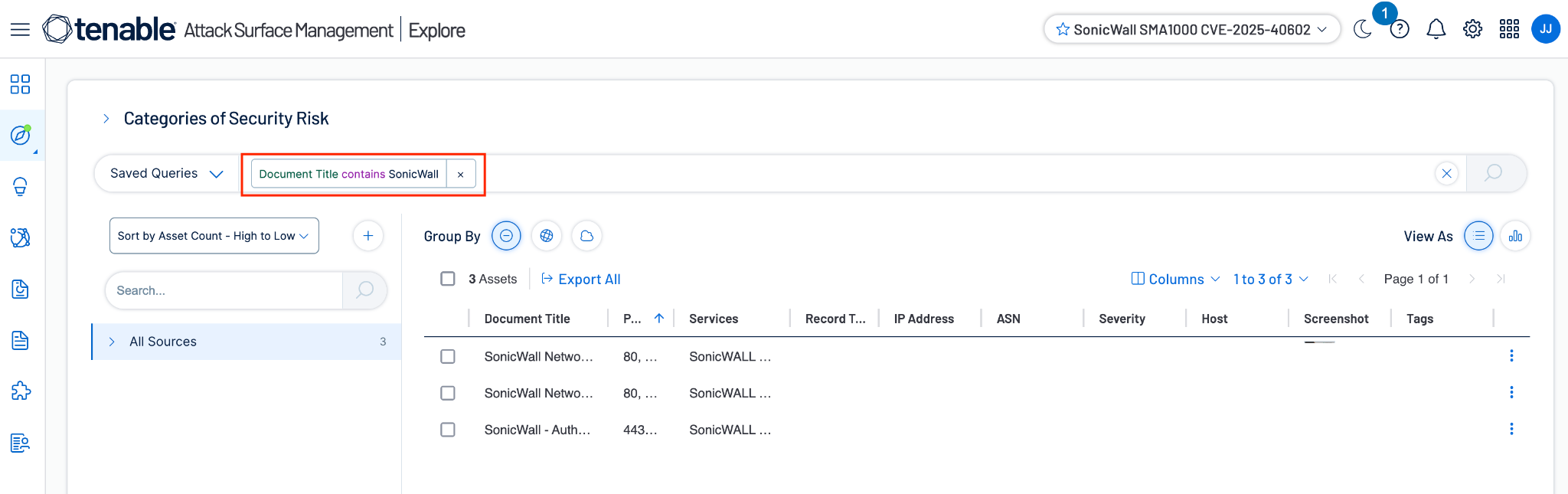
Tenable Attack Surface Management customers are able to identify these assets using a filtered search for SonicWall devices:
Get more information

Join Tenable's Research Special Operations (RSO) Team on Tenable Connect for further discussions on the latest cyber threats.

Learn more about Tenable One, the Exposure Management Platform for the modern attack surface.