


When quantum computers become generally available, they’ll be able to crack current public-key cryptographic algorithms, putting digitally stored and transmitted data at risk. But the threat already exists, as attackers use the "harvest now, decrypt later" tactic. Discover why building a comprehensive cryptographic inventory and executing a phased operational strategy are critical for protecting your data against quantum computing attacks.
Future quantum computers will represent a threat to the foundational security architecture that protects digital data.
For decades, the global economy, national security apparatus, and critical infrastructure have relied on asymmetric cryptography, specifically RSA and elliptic curve cryptography (ECC), to secure data in transit, authenticate identities, and protect digital signatures. The mathematical difficulty of factoring large integers or solving discrete logarithm problems has long provided a robust shield against cyber attacks launched using conventional computing capabilities.
However, the rapid maturation of quantum computing represents an existential threat to these algorithms. A fully fault-tolerant, cryptographically relevant quantum computer (CRQC) capable of instantly shattering current encryption standards is still several years away. However, organizations need to migrate to quantum-resistant algorithms now. The reason? Adversaries are using "harvest now, decrypt later" (HNDL) tactics. They steal data encrypted with algorithms vulnerable to quantum computing attacks, and save it, hoping to decrypt it in the future once quantum capabilities mature.
Recognizing the immediacy of this threat, regulatory agencies have responded accordingly. The White House recently issued Executive Order 14412, “Securing the Nation Against Advanced Cryptographic Attacks,” which mandates that executive-branch federal agencies pay immediate operational and engineering attention to post-quantum cryptography (PQC) readiness.
This directive introduces critical pillars that redefine enterprise security strategies:
In this high-stakes regulatory environment, visibility has emerged as the primary currency of defense. Organizations cannot migrate what they cannot see. Consequently, governments and regulatory bodies worldwide, from the White House and the U.S. National Security Agency (NSA) to the European Union and the Monetary Authority of Singapore, have synchronized their directives around a single, non-negotiable requirement: the establishment of a comprehensive cryptographic inventory. Organizations must identify, catalog, and assess every cryptographic asset within their environment to facilitate an orderly transition to PQC.
Current public-key infrastructure (PKI) relies on the computational intractability of specific mathematical problems. RSA encryption relies on the difficulty of integer factorization, while Diffie-Hellman and ECC rely on the discrete logarithm problem. It would take billions of years for a classical supercomputer to crack a 2048-bit RSA key.
Quantum computers utilize qubits, which can exist in a state of superposition, representing both 0 and 1 simultaneously. This property, combined with quantum entanglement, allows for massive parallelism in calculation.
In 1994, mathematician Peter Shor developed Shor’s Algorithm, which theoretically demonstrated that a quantum computer with sufficiently stable qubits could solve both integer factorization and discrete logarithm problems in polynomial time versus problems in exponential time on a classical computer. In other words, a problem that would take an impossibly long time for any real-world computer problem to solve can now be solved in a usefully short amount of time.
The implications are catastrophic for current standards:
Symmetric encryption, like AES-256, is more resilient; Grover’s Algorithm effectively halves the key strength, meaning AES-128 provides only 64 bits of security, but AES-256 remains secure against quantum attacks. Therefore, the immediate crisis is concentrated in asymmetric cryptography used for key exchange, such as TLS/SSL handshakes and SSH session negotiation, as well as for digital signatures (authentication, code signing).
The most pervasive misconception regarding PQC is that organizations have until Q-Day, the day a CRQC comes online, to upgrade their systems. This view ignores the “harvest now, decrypt later” attack vector, which has fundamentally shifted the risk timeline from the future to the present.
In an HNDL attack, sophisticated adversaries, primarily nation-states and well-funded criminal syndicates, intercept encrypted traffic today. At scale, this harvesting is primarily executed by nation-states utilizing Border Gateway Protocol (BGP) route manipulations to hijack large volumes of data in transit, alongside the exfiltration and theft of whole encrypted databases during network intrusions. While attackers cannot currently read this data, they store it in massive data centers, effectively time-capsuling the information. The moment a quantum computer capable of running Shor’s Algorithm becomes available, they will then decrypt this harvested data.
Implementing the right tools is only the first step. Organizations need a coherent operational strategy to navigate the migration. Based on NIST SP 1800-38 and CISA guidance, the following phased approach is recommended.
Phase 1: Automated discovery: Establish the baseline. You cannot fix what you do not know exists. Within environments, discovery goes a step further than reading configurations: Organizations should inventory resources from the connected accounts and actively scan their internet-facing services to capture the key exchanges and ciphers these services negotiate. Because HDNL targets data in transit, this outside-in view pinpoints the exposed cloud services most at risk and folds them directly into your exposure management workflow.
Phase 2: Prioritization and risk assessment: Not every server needs PQC today. Identify systems with the highest risk and the most critical data.
Phase 3: Remediation and crypto-agility: Upgrade systems to hybrid — meaning, running in parallel both conventional cryptography and PQC — and, finally, fully PQC compliant. Governmental mandates generally have set the year 2035 for complete quantum resistance for all systems. Avoid hard-coding the new algorithms. Use configurations that allow you to swap algorithms easily. The PQC standards are new; if a vulnerability is found next year in one of the new PQC standards, you must be able to switch to an alternative without recompiling code.
Phase 4: Continuous verification: Prevent regression by making regular compliance assessments. A system might be compliant today, but a DevOps push next week might overwrite the config file and revert it to RSA-only. Continuous scanning ensures you maintain the quantum safe state over time.
Closing the gap on HNDL starts with treating cryptographic risk as just another exposure to manage, not a separate audit exercise.
Bring SSL/TLS and SSH protocol visibility across your cloud and IT infrastructure into the Tenable One Exposure Management Platform's workflow you use to track vulnerabilities, misconfigurations, and identity risk. That way, cryptographic weaknesses surface alongside everything else competing for your team’s attention, instead of living in a separate report.
That visibility comes together in Tenable One’s Cryptographic Inventory view, which shows where cryptographic risk lives across your environment: Which services still rely on classical, quantum-vulnerable ciphers, and which have already moved to post-quantum protection. Widgets summarize your overall cryptographic posture at a glance, so quantum readiness becomes one more metric in your exposure picture.
What the cryptographic inventory view surfaces:
Users can drill down into specific assets to see the JSON-based Cryptographic Inventory and use the Tenable Asset Criticality Rating (ACR) to help with prioritization of systems for remediation. ACR assesses factors like device function, connectivity, and third-party data. Assets with higher ACR (e.g., 6–10) are more critical to your business.
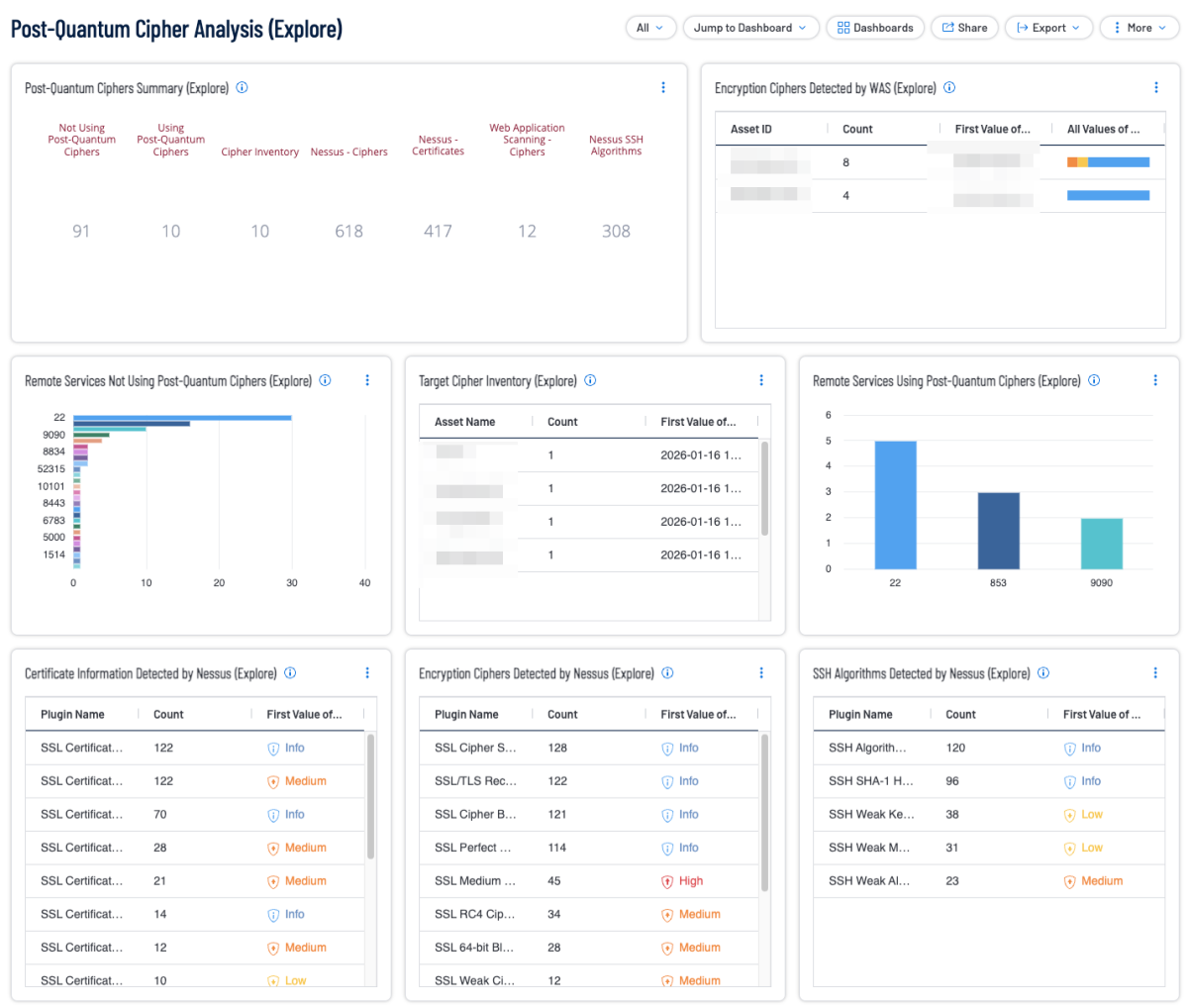
Post-quantum cipher analysis dashboard in the Tenable One Exposure Management Platform
The transition to PQC is an immediate engineering and compliance challenge for today's leadership. The HNDL threat makes the risks a current reality, while the strict enforcement mechanisms of Executive Order 14412, alongside international regulatory frameworks like the EU’s Digital Operational Resilience Act (DORA), ensure that the compliance and contractual consequences are imminent.
The days of treating cryptography as a set-and-forget utility are over. Cryptography is now a dynamic asset class that requires active management, continuous inventory, and strategic agility.
Tenable’s introduction of the set of Cryptographic Inventory dashboards and plugins represents a critical evolution in vulnerability management. It provides the data foundation necessary for the PQC transition. It empowers organizations to answer the regulator’s question, “Are you quantum ready?”, with data, precision, and confidence. The quantum era is arriving. With the right visibility, organizations can ensure their security arrives with it.
此内容由惯性聚合(RSS阅读器)自动聚合整理,仅供阅读参考。 原文来自 — 版权归原作者所有。