
惯性聚合 高效追踪和阅读你感兴趣的博客、新闻、科技资讯
阅读原文 在惯性聚合中打开

推荐订阅源

AI
AI
cs.AI updates on arXiv.org
Google DeepMind News
T
Tenable Blog
博客园_首页
S
Securelist
Spread Privacy
Spread Privacy
Google Online Security Blog
Forbes - Security
Forbes - Security
Engineering at Meta
Engineering at Meta
U
Unit 42
L
LINUX DO - 热门话题
量子位
T
Threat Research - Cisco Blogs
博客园 - 【当耐特】
C
Cyber Attacks, Cyber Crime and Cyber Security
K
Kaspersky official blog
MyScale Blog
MyScale Blog
P
Proofpoint News Feed
The Last Watchdog
The Last Watchdog
Google DeepMind News
GbyAI
GbyAI
Martin Fowler
Martin Fowler
Exploit-DB.com RSS Feed
cs.CL updates on arXiv.org
Security Latest
Security Latest
Scott Helme
Scott Helme
V
Vulnerabilities – Threatpost
奇客Solidot–传递最新科技情报
奇客Solidot–传递最新科技情报
I
InfoQ
Know Your Adversary
Know Your Adversary
Cisco Talos Blog
Cisco Talos Blog
The Register - Security
T
The Blog of Author Tim Ferriss
aimingoo的专栏
aimingoo的专栏
V2EX - 技术
V2EX - 技术
T
Tailwind CSS Blog
月光博客
月光博客
Recent Announcements
G
Google Developers Blog
F
Full Disclosure
W
WeLiveSecurity
宝玉的分享
宝玉的分享
腾讯CDC
G
GRAHAM CLULEY
Vercel News
Vercel News
Simon Willison's Weblog
美团技术团队
cs.CV updates on arXiv.org
Help Net Security
Help Net Security

INRIX

INRIX Highlights AI Infrastructure Intelligence at Neudata's New York Summer Data Summit 2026 - INRIX Cities Can Reduce Emissions Without New Infrastructure - INRIX Late Night Football Leads to Lighter Rush Hour in England - INRIX Transparency as a Product Feature: Introducing INRIX Speeds Updates - INRIX Applying for a FHWA/INFRA Grant Track 2? Here’s How INRIX Can Help - INRIX World Cup – INRIX Traffic Report (June 12-June 28) - INRIX INRIX to Be Recognized at AWS Government Competency Leadership Circle - INRIX How Traffic Engineers Use Probe-Based Signal Analytics to Improve Signal Performance - INRIX World Cup – INRIX Traffic Report (June 16-June 21) - INRIX INRIX World Cup Traffic Report – Day 1 Prediction for June 11, 2026 - INRIX World Cup – INRIX Traffic Report (June 12-June 15) - INRIX How Shippers, Carriers, and 3PLs Can Reduce Delivery Risk Using Big Data Basemap and INRIX Partner to Expand On‑Demand Access to High‑Precision Transportation Data Through DataCutter From Necessity to Lifestyle: A Year of Bike Commuting INRIX at NACTO Designing Cities 2026: Advancing the Future of Urban Mobility Mobility as a Hazard Signal: Lessons from Tornado-Prone Alabama Why Friday Commutes Are Falling First in the Bay Area’s Supercommuter Belt Memorial Day Doesn’t Just Change Traffic — It Changes Where Crash Risk Happens How Agencies Are Using Signal Analytics to Improve Traffic Operations Why Automated, AI‑Based Traffic Bulletins Beat Manual Reporting Construction Everywhere — But I-90 Became the Biggest Problem INRIX Celebrates NCTCOG’s TexITE Award for Advancing Data-Driven Signal Timing - INRIX How Cities Use Micromobility Data to Make Better Policy Freight Feels the Fuel Squeeze First: INRIX Data Shows Fleets Trimming Distance and Speed Expanding Right-of-Way Intelligence Beyond the Curb and Onto the Sidewalk What Cities Can Learn from Each Other: The Value of Micromobility Benchmarking Five More Innovative Ways to Reduce Traffic Congestion and Improve Mobility Fuel Prices Are Rising, But Driving Behavior Looks Steady Teaching An Old LLM New Tricks: An Innovation Week Project What’s New in INRIX IQ: Signal Analytics, Mission Control & Data Downloader Updates From Data Collection to Public Trust: Why Transparency Matters in Shared Mobility Building a Hybrid Signal Performance Strategy for State DOTs From Data to Decisions: How Ride Report is Powering the Future of Multimodal Mobility What Happens When You Let Traffic Signals Pick Your College Basketball Tournament Finals? Are Drivers Slowing Down to Save Fuel as Prices Rise in March 2026? INRIX Recognized as a 2026 Artificial Intelligence Excellence Award Winner Turning Mobility Data Into Infrastructure Intelligence Detecting Data Center Construction Through Real-World Mobility Signals From Smart Streets to Smarter Cities: Validating and Scaling Traffic Volume Estimation in NYC Getting the Most Out of Micromobility Equity Initiatives with Ride Report Detecting Vehicle Abandonment During Wildfire Evacuations
World Cup – INRIX Traffic Report (June 15) - INRIX
Ashley Babani · 2026-06-19 · via INRIX

Following the opening matches of the 2026 FIFA World Cup, INRIX continued to monitor traffic conditions around host stadiums to understand how fans and everyday travelers shared the road network. While some cities experienced significant congestion immediately before and after matches, others saw only minor impacts compared to a typical Monday. The June 15 matches in Atlanta, Seattle, Miami, and Los Angeles highlight how local travel patterns, stadium locations, and kickoff times influenced traffic conditions across host markets. For more on the tournament’s initial traffic impacts, read our earlier analysis of FIFA World Cup Opening Day traffic, World Cup-INRIX Traffic Report (June 12-June 14) 

June 15, 2026 – Gillette Stadium – Atlanta, GA – 12:00pm Kickoff 
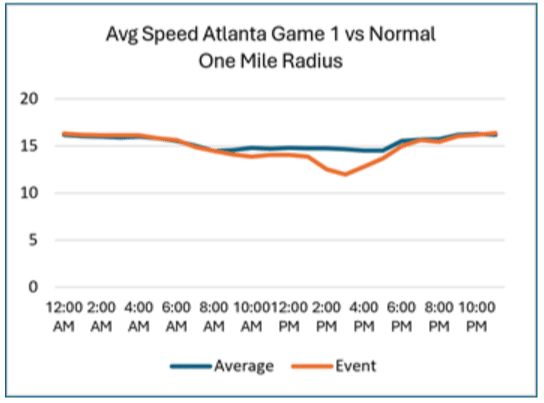
Within a one mile radius of the stadium, speeds fell the most post-game in the 3:00pm hour, with travel speeds just under 12mph, down 18% from its normal, 14.6mph average. 

More than one mile out from the epicenter, speeds only fell slightly, at about four percent at the 3:00pm hour. 

Key Corridors like I-85/I-75 S into the city saw only slight decreases in speed at certain parts of the day compared to a typical Monday, but traffic was generally quicker than a normal Monday. 

June 15, 2026 – Seattle Stadium – Seattle, WA– 12:00pm Kickoff 
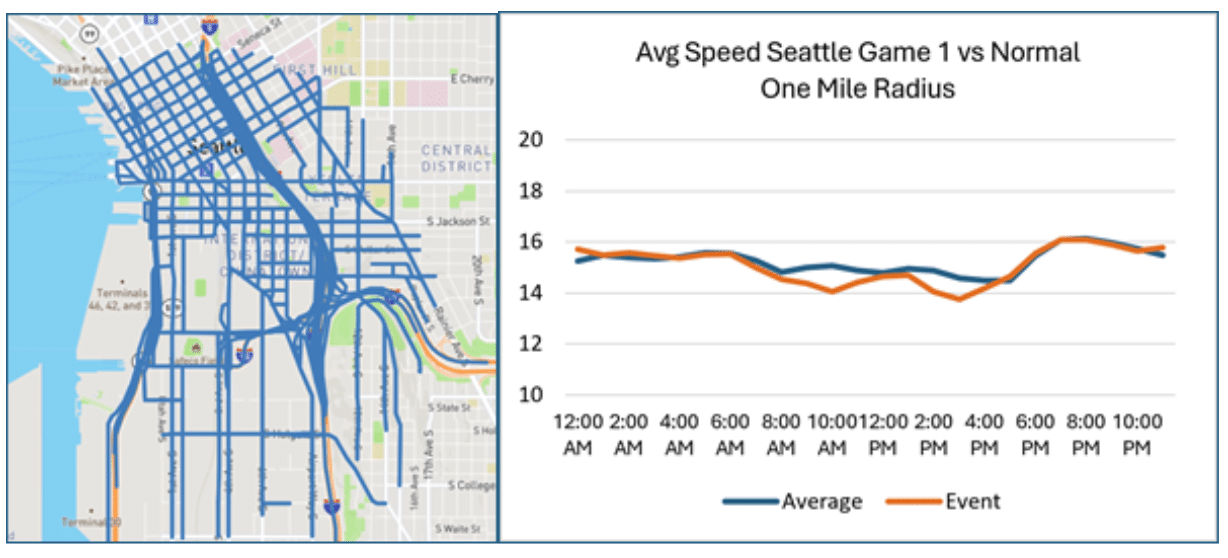
Traffic around the Seattle Stadium only varied slightly compared to the typical Monday. Speeds slowed 7% in the 10:00am before the noon kickoff, and slowed again by 6% versus the average Monday in the 2:00pm and 3:00pm hours following the event. 

Even on key corridors, like I-5 Southbound from Lynnwood to Mercer Street, saw far less traffic congestion versus the typical Monday, with speeds reaching 38mph at the 7:00am hour versus the normal 26.5 mph during the same hour. 

June 15, 2026 – Miami Stadium – Miami, FL – 6:00pm Kickoff 
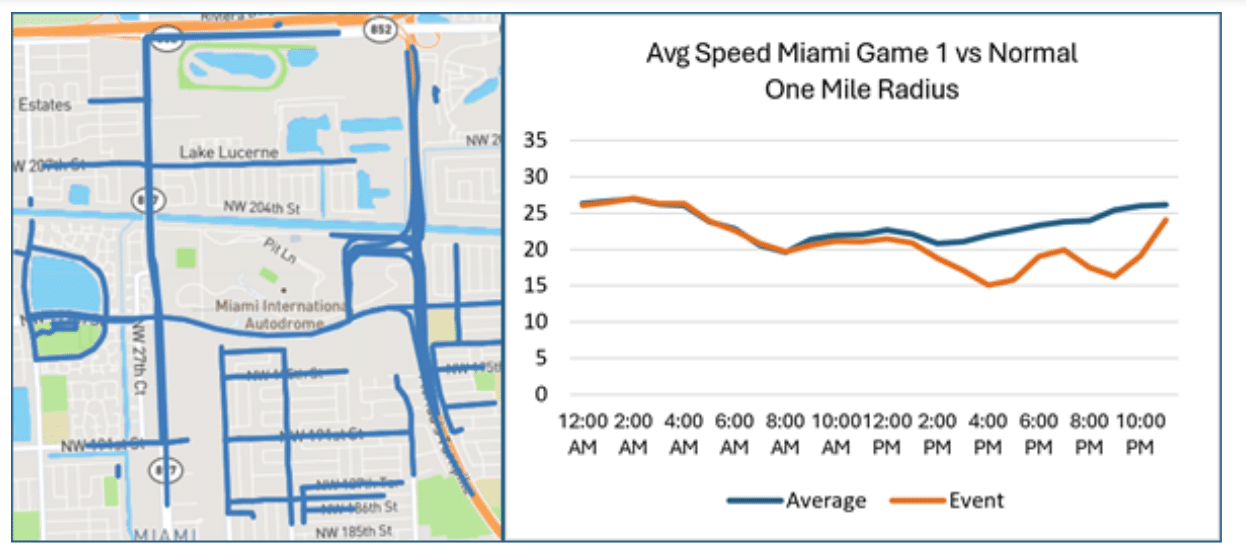
Within one mile of the stadium saw significant congestion prior to and after the World Cup game on June 15, 2026. Traffic speeds slowed 31% below normal to 15.1mph by 4:00pm, as commuters mixed with eventgoers before the 6:00pm kickoff. Post-game traffic was also significant after the game, with traffic slowing as much as 36% below normal to 16.3mph during the 9:00pm hour. 

Within 1-3 miles from the stadium, traffic also slowed 8% to 18.9mph below normal at the 4:00pm hour. 

GAME 2: June 15, 2026 – SoFi Stadium – Los Angeles, CA – 6:00pm Kickoff 
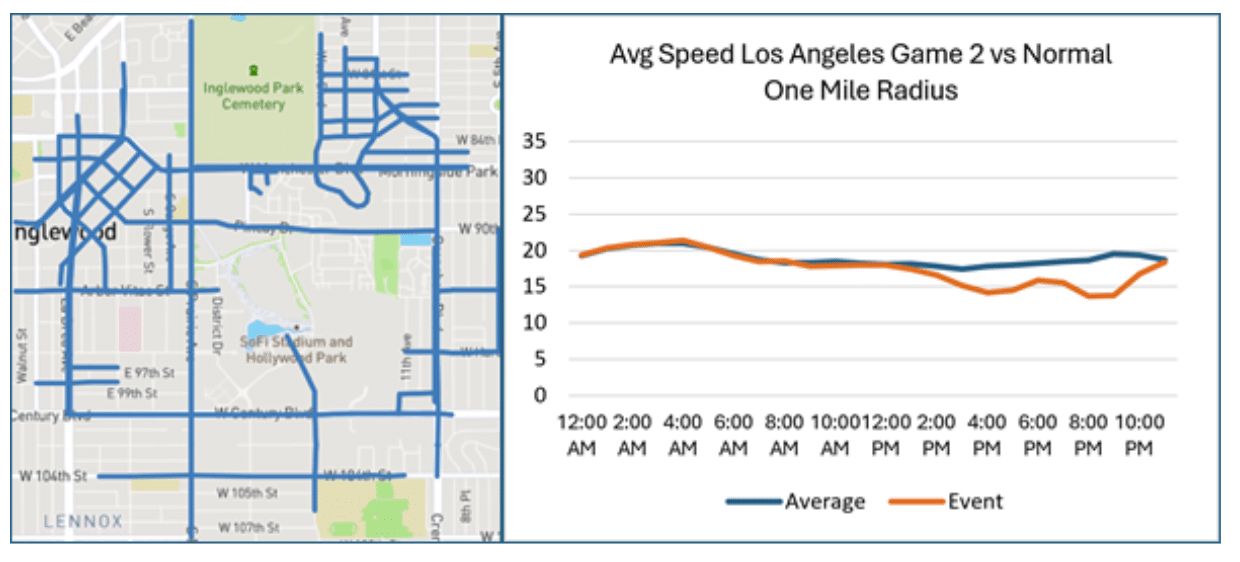
Los Angeles’ SoFi Stadium hosted its second game of the FIFA World Cup on Monday, June 15, 2026. With a 6:00pm kickoff, traffic within one-mile of the stadium began to build around 4:00pm, when traffic speeds fell 20% below normal to 14.2mph. Soon after the game, during the 8:00pm and 9:00pm hours, traffic speeds fell 29% below normal to 13.8mph. 

Traffic speeds fell similarly to the first game, with post-game slowdowns exceeding pre-game slowdowns. 

Traffic impacts from the June 15 matches varied widely across host cities, highlighting how kickoff times, venue locations, and local travel patterns can shape congestion during the World Cup. As the tournament continues, INRIX will keep tracking traffic trends and mobility impacts across host markets. Stay tuned for more insights throughout the 2026 FIFA World Cup.