惯性聚合 高效追踪和阅读你感兴趣的博客、新闻、科技资讯
阅读原文 在惯性聚合中打开

推荐订阅源

Project Zero
Project Zero
Security Archives - TechRepublic
C
Cyber Attacks, Cyber Crime and Cyber Security
Security Latest
Security Latest
Scott Helme
Scott Helme
Threat Intelligence Blog | Flashpoint
V
Vulnerabilities – Threatpost
C
CERT Recently Published Vulnerability Notes
S
Schneier on Security
G
GRAHAM CLULEY
L
Lohrmann on Cybersecurity
D
Darknet – Hacking Tools, Hacker News & Cyber Security
I
Intezer
cs.CL updates on arXiv.org
F
Full Disclosure
T
The Exploit Database - CXSecurity.com
P
Proofpoint News Feed
WordPress大学
WordPress大学
Microsoft Azure Blog
H
Help Net Security
大猫的无限游戏
大猫的无限游戏
MyScale Blog
MyScale Blog
Hacker News: Ask HN
Hacker News: Ask HN
G
Google Developers Blog
H
Heimdal Security Blog
O
OpenAI News
Hugging Face - Blog
Hugging Face - Blog
cs.AI updates on arXiv.org
L
LangChain Blog
C
Cisco Blogs
云风的 BLOG
云风的 BLOG
IT之家
IT之家
Cyberwarzone
Cyberwarzone
cs.CV updates on arXiv.org
Know Your Adversary
Know Your Adversary
博客园 - 聂微东
The Cloudflare Blog
C
Check Point Blog
K
Kaspersky official blog
C
CXSECURITY Database RSS Feed - CXSecurity.com
月光博客
月光博客
T
Tor Project blog
T
Threat Research - Cisco Blogs
T
Tailwind CSS Blog
P
Proofpoint News Feed
K
KPMG report finds enterprise disconnect between AI and its ROI | CIO
A
About on SuperTechFans
小众软件
小众软件
Cloudbric
Cloudbric
A
Arctic Wolf

Human Risk Management Blog

Trust, Verify, Protect: Modernizing Email Security for the Cloud Report: Social Engineering Remains a Central Part of AI-assisted Attacks ClickFix Social Engineering is Now the Leading Malware Delivery Method CyberheistNews Vol 16 #28 Your 2026 Phishing by Industry Benchmarks: The Findings on Human Risk Scammers Can Use AI Tools to Pinpoint Your Location Based on a Photo Report: Attackers Are Using AI to Automate Social Engineering Your KnowBe4 Fresh Compliance Plus Content Updates from June 2026 From Awareness to Digital Workforce Security Your KnowBe4 Fresh Content Updates from June 2026 Threat Actor Uses Phishing to Breach Orgs for Ransomware Gangs Invoice Phishing Attacks Are Abusing the Shop App Phishing Campaign Impersonates Interpol to Deliver Ransomware Prompt Injection and the Rise of Agentic Risk Hyper-Targeted Social Engineering Needs Real-Time Video Response Your Email is Protected. Is Your Teams Chat? CyberheistNews Vol 16 #27 [HOW TO] Your Cybersecurity Starts at Home on World Social Media Day 2026 Phishing by Industry Benchmarking Report: Findings on Human Risk Static DLP Is Leaving You in the Dark: Why It’s Time for Intelligent, Self-Serve Outbound DLP and Misdirected Content Analysis INC Ransomware Gang Targets the Legal Sector 5 Essential Cybersecurity Defenses for Cloud Email Security Cybercriminals Are Targeting the FIFA World Cup 2026 Why Bite-Sized Security Awareness Training Matters in an Age of TikTok and Digital Distraction Happy 3rd Birthday to Our KnowBe4 Community! Phishing Exposes Employee Data at 86% of Fortune 100 Companies Shadow AI Is Not Shadow IT With a Better Marketing Budget CyberheistNews Vol 16 #26 A New Extortion Scam Uses IT Impersonation to Breach Organizations Cybersecurity Starts At Home This World Social Media Day FTC Report: Americans Lost $3.5 Billion to Imposter Scams Last Year Report: Device Code Phishing is Surging Report: Online Shoppers Increasingly Ignore Scam Warning Signs Security Training Needs Google Maps, Not Christopher Columbus Turn Account Takeover Into Real-Time Security Coaching Extortion Gang Sends In-Person Attackers to Exfiltrate Data Attackers aren’t loyal to any collaboration channel CyberheistNews Vol 16 #25 [The AI Tell] How To Expose Machine-Written Phishing Fast Social Engineering Attacks Abuse Workplace Collaboration Tools New Extortion Brand Uses IT Impersonation to Breach Organizations APWG Report: Social Media Phishing is Surging Cybersecurity Awareness Training for AI: Key Focus Areas Americans Lost $900 Million to AI-Powered Scams Last Year What AI Can’t Hide When It Writes a Phishing Email Your AI Agents Are Eager to Please And Easy to Exploit Best AI Agent Security Tools for SMB and Enterprise in 2026 4 Hot Summer Travel Tips To Avoid Scams CyberheistNews Vol 16 #24 [FBI Alert] Lock Down Your Microsoft 365 Device Code Flows Now The Role of Agentic AI in Phishing Security Training A Credit Score for Cyber Behavior Agentic AI Security in 2026: What to Know How to Secure AI Agents: 4 Best Practices An Overview of Email Compliance Regulations and Reporting Report: AI-Assisted Fraud is Surging Attackers Use Spoofed ChatGPT Site to Deliver Malware I Love Device-Bound Session Credentials, But They Are Still Phishable and Hackable Nearly Two-Thirds of CEOs Cite Cyberattacks as Their Top Concern A Look at Spam vs. Phishing: 4 Key Differences KnowBe4 Wins Multiple 2026 TrustRadius Top Rated Awards Cyber Insurance for Mid‑Market Organizations in Southeast Asia KnowBe4 Earns Multiple 2026 Buyer's Choice Awards from TrustRadius The New Frontier: Securing Japan’s Hybrid Digital Workforce (2026 & Beyond) CyberheistNews Vol 16 #23 Now Phishing Attacks Use Real Hotel Reservations to Target Travelers Report: AI-Enabled Social Engineering Attacks Are on the Rise Your KnowBe4 Fresh Compliance Plus Content Updates from May 2026 FBI: Kali365 Phishing Kit is Targeting Microsoft 365 Accounts KB4-CON - AI Is Everything How to Secure AI Adoption In Your Organization Your KnowBe4 Fresh Content Updates from May 2026 The Silent Invitation: A Deep Dive into Calendar Invite Phishing Cyber Insurance for Mid‑Market Organizations in Southeast Asia Chinese-Language Phishing Kits Are Growing More Advanced Phishing Attacks Are Using Real Hotel Reservation Info to Target Travelers Warning: Scammers are Exploiting Geopolitical Unrest Athletes Are Increasingly Targeted by Social Engineering Attacks AI Agent Governance Part 3 - Runtime Governance: The Hidden Performance Cost of Agentic AI AI Agent Governance Part 2 - What Good Looks Like: Governing AI Agents in Practice 8 Ways to Reduce False Positives in Email Security Ransomware Attacks Drive a Surge in Cyber Insurance Claims My Favorite 5 KnowBe4 Agents Perry Carpenter KB4-CON 2026 Q&A: Deepfakes & Deception Free Gift Fallacy: How Attackers Harvest Credit Cards via Fake Surveys When Global Conflict Becomes a Cyber Weapon: How Iran Tensions and Other Stressful Events Fuel Social Engineering Attacks CyberheistNews Vol 16 #21 [Heads Up] GitHub Breach Shows Developer Tools Are Social Engineering Targets Alert: Extortion Groups Are Using Phishing Kits to Automate Their Attacks Beyond the Chatbot: Why Your AI Agents are Your Newest (and Most Vulnerable) Colleagues Report: Adversarial Use of AI is Evolving
From 1% to 26%: How AIDA Orchestration Fixes the Remedial Training Gap
Zach Marner · 2026-06-18 · via Human Risk Management Blog

As we speak, bad actors are using AI agents to do their dirty work.

Our own research tells us 85.8% of phishing attacks were AI-driven in the past 12 months. Agentic power is helping social engineering and malware get smarter, faster and harder to detect.

But enough of what you probably already know. Let’s talk about how we can address these risks.

Our CISO Advisor Dr. Martin Kraemer wrote recently about AI agents being used for good. Agentic AI has the ability to address technical and strictly infosec-based organizational roadblocks (SOC alert fatigue, out-dated email security, etc.).

But AI agents are not just for the IT side of the house. Those responsible for security awareness training (SAT), admittedly sometimes one and the same, should get to play with these toys too.

This is where AI Orchestration comes in.

What Is AI Orchestration in Security Awareness Training?

KnowBe4’s AIDA (Artificial Intelligence Defense Agents) Orchestration transforms security awareness from a manual process into an always-on system designed to keep pace with modern threats.

AIDA Orchestration acts as the “Moderator Agent” for SAT programs, coordinating how other agents work together as a single system. Admins maintain control by defining guardrails called "Plans" that set boundaries such as testing frequency, training limits and user group policies. Within those boundaries, AIDA Orchestration executes autonomously.

By coordinating multiple KnowBe4 AI agents around the single goal of reducing human risk, it delivers smarter training, stronger defenses and real operational relief. This technology monitors behavior, detects risk signals and responds automatically with targeted interventions at the moment they're most likely to drive behavior change.

Two Gaps AIDA Orchestration Can Help Close

The Velocity Mismatch

Adversaries operate in real time. Even the best SAT programs can operate on a batch schedule. When an employee fails a phishing simulation, any remedial training that has to be manually assigned could take days to deliver. Organizations could be asking employees to learn from mistakes they've already forgotten making.

The Administrative Gap

For large security teams, the hidden cost of SAT isn't the license fee; it's hours spent on manual triage, list management and campaign scheduling. Every hour an SAT admin spends managing training logistics is an hour not spent on researching emerging risks and improving the security posture and culture.

AIDA Orchestration vs. Manual SAT: By the Numbers

Some of the smartest folks at KnowBe4 have spent most of 2026 tracking AIDA Orchestration usage across a select number of KnowBe4 customers. Here’s what they’ve found so far:

Metric No Orchestration With AIDA Orchestration
Remedial training assignment rate after phishing failure <1% 26%
Total training coverage 20%-30% 50%-60%
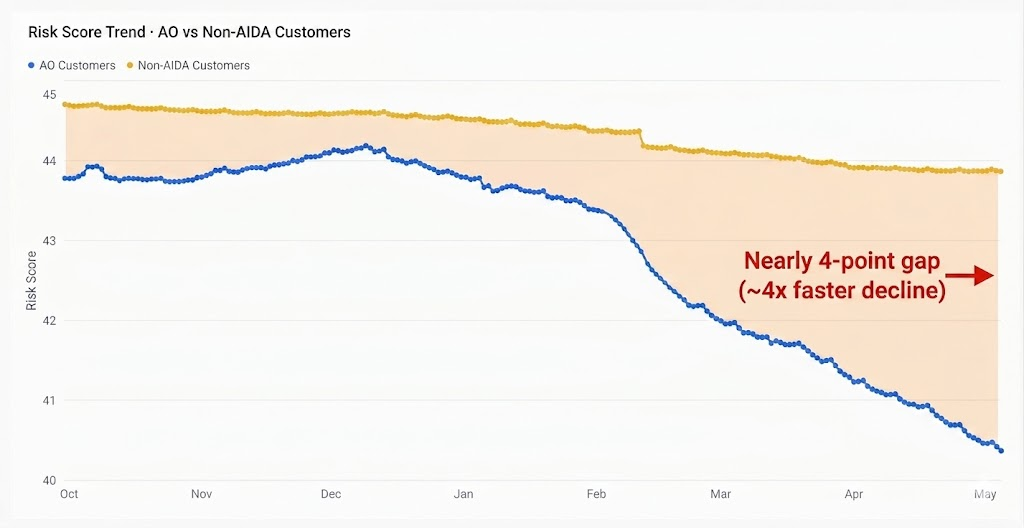
Risk score reduction speed Baseline 4x faster
Users trained Baseline 2x more users
Phishing emails reported 20% 36%

AIDA-AI-Orchestration-Data-Blog-Image

How AI Orchestration Closes the Gap

For overworked, overstressed SAT admins, here’s what these numbers mean:

1. Closing the Remedial Loop

By automating the response to a phishing simulation failure, AIDA Orchestration-driven environments see remedial training rates jump from less than 1% to 26%. The difference isn't just frequency—it's proximity. A targeted, relevant nudge delivered at the moment of failure drives behavior change in a way that a delayed generic module never can.

2. Data-Driven Risk Reduction

Organizations using AIDA Orchestration experience a 4x faster reduction in risk scores compared to those using traditional methods. By identifying training gaps across multiple risk dimensions and intelligently doubling the number of actively trained users, AIDA Orchestration transforms a passive training program into a dynamic defense layer.

3. From Passive User to Active Sensor

When training is relevant and timely rather than repetitive and delayed, employees stop being passive targets and start behaving as active participants in the organization's defense. AIDA Orchestration's personalized reach drove a 79% increase in phishing email reporting rates, turning the workforce into a distributed early-warning system.

Which Organizations Need AI Orchestration?

AIDA Orchestration is the right fit if:

  • The organization has experienced repeated phishing failures despite existing training
  • Security admin bandwidth is a bottleneck
  • Leadership needs measurable, reportable evidence of behavior change; not just completion rates
  • The goal is to reduce human risk scores at scale, faster than manual programs allow

For organizations with 500+ employees, distributed workforces or high-frequency phishing exposure, the ROI case for AIDA Orchestration is clear: administrative savings alone often justify the investment before factoring in risk reduction.

Key Takeaways: AIDA Orchestration in Security Awareness Training

  • AIDA Orchestration is the always-on moderator agent that coordinates AI agents across a SAT program — autonomously executing training, remediation and risk response within admin-defined guardrails called "Plans”
  • AIDA Orchestration closes the gap between manual training and automated assignments, raising remedial training assignment rates from less than 1% to 26%
  • Total training coverage doubles, from 20–30% of users under manual programs to 50–60% with AI Orchestration active
  • Risk scores drop 4x faster in organizations using AIDA Orchestration vs. those relying on traditional methods, with 2x more users actively trained.
  • Phishing reporting rates increase from 20% to 36%, a 79% lift, when training is timely and relevant, turning employees from passive targets into active threat sensors

The Result: AIDA Orchestration Means Risk Reduction

The ultimate goal of a culture-embedded security awareness strategy is more sensors, not just fewer clicks.

In 2026, the question for the CISO isn't whether the organization has an SAT program. The question is: Does the program move as fast as the attackers do?