


惯性聚合 高效追踪和阅读你感兴趣的博客、新闻、科技资讯
阅读原文 在惯性聚合中打开

推荐订阅源

V
Vulnerabilities – Threatpost
Google DeepMind News
T
Threatpost
AWS News Blog
AWS News Blog
NISL@THU
NISL@THU
Security Latest
Security Latest
C
Cisco Blogs
Spread Privacy
Spread Privacy
Simon Willison's Weblog
L
LINUX DO - 热门话题
Know Your Adversary
Know Your Adversary
L
LINUX DO - 最新话题
P
Privacy & Cybersecurity Law Blog
SecWiki News
SecWiki News
O
OpenAI News
Threat Intelligence Blog | Flashpoint
H
Hacker News: Front Page
Scott Helme
Scott Helme
C
Check Point Blog
WordPress大学
WordPress大学
钛媒体:引领未来商业与生活新知
钛媒体:引领未来商业与生活新知
爱范儿
爱范儿
博客园 - 【当耐特】
H
Heimdal Security Blog
The Hacker News
The Hacker News
罗磊的独立博客
C
CERT Recently Published Vulnerability Notes
美团技术团队
Application and Cybersecurity Blog
S
SegmentFault 最新的问题
Last Week in AI
Last Week in AI
Project Zero
Project Zero
OSCHINA 社区最新新闻
OSCHINA 社区最新新闻
宝玉的分享
宝玉的分享
The Register - Security
A
Arctic Wolf
酷 壳 – CoolShell
酷 壳 – CoolShell
G
GRAHAM CLULEY
L
Lohrmann on Cybersecurity
T
The Blog of Author Tim Ferriss
G
Google Developers Blog
Attack and Defense Labs
博客园 - 叶小钗
大猫的无限游戏
大猫的无限游戏
Latest news
Latest news
I
InfoQ
K
KPMG report finds enterprise disconnect between AI and its ROI | CIO
Y
Y Combinator Blog
J
Java Code Geeks
S
Security @ Cisco Blogs

Clean Tech News | The HinduBusinessLine

Solex Energy in talks for solar venture in Ghana How solar thermal can ‘green’ manufacturing processes The missing element in India’s rare-earths scheme Why, at 42.79%, record RE penetration is as much a cause for worry as cheer Solar self-reliance may cost India ₹30,000 cr this year No reply from CEA: CERC Utah bets on nuclear to power AI-driven data centre growth RE sector awaits easing of generation forecast norms Agastya Energy secures ₹4,000-cr loan from IREDA ‘Right of way’ issue is killing us: Wind industry RE projects: Build more, save ₹2.27 lakh cr Integrating climate finance into the banking regulatory framework GEF: The conservation kitty just shrank 36% The fresh wind turning Suzlon 2.0 turbines An e-dumper locator for safe disposal of electronic waste Smart meter rollout is impeded by its ambiguous status How protected are power plants from the risk of flooding? New coating steps up green hydrogen output, lowers cost India’s nuclear power ambitions face a tariff test India’s ambitions for nuclear energy face a tariff test How India’s ethanol hedge is paying back Why Tamil Nadu needs more verified clean power Wartsila’s fresh pitch to industry — grid stability The wait for atmanirbharta in pumped storage projects Liquidation of discoms’ regulatory assets will spur industrial use of renewable energy CERC sends out feelers for ‘capacity markets’ APTEL’s judgement is a wakeup call for discoms After a lull, why temperature spikes are likely to intensify in north India Power regulator’s nudge towards ‘market coupling’ Cruising towards Indian carbon market Renewable energy ministry approves pilot CfD scheme Renewable components supply chained to imports Despite PFBR going critical, India is still a long way from thorium utilisation Oil-starved industry looks to reignite heat pumps Key takeaways from CEA’s national power generation adequacy plan for the coming decade Storage, flexible usage and ‘virtual supply’ are key to taming peak power demand CERC settles dispute dating back a quarter century New NDC: As wars rage elsewhere, India must battle to green itself Can ‘district cooling’ temper peak power demand? Buzz in energy storage sector Electrifying effect of India Energy Stack What is slowing residential rooftop solar installations Indian solar sector hits third century International Energy Agency voices concern over rising electricity bills Well-intentioned, but politically fraught New concepts reflect NEP 2026’s modern thinking PM Surya Ghar: Where does India stand on the second anniversary of the scheme? NLC to add 650 MW of solar power capacity this year CCUS: An idea whose time has come, but at a price Why rigid control of power grid frequency should be a thing of the past Can ‘cooling-as-a-service’ fix the decarbonisation gap? Energy storage: From better to BESS Why Maharashtra’s solar pump scheme is grabbing attention globally Bids for ₹6,444 cr west-east RE transmission project Why VPPAs may not be a game-changer Shrinking gap in peak electricity demand Developers told to add BESS, shift to non-solar hours A watershed moment for battery storage capacity ‘ANEEL fuel fundamentally reshapes India’s thorium pathway’ A farmer’s fraught venture into solar generation Why the new nuclear legislation may not attract private investment Odisha’s green hydrogen pitch rides on its revenue surplus German firm Enerparc bags electricity trading licence The bigger, the better, right? Suzlon says not really India must capture carbon to unleash climate action India’s clean energy transition finds its tipping point in 2025 India faces 1.3 million transformer failures annually How floating solar can buoy up India’s green transition Rooftop solar installations gather speed; touch 22.5 GW All green talk, no greenback Mining silver and more from retired solar panels India’s NDC: To publish or not to publish COP: The rise of a new influential triad A Himalayan effort at climate change mitigation International meet on green hydrogen in New Delhi Climate action: A case of ‘a lot’ done to little avail Solar+battery vs new coal Why are so many transmission towers collapsing? Virtual PPAs, the next big thing in RE Tackling the black sheep of waste RE development in the time of data vacuum Powering the plough: What PM-KUSUM scheme must do to give a fillip to farmers Maharashtra overtakes Tamil Nadu in Renewable Energy capacity India’s non-fossil-fuel power capacity crosses 250-GW mark Non-fossil based power generation reaches 30% Hydrogen body urges refineries to tender for GH2 Blues of the global green hydrogen story A booster shot for the recycling sector Power regulator proposes tweaks to deviation settlement mechanism Global hydrogen demand up 2% in two years: Report How to accurately peg ‘additionality’ in carbon credits Adani to sell thermal power at ₹6.07 a kWhr Rossiya set to cleave a green sea route Green bonds: How to overcome the challenge of fading ‘greenium’
Electrifying energy consumption
By M Ramesh · 2026-05-25 · via Clean Tech News | The HinduBusinessLine
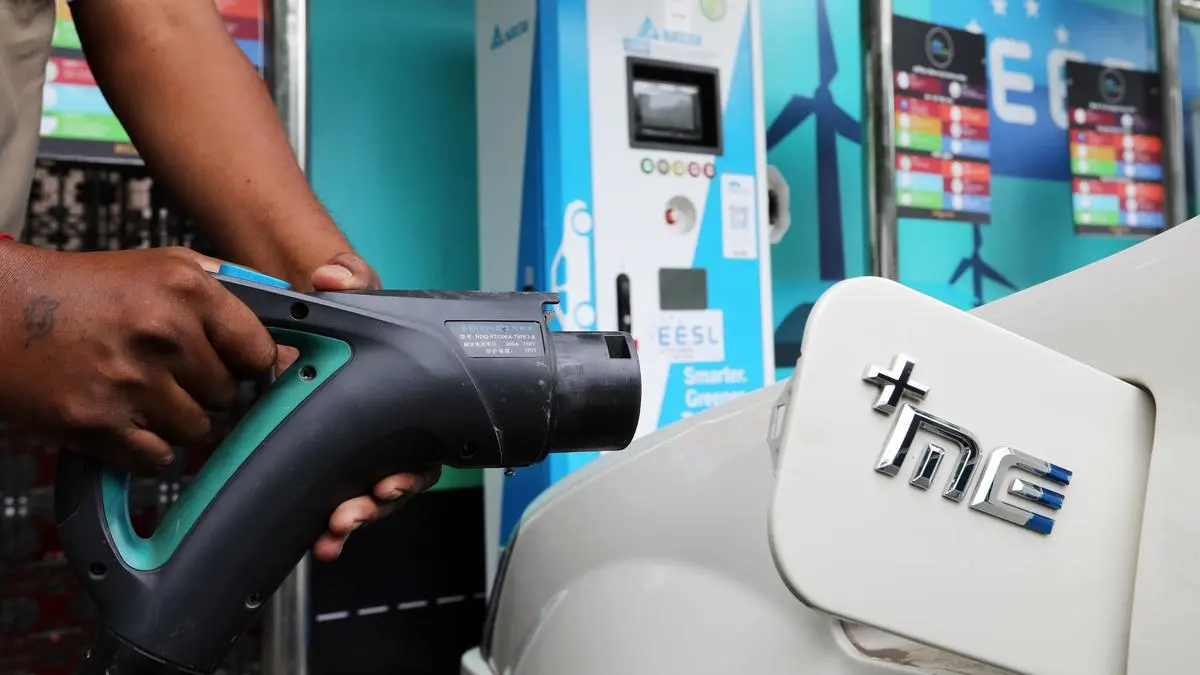
PLUG AND PLAY. Adequate charging infrastructure can hasten the electrification of the transport sector

PLUG AND PLAY. Adequate charging infrastructure can hasten the electrification of the transport sector | Photo Credit: T. Narayan

In 2024-25, India’s energy supply stood at 9,32,816 kilotonnes of oil equivalent (domestic production and imports); the energy consumed was 6,08,578 KToe, according to Energy Statistics India. This means 35 per cent of total primary energy supply (TPES) was taken away by conversion and system losses.

The number, which was the same the previous year too, is indeed high but not shocking. It is comparable to most countries. The main reason for the loss in India is thermal power, where a good 60-65 per cent of energy contained in coal is lost during conversion into electricity.

Energy lost is money lost.

There is, however, considerable scope for loss reduction.

The first option is to use higher efficiency boiler-turbine systems for thermal power plants. The second is to reduce dependence on coal-based electricity, which is happening. Today, 28 per cent of the electricity that flows in India’s grid comes from non-fossil fuels. Indeed, the country would need to build around 80 GW of new coal power plants, but the share of thermal power in the electricity mix can be expected to fall.

All of this will help reduce the gap between the primary energy supply and final energy consumption, but only a little — unless the share of electricity in the total final consumption (TFC) of energy increases substantially. Today it is just 23 per cent. This means 77 per cent of energy is consumed as molecules and not electrons. Increasing the share of renewable energy and nuclear can improve energy security, while dependence on imported molecules leaves the country vulnerable — as the current Strait of Hormuz experience illustrates.

Vinay Pabba, CEO, Vibrant Energy, notes in his LinkedIn post that “until we change that, no amount of solar and other RE capacity will buy us security”.

So, the task before energy planners is to first increase the share of electricity in TFC while reducing the share of coal and oil in TPES.

Boosting electricity

Much of India’s industrial energy demand is still met through direct combustion of coal, furnace oil and diesel for process heat.

In 2024-25, industry used 1,72,369 Ktoe of energy directly from coal. A substantial part of it can be used more efficiently if electricity is used instead of coal for applications such as industrial heating. Many electric end-use technologies are significantly more energy-efficient than direct fuel combustion. Take heat pumps, for example. A coal boiler may convert 100 units of energy in coal into roughly 80 units of useful heat. But if the same coal is first converted into electricity to run a heat pump, the system can deliver even more useful heat because heat pumps move ambient heat rather than generate all heat directly. Burning coal that holds, say, 100 kWhr of energy can produce 80 kWhr of heat energy (conversion into heat energy is more efficient than conversion into electricity); comparatively, the same coal when converted into electricity to run a heat pump can give 120 kWhr of heat, because of the high coefficient of performance (CoP) of heat pumps.

Experts, therefore, argue that policy must focus explicitly on industrial electrification. This would initially shift energy demand toward the power sector but, over time, allows cleaner generation sources to decarbonise a much larger share of the economy.

Pabba suggests mandating electric boilers for low-temperature (below 150 degrees C) industrial heating applications — a segment that accounts for a significant share of industrial heat demand. He also calls for phased replacement schedules for diesel and fuel-oil boilers, restrictions on new coal-fired industrial boilers in metros, and a redesign of India’s ‘Perform, Achieve and Trade’ (PAT) scheme to push industries toward fuel switching rather than merely incremental efficiency gains.

The transport sector offers another pathway to electrification — one that is perhaps easier than industry. Oil products account for 49 per cent of TCS (2,42,386 Ktoe out of 6,08,578 Ktoe). If the charging infrastructure can be quickly built, then a substantial share of vehicles can move from oil to electricity. Here, Pabba argues that direct bans and mandates catalyse the process faster than India’s current approach of subsidies.

The hurdles

Raising electricity in the overall energy mix will face political headwinds. Increasing the share of electricity necessarily means keeping its cost low. But in a country where industry is asked to pay for free or low-cost supply to underprivileged communities, lowering industrial tariffs is politically fraught.

The draft New Electricity Policy 2026, developed by the Ministry of Power in January, speaks against “relentless cross-subsidy”. Therein lies some hope for the electrification of energy.

Published on May 25, 2026